
The Power of Grammar, THE MISCOMMUNICATION TRILOGY, “The Entropy of Communication, Vol. II”, Part 7
Book Review

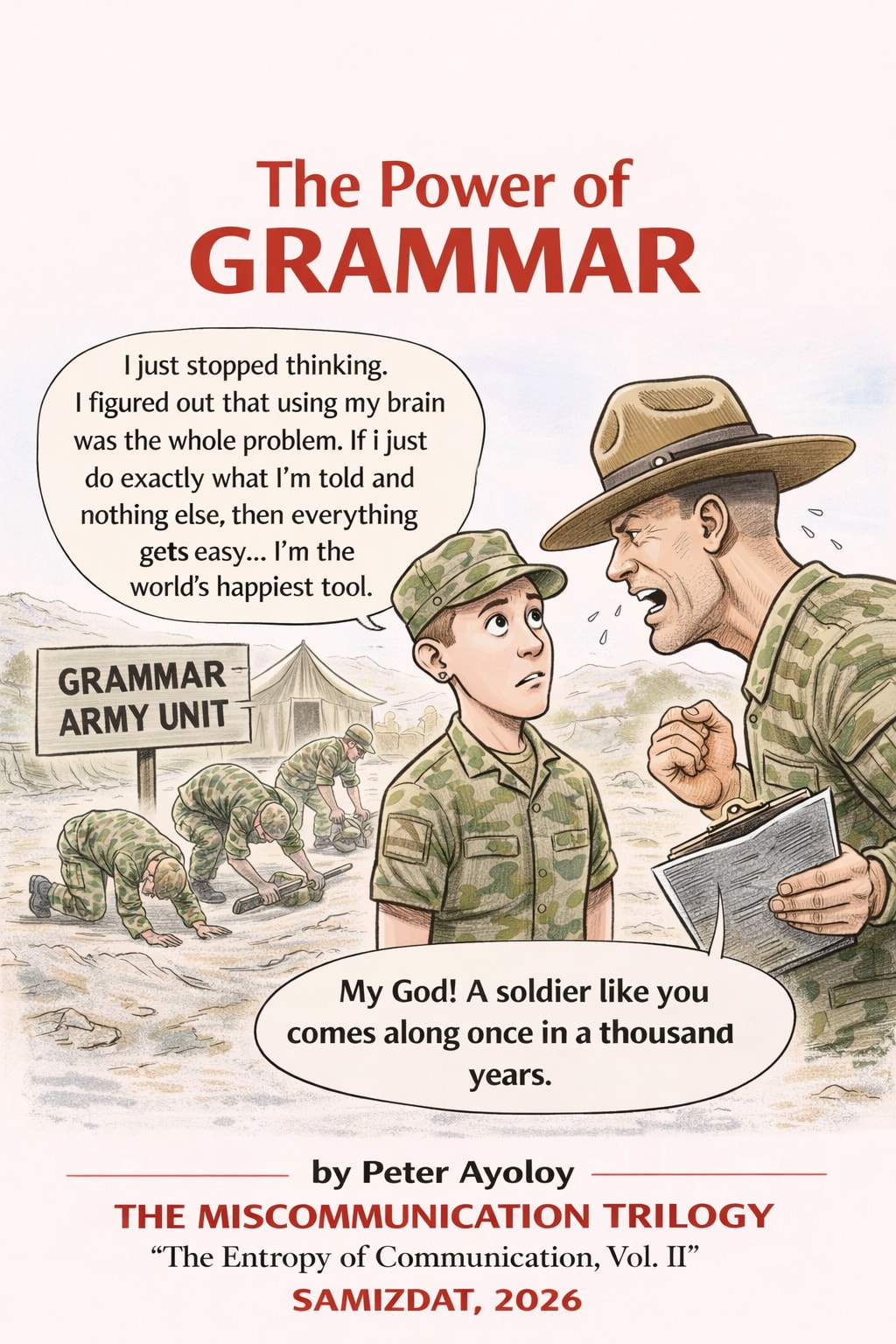
The Grammar of Collapse: A Review of Language at the Edge
The Architecture of Control
This volume presents itself not merely as a continuation of a larger intellectual project but as a decisive deepening of its central concern: the instability of language as a medium of truth. From the outset, the work positions grammar not as a passive system of rules but as an active architecture, one that shapes the conditions under which meaning becomes possible. What distinguishes this approach is its refusal to treat language as transparent. Instead, language is rendered opaque, structured, and, most importantly, vulnerable. The book’s central argument unfolds through a sustained interrogation of what it calls the planned obsolescence of language. This concept, borrowed from the logic of industrial design, is transposed into the domain of communication with striking precision. Language, in this view, does not simply evolve; it is gradually transformed in ways that diminish its capacity for clarity and resistance. The transformation is neither abrupt nor easily perceptible. It proceeds through small adjustments in grammatical patterns, through the normalization of ambiguity, and through the increasing flexibility of meaning. What emerges is a portrait of language as a system under pressure. Grammar, traditionally understood as a stabilizing force, is revealed to be a site of tension. It both constrains and enables, both clarifies and distorts. The analysis demonstrates that grammatical structures are not neutral containers but mechanisms that actively guide interpretation. In doing so, the book aligns itself with a broader tradition of thought that sees language as constitutive of reality rather than merely reflective of it.
The strength of this first part lies in its conceptual clarity. The argument is developed with a philosophical rigor that avoids simplification without becoming inaccessible. The reader is gradually led to recognize that the apparent stability of language conceals a dynamic process of reconfiguration. This recognition is not presented as a speculative hypothesis but as a necessary conclusion drawn from the internal logic of the system itself. At the same time, the work does not fall into determinism. While it emphasizes the structural forces shaping language, it leaves room for human agency. The system may be under transformation, but it is not beyond comprehension. This balance between structural analysis and critical awareness is one of the defining features of the book.
Coercion, Creativity, and the Limits of Meaning
The second major contribution of the volume lies in its detailed examination of linguistic coercion. Here, the abstract notion of grammatical transformation is grounded in concrete mechanisms. The processes of selection, enrichment, and override are presented not as isolated phenomena but as integral components of linguistic productivity and creativity. Through these mechanisms, language is shown to possess a remarkable capacity for adaptation. Yet this capacity is not unambiguously positive. The book carefully demonstrates that the same mechanisms that enable creativity also introduce instability. Selection allows for contextual variation, enrichment introduces implicit meanings, and override permits structural deviations. Together, they expand the expressive range of language. However, they also weaken the direct correspondence between form and meaning. This duality is explored with considerable nuance. The analysis avoids the temptation to romanticize linguistic creativity. Instead, it insists on the ambivalence of these processes. Creativity is not simply a sign of vitality; it is also a potential source of distortion. As coercion becomes more prevalent, the boundary between intended meaning and inferred meaning becomes increasingly blurred.
One of the most compelling aspects of this section is its integration of diachronic and synchronic perspectives. The historical analysis reveals that the role of coercion has expanded over time. What once appeared as marginal or exceptional has become normalized. This normalization is not presented as a decline in linguistic competence but as a shift in the balance of the system. Language users become more adept at navigating ambiguity, but the system itself becomes less stable. The discussion of neologisms further reinforces this point. Newly coined verbs are shown to rely heavily on coercive mechanisms, particularly enrichment. This reliance suggests that contemporary language operates with an increased tolerance for implicit meaning. Communication becomes more efficient in certain respects, but also more dependent on shared assumptions and contextual knowledge.
Perhaps the most provocative element of this section is the introduction of what is termed unruly coercion. These are cases where linguistic forms cannot be fully explained within existing semantic categories. They represent a form of creativity that exceeds the boundaries of the system. While rare, they highlight the limits of grammatical analysis. Language, it seems, retains the capacity to produce meanings that resist formalization. This insight is both illuminating and unsettling. It suggests that no system of rules, however comprehensive, can fully account for the dynamics of language. At the same time, it raises questions about the coherence of the system as a whole. If language can generate meanings outside its own structures, what guarantees the stability of those structures?
Miscommunication as a Structural Condition
The final part of the book, and of this review, confronts the broader implications of the analysis. If language is subject to planned obsolescence, if grammar can both enable and distort meaning, and if coercion is an integral part of linguistic function, then miscommunication can no longer be treated as an anomaly. It becomes a structural condition. This conclusion is developed with a sense of urgency that distinguishes the work from purely theoretical studies. The erosion of linguistic precision is not an abstract problem; it has tangible consequences for how individuals think, interact, and understand the world. When meaning becomes unstable, the possibility of shared understanding is compromised.
The book does not suggest that communication has collapsed. On the contrary, it emphasizes that language continues to function. People speak, write, and understand one another. However, this functionality is reinterpreted. Communication is no longer a straightforward transmission of meaning but a complex process of negotiation. The listener must actively reconstruct what is meant, often relying on incomplete or ambiguous cues. This shift has profound implications. It alters the relationship between speaker and listener, between intention and interpretation, between truth and representation. The possibility of manipulation increases, not because language becomes deceptive in a simple sense, but because its structures allow for multiple, equally plausible interpretations.
The concept of planned obsolescence provides a unifying framework for these observations. It suggests that the changes in language are not merely organic but may be shaped by broader social and technological forces. While the book does not engage in speculative claims about intentional design, it leaves open the possibility that linguistic systems can be influenced in systematic ways. What ultimately distinguishes this work is its refusal to offer easy solutions. It does not propose a return to a purer form of language, nor does it advocate for rigid standardization. Instead, it calls for awareness. The reader is encouraged to recognize the mechanisms at work, to understand how meaning is constructed and transformed, and to engage critically with language.
In this sense, the book functions not only as an analysis but as an intervention. It challenges the reader to reconsider assumptions about communication and to confront the fragility of meaning. The implications extend beyond linguistics, touching on questions of knowledge, power, and social interaction. As a whole, the volume succeeds in articulating a complex and timely argument. It combines theoretical depth with analytical precision, offering insights that are both intellectually rigorous and practically relevant. The concept of the planned obsolescence of language provides a powerful lens through which to examine contemporary communication, revealing patterns that might otherwise remain hidden. The Grammar of Collapse stands as a significant contribution to the study of language. It does not merely describe a phenomenon; it compels the reader to see language differently. In doing so, it opens a space for further inquiry, inviting reflection on the conditions under which meaning persists—and the forces that threaten to dissolve it.
About the Creator
Peter Ayolov
Peter Ayolov’s key contribution to media theory is the development of the "Propaganda 2.0" or the "manufacture of dissent" model, which he details in his 2024 book, The Economic Policy of Online Media: Manufacture of Dissent.
Enjoyed the story? Support the Creator.
Subscribe for free to receive all their stories in your feed.
Comments
There are no comments for this story
Be the first to respond and start the conversation.