
The Post-Truth Prophesy, THE MISCOMMUNICATION TRILOGY, “The Entropy of Communication, Vol. II”, Part 8
Book Review

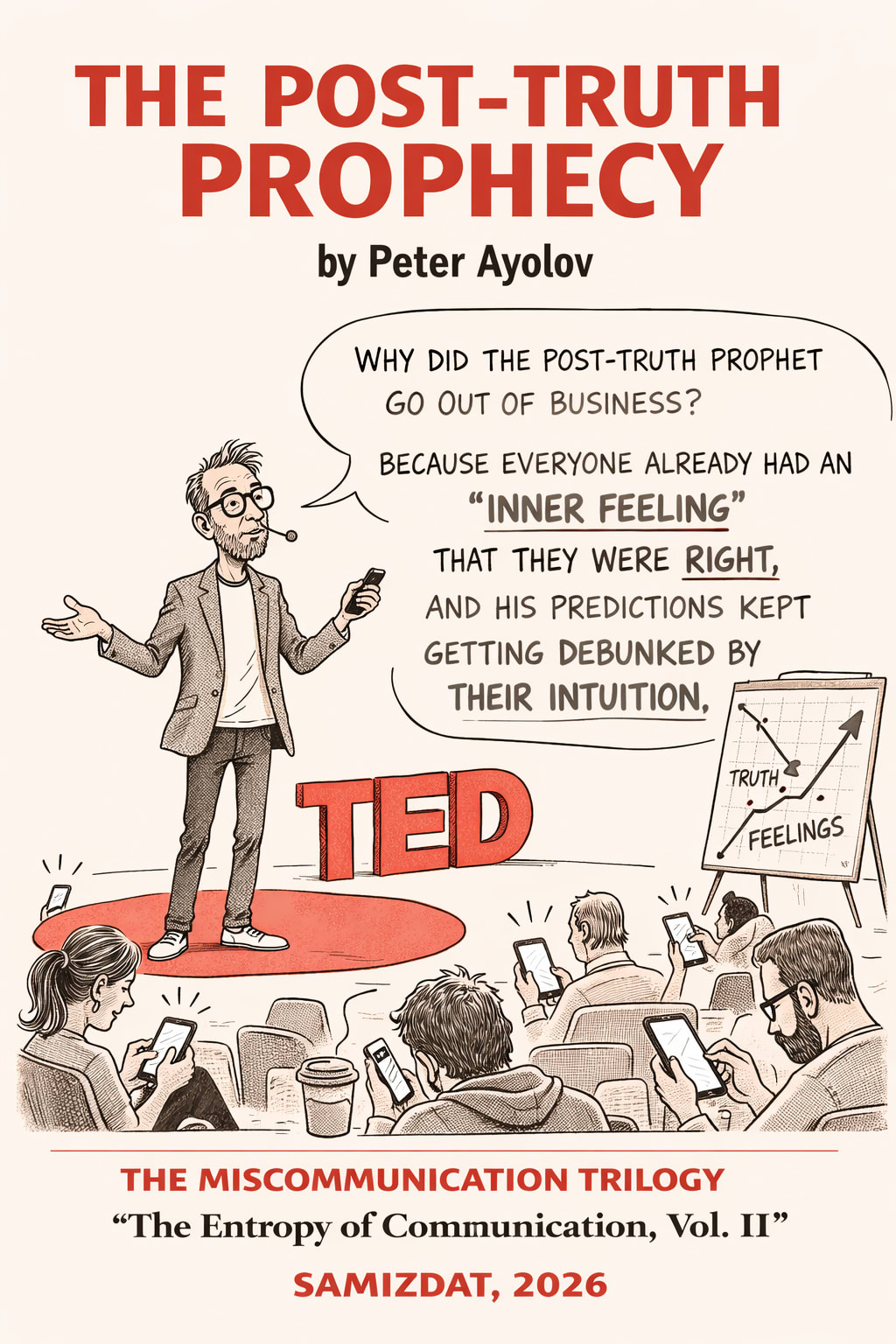
The Collapse That Speaks: A Critical Review of The Post-Truth Prophesy
The Architecture of a Failing Language
The Post-Truth Prophesy, positioned as Part 8 of the second volume of The Miscommunication Trilogy, advances a provocative and unsettling thesis: language itself has entered a phase of engineered decay. The book does not treat miscommunication as an accidental byproduct of complexity, but as a structural condition—one that emerges from the continuous rewriting of meaning in response to failed predictions, broken promises, and shifting realities. At its core lies the concept of the planned obsolescence of language, a notion that reframes linguistic instability not as a weakness but as a functional necessity of modern systems. What makes this work particularly compelling is its interdisciplinary synthesis. It draws from prophetic traditions, sociological futurology, cognitive dissonance theory, and technological acceleration, weaving them into a unified narrative about how meaning is produced, destabilized, and replaced. The discussion of prophecy is especially effective. Rather than treating prophecy as a primitive or outdated form of thought, the book reinterprets it as a precursor to modern predictive systems. In both cases, the failure of prediction does not lead to abandonment but to reinterpretation. This insight aligns closely with the work of Leon Festinger and later scholars who demonstrated that belief systems often strengthen in the face of contradiction.
The strength of the book lies in its ability to reveal a pattern across domains that are usually treated separately. Economic forecasts, climate models, religious prophecies, and technological predictions all operate under similar constraints. They generate expectations, those expectations shape behavior, and when reality diverges, language intervenes to restore coherence. In this sense, language becomes a stabilizing mechanism for inherently unstable systems. It absorbs failure and converts it into narrative continuity. However, the argument is not without its risks. By framing language as a system that must constantly renew itself through failure, the book edges toward a form of determinism. It implies that all communication is ultimately self-correcting through reinterpretation, which may underplay the moments when communication genuinely collapses rather than adapts. Still, this tension is part of the book’s intellectual appeal. It forces the reader to confront the possibility that what we perceive as clarity may already be a post hoc reconstruction.
Prediction, Power, and the Illusion of Control
A central theme in the book is the transformation of prediction into a form of power. Drawing implicitly on the insights of Daniel Bell, the text argues that forecasting is less about anticipating the future and more about structuring the present. Predictions do not merely describe what might happen; they shape decisions, allocate resources, and influence collective behavior. In doing so, they create the very conditions they claim to foresee. This idea is explored through multiple domains. In climate discourse, for instance, predictive models function as both warnings and rhetorical tools. They mobilize political action while simultaneously accommodating uncertainty through adjustable interpretations. In economics, forecasts persist even when repeatedly disproven, because they provide a necessary framework for decision-making. The same logic applies to technological visions such as the metaverse, where speculative futures drive real-world investment and innovation long before the technology fully materializes.
The book is particularly sharp in its critique of how failed predictions are managed. Rather than being treated as errors, they are reframed as partial successes, misinterpretations, or events that have been postponed. This process mirrors the mechanisms described by Karl E. Weick, where belief systems adapt by incorporating contradictions rather than eliminating them. The result is a system that appears resilient but is, in fact, dependent on continuous reinterpretation. One of the most striking aspects of this analysis is its implication for authority. If predictions cannot be falsified in any definitive sense, then the authority of experts shifts from accuracy to credibility. The ability to maintain a coherent narrative becomes more important than the ability to produce correct forecasts. This has profound consequences for public trust, particularly in an era where information is abundant but consensus is fragile. Yet the book avoids descending into cynicism. It does not claim that all predictions are meaningless or manipulative. Instead, it suggests that prediction is inherently constrained by the complexity of the systems it seeks to describe. The future is not a fixed destination but a moving target shaped by countless interactions. In this context, the failure of prediction is not a flaw but an inevitability. What matters is how that failure is interpreted and integrated into the broader narrative.
The Entropy of Meaning and the Future of Communication
The final and perhaps most ambitious dimension of the book is its exploration of linguistic entropy. As information systems expand and accelerate, language is subjected to increasing pressure. Meanings multiply, contexts shift, and the stability of words erodes. The book argues that this process is not merely a side effect of technological change but a defining feature of the contemporary condition. The discussion of information overload is particularly effective. Drawing on the exponential growth of data and the rise of filtering systems, the text shows how the problem has shifted from scarcity to excess. In such an environment, meaning is no longer derived from access to information but from the ability to select, interpret, and prioritize it. This aligns with broader observations about the digital age, where platforms mediate not just communication but perception itself. The concept of planned obsolescence is extended beyond physical goods to encompass language. Just as technologies are designed to be replaced, meanings are constantly updated to remain relevant. This creates a paradox: language must remain stable enough to communicate but flexible enough to adapt. The balance between these two demands is increasingly difficult to maintain, leading to a state of perpetual revision.
The book’s treatment of this tension is both insightful and unsettling. It suggests that the erosion of meaning is not a temporary crisis but a structural condition. As systems become more complex, the need for adaptive language increases. This, in turn, accelerates the cycle of reinterpretation. The result is a form of communication that is always in flux, never fully settled. Critically, the book does not offer a simple solution to this problem. It resists the temptation to call for a return to some imagined linguistic purity. Instead, it invites the reader to recognize and navigate the dynamics at play. This is both a strength and a limitation. On one hand, it preserves the analytical integrity of the argument. On the other, it leaves the reader with a sense of unresolved tension. As a review, one must acknowledge that The Post-Truth Prophesy is not an easy book. Its density, its refusal to simplify, and its insistence on confronting uncomfortable truths may alienate some readers. Yet these very qualities are what make it significant. It does not merely describe the entropy of communication; it embodies it, forcing the reader to engage with the instability it analyzes.
In conclusion, this work stands as a rigorous and provocative contribution to contemporary thought. It challenges conventional assumptions about language, prediction, and truth, offering a framework that is both coherent and deeply disquieting. Whether one agrees with its central thesis or not, it is difficult to ignore the patterns it reveals. In a world where meaning is increasingly contested, The Post-Truth Prophesy provides a lens through which to understand not just what is being said, but how and why it continues to change.
About the Creator
Peter Ayolov
Peter Ayolov’s key contribution to media theory is the development of the "Propaganda 2.0" or the "manufacture of dissent" model, which he details in his 2024 book, The Economic Policy of Online Media: Manufacture of Dissent.
Enjoyed the story? Support the Creator.
Subscribe for free to receive all their stories in your feed.
Comments
There are no comments for this story
Be the first to respond and start the conversation.