
The Obsolete Communication, THE MISCOMMUNICATION TRILOGY, “The Tower of Babble, Vol. III”, Part 20
Book Review

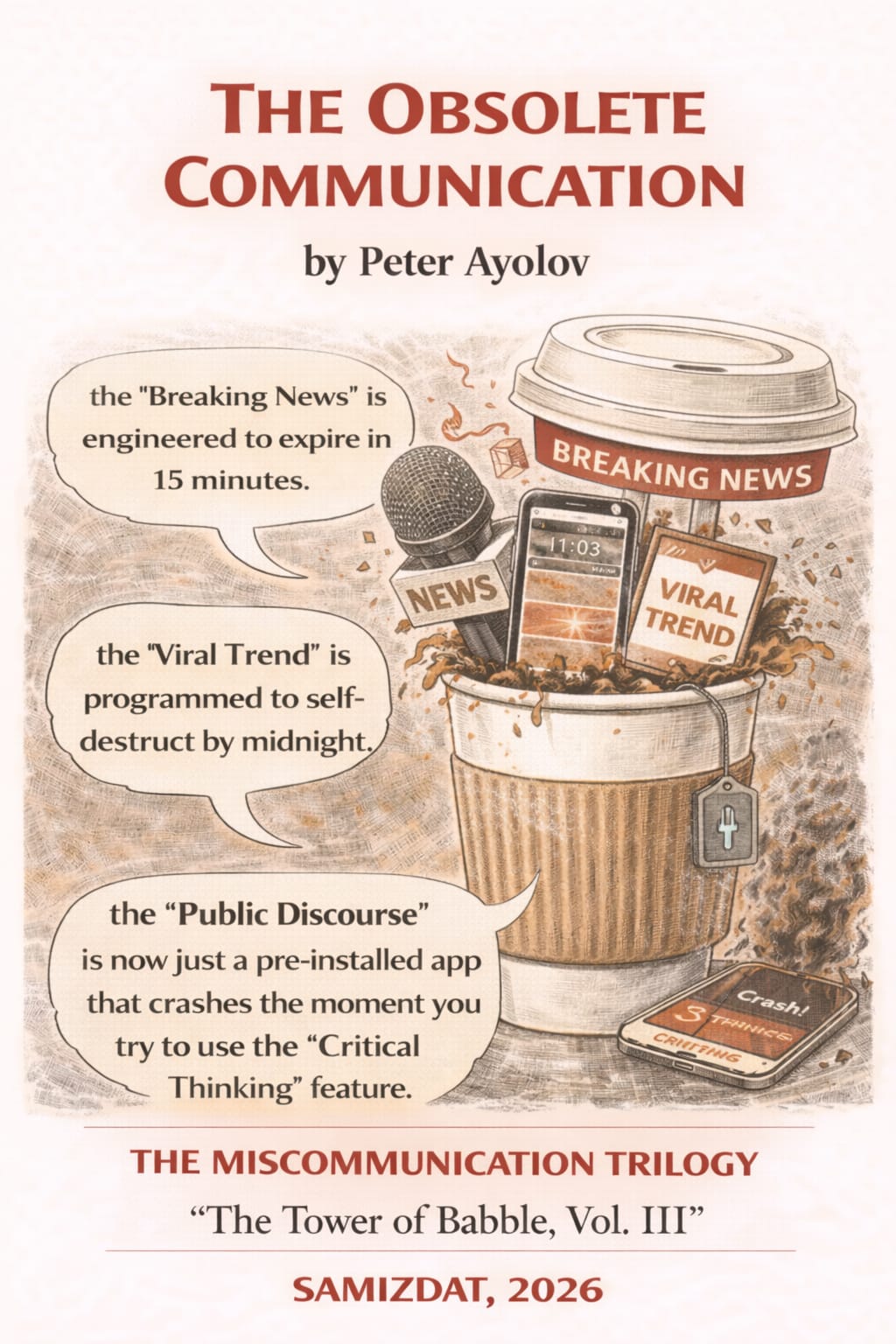
The Extinction of Understanding: A Review of The Obsolete Communication
The Silence Beneath the Noise
The Obsolete Communication stands as one of the most ambitious and intellectually expansive contributions to Miscommunication Trilogy, Vol. III: The Tower of Babble. While many contemporary studies of language focus on communication as a mechanism of connection, efficiency, and information transfer, this volume turns attention toward a more unsettling possibility: that communication itself may be subject to the same forces of decline, replacement, and obsolescence that govern technologies, institutions, ideologies, and civilizations. The book develops this insight through an extraordinary synthesis of research drawn from linguistics, communication studies, developmental psychology, philosophy, neuroscience, sociology, anthropology, and pragmatics. The result is not merely a collection of discussions about language but a sustained theoretical meditation on the mortality of communicative systems and the fragility of shared meaning. One of the volume’s greatest achievements lies in its ability to move seamlessly between empirical research and philosophical reflection. The opening discussions concerning language attrition, language death, and communicative decline establish a framework that extends far beyond traditional linguistic concerns. Languages are shown not as static repositories of words and grammar but as living social institutions whose survival depends on transmission, participation, and collective recognition. The studies on first-language loss provide particularly striking illustrations of this process. What disappears is not merely vocabulary or syntax but entire communicative repertoires: reflex responses, spontaneous humor, repartee, sound symbolism, and emotional immediacy. The erosion of these elements reveals that language resides not only in dictionaries and grammatical systems but also in habits, memories, gestures, emotions, and social relationships. Communication emerges as something embodied and historically situated rather than abstract and universal.
The volume consistently challenges mechanistic understandings of communication. Throughout its chapters, communication appears less as a channel through which information passes and more as a complex ecology sustained through interaction. Meaning is never simply transmitted; it is negotiated through intricate combinations of verbal and nonverbal cues. Studies examining infant-directed speech, gesture, facial expression, eye gaze, prosody, and communicative intent demonstrate that communication begins long before language in its conventional form emerges. Infants interpret communicative intentions through melodic contours, facial movements, and patterns of attention. Adults rely on subtle signals of intentionality, emotional expression, and contextual framing. Communication is revealed as a multimodal process whose success depends on shared assumptions that often remain invisible until they begin to fail. The title The Obsolete Communication therefore acquires considerable theoretical power. The book suggests that communication itself may become obsolete in particular forms even while continuing to exist in others. Just as technologies are superseded by new technologies, communicative systems are continuously transformed by changing social, cultural, and technological conditions. Yet unlike technological obsolescence, communicative obsolescence involves the disappearance of entire worlds of understanding. The loss of a communicative form entails the loss of specific ways of perceiving, categorizing, remembering, and relating to others. By tracing these processes across diverse disciplines, the volume establishes itself as a significant contribution not only to communication studies but also to broader debates concerning culture, identity, and social transformation.
The Architecture of Intentional Meaning
A second major strength of the book lies in its sustained exploration of communicative intent as the foundation of social interaction. Throughout the volume, communicative intent functions as a unifying concept linking diverse fields of inquiry. Whether examining infant development, autism, humor, gesture, discourse ethics, social interaction, or language acquisition, the studies repeatedly return to the question of how individuals recognize that another person is attempting to communicate something. This focus transforms the book from a study of communication as a system of signs into an investigation of communication as a fundamentally social and intentional activity. The discussions devoted to communicative intent are especially valuable because they reveal the extraordinary complexity underlying apparently simple interactions. Communication depends not merely upon the production of signals but upon the recognition that those signals are produced with communicative purposes. This distinction, explored through philosophical analyses inspired by Grice and later theorists, highlights the difference between natural signs and intentional acts. A gesture, facial expression, utterance, or movement becomes communicative only when it is understood as intentionally directed toward another person. Such recognition forms the basis of social understanding itself.
The empirical studies examined throughout the volume provide compelling evidence for this claim. Research on infant communication demonstrates that communicative intent develops gradually through eye gaze, persistence, signal modification, and coordinated attention. Investigations into autism reveal the challenges involved in interpreting unconventional communicative behaviors and underscore the importance of understanding communication beyond conventional linguistic forms. Studies of gestures and movement show that communicative intent becomes visible through exaggerated kinematic patterns, altered eye gaze, and deliberate modifications of bodily action. Even humor is analyzed as a communicative tool serving functions of identification, clarification, enforcement, and differentiation within social groups. Particularly noteworthy is the volume’s emphasis on multimodality. Communication is shown to depend upon the integration of numerous channels simultaneously. Prosody, facial expression, gesture, posture, gaze direction, movement amplitude, and contextual information all contribute to the interpretation of communicative intent. The research on infant-directed speech and song illustrates how melodic contours communicate emotional and pragmatic information even when semantic content is absent. Similarly, studies of facial movements reveal that observers can accurately identify communicative intentions solely from visual information. Such findings challenge linguistic theories that privilege verbal content while neglecting the broader ecology of communication.
The volume’s treatment of communicative intent also carries important philosophical implications. By emphasizing the centrality of intention, the book rejects simplistic models of communication as mere information exchange. Communication is portrayed instead as an intersubjective process requiring mutual recognition and shared participation. Meaning emerges not from isolated minds but from social interaction. This perspective aligns many of the volume’s empirical investigations with broader traditions in pragmatics, phenomenology, and communicative action theory. The result is a remarkably coherent account of communication as a dynamic process through which individuals continuously construct and negotiate social reality.
The Future Ruins of Language
The most provocative contribution of The Obsolete Communication lies in its ability to connect seemingly disparate phenomena into a unified theory of communicative fragility. The volume repeatedly demonstrates that communication depends upon conditions that can never be fully guaranteed. Shared meanings require shared experiences. Intentions require recognition. Languages require transmission. Communities require symbolic systems capable of coordinating expectations across generations. None of these conditions is permanent. Consequently, communication itself becomes vulnerable to historical change. This theme acquires particular significance when considered within the broader context of The Planned Obsolescence of Language, the overarching project of the Miscommunication Trilogy. Earlier volumes explored various forms of linguistic manipulation, fragmentation, alienation, dehumanization, and symbolic conflict. The Obsolete Communication extends these concerns by investigating what happens when communication itself becomes unstable. Rather than focusing exclusively on the content of messages, the book examines the conditions that make messages possible in the first place. In doing so, it reveals that communicative systems are historical constructions subject to continual transformation.
The volume is especially effective in demonstrating that obsolescence is not merely a process of loss. While many of the studies document decline, attrition, and fragmentation, they also reveal communication’s capacity for adaptation. New communicative forms emerge as older forms disappear. New conventions develop in response to changing social environments. Communication survives precisely because it remains flexible. Yet this flexibility comes at a cost. Every adaptation involves forgetting. Every innovation leaves behind obsolete forms. The history of communication thus becomes inseparable from the history of disappearance. What distinguishes this book from many contemporary discussions of communication is its refusal to treat technological progress as a solution to communicative problems. Increased connectivity does not necessarily produce increased understanding. Information abundance does not guarantee meaningful interaction. Indeed, several themes running through the volume suggest that contemporary communication may be experiencing new forms of obsolescence even amid unprecedented technological sophistication. Shared contexts become fragmented. Symbolic communities become unstable. Communicative intentions become harder to interpret. Understanding becomes increasingly dependent upon fragile and temporary alignments among participants who often inhabit radically different communicative worlds.
As a contribution to communication theory, The Obsolete Communication is both comprehensive and original. It successfully integrates empirical findings from numerous disciplines into a coherent philosophical framework while maintaining accessibility and conceptual clarity. More importantly, it advances a compelling thesis regarding the historical nature of communication itself. Communication is not a timeless human essence. It is a social institution continuously created and recreated through collective practice. Like all institutions, it can decline, fragment, and disappear. The book ultimately leaves the reader with a profound realization. Human beings inhabit worlds constructed through communication, yet those worlds are never secure. Languages vanish. Meanings shift. Intentions become obscure. Shared understandings dissolve. Nevertheless, individuals continue attempting to bridge these gaps through new forms of expression and interaction. In documenting this tension between permanence and disappearance, continuity and transformation, the volume offers a powerful reflection on the human condition itself. The Obsolete Communication is therefore not simply a book about language. It is a study of how societies create meaning, how they lose it, and how they struggle endlessly to create it again.
About the Creator
Peter Ayolov
Peter Ayolov’s key contribution to media theory is the development of the "Propaganda 2.0" or the "manufacture of dissent" model, which he details in his 2024 book, The Economic Policy of Online Media: Manufacture of Dissent.
Enjoyed the story? Support the Creator.
Subscribe for free to receive all their stories in your feed.
Comments
There are no comments for this story
Be the first to respond and start the conversation.