
The New Religions Spell, THE MISCOMMUNICATION TRILOGY, “The Tower OF Babble, Vol. III”, Part 6
Book Review

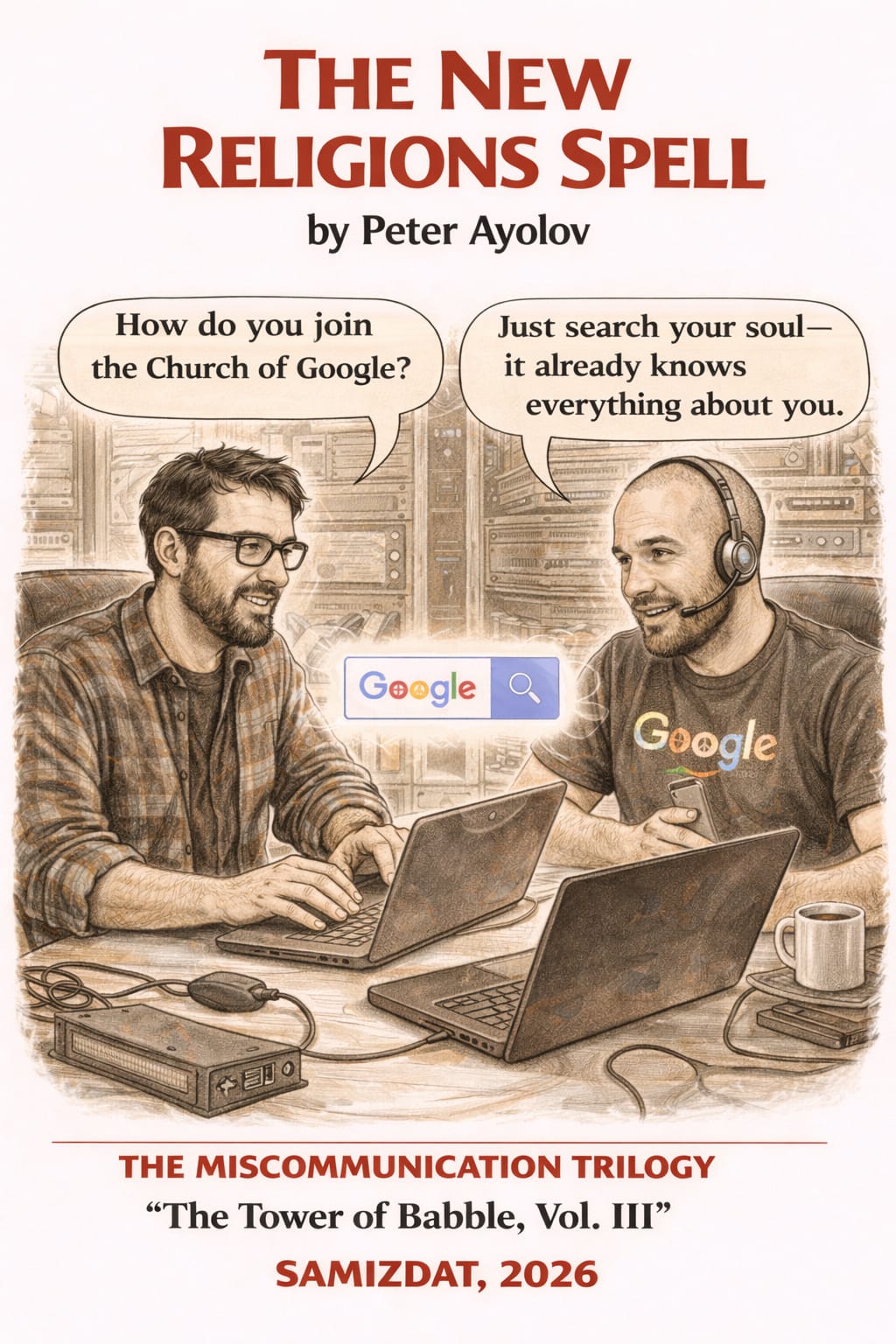
The Marketplace of Faith: Belief, Power, and the New Sacred Order
The Return of Enchantment in a Secular Age
The New Religions Spell is one of the most ambitious and intellectually provocative volumes in The Tower of Babble, the third installment of The Miscommunication Trilogy. At its core, the book challenges one of the defining assumptions of modern civilization: the belief that religion is disappearing. Contrary to the familiar narrative of secular progress, this work argues that faith has not vanished from contemporary society. Instead, it has migrated into new institutions, new ideologies, and new cultural practices. The result is not a post-religious world but a world saturated with alternative forms of belief, many of which operate beneath the threshold of conscious recognition. The book begins by examining religion not as a specific institution but as a broader human impulse toward meaning, order, and transcendence. Through an extensive exploration of historical and contemporary sources, it demonstrates that modern societies continue to generate myths, prophets, rituals, sacred symbols, and systems of salvation. What has changed is not the existence of faith but its object. Where earlier generations sought redemption through traditional churches, modern individuals increasingly seek fulfillment through markets, politics, self-help movements, prosperity theology, technological innovation, and therapeutic cultures. The sacred has not disappeared; it has simply assumed new disguises.
One of the book’s greatest strengths lies in its ability to connect seemingly unrelated phenomena. The reader encounters discussions of Joel Osteen’s prosperity gospel, Joseph Smith’s Mormon revelations, Puritan covenant theology, neoliberal economics, self-help literature, Walter Benjamin’s philosophy of language, Georg Simmel’s reflections on money, and contemporary market ideology. At first glance, these subjects appear disconnected. Yet the book gradually reveals the invisible threads linking them together. Each represents a particular attempt to create meaning within conditions of uncertainty. Each transforms language into a vehicle for authority. Each offers promises of redemption adapted to the circumstances of its historical moment. The analysis is particularly compelling when examining the evolution of prosperity theology. Rather than dismissing the movement as a simple fraud or manipulation, the book situates it within a broader American tradition that merges spiritual aspiration with economic ambition. The prosperity gospel becomes a symbolic expression of deeper cultural assumptions regarding success, virtue, and divine favor. By tracing its historical roots through Puritanism, revivalism, free-market ideology, and self-help culture, the author demonstrates how contemporary prosperity movements emerged from longstanding patterns within American religious thought.
The volume also excels in revealing the religious dimensions of ostensibly secular institutions. Markets become objects of faith. Economic theories function as doctrines. Politicians assume prophetic roles. Corporations cultivate rituals and symbols designed to inspire loyalty. Technological innovation promises salvation through progress. Through these examples, the book encourages readers to reconsider the categories through which modern life is understood. The distinction between sacred and secular becomes increasingly unstable. What emerges instead is a landscape populated by competing systems of belief, each seeking authority over the interpretation of reality. This first section of the book therefore establishes its central thesis with remarkable force: modernity has not abolished enchantment. It has multiplied it. The contemporary world remains governed by narratives, symbols, and myths that shape behavior as powerfully as any traditional religion. By exposing these hidden structures of belief, the volume invites readers to examine the sacred assumptions embedded within everyday life.
Money, Language, and the Manufacture of Reality
The most original contribution of The New Religions Spell lies in its examination of the relationship between language, money, and belief. Drawing extensively from philosophical, economic, and theological sources, the book argues that language and money function as parallel symbolic systems through which reality is organized and interpreted. This insight provides the intellectual foundation for much of the volume’s analysis. Throughout the text, money appears not merely as an economic instrument but as a cultural force that reshapes perception. The discussions of Goethe, Kant, Hegel, Lessing, Heidegger, Benjamin, and Simmel reveal how monetary forms influence modes of thought. Contracts, paper money, debts, promises, exchange, and symbolic value become metaphors for understanding language itself. Just as money abstracts value from physical commodities, language abstracts meaning from lived experience. Both systems depend upon collective trust. Both derive power from shared belief. Both create realities that are simultaneously intangible and immensely consequential.
The treatment of Walter Benjamin is particularly illuminating. Benjamin’s notion that language is more than a tool of communication becomes central to the volume’s broader argument. Language is presented as the medium through which human beings construct worlds of meaning. Naming is not merely descriptive; it is creative. Every act of naming establishes categories, distinctions, and relationships that shape perception. This insight resonates throughout the book, especially in its analysis of how modern ideologies employ language to establish legitimacy and authority. Equally important is the discussion of money as a symbolic system. Drawing on Simmel’s philosophy, the book demonstrates how money gradually evolved from a material substance into a largely symbolic medium. This transformation mirrors broader cultural developments in which abstractions increasingly dominate social life. Financial systems become detached from physical production. Economic value becomes increasingly speculative. Human relationships are mediated through impersonal exchanges. The symbolic replaces the tangible. In this context, money begins to function almost as a theological concept—a universal equivalent capable of translating all qualitative differences into quantitative measures.
The volume’s exploration of prosperity theology further extends this analysis. Here, language itself becomes a mechanism of economic and spiritual transformation. The Word of Faith movement, with its emphasis on positive confession and verbal declarations of abundance, exemplifies the belief that language possesses creative power. Words become instruments through which reality is shaped. This fusion of linguistic and economic symbolism reveals the deep interconnectedness of belief, communication, and value. The author repeatedly returns to the theme of miscommunication, the central concern of the trilogy as a whole. Modern societies are portrayed as environments saturated with competing symbolic systems. Every institution generates its own vocabulary, myths, and narratives. Political movements redefine familiar words. Religious groups reinterpret traditional doctrines. Economic ideologies transform moral concepts into market categories. The result is an increasingly fragmented communicative environment where shared meanings become difficult to sustain.
What makes this analysis especially valuable is its refusal to reduce these developments to simple manipulation or conspiracy. Instead, the book treats them as structural consequences of modernity itself. As traditional sources of authority decline, symbolic competition intensifies. New systems of meaning emerge to fill the resulting vacuum. Language becomes the primary battlefield upon which these struggles unfold. In this sense, The New Religions Spell is not merely a study of religion but an investigation into the processes through which reality itself is socially constructed.
The New Sacreds and the Future of Belief
The final achievement of The New Religions Spell lies in its capacity to transform a collection of historical and theoretical materials into a coherent diagnosis of contemporary civilization. The book ultimately argues that humanity is entering an era characterized by the proliferation of new sacred forms. Traditional religious institutions continue to exist, but they now compete with a vast array of alternative systems offering meaning, identity, and redemption. The emergence of these new sacreds reflects both the strengths and weaknesses of modern society. On one hand, the decline of centralized religious authority has created unprecedented opportunities for intellectual freedom and cultural diversity. Individuals can choose among countless worldviews, communities, and spiritual practices. On the other hand, this same diversity generates instability. Without commonly accepted frameworks of meaning, societies become vulnerable to fragmentation, polarization, and manipulation.
The book is particularly persuasive in its analysis of political and economic belief systems. Neoliberalism, market fundamentalism, and consumer culture are presented not simply as policies or lifestyles but as comprehensive moral visions. They establish definitions of success, failure, virtue, and worth. They promise salvation through growth, consumption, and self-improvement. They possess their own prophets, rituals, and sacred texts. By framing these systems as forms of religion, the book exposes dimensions of contemporary life that often remain invisible. Another significant contribution is the treatment of self-help culture. Rather than dismissing it as superficial optimism, the author interprets it as a modern spiritual technology. The promise of endless self-reinvention becomes a secular equivalent of religious conversion. Individuals are encouraged to view themselves as ongoing projects requiring constant improvement, adaptation, and optimization. This mentality reflects broader economic and cultural pressures while simultaneously providing a sense of purpose and direction.
The writing throughout the volume is ambitious, interdisciplinary, and intellectually adventurous. It moves comfortably between theology, philosophy, economics, sociology, cultural criticism, and intellectual history. While the scope is vast, the central argument remains remarkably consistent. The book repeatedly demonstrates how language creates belief, how belief organizes social life, and how modern institutions increasingly function as substitute religions. Ultimately, The New Religions Spell succeeds because it addresses one of the defining questions of the contemporary age: what replaces traditional religion when traditional religion loses authority? The answer offered is both unsettling and illuminating. Nothing replaces religion because religion, understood as humanity’s search for meaning, never disappears. It merely changes form. New gods emerge. New scriptures circulate. New rituals organize daily life. New prophets promise redemption. Beneath the surface of modern rationality, the ancient human need for transcendence continues its work.
As a contribution to The Miscommunication Trilogy, this volume stands as a profound examination of the relationship between language, belief, and power. It reveals how contemporary societies continuously manufacture new realities through symbolic systems that shape perception and behavior. More importantly, it reminds readers that the struggle over language is ultimately a struggle over the meaning of human existence itself. In an age overflowing with competing truths, The New Religions Spell offers a compelling exploration of how modern civilizations continue to live beneath the shadow—and the enchantment—of their own creations.
About the Creator
Peter Ayolov
Peter Ayolov’s key contribution to media theory is the development of the "Propaganda 2.0" or the "manufacture of dissent" model, which he details in his 2024 book, The Economic Policy of Online Media: Manufacture of Dissent.
Enjoyed the story? Support the Creator.
Subscribe for free to receive all their stories in your feed.
Comments
There are no comments for this story
Be the first to respond and start the conversation.