
The Netspeak Obsolescence, THE MISCOMMUNICATION TRILOGY, “The Tower Of Babble, Vol. III”, Part 15
Book Review

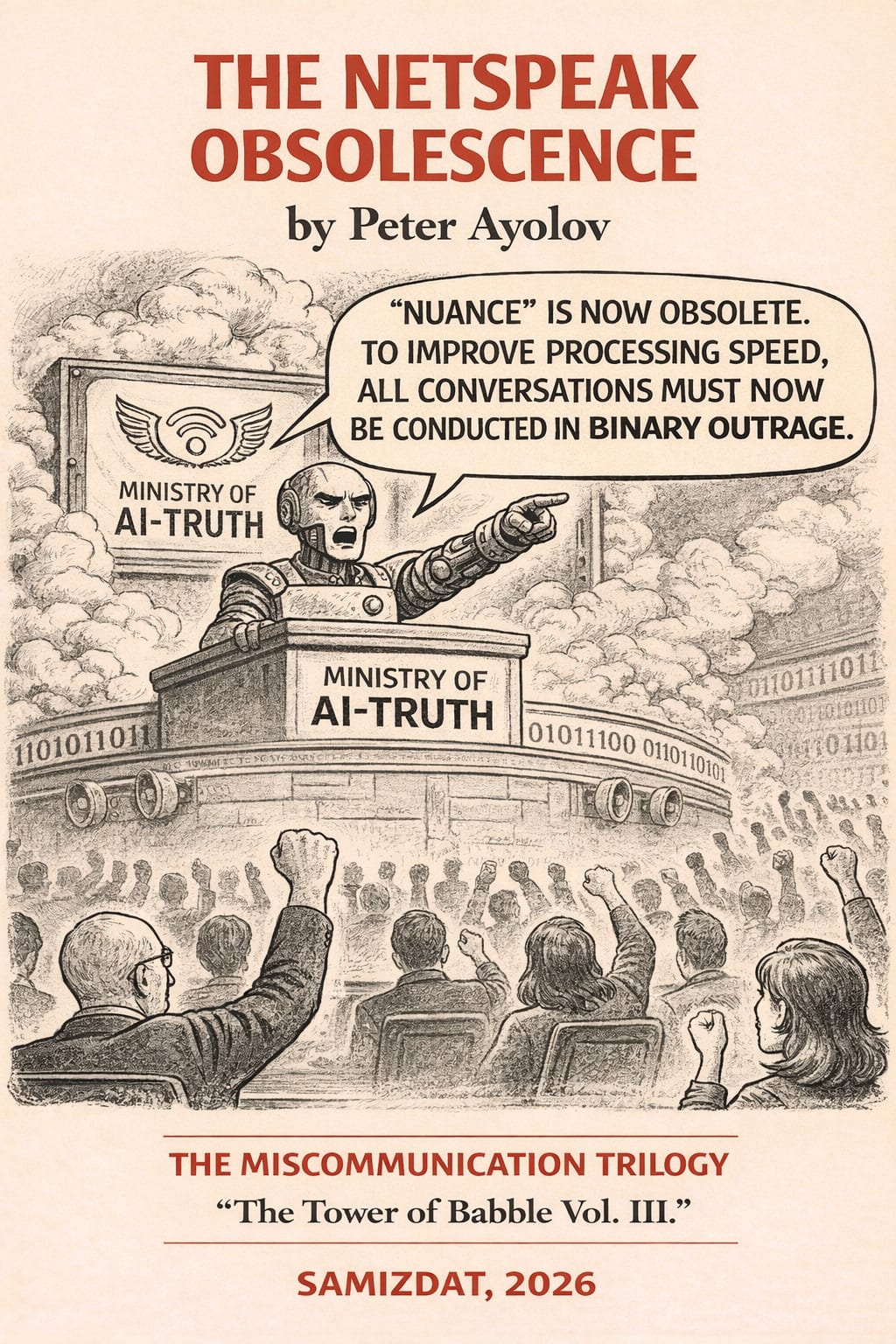
The Digital Babel: A Review of The Netspeak Obsolescence
Mapping the Collapse of Meaning in the Digital Age
The Netspeak Obsolescence is an ambitious and far-reaching examination of one of the defining paradoxes of contemporary society: the unprecedented expansion of communication alongside the apparent decline of understanding. Positioned within the broader framework of The Miscommunication Trilogy and its central theme of the Planned Obsolescence of Language, the book investigates the technological, social, psychological, and cultural forces that are transforming human communication in the twenty-first century. Rather than treating digital communication merely as a neutral technological development, the work approaches it as a profound civilizational shift that is altering the structure, purpose, and function of language itself. One of the book’s greatest strengths lies in its ability to synthesize a vast range of disciplines into a coherent narrative. Drawing from communication studies, media theory, psychology, sociology, linguistics, political science, and digital culture, the text constructs a comprehensive picture of the contemporary communicative environment. The internet emerges not simply as a technological platform but as a social ecosystem that reshapes how people think, interact, argue, persuade, and understand one another. Through its exploration of comment sections, social media interactions, online anonymity, trolling, digital shaming, cyberharassment, emotional contagion, and artificial intelligence, the book demonstrates how digital environments increasingly privilege speed, visibility, and emotional intensity over reflection, complexity, and understanding.
A particularly compelling aspect of the analysis is its treatment of online commenting culture. Rather than dismissing comment sections as merely toxic spaces, the book carefully examines their democratic promise alongside their practical failures. Online comments were initially envisioned as mechanisms for public participation and civic engagement. Yet the reality often proved very different. The text demonstrates how anonymity, algorithmic incentives, emotional polarization, and technological affordances have transformed many digital discussion spaces into arenas of hostility and fragmentation. In doing so, the book avoids simplistic explanations and instead presents online discourse as the product of complex interactions between technological systems and human psychology. The discussion of Netspeak itself serves as both a linguistic and cultural diagnosis. The book does not condemn new forms of digital expression as inherently inferior. Instead, it explores how abbreviations, emojis, memes, internet slang, and compressed forms of communication emerge as adaptations to digital environments. The concern is not that language evolves but that communicative depth becomes increasingly difficult to sustain within systems designed to maximize speed and engagement. This distinction gives the work an intellectual sophistication that separates it from nostalgic critiques of technological change. The Netspeak Obsolescence is not a lament for a lost past but an investigation into the conditions shaping the future of communication.
Digital Conflict, Public Shaming, and the New Architecture of Discourse
One of the most powerful dimensions of The Netspeak Obsolescence is its examination of how digital communication has transformed the social consequences of speech. The book demonstrates that communication in the digital age possesses qualities fundamentally different from previous historical forms of interaction. Digital messages are searchable, reproducible, permanent, and capable of reaching global audiences within seconds. As a result, communication no longer disappears into memory but remains embedded within technological systems capable of preserving and redistributing content indefinitely. The text devotes significant attention to digital shaming, cyberhumiliation, and the emergence of online outrage as a defining feature of contemporary public life. Through numerous examples and theoretical perspectives, the book reveals how digital platforms have created conditions in which ordinary individuals can become targets of global condemnation almost instantaneously. The analysis is particularly effective because it avoids reducing these phenomena to individual moral failures. Instead, the author situates them within broader structural conditions, including platform design, anonymity, social identity processes, emotional amplification, and algorithmic engagement systems.
Equally important is the book’s exploration of incivility. Drawing on extensive research concerning online comments and public discourse, the text illustrates how uncivil interactions shape perceptions of information, media credibility, political identity, and public participation. The discussion moves beyond the common assumption that incivility is simply a matter of bad manners. Instead, it demonstrates how hostile communication influences cognitive processing, emotional responses, group identification, and perceptions of social reality. The result is a nuanced understanding of how digital communication environments contribute to polarization and social fragmentation. The analysis of personality and online behavior adds another valuable dimension to the work. By examining traits such as agreeableness, neuroticism, conscientiousness, openness, and extraversion, the book demonstrates that online discourse cannot be understood solely through technological explanations. Different individuals engage with digital platforms in different ways, influenced by their psychological predispositions and social motivations. This perspective enriches the broader argument by showing how technological systems interact with existing human tendencies rather than simply determining behavior independently.
Another particularly relevant contribution is the discussion of deception and authenticity in digital communication. The book highlights how the distinction between truthful representation and manipulation becomes increasingly complicated within digitally mediated environments. Online identities can be curated, altered, concealed, or fabricated. Communication becomes detached from many of the contextual cues traditionally associated with face-to-face interaction. As a consequence, trust becomes one of the central challenges of the digital age. The examination of deception, misinformation, anonymity, and identity construction reveals the extent to which contemporary communication systems challenge traditional assumptions about credibility and authenticity. What emerges from these analyses is a portrait of a communicative environment characterized by extraordinary connectivity but persistent instability. Public discourse becomes fragmented into competing narratives, emotional reactions, and identity-based conflicts. Communication multiplies while consensus becomes increasingly elusive. The book effectively captures this contradiction, demonstrating that technological abundance does not automatically produce social understanding.
The Future of Language and the Possibility of Renewal
Despite its extensive documentation of communicative crises, The Netspeak Obsolescence ultimately resists pessimism. One of the most notable achievements of the book is its ability to balance critical analysis with constructive reflection. Rather than presenting technological transformation as an irreversible path toward linguistic decline, the work emphasizes the resilience of language and the continuing possibility of meaningful communication. This perspective prevents the text from becoming merely a catalogue of digital pathologies and instead positions it as a thoughtful exploration of future possibilities. The concluding sections emphasize that language itself is not disappearing. Human beings continue to communicate, create meaning, share stories, and construct communities through linguistic interaction. What is changing are the conditions under which communication occurs. The book argues that preserving meaningful discourse requires conscious cultural, educational, and institutional efforts. Digital literacy must extend beyond technical proficiency to include critical thinking, contextual understanding, emotional intelligence, and ethical responsibility. Communication technologies may continue evolving, but the preservation of understanding remains a fundamentally human responsibility.
Particularly compelling is the book’s discussion of journalism, education, and democratic institutions. These institutions traditionally functioned as mediators of information and facilitators of public discourse. The digital environment challenges these roles by decentralizing communication and distributing communicative power across vast networks of users. Yet the book argues that the need for reliable information, thoughtful deliberation, and responsible communication has not diminished. If anything, these functions become even more important within environments characterized by informational abundance and communicative chaos. The text also addresses the growing influence of artificial intelligence and automated communication systems. Rather than treating AI as either a miracle solution or an existential threat, the book situates it within broader questions concerning authorship, authenticity, knowledge production, and communicative responsibility. This balanced approach reflects the overall intellectual character of the work, which consistently avoids simplistic conclusions in favor of careful analysis.
As a contribution to contemporary discussions of language, media, and society, The Netspeak Obsolescence succeeds on multiple levels. It offers a detailed examination of digital communication practices, a sophisticated theoretical framework for understanding contemporary discourse, and a broader reflection on the future of language itself. Most importantly, it places these developments within the larger context of the Planned Obsolescence of Language, demonstrating how technological acceleration, media systems, political polarization, and cultural transformation collectively reshape the communicative foundations of modern life. The Netspeak Obsolescence is ultimately a study of the tension between communication and understanding. It reminds readers that the existence of more messages does not guarantee more meaning, that connectivity does not automatically create community, and that participation does not necessarily produce dialogue. Yet it also affirms the enduring human capacity to adapt, reflect, and rebuild communicative practices capable of sustaining knowledge, empathy, and democratic life. In doing so, the book establishes itself as a significant and thought-provoking contribution to the study of language in the digital age.
About the Creator
Peter Ayolov
Peter Ayolov’s key contribution to media theory is the development of the "Propaganda 2.0" or the "manufacture of dissent" model, which he details in his 2024 book, The Economic Policy of Online Media: Manufacture of Dissent.
Enjoyed the story? Support the Creator.
Subscribe for free to receive all their stories in your feed.
Comments
There are no comments for this story
Be the first to respond and start the conversation.