
The Language of Eudaimonia, THE MISCOMMUNICATION TRILOGY, “The Tower of Babble, Vol. III”, Part 22
Book Review

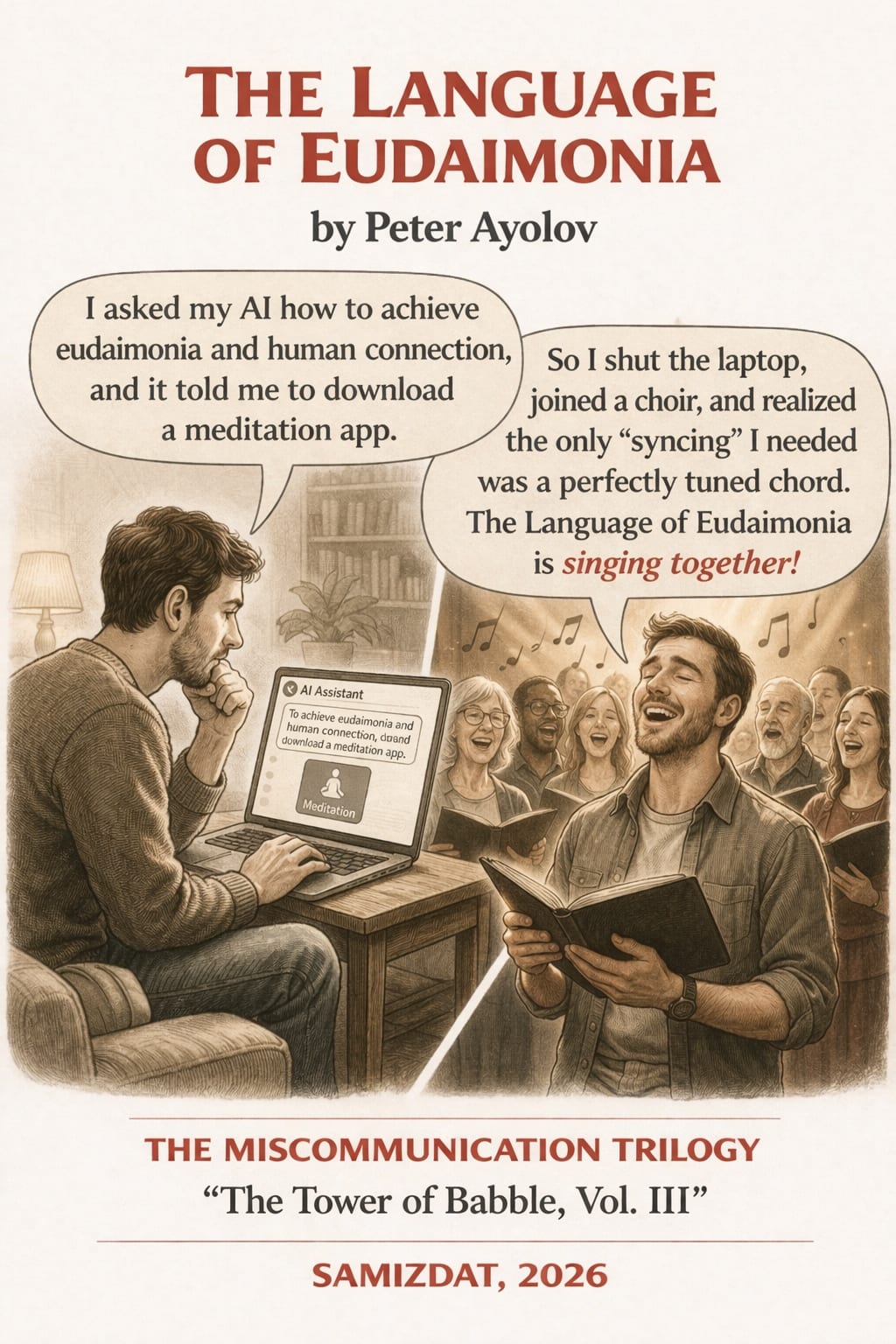
The Song of Human Flourishing: Language, Music, and the Recovery of Meaning
Language as the Architecture of Human Existence
The Language of Eudaimonia occupies a distinctive place within contemporary reflections on communication, culture, and human flourishing. As part of a broader investigation into the planned obsolescence of language, the book approaches communication not as a technical problem but as a civilisational question. At its core lies the conviction that language is not simply an instrument used by human beings but the very medium through which human reality becomes intelligible. The work challenges the increasingly common tendency to reduce language to information transfer, political messaging, technological coding, or economic exchange. Instead, it restores an older and richer understanding in which language constitutes the foundation of thought, memory, identity, and social life. Throughout the volume, language appears as the environment within which human beings discover themselves and construct shared worlds of meaning. Philosophical reflections drawn from traditions ranging from classical antiquity to modern phenomenology reveal that speech is inseparable from existence itself. The book repeatedly returns to the proposition that human flourishing cannot be understood apart from the symbolic structures that sustain culture and consciousness. What distinguishes this volume from many contemporary studies of communication is its refusal to separate language from broader questions concerning value, purpose, and human destiny. The author demonstrates that the crisis of communication visible in modern societies is not merely a matter of technological disruption or political polarisation. It reflects a deeper erosion of humanity’s relationship to language as a source of meaning. The concept of eudaimonia serves as an organising principle through which diverse fields of inquiry are brought into dialogue. Rather than treating happiness as subjective satisfaction, the book adopts the classical understanding of flourishing as a process of self-realisation, ethical development, and participation in meaningful forms of life. This perspective allows language to emerge not merely as a communicative mechanism but as a condition for the possibility of flourishing itself. The volume succeeds in showing how every conception of the good life depends upon linguistic resources capable of articulating values, preserving traditions, and transmitting cultural memory. Through extensive engagement with philosophy, linguistics, communication theory, and cultural history, the work constructs a comprehensive argument that language remains humanity’s most important symbolic achievement. The result is a sustained defence of communication as the foundation of civilisation and a powerful critique of the forces that threaten to reduce language to a disposable commodity within the contemporary information economy.
The Music of Humanity and the Search for Connection
One of the most compelling dimensions of the book is its exploration of the profound relationship between language and music. Rather than treating music as a secondary cultural phenomenon, the volume presents it as one of the most revealing expressions of human nature. Drawing upon philosophy, ethnomusicology, anthropology, psychology, evolutionary theory, and communication studies, the book demonstrates that music occupies a unique position at the intersection of cognition, emotion, embodiment, and social life. Across cultures and historical periods, music emerges as a universal practice through which individuals negotiate identity, belonging, cooperation, and meaning. The discussions of musical universals reveal how rhythm, melody, synchronisation, and emotional expression create shared experiences that transcend cultural boundaries while preserving cultural diversity. Particularly impressive is the way the volume integrates seemingly disparate perspectives into a coherent narrative. The evolutionary theories of music as coalition signalling, the anthropological analyses of communal ritual, the philosophical reflections on music and language, and the sociological examinations of musical participation all converge around a central insight: human beings are fundamentally communicative and relational creatures. Music appears not merely as entertainment but as a mechanism through which communities coordinate behaviour, transmit values, and establish social bonds. The examination of music as a form of ontological security is especially significant. By showing how musical practices reinforce belonging, continuity, and emotional attunement, the book highlights dimensions of human flourishing often neglected by purely rational or utilitarian models of well-being. Equally valuable is the discussion of cross-cultural musical understanding, which demonstrates both the universality and particularity of human expression. Music becomes a model for understanding how communication can bridge differences without erasing them. The analyses of musical emotion, synaesthesia, ritual participation, and social coordination reinforce the broader argument that flourishing requires more than information. It requires resonance, empathy, and participation in shared symbolic worlds. The volume’s engagement with the works of John Blacking, Jacques Attali, Edward Hagen, Gregory Bryant, and numerous other thinkers enriches its interdisciplinary scope while maintaining thematic coherence. Music emerges as both a subject of investigation and a metaphor for the human condition itself. Like language, music allows individuals to participate in realities larger than themselves while preserving the uniqueness of personal experience. Through its careful exploration of these themes, the book succeeds in revealing why music remains indispensable to any serious understanding of human flourishing and why its significance extends far beyond aesthetic appreciation.
Eudaimonia Against the Obsolescence of Meaning
The greatest achievement of The Language of Eudaimonia lies in its ability to connect diverse intellectual traditions to a pressing contemporary concern: the erosion of meaningful communication in modern societies. The volume is not nostalgic, nor does it advocate a return to idealised past forms of culture. Instead, it offers a sophisticated diagnosis of the conditions that threaten the communicative foundations of human flourishing. Throughout the book, language, music, and culture are examined against the background of accelerating technological change, commodification, and informational saturation. The analyses inspired by Jacques Attali are particularly illuminating in this regard. The discussions of noise, repetition, commodification, and the political economy of music provide a broader framework for understanding how symbolic practices are transformed under contemporary economic conditions. The book demonstrates that the planned obsolescence of language is not merely a linguistic phenomenon but part of a wider process through which meaning itself becomes unstable. Communication increasingly functions according to the logic of consumption, where novelty replaces continuity and visibility replaces understanding. Against this tendency, the volume proposes eudaimonia as an alternative horizon. Flourishing emerges not through endless accumulation of information but through participation in practices that cultivate understanding, creativity, memory, and community. The work consistently emphasises that language and music are not luxuries added to an otherwise complete existence. They are essential conditions of human life. By preserving collective memory, articulating ethical ideals, and enabling meaningful relationships, they sustain the symbolic environment within which flourishing becomes possible. The book’s interdisciplinary method is one of its greatest strengths. Philosophy, linguistics, psychology, anthropology, neuroscience, communication studies, and musicology are woven together into a coherent intellectual project without sacrificing complexity or depth. The result is a work that speaks simultaneously to scholars of communication, cultural theorists, philosophers, educators, and general readers interested in the future of human civilisation. As a contribution to The Miscommunication Trilogy, this volume broadens the investigation of linguistic decline by focusing not only on what is being lost but also on what must be preserved. It demonstrates that resistance to linguistic obsolescence requires more than criticism. It requires the cultivation of alternative forms of communication capable of sustaining meaning and human flourishing. Ultimately, The Language of Eudaimonia is a meditation on the conditions that allow individuals and societies to thrive. It argues persuasively that language and music remain among humanity’s most powerful resources for creating meaningful lives. In an age marked by fragmentation, distraction, and communicative overload, the book serves as a reminder that the future of civilisation depends not only upon technological innovation or economic growth but also upon the preservation of humanity’s capacity to speak, listen, remember, imagine, and sing.
About the Creator
Peter Ayolov
Peter Ayolov’s key contribution to media theory is the development of the "Propaganda 2.0" or the "manufacture of dissent" model, which he details in his 2024 book, The Economic Policy of Online Media: Manufacture of Dissent.
Enjoyed the story? Support the Creator.
Subscribe for free to receive all their stories in your feed.
Comments
There are no comments for this story
Be the first to respond and start the conversation.