
The Language of Culture Wars, THE MISCOMMUNICATION TRILOGY, “The Tower OF Babble, Vol. III”, Part 4
Book Review

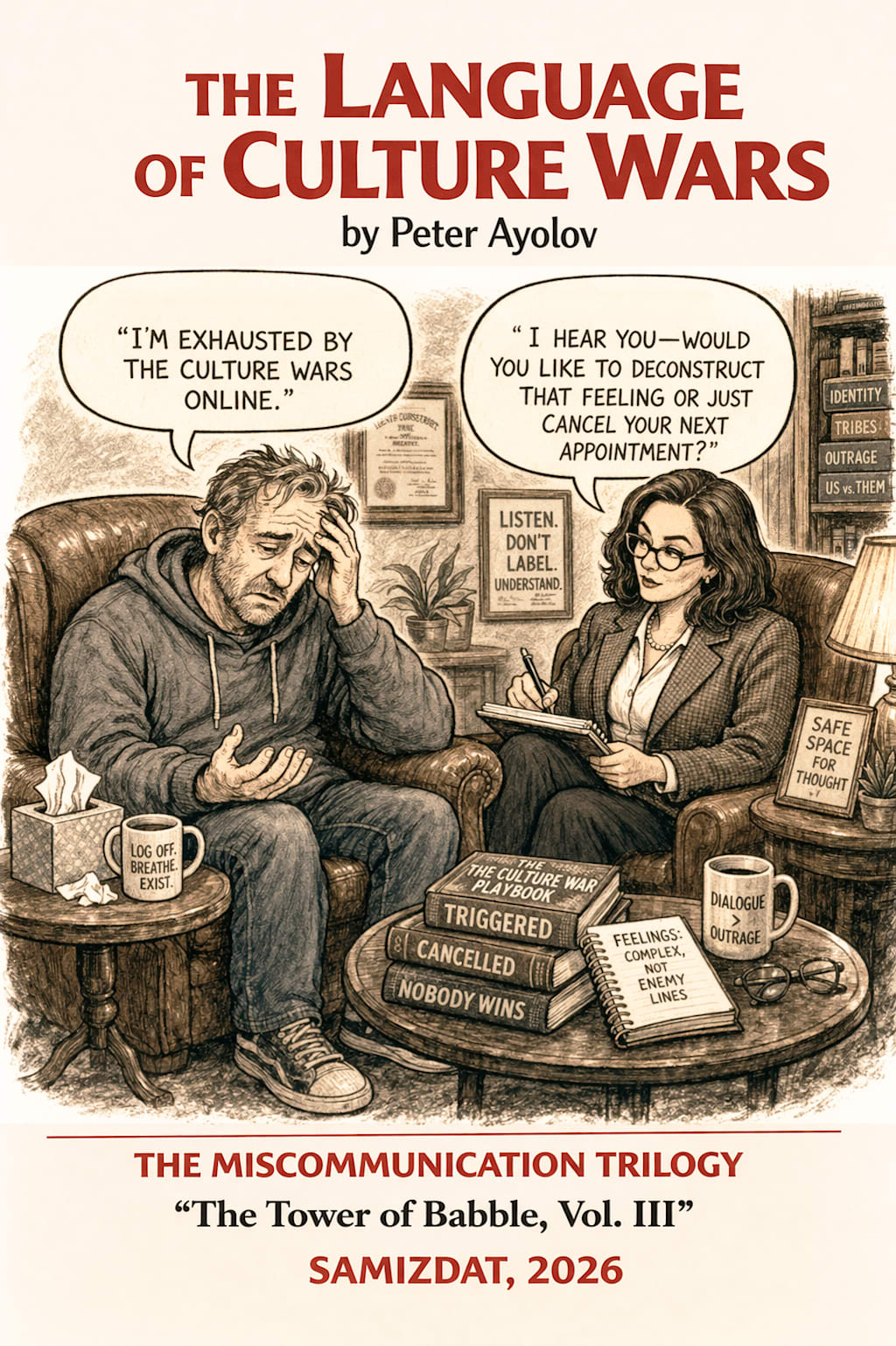
The Babel of Meanings: A Review of The Language of Culture Wars
Communication as Conflict
The Language of Culture Wars is one of the most ambitious contributions to The Tower of Babble, Vol. III and perhaps one of the most relevant examinations of contemporary public life within The Miscommunication Trilogy. While many books explore political polarization, media manipulation, ideological radicalization, or identity conflicts as separate phenomena, this volume approaches them as manifestations of a deeper process: the transformation of language from a medium of communication into a medium of conflict. The central insight of the book is deceptively simple yet profoundly important. Human societies are held together not merely by institutions, laws, economies, or technologies but by shared systems of meaning. When those systems begin to fracture, society does not merely experience disagreement; it experiences a crisis of communication itself.
The book situates contemporary culture wars within a much broader historical and anthropological framework. Rather than treating present political conflicts as temporary deviations or accidental products of social media, it argues that they represent the culmination of a long historical process in which language increasingly becomes detached from its communicative function. Words cease to serve as common references to reality and instead become markers of ideological allegiance. Public discourse gradually transforms into symbolic warfare. One of the book’s greatest strengths lies in its refusal to reduce cultural conflict to simplistic partisan explanations. The analysis consistently avoids the temptation to portray one ideological camp as uniquely responsible for polarization. Instead, it examines the structural mechanisms that generate conflict across the entire political spectrum. The result is a work that investigates the conditions under which communication itself becomes impossible. Political movements, media institutions, educational systems, activist organizations, and digital technologies all participate in the production of competing realities.
Particularly compelling is the book’s examination of how modern political disputes increasingly concern definitions rather than policies. The struggle over the meaning of concepts such as freedom, equality, justice, identity, diversity, oppression, nationhood, and democracy has become more important than the practical questions these concepts were originally intended to address. As language becomes the object of political struggle, political conflict acquires an almost theological character. Opponents are no longer merely mistaken; they are viewed as morally illegitimate. Public discourse becomes a process of symbolic purification in which competing groups seek to establish exclusive authority over meaning. The book demonstrates that culture wars are not primarily conflicts over interests but conflicts over interpretation. This distinction is crucial. Economic disputes can often be negotiated through compromise because material interests are divisible. Symbolic conflicts are more difficult because they concern moral legitimacy and collective identity. The Language of Culture Wars shows how modern societies increasingly find themselves trapped within these symbolic confrontations, where compromise appears equivalent to surrender and disagreement appears equivalent to moral failure.
What emerges from this analysis is a portrait of a civilization experiencing a crisis of shared meaning. The traditional public sphere depended upon a relatively common linguistic framework through which disagreements could be articulated. The contemporary world, by contrast, increasingly resembles a fragmented symbolic landscape where different groups employ identical vocabularies while assigning radically different meanings to them. Communication persists, yet understanding declines. The significance of this diagnosis extends beyond contemporary politics. The book suggests that the deterioration of communication represents one of the defining characteristics of modern civilization. The language of culture wars is therefore not merely a symptom of political dysfunction but a manifestation of a broader cultural transformation that affects every aspect of social life.
The Politics of Symbols and Identity
A second major achievement of the book is its exploration of the relationship between language, identity, and power. Rather than treating language as a neutral instrument, the text emphasizes its role in organizing perception. Human beings do not simply observe reality; they interpret it through conceptual categories that shape what they notice, value, and remember. Consequently, control over language becomes inseparable from control over social reality. This insight allows the author to connect diverse phenomena that are often analyzed separately. Debates about historical memory, educational curricula, media representation, political correctness, censorship, hate speech, nationalism, multiculturalism, and identity politics are revealed as expressions of a common struggle over symbolic authority. The central question in each case concerns who possesses the power to define reality and whose interpretation will become socially dominant.
The discussion of symbolic warfare is particularly effective because it avoids simplistic explanations. The book neither dismisses cultural conflicts as irrational nor celebrates them as inevitable forms of liberation. Instead, it examines how symbols acquire political significance. Words, images, historical narratives, and cultural practices become contested because they function as markers of collective identity. Every group seeks recognition through language, and every challenge to its preferred language is experienced as a challenge to its legitimacy. One of the most persuasive arguments advanced throughout the work is that contemporary polarization cannot be understood solely through economic analysis. Economic factors remain important, but they operate within symbolic frameworks that assign meaning to material conditions. Individuals respond not only to what happens but also to how what happens is interpreted. Political movements succeed when they provide compelling narratives capable of transforming social experiences into collective identities.
The book demonstrates how digital communication technologies have accelerated this process. Social media platforms have expanded opportunities for participation while simultaneously encouraging fragmentation. Individuals increasingly inhabit informational environments populated by like-minded participants who reinforce shared assumptions. This development does not merely increase disagreement; it reduces exposure to alternative interpretive frameworks. Over time, separate symbolic communities emerge, each possessing its own vocabulary, heroes, grievances, and moral certainties. The resulting polarization is not simply intellectual but emotional. Political identities become intertwined with personal identities. Debates about policy become debates about belonging. Public discourse becomes saturated with moral language because symbolic conflicts are ultimately struggles over virtue, legitimacy, and recognition. The language of culture wars therefore acquires an intensity that often appears disproportionate to the issues being discussed. Yet the book convincingly demonstrates that this intensity arises precisely because language has become the primary mechanism through which social groups define themselves.
Another noteworthy feature is the author’s treatment of ideological narratives as modern mythologies. This does not imply that they are false. Rather, it suggests that they function as interpretive frameworks that organize collective experience. Every political movement constructs stories about the past, the present, and the future. Every movement identifies heroes, victims, villains, and sources of redemption. Culture wars emerge when these competing narratives become incompatible and when no overarching symbolic framework exists to reconcile them. The analysis is particularly valuable because it situates contemporary developments within a longer historical perspective. The struggle over language is shown to be a recurring feature of human history rather than a uniquely modern phenomenon. What distinguishes the present era is the unprecedented scale, speed, and intensity with which symbolic conflicts are transmitted and amplified.
The Future of Meaning
The most important contribution of The Language of Culture Wars lies in its broader implications for understanding the future of democratic society. The book is not merely an examination of contemporary polarization. It is ultimately an investigation into the conditions necessary for communication itself. Throughout the text, a recurring theme emerges: societies can survive disagreement, but they cannot survive indefinitely without a shared framework of meaning. Democracy depends upon the existence of a common linguistic space within which conflicts can be negotiated. Citizens do not need to agree about everything, but they must possess enough common ground to understand one another. When this condition disappears, political life becomes increasingly unstable.
The author’s interpretation of the contemporary moment is therefore simultaneously critical and cautionary. The crisis affecting democratic societies is not primarily institutional but communicative. Elections, legislatures, courts, and media organizations continue to function, yet the symbolic foundations that once supported them are weakening. Public trust declines because citizens increasingly inhabit different realities. Shared narratives fragment. Consensus becomes elusive. The book’s connection to the broader theme of the planned obsolescence of language is particularly powerful. Language, which once facilitated cooperation across large populations, is increasingly subjected to forces that undermine its stability. Concepts are continually redefined, meanings become fluid, and public discourse is dominated by symbolic competition. The result is a society in which communication remains technologically abundant but socially fragile.
Yet the work avoids pessimism. Rather than presenting cultural conflict as an irreversible catastrophe, it encourages a deeper understanding of the mechanisms that generate misunderstanding. By revealing how language structures perception and how symbolic systems shape political behavior, the book offers readers a framework for interpreting contemporary events with greater clarity. Understanding does not eliminate conflict, but it reduces the likelihood that conflict will be mistaken for communication. The Language of Culture Wars succeeds because it addresses one of the most significant yet least understood developments of the twenty-first century. It combines insights from political theory, sociology, anthropology, media studies, cultural criticism, and the philosophy of language into a coherent analysis of symbolic conflict. More importantly, it treats language not as a peripheral aspect of politics but as the very terrain upon which political struggles increasingly occur.
As a contribution to The Tower of Babble, Vol. III, the book occupies a central place within the larger intellectual architecture of The Miscommunication Trilogy. It demonstrates that the crisis of modern civilization is not simply a crisis of institutions or ideologies but a crisis of communication itself. The contemporary world possesses unprecedented capacities for transmitting information, yet it struggles to maintain shared meaning. This paradox lies at the heart of the culture wars and at the center of the book’s enduring relevance. The Language of Culture Wars is therefore not merely a study of political polarization. It is an exploration of how civilizations communicate, how they misunderstand, and how they risk losing the common language upon which collective life depends. Its importance extends far beyond current controversies, offering a profound reflection on the future of communication in an age increasingly defined by the struggle for meaning.
About the Creator
Peter Ayolov
Peter Ayolov’s key contribution to media theory is the development of the "Propaganda 2.0" or the "manufacture of dissent" model, which he details in his 2024 book, The Economic Policy of Online Media: Manufacture of Dissent.
Enjoyed the story? Support the Creator.
Subscribe for free to receive all their stories in your feed.
Comments
There are no comments for this story
Be the first to respond and start the conversation.