
The Grammar of Stupidity, THE MISCOMMUNICATION TRILOGY, “The Tower Of Babble, Vol. III”, Part 11
Book Review

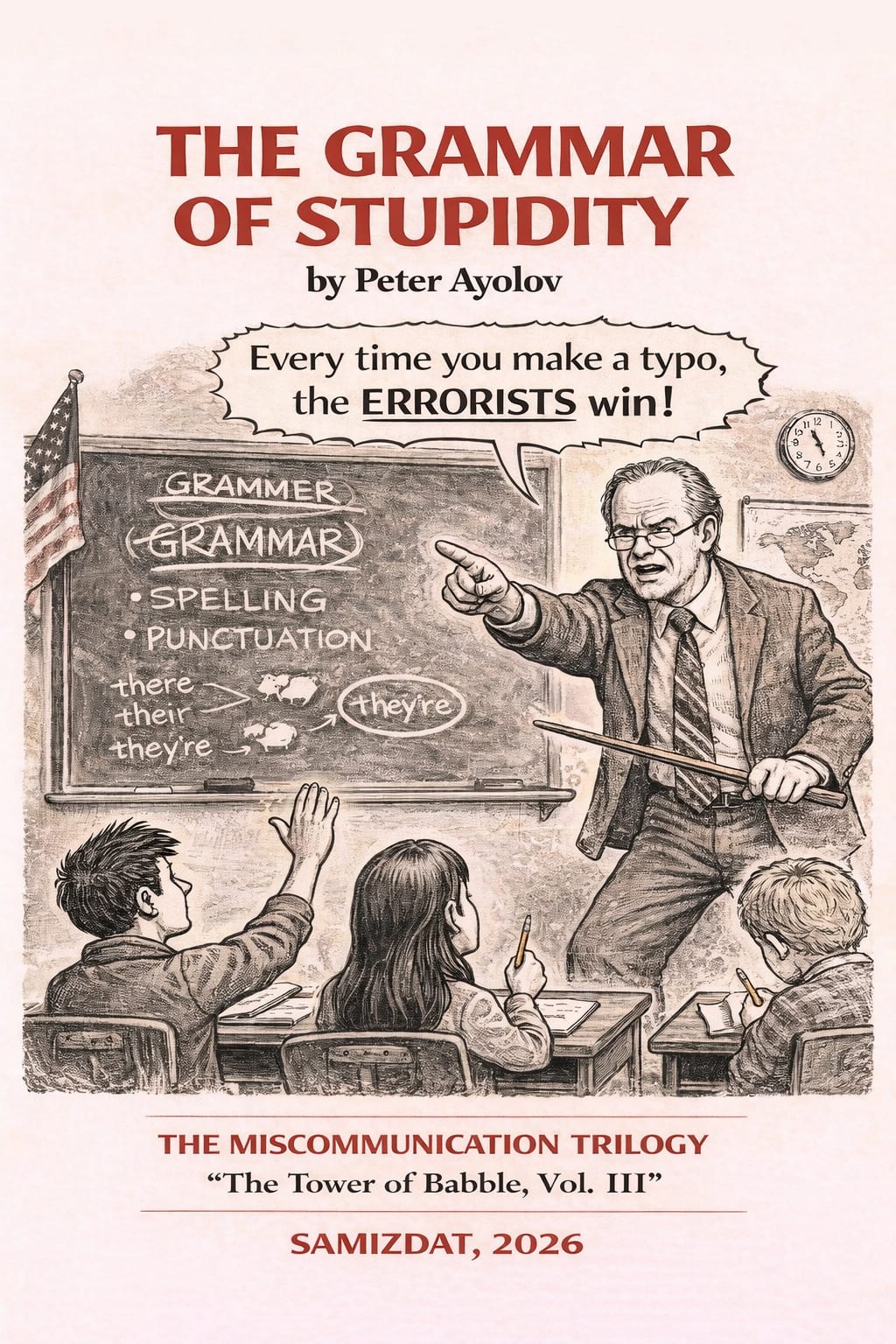
The Architecture of Folly: Language, Power and the Grammar of Human Error
Stupidity Beyond Intelligence
The Grammar of Stupidity, Part 11 of The Tower of Babble, Vol. III of The Miscommunication Trilogy, is a provocative exploration of one of the most neglected subjects in the humanities and social sciences: the relationship between intelligence, language, and human folly. Rather than treating stupidity as a simple absence of intellect, the book presents it as a complex cultural, psychological, and linguistic phenomenon that permeates every level of human existence. Drawing from philosophy, psychology, sociology, organizational studies, artificial intelligence research, and historical analysis, the volume challenges one of modern civilization’s most cherished assumptions—that greater intelligence naturally leads to wiser decisions.
The central achievement of the book lies in its ability to shift the discussion away from intelligence as a measurable quantity and toward the processes through which human beings interpret reality. Throughout the text, stupidity is portrayed not as a rare defect found only in a few unfortunate individuals but as a universal tendency embedded within the very mechanisms that allow people to navigate the world. Cognitive schemas, social identities, institutional structures, and linguistic categories all become sources of distortion that shape perception long before conscious reasoning begins. The result is a society populated by intelligent individuals who repeatedly act against their own interests while remaining convinced of their rationality. One of the most compelling themes developed throughout the volume is the distinction between intelligence and wisdom. The book systematically dismantles the belief that academic achievement, professional expertise, or high IQ automatically translate into sound judgment. Through discussions of dysrationalia, the intelligence trap, expert overconfidence, managerial incompetence, and institutional failure, it demonstrates how intelligence often becomes a tool for defending errors rather than correcting them. The smarter the individual, the more sophisticated the rationalization frequently becomes. In this regard, the work joins a growing body of scholarship questioning traditional definitions of intelligence while extending the critique into the realms of communication and culture.
The volume is especially effective in illustrating how stupidity becomes institutionalized. Bureaucracies, corporations, governments, educational systems, and even scientific communities are shown to reproduce the same maladaptive patterns that characterize individual cognition. Instead of correcting mistakes, institutions often reward conformity, suppress criticism, and protect existing power structures. What appears at first to be a collection of isolated failures gradually emerges as a coherent pattern of collective self-deception. The book therefore succeeds in transforming stupidity from a personal flaw into a structural phenomenon that shapes entire societies. Equally significant is the author’s insistence that stupidity cannot be separated from language. The categories through which people understand reality are transmitted linguistically, and language itself often becomes a mechanism for preserving obsolete assumptions. This insight connects the volume directly to the broader concerns of The Miscommunication Trilogy, where language is presented not merely as a communication tool but as a system that gradually loses its ability to describe reality accurately. In this context, stupidity becomes a linguistic phenomenon as much as a psychological one. People become trapped within vocabularies that simplify, distort, and ultimately replace direct engagement with the world. The result is a powerful critique of modern communication and the intellectual habits it encourages.
Schemas, Culture and the Production of Folly
A major strength of The Grammar of Stupidity lies in its examination of the cultural and historical foundations of human error. Rather than treating stupidity as an accidental by-product of ignorance, the book argues that it is systematically produced and reinforced through socialization, education, ideology, and institutional life. The concept of the schema serves as the theoretical backbone of this argument. Schemas are presented as adaptive cognitive structures that help individuals navigate complex environments, yet they simultaneously become obstacles to learning and adaptation when they harden into rigid belief systems. This dual nature of schemas forms one of the most intellectually productive themes in the volume. On one hand, schemas provide stability, predictability, and social cohesion. On the other, they filter information, suppress anomalies, and encourage selective perception. As a consequence, individuals frequently interpret reality not as it exists but as their schemas require it to exist. This mechanism explains why people persist in false beliefs despite overwhelming evidence and why entire cultures can maintain practices that are clearly maladaptive. The discussion successfully bridges psychological theories of cognition with broader sociological analyses of ideology and power.
The historical sections of the book further expand this argument by tracing recurring patterns of stupidity throughout Western civilization. Ancient Greece, Rome, medieval Christianity, colonial empires, modern bureaucracies, and contemporary democracies are all examined as examples of societies that gradually became trapped within their own intellectual frameworks. Particularly effective is the observation that power and stupidity often grow together. Institutions created to solve problems eventually become more concerned with preserving themselves than with adapting to changing conditions. This pattern recurs throughout history, producing cycles of stagnation, decline, and collapse. The analysis of culture is equally ambitious. Culture is described not simply as a repository of values but as a mechanism for transmitting both knowledge and error across generations. Language, ideology, religion, economics, politics, and technology all contribute to the reproduction of maladaptive beliefs. By emphasizing the role of cultural transmission, the book moves beyond individual psychology and addresses the broader processes through which stupidity becomes normalized. In this framework, institutions do not merely reflect human limitations; they actively amplify them.
Particularly noteworthy is the treatment of language as both an adaptive and maladaptive force. Language allows individuals to categorize experience, communicate knowledge, and coordinate collective action. Yet it also encourages simplification, stereotyping, and emotional manipulation. Euphemisms replace reality, slogans replace analysis, and ideological narratives replace genuine understanding. The book repeatedly demonstrates how linguistic categories shape perception and constrain thought. This insight gives the work a distinctive place within contemporary discussions of communication, media, and discourse. The volume also provides a compelling critique of modern technological society. Contrary to optimistic assumptions that technological progress automatically improves human judgment, the book argues that technological systems frequently magnify existing cognitive weaknesses. Information overload, algorithmic curation, institutional complexity, and digital communication create environments in which errors spread more rapidly than ever before. As technology increases society’s capacity to act, it does not necessarily increase its capacity to think wisely. This tension between technical sophistication and cognitive stagnation becomes one of the defining themes of the work.
The Planned Obsolescence of Language and the Future of Human Judgment
The deepest contribution of The Grammar of Stupidity emerges when it is read within the broader framework of The Miscommunication Trilogy. At this level, the volume becomes more than a study of foolishness; it becomes an examination of how language itself contributes to the persistence of human error. The trilogy’s overarching concept of the planned obsolescence of language provides a powerful interpretive lens through which the arguments of this volume gain additional significance. According to this perspective, language gradually accumulates distortions as words become detached from the realities they once described. Concepts survive long after the conditions that produced them have disappeared. Political slogans, institutional vocabularies, ideological labels, and cultural narratives continue to shape perception even when they no longer correspond to reality. As language becomes increasingly obsolete, communication ceases to facilitate understanding and instead generates confusion. Stupidity, therefore, is not merely an individual cognitive failure but a symptom of linguistic systems that no longer function effectively.
The book’s discussions of artificial intelligence, expertise, organizational failure, and collective irrationality all reinforce this broader argument. Whether examining flawed decision-making in corporations, the misuse of expert knowledge, or the dangers of algorithmic systems trained on poor data, the volume consistently returns to the problem of interpretation. Information alone is never enough. The crucial issue is how information is framed, categorized, and understood. When linguistic frameworks become detached from reality, even enormous quantities of information fail to produce wisdom. What makes the book especially valuable is its refusal to offer simplistic solutions. Rather than proposing a utopian escape from stupidity, it emphasizes the permanent tension between adaptation and rigidity, learning and certainty, intelligence and wisdom. Human beings require schemas, institutions, and language in order to function, yet these same mechanisms inevitably generate distortions. The challenge is therefore not to eliminate stupidity altogether but to recognize its sources and develop practices capable of limiting its influence.
The volume ultimately advocates intellectual humility as the most effective defense against folly. Throughout its discussions of psychologists, philosophers, scientists, and historians, it repeatedly highlights the importance of questioning assumptions, embracing uncertainty, and remaining open to alternative perspectives. These qualities are presented not as signs of weakness but as prerequisites for genuine wisdom. In a world increasingly dominated by ideological certainty, technological complexity, and institutional rigidity, such a message carries particular significance. As a contribution to contemporary discussions of communication, culture, and cognition, The Grammar of Stupidity is both ambitious and unsettling. It challenges readers to reconsider their assumptions about intelligence, expertise, progress, and rationality. More importantly, it reveals how deeply human error is embedded within the very systems designed to overcome it. The result is a thought-provoking exploration of the limits of human understanding and the enduring role of folly in shaping personal lives, institutions, and civilizations. By situating stupidity at the center of communication and culture, the book provides a compelling continuation of The Miscommunication Trilogy’s broader investigation into the planned obsolescence of language and the consequences of a world increasingly unable to distinguish between words and reality.
About the Creator
Peter Ayolov
Peter Ayolov’s key contribution to media theory is the development of the "Propaganda 2.0" or the "manufacture of dissent" model, which he details in his 2024 book, The Economic Policy of Online Media: Manufacture of Dissent.
Enjoyed the story? Support the Creator.
Subscribe for free to receive all their stories in your feed.
Comments
There are no comments for this story
Be the first to respond and start the conversation.