
The Functions of Writing, THE MISCOMMUNICATION TRILOGY "The Conspiracy of Speech, Vol. I." Part 17
Review

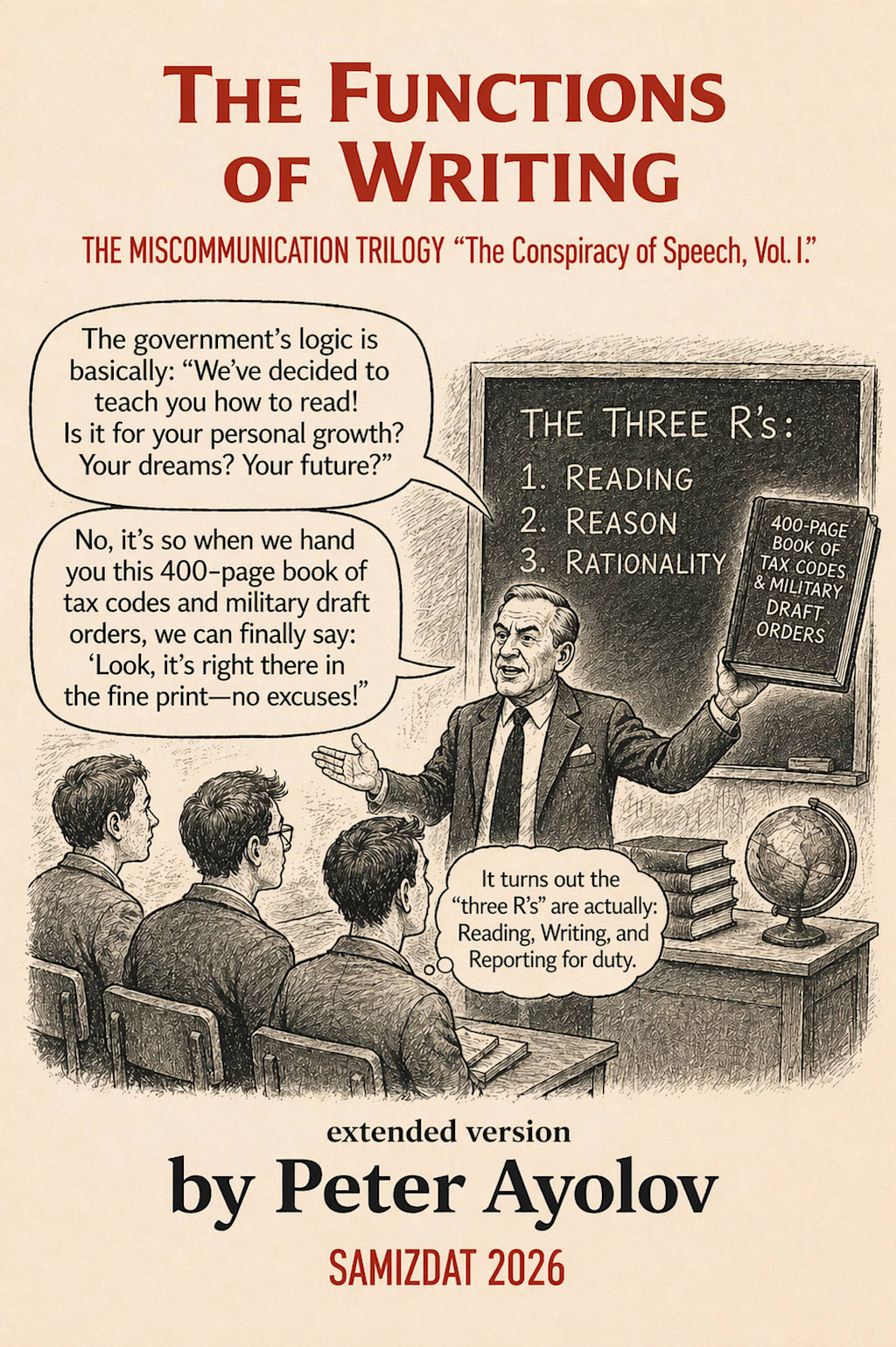
The Paradox of Preservation: A Critical Review of The Functions of Writing
This book offers a sustained and ambitious examination of writing as a central force in the evolution of human communication, cognition, and social organization. Rather than treating writing as a neutral tool for recording and transmitting meaning, it repositions it as a complex system that simultaneously stabilizes and destabilizes language. The guiding premise—that language is subject to a form of planned obsolescence—provides a unifying thread through a wide range of disciplines, including anthropology, linguistics, philosophy, psychology, and media theory. The result is a work that challenges conventional assumptions about literacy and forces the reader to reconsider what writing actually does.
One of the book’s most compelling strengths lies in its ability to synthesize diverse theoretical perspectives into a coherent argument. Drawing on figures such as Claude Lévi-Strauss, Roland Barthes, Michel Foucault, and contemporary cognitive researchers, it constructs a layered understanding of writing that moves beyond simple narratives of progress. Lévi-Strauss’s critique of writing as an instrument of social control serves as a crucial foundation, establishing the idea that writing is not inherently linked to intellectual advancement but to the organization of power. This insight is developed throughout the book, which consistently returns to the relationship between writing and hierarchy, showing how literacy has historically been tied to systems of regulation, administration, and exclusion. At the same time, the book does not reduce writing to a purely oppressive force. Instead, it emphasizes its dual nature, demonstrating how the same mechanisms that enable control also create possibilities for resistance and creativity. The discussion of grassroots literacies and digital communication is particularly effective in illustrating this point. By highlighting informal and hybrid forms of writing, the text shows that writing is not fixed but adaptable, capable of evolving beyond the constraints imposed by institutional norms. This balance between critique and recognition of possibility is one of the book’s most important contributions, preventing it from collapsing into a one-dimensional argument.
The exploration of cognition is another major strength. The book convincingly argues that writing does not merely record thought but reshapes it, introducing new patterns of organization that influence how ideas are formed and expressed. The emphasis on writing as an externalized memory is especially significant, as it reveals how literacy transforms the relationship between mind and knowledge. By shifting the burden of memory from the individual to the medium, writing allows for the accumulation of information on a scale that would otherwise be impossible. However, this shift also introduces a dependency that alters cognitive habits, encouraging linearity, categorization, and abstraction. The discussion of how digital media disrupts these patterns adds a contemporary dimension, suggesting that the cognitive effects of writing are not static but continue to evolve. The treatment of authorship provides another key dimension to the book’s argument. By engaging with the critiques of Barthes and Foucault, the text demonstrates how the figure of the author functions as a mechanism of control, anchoring meaning within a supposed origin. At the same time, it acknowledges the persistence of authorship in both critical practice and popular culture, highlighting the tension between theoretical rejection and practical reliance. This section is particularly effective in showing how the concept of the author is intertwined with broader issues of authority, ownership, and interpretation, making it clear that the question of authorship cannot be separated from the question of writing itself.
Perhaps the most original aspect of the book is its central thesis of the planned obsolescence of language. This idea reframes the entire discussion, suggesting that writing does not preserve meaning intact but sets in motion a continuous process of reinterpretation. Each text survives, but its meaning changes as it is read in new contexts. This perspective challenges the assumption that writing provides stability, revealing instead that it creates a form of structured instability. The concept is both provocative and productive, offering a new way of understanding the relationship between permanence and change in language. However, the book is not without its challenges. Its dense, philosophical style demands a high level of engagement from the reader, and its refusal to simplify complex ideas may make it difficult for those unfamiliar with the theoretical frameworks it draws upon. The integration of multiple disciplines, while a strength, can also create moments where the argument feels diffuse, as the text moves between different fields without always providing clear transitions. At times, the emphasis on paradox and complexity risks overshadowing more concrete examples, leaving the reader with an abstract understanding that could benefit from further illustration.
Another potential limitation lies in the scope of the argument. By focusing on writing as a transformative force, the book sometimes underplays the role of other factors in shaping language and communication. While this focus is necessary for the development of its central thesis, it may leave some readers wishing for a more balanced consideration of the broader context. Additionally, the critique of writing as an instrument of power, though compelling, could be further developed through more detailed engagement with specific historical and cultural cases. Despite these challenges, the book’s contributions far outweigh its limitations. Its ability to bring together insights from multiple disciplines into a unified framework is impressive, and its central argument offers a powerful rethinking of writing’s role in human life. By showing that writing is not a simple tool but a system that shapes thought, organizes power, and transforms meaning, the book opens up new avenues for understanding language and communication.
The relevance of this work is particularly evident in the context of contemporary digital culture. As writing becomes increasingly fragmented and fluid, the questions raised by the book become more urgent. The shift from stable texts to dynamic, constantly updated forms of communication challenges traditional notions of literacy and interpretation, making it essential to reconsider the functions of writing in this new environment. The book provides a framework for thinking about these changes, suggesting that the tensions it identifies are not new but intensified by technological developments. In conclusion, this is a thought-provoking and intellectually rigorous work that redefines the way we think about writing. Its exploration of writing as both a stabilizing and destabilizing force, as a tool of power and a medium of resistance, offers a nuanced and compelling perspective that is likely to resonate across disciplines. While its density may limit its accessibility, those willing to engage with its arguments will find a rich and rewarding analysis that challenges fundamental assumptions about language, meaning, and communication. The book does not provide easy answers, but it succeeds in making the problem of writing visible in a way that is both unsettling and illuminating, ensuring its place as a significant contribution to the study of language and its role in human life.
About the Creator
Peter Ayolov
Peter Ayolov’s key contribution to media theory is the development of the "Propaganda 2.0" or the "manufacture of dissent" model, which he details in his 2024 book, The Economic Policy of Online Media: Manufacture of Dissent.
Enjoyed the story? Support the Creator.
Subscribe for free to receive all their stories in your feed.
Comments
There are no comments for this story
Be the first to respond and start the conversation.