
The Fallacy of Language, THE MISCOMMUNICATION TRILOGY, “The Entropy of Communication, Vol. II”, Part 9
Book Review

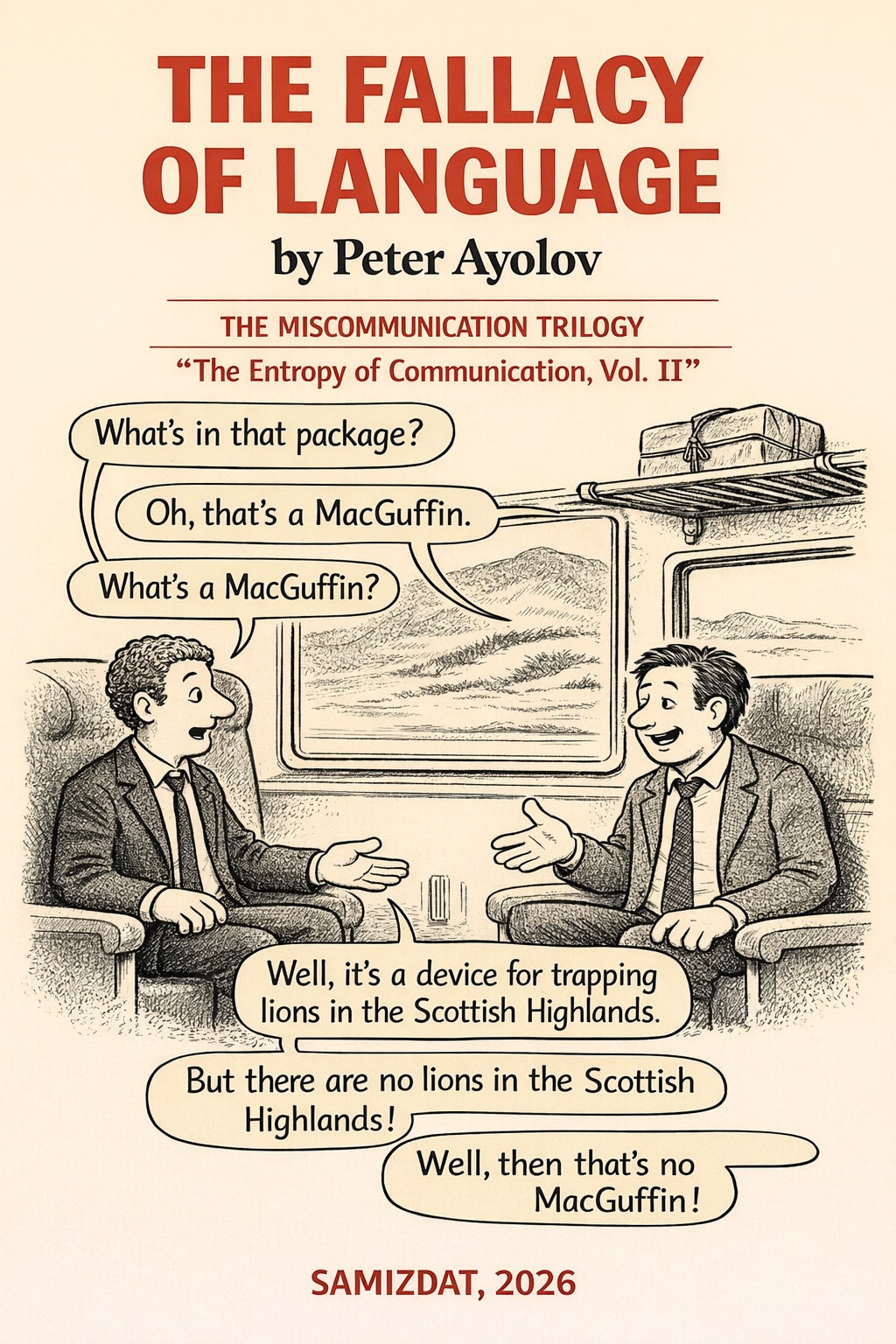
The Grammar of Fraud: Language, Deception, and the Collapse of Truth
The Fallacy of Language, Part 9 of THE MISCOMMUNICATION TRILOGY, “The Entropy of Communication, Vol. II,” is an ambitious and intellectually expansive investigation into one of the most unstable foundations of modern civilization: language itself. Moving across philosophy, linguistics, behavioral economics, fraud studies, scientific discourse, rhetoric, psychology, legal theory, and communication studies, the book argues that language is not merely a neutral instrument for describing reality but an active and deeply unstable force capable of manufacturing illusion, distortion, manipulation, and social entropy. What emerges is not simply a study of communication but a large-scale philosophical anatomy of deception in modern society. At the center of the volume lies the concept of the planned obsolescence of language. The book presents modern communication not as a system evolving toward clarity and enlightenment, but as one increasingly dominated by acceleration, symbolic overload, fragmentation, ambiguity, and institutionalized misunderstanding. Language, once imagined as the medium through which civilization preserved truth and continuity, now appears vulnerable to corruption by political rhetoric, technological mediation, commercial manipulation, scientific jargon, bureaucratic abstraction, and psychological bias. Throughout the text, the reader encounters a recurring paradox: humanity communicates more than ever before, yet genuine understanding appears increasingly fragile. One of the book’s greatest strengths is the breadth of its interdisciplinary approach. Rather than treating deception as merely a moral failing of isolated individuals, the work demonstrates how dishonesty is embedded within communicative structures themselves. Discussions of Dan Ariely’s behavioral economics research illustrate how ordinary individuals rationalize small acts of dishonesty while preserving positive self-images. The concept of the “fudge factor” becomes particularly important because it reveals that deception often operates not through dramatic criminality but through subtle self-justifications that allow people to benefit from dishonesty without consciously abandoning their sense of moral integrity. The book effectively shows how this process extends beyond individuals into institutions, corporations, governments, and even scientific communities.
Especially compelling is the way the text juxtaposes Ariely’s theories about dishonesty with later controversies surrounding his own research. The discussion of fraudulent or statistically impossible data in the famous honesty-signature experiments creates a strikingly self-referential irony. A study designed to expose dishonesty becomes itself implicated in allegations of deception and data manipulation. This episode functions as more than academic scandal; within the larger architecture of the book it becomes symbolic of a civilization increasingly unable to separate truth from performance, credibility from reputation, or evidence from persuasion. The replication crisis in science thus appears not merely as a technical problem but as part of a deeper communicative disorder affecting modern epistemology itself. The volume’s treatment of scientific language is among its most intellectually sophisticated contributions. Drawing heavily from Language as a Scientific Tool and the work of scholars such as Matthias Dörries, the text explores the historical relationship between language, scientific thought, and cultural authority. Galileo, Heinrich Kayser, and Werner Heisenberg are portrayed not simply as scientists but as linguistic actors struggling to construct conceptual systems capable of expressing radically new understandings of reality. Galileo’s literary sensibilities, Kayser’s philological treatment of spectroscopy, and Heisenberg’s philosophical reflections on the inadequacy of ordinary language in quantum mechanics all reinforce the book’s central argument: scientific discovery is inseparable from linguistic innovation. Particularly effective is the portrayal of Heisenberg’s struggle to articulate quantum mechanics through language fundamentally shaped by classical assumptions. The discussion suggests that scientific revolutions are not purely empirical events but linguistic crises in which existing vocabularies become insufficient for emerging realities. This insight resonates powerfully with the broader themes of the book. If language determines the limits of communicable thought, then every transformation in scientific understanding simultaneously destabilizes inherited systems of meaning.
The examination of English as the global language of science extends this argument into contemporary geopolitics. The analysis of linguistic dominance in scientific publishing highlights the inequalities imposed upon non-native speakers, the marginalization of alternative scientific traditions, and the gradual erosion of linguistic diversity. Here the planned obsolescence of language takes on another dimension. The increasing homogenization of scientific discourse under global English creates efficiencies of communication while simultaneously narrowing conceptual plurality. The text carefully avoids simplistic condemnation; instead, it presents the spread of English as both a practical necessity and a form of epistemic centralization with profound cultural consequences. Equally compelling is the book’s extensive engagement with fraud and legal linguistics through the work of Roger W. Shuy. These sections provide some of the most concrete demonstrations of how language operates within systems of power and deception. The detailed analyses of fraud cases reveal how meaning is rarely located in isolated words or “smoking gun” phrases but instead emerges from broader speech events, schemas, conversational strategies, and contextual structures. The text repeatedly emphasizes that ambiguity itself can become an instrument of manipulation. Terms like “commission,” “payment,” or “agreement” acquire radically different implications depending on conversational framing, hidden agendas, and institutional context. The government contract fraud case involving the Foreign Military Financing Program serves as a particularly effective illustration. The linguistic analysis demonstrates how covert agendas and ambiguous terminology can create prosecutorial narratives that collapse under close contextual examination. The book does not romanticize linguistic analysis as infallible truth-detection; instead, it presents language as inherently unstable terrain in which competing interpretations struggle for dominance. This reinforces one of the work’s central philosophical concerns: communication is never purely transparent, and meaning is always vulnerable to distortion by institutional interests and interpretive frameworks.
Another notable achievement of the volume is its exploration of fallacies not simply as logical errors but as structural features of modern communication. The book repeatedly demonstrates how rhetoric, cognitive bias, incentive systems, media framing, and institutional pressures shape perception independently of factual accuracy. The discussions of relativity effects in consumer behavior, for example, reveal how human decision-making depends less on absolute values than on comparative framing. This insight becomes emblematic of a larger civilizational problem. Modern societies increasingly operate through systems of symbolic comparison, perception management, and manufactured relativity in which truth itself becomes secondary to contextual persuasion. The philosophical implications of these arguments are substantial. Beneath its discussions of fraud, scientific terminology, behavioral psychology, and linguistic manipulation lies a broader meditation on the fragility of shared meaning in technological civilization. The book implicitly challenges Enlightenment assumptions that more communication necessarily produces more understanding. Instead, it suggests that communication systems may generate entropy as rapidly as they generate knowledge. Every expansion of symbolic production creates new possibilities for distortion, misunderstanding, strategic ambiguity, ideological manipulation, and epistemic fragmentation. Stylistically, the book adopts an expansive and cumulative approach. Rather than developing a narrow thesis through linear argumentation, it constructs a vast conceptual network connecting apparently disparate subjects into a unified reflection on communicative instability. Scientific publishing scandals, insurance fraud, philosophical linguistics, quantum mechanics, cognitive biases, rhetorical manipulation, and institutional dishonesty all become interconnected manifestations of a civilization struggling to maintain coherent systems of meaning. This breadth occasionally risks repetition, yet it also contributes to the work’s intellectual atmosphere, reinforcing the sense that communicative entropy permeates every domain of modern life.
The strongest sections are those where abstract philosophical concerns intersect with concrete examples. The stories of staged insurance frauds, fabricated peer reviews, manipulated scientific data, and ambiguous legal conversations provide tangible illustrations of how language functions within systems of deception. These examples prevent the work from becoming overly theoretical and instead ground its arguments within recognizable institutional realities. Particularly memorable is the recurring tension between intentional deception and self-deception. The book consistently suggests that many forms of dishonesty emerge not from outright malicious intent but from complex rationalizations that allow individuals and institutions to preserve positive self-images while participating in ethically compromised systems. At times, the volume conveys an almost tragic vision of modern civilization. Language appears simultaneously indispensable and unreliable: the very medium through which truth is pursued becomes the instrument through which truth is destabilized. Scientific discourse depends upon linguistic precision yet remains vulnerable to rhetoric, institutional incentives, and symbolic manipulation. Legal systems rely upon language while constantly struggling against ambiguity and interpretive conflict. Public communication expands exponentially through digital technologies even as trust, coherence, and shared understanding deteriorate.
Yet the work is not entirely pessimistic. Beneath its critique lies an implicit defense of careful analysis, contextual interpretation, and intellectual vigilance. The repeated emphasis on examining speech events, schemas, conversational structures, and rhetorical strategies suggests that communicative collapse is not inevitable. The book advocates a form of critical linguistic awareness capable of resisting simplistic interpretations and exposing hidden structures of deception. In this sense, the work functions not only as diagnosis but also as intellectual warning. The Fallacy of Language ultimately succeeds because it refuses simplistic binaries between truth and falsehood, honesty and dishonesty, or science and rhetoric. Instead, it presents communication as a dynamic and unstable field shaped by competing motivations, institutional pressures, cultural assumptions, and psychological limitations. Language emerges as both humanity’s greatest civilizational achievement and one of its most dangerous vulnerabilities. As a contribution to contemporary discussions of communication, epistemology, and cultural fragmentation, the book is remarkably timely. In an era dominated by algorithmic media systems, information overload, ideological polarization, artificial intelligence, institutional distrust, and accelerating symbolic production, its concerns feel urgent rather than abstract. The planned obsolescence of language becomes a powerful metaphor for a society in which words are continuously recycled, reframed, commodified, weaponized, and emptied of stable meaning.
The final impression left by the volume is deeply unsettling yet intellectually stimulating. It forces the reader to reconsider assumptions about communication itself. Language no longer appears as a transparent bridge between minds but as a contested territory shaped by power, perception, history, incentives, and interpretation. The book suggests that the future crisis of civilization may not arise primarily from technological failure or material scarcity, but from the gradual erosion of shared meaning itself. In this respect, The Fallacy of Language stands as one of the more philosophically ambitious installments within THE MISCOMMUNICATION TRILOGY. It transforms discussions of fraud, rhetoric, scientific terminology, and cognitive bias into a broader meditation on the instability of truth in modernity. The result is a dense, provocative, and intellectually wide-ranging work that challenges readers to confront the uncomfortable possibility that humanity’s most essential tool for understanding reality may also be the primary mechanism through which reality becomes obscured.
About the Creator
Peter Ayolov
Peter Ayolov’s key contribution to media theory is the development of the "Propaganda 2.0" or the "manufacture of dissent" model, which he details in his 2024 book, The Economic Policy of Online Media: Manufacture of Dissent.
Enjoyed the story? Support the Creator.
Subscribe for free to receive all their stories in your feed.
Comments
There are no comments for this story
Be the first to respond and start the conversation.