
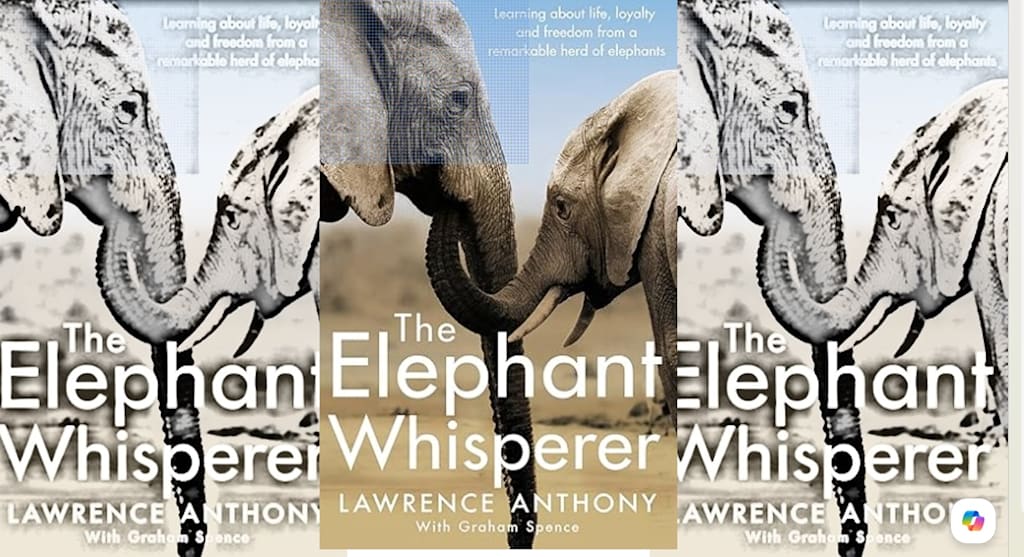
The Elephant Whisperer by Lawrence Anthony
Nothing is impossible until it's done - Nelson Mandela
I was captivated and enthralled with the book “An Elephant in My Kitchen” by Francoise Malby-Anthony that was a birthday present from Heather, my wife.
As soon as I finished reading it, far too soon as it was intended to keep me quiet for at least a month but only lasted a couple of weeks, I emailed the author at the Thula Thula Game Reserve in Zululand to say how much I had enjoyed the book.
It was while reading the book that I became aware of “The Elephant Whisperer” by her late husband, Anthony Lawrence and so did Heather.
The following morning, I had to take Heather to a local hospital. After Heather went off to her appointment I had a browse along the shelves of the charity shop in the lobby. Serendipity or what, but there in the animal section of the roughly organised shelves was “The Elephant Whisperer”.
While I was enjoying a coffee I checked my emails and there was a reply from Francoise Malby-Anthony. Amongst her words was a strong recommendation to read “The Elephant Whisperer” which I had just bought two minutes earlier and was about to start reading. In some ways I am sorry I didn’t read this book first but that has not taken away any of the pleasure I have gained from both books.
Is there a word for a double serendipity?
It was the prologue and as with “An Elephant in My Kitchen” and before I could finish the first paragraph I was captivated and enthralled. How else could a reader not be baited and hooked after reading “In 1999, I was asked to accept a herd of troubled wild elephants on my game reserve”?
Lawrence Anthony, despite having only bought five thousand acres of bush to set up a reserve in 1998, had very little choice in the matter. The alternative for the herd if they could not be homed was to be shot. That was three adult females, three youngsters (the pachyderm equivalent of British primary school children, two babies and an adolescent bull.
The bull would be weighing in with a minimum weight of two thousand kilos. That would be some critical mass to deal with at the best of times. Then add in the hormones that start coursing through the body and their associated attitudes and the result is challenging behaviour without the acne human teenagers suffer from.
After saying “Yes” to taking on the herd with all of its problems and putting the phone down the author admitted to not having a clue about the ensuing adventures, dramas, challenges, dramas and relationships with animals and people. And what rich experiences are recorded in this book that take the reader through the entire spectrum of emotions leaving the reader wanting more.
Those nine elephants with all of their emotional baggage became the foundation stock for the Thula Thula Reserve. What they did was challenge the resources of the reserve from the moment they arrived. They were desperate to get back to their homeland, despite their arrival there meaning immediate slaughter. For those of you who have ever watched “The Great Escape” these pachyderms could have given Steve McQueen, Richard Attenborough and James Garner lessons in escapology including getting through fences pulsing with eight thousand volts.
What really saved this family of rogue elephants was patience, respect and time which Lawrence gave unconditionally; collectively known as love. He concentrated on the matriarch, Nana, and once he had established a bond with her the group dynamic changed for the better and they decided to stay. That was nearly thirty years ago. Since then, the herd has expanded and yes, as at 24th May 2026 the matriarch “Nana” is still alive and as she is about sixty years old. Her role went to her daughter, Frankie, who sadly died but in the tradition of keeping things in the family her granddaughter, Marula, has assumed the mantle of responsibility.
Tales of Lawrence’s success with this herd travelled far and wide along the bush telegraph and added kudos to his sobriquet “The Elephant Whisperer”.
After the elephants arrived the reserve became home to white and black rhinos, leopards, lions; all of which were or still are on the endangered species. Along with the inclusion of each new species the author takes the reader through the emotional, physical, logistical and bureaucratic efforts that are made to get these different animals on to the reserve.
Even with high security fencing and specialist security teams poaching was then and still is one of the biggest threats to wildlife generally in Africa as well as in reserves such as Thula Thula. Nature is hard and unsentimental at the best of times but it is the stories of poaching that show the worst side of our own kind. Taking “one for the pot” is almost understandable but to take one like an elephant or an rhino just for their tusks or horns and leaving them to die in agony after being mutilated and in the presence of their young is below sub-human behaviour.
“Thula Thula” is Zulu for “peace and tranquillity”. With the development of the game reserve with its conservation work, research, hospitality, education programs and outreach work to the surrounding countryside it is more than that, it is a philosophy.
The whole book is well written and detailed but not in an overwhelming way. It made me want to keep reading and then when I got to the last page I felt like I was on the dockside watching an ocean liner carrying family members and good friends disappear over the horizon.
About the Creator
Alan Russell
When you read my words they may not be perfect but I hope they:
1. Engage you
2. Entertain you
3. At least make you smile (Omar's Diaries) or
4. Think about this crazy world we live in and
5. Never accept anything at face value
Enjoyed the story? Support the Creator.
Subscribe for free to receive all their stories in your feed.
Comments
There are no comments for this story
Be the first to respond and start the conversation.