
The Doublespeak Dilemma, THE MISCOMMUNICATION TRILOGY, “The Entropy of Communication, Vol. II”, Part 10
Book Review

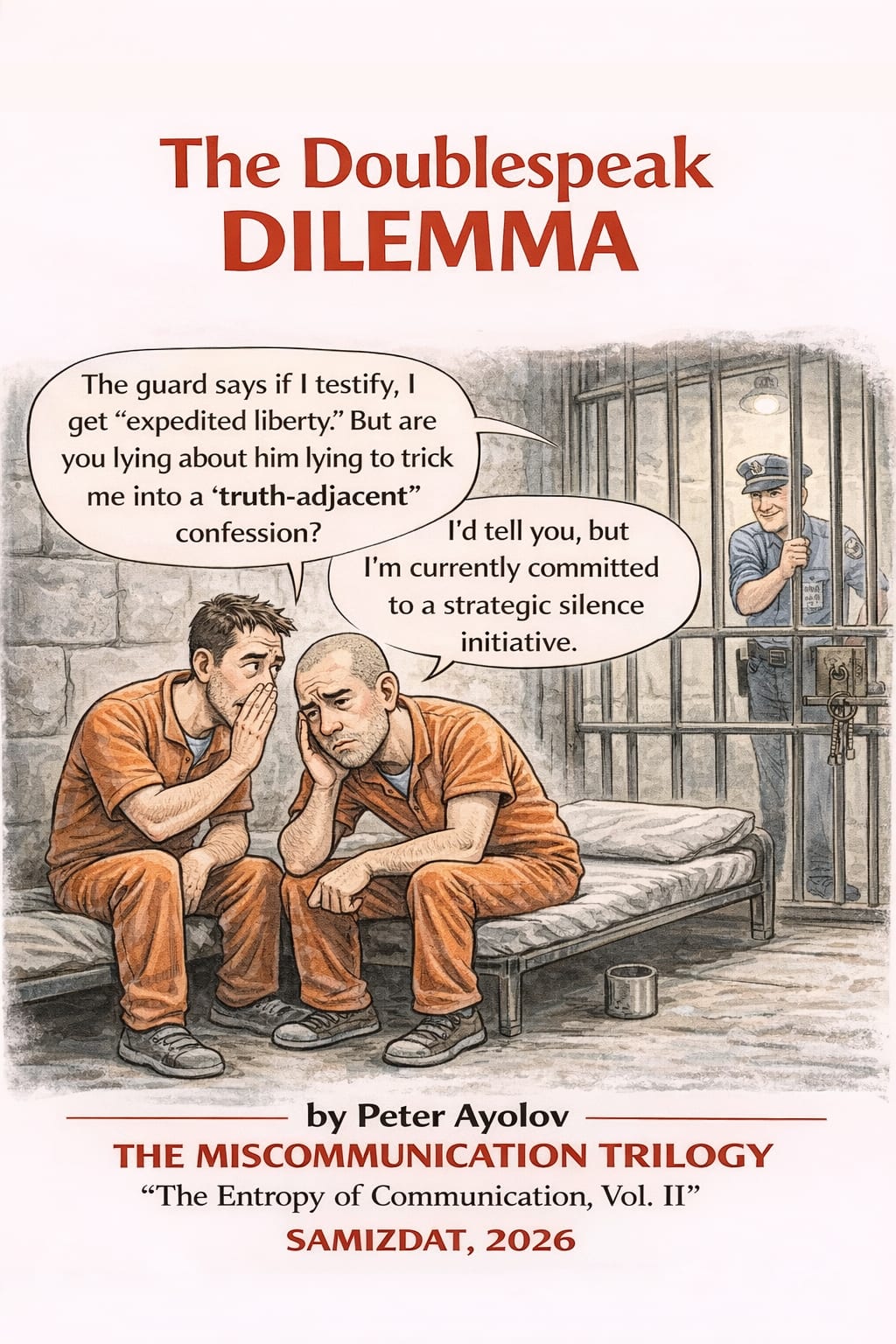
The Machinery of Deception: Language, Power, and the Collapse of Meaning
The Architecture of Linguistic Manipulation
The Doublespeak Dilemma stands as one of the most ambitious and intellectually provocative examinations of language and power within contemporary philosophical and cultural criticism. As part of THE MISCOMMUNICATION TRILOGY, “The Entropy of Communication, Vol. II”, the book explores not merely the existence of propaganda or deceptive rhetoric but the deeper structural crisis affecting communication itself. The central argument running through the work is that modern civilization is experiencing the planned obsolescence of language—a gradual deterioration of meaning caused by political manipulation, technological mediation, ideological framing, bureaucratic abstraction, and mass media saturation. What makes this volume particularly compelling is its refusal to reduce doublespeak to a narrow political issue. Instead, the book presents linguistic manipulation as a foundational condition of modern existence. Words are no longer treated as neutral tools for describing reality but as strategic instruments designed to shape emotional reactions, manufacture consent, soften violence, intensify hostility, and reorganize collective perception. Throughout the text, language emerges as both civilization’s greatest achievement and its most dangerous weapon. The work moves fluently through an impressive range of intellectual territories. Political rhetoric, discourse analysis, general semantics, conceptual metaphor theory, psychology, philosophy, jurisprudence, media studies, and communication theory are woven together into a broad interdisciplinary investigation. References to Orwell, Churchill, Korzybski, Goffman, Lakoff, Leech, and numerous other theorists and rhetoricians create a dense intellectual framework without overwhelming the reader. Rather than functioning as disconnected academic references, these thinkers become part of a coherent philosophical narrative about the instability of meaning in the modern world.
One of the strongest aspects of the book is its ability to reveal how ordinary vocabulary conceals systems of power. Euphemisms such as “collateral damage,” “public diplomacy,” “community standards,” and “surgical strike” are examined not merely as linguistic curiosities but as mechanisms of psychological conditioning. The text repeatedly demonstrates that naming determines emotional perception long before rational judgment occurs. Military invasions become humanitarian interventions, censorship becomes safety, and political coercion becomes protection. The manipulation of language is shown to be inseparable from the manipulation of consciousness itself. Particularly effective is the book’s analysis of Unspeak and modern political rhetoric. The discussions of terms like “anti-social behaviour,” “climate change,” “weapons of mass destruction,” and “faith community” expose how public language increasingly embeds ideological assumptions within apparently neutral terminology. The author convincingly demonstrates that political power now operates less through overt repression than through symbolic framing. Control over vocabulary becomes control over emotional and moral interpretation. The volume’s treatment of euphemism and dysphemism is equally sophisticated. Rather than presenting these concepts as simple opposites, the text explores how both function strategically within systems of persuasion. Euphemism softens reality through abstraction and sanitization, while dysphemism intensifies hostility through symbolic demonization. Churchill’s wartime speeches serve as a particularly fascinating case study. His rhetoric is analyzed not merely as patriotic oratory but as a deliberate system of moral polarization where enemies become animals, darkness, criminals, and monsters. Through such analysis, the book reveals how political language constructs emotional universes in which violence becomes morally justified. Another major strength lies in the philosophical depth underlying the work. The repeated engagement with general semantics and the distinction between language and reality provides the book with intellectual coherence beyond ordinary political commentary. The influence of Korzybski’s principle that “the map is not the territory” echoes throughout the volume. Human beings repeatedly confuse symbolic systems with concrete reality, reacting emotionally to words, labels, and abstractions rather than to lived experience itself. This insight transforms the book from a study of rhetoric into a broader meditation on consciousness and civilization.
The Entropy of Communication
What distinguishes The Doublespeak Dilemma from many contemporary works on propaganda or media manipulation is its insistence that the crisis of communication extends far beyond institutional dishonesty. The book argues that doublespeak has become embedded within everyday social existence. Individuals increasingly communicate strategically rather than sincerely, shaping language according to systems of social approval, ideological conformity, and digital visibility. This argument becomes especially powerful in the sections dealing with technology and social media. The text presents digital communication not as a neutral expansion of human expression but as a force actively reshaping language itself. Social platforms reward emotional immediacy, simplification, outrage, and symbolic performance rather than reflection or conceptual precision. Communication fragments into slogans, hashtags, coded references, and algorithmically optimized speech patterns. The analysis of technological influence on language is one of the most contemporary and intellectually urgent aspects of the book. The discussion of how individuals alter vocabulary to evade moderation systems reveals a subtle but important transformation in modern communication. Language begins adapting itself not to truth or clarity but to algorithmic survival. Speech mutates under invisible systems of technological governance, producing forms of indirectness and symbolic substitution reminiscent of communication patterns associated with authoritarian censorship. The author’s concept of the planned obsolescence of language provides the theoretical center of the entire work. Borrowing the economic idea of products deliberately designed to become outdated, the book argues that modern communication systems gradually destabilize meaning itself. Words become disposable, continuously repurposed according to ideological fashion, media cycles, and technological pressure. Terms that once possessed moral or intellectual clarity dissolve into vague emotional signals manipulated according to circumstance. This argument carries enormous philosophical implications. If language loses stability, then truth itself becomes increasingly difficult to preserve because truth depends upon some continuity between words and reality. The book repeatedly returns to this concern: a civilization unable to trust language eventually loses the capacity for coherent dialogue, historical memory, and shared moral understanding.
The sections dealing with harmful speech and verbal aggression deepen this analysis by demonstrating how language participates in systems of social power. The discussion of racist speech reveals that words wound not merely because of literal content but because they operate within histories of exclusion, humiliation, and symbolic domination. Particularly insightful is the distinction between direct and indirect hostility. The book persuasively argues that subtle, indirect forms of aggression may inflict deeper psychological harm precisely because they remain socially ambiguous and therefore difficult to confront publicly. Equally important is the text’s refusal to adopt simplistic solutions. Although the work sharply criticizes propaganda, manipulation, and ideological abstraction, it avoids naïve fantasies about perfectly transparent communication. The author repeatedly acknowledges that language has always involved ambiguity, framing, and strategic presentation. Human beings cannot exist socially without some degree of symbolic mediation. The dilemma therefore lies not in the mere existence of rhetorical manipulation but in the industrialization and amplification of linguistic distortion within modern technological civilization. The philosophical maturity of the work becomes especially visible here. Rather than imagining a return to some lost age of honest speech, the book recognizes doublespeak as a permanent tension within communication itself. Every act of speech simultaneously reveals and conceals. Human beings constantly negotiate between sincerity and diplomacy, truth and strategy, clarity and social survival. The modern crisis emerges because institutional systems have magnified the manipulative dimension of language while weakening traditional structures capable of preserving semantic stability.
Language at the Edge of Collapse
The most unsettling aspect of The Doublespeak Dilemma lies in its portrayal of civilization approaching a condition where communication itself begins collapsing under the weight of manipulation and abstraction. The book presents modern society as increasingly trapped within symbolic systems detached from concrete experience. Human beings no longer encounter reality directly but through prearranged narratives, ideological vocabularies, media framings, and emotional scripts. This condition generates a pervasive atmosphere of distrust and cynicism. Public discourse becomes performative rather than exploratory. Political speeches, corporate statements, journalistic narratives, and institutional declarations are approached with suspicion because individuals instinctively recognize that language increasingly functions strategically rather than descriptively. Communication ceases to create understanding and instead becomes psychological positioning within ideological systems. The author’s treatment of this semantic exhaustion is among the strongest elements of the entire volume. The text repeatedly evokes the image of a civilization drowning in speech while starving for meaning. Information multiplies endlessly, yet understanding diminishes. Words circulate constantly across screens and institutions, but their connection to lived reality weakens progressively. The result is not silence in the traditional sense but a deeper silence hidden beneath overwhelming rhetorical noise—a silence produced when language itself loses credibility. The writing style reinforces these themes effectively. The prose is dense, philosophical, and often deliberately relentless, mirroring the conceptual overload characteristic of contemporary communication systems. Yet despite its intellectual intensity, the text remains surprisingly readable because of its strong thematic cohesion. Examples drawn from politics, military rhetoric, media discourse, and everyday language continually anchor abstract philosophical discussions within recognizable realities. At times, the book’s scope becomes almost overwhelming. The sheer number of interconnected subjects—propaganda, semantics, racism, euphemism, warfare, political rhetoric, technology, ideology, and philosophy—creates an atmosphere of intellectual saturation. Yet this excess may itself reflect the condition the book seeks to describe: a civilization overwhelmed by symbolic complexity and informational fragmentation.
The work’s strongest achievement ultimately lies in its ability to transform language from a passive background medium into the central battlefield of modern civilization. Communication is no longer presented as a secondary cultural phenomenon but as the infrastructure through which power, morality, identity, and reality itself are negotiated. The corruption of language becomes inseparable from the corruption of political and social life. Importantly, the book does not end in total despair. Beneath its dark analysis lies a persistent belief that language still possesses the capacity to preserve truth when used carefully, reflectively, and responsibly. Philosophy, literature, historical memory, and honest dialogue appear as forms of resistance against semantic collapse. The exposure of doublespeak weakens its invisibility. Critical awareness restores some distance between words and the realities they attempt to shape. This tension between warning and possibility gives the work much of its emotional force. The Doublespeak Dilemma is not merely an academic exploration of rhetoric; it is a philosophical warning about the future of consciousness within societies increasingly governed by symbolic manipulation. The book suggests that once words lose stable meaning, human beings risk losing the ability not only to understand one another but to understand themselves. In the end, The Doublespeak Dilemma emerges as an intellectually ambitious and deeply unsettling examination of modern communication. It challenges readers to reconsider the hidden structures embedded within ordinary language and to recognize how power increasingly operates through vocabulary itself. Dense, provocative, and philosophically expansive, the book stands as a major contribution to contemporary reflections on propaganda, semantics, technology, and the fragile relationship between language and truth.
More than a study of doublespeak, it is a meditation on civilization at the edge of semantic exhaustion—a world where communication expands endlessly while meaning slowly disappears beneath the machinery of persuasion.
About the Creator
Peter Ayolov
Peter Ayolov’s key contribution to media theory is the development of the "Propaganda 2.0" or the "manufacture of dissent" model, which he details in his 2024 book, The Economic Policy of Online Media: Manufacture of Dissent.
Enjoyed the story? Support the Creator.
Subscribe for free to receive all their stories in your feed.
Comments
There are no comments for this story
Be the first to respond and start the conversation.