
The Customer Is Always Right.
The Pantomime of the Skull-Devouring Mannequins

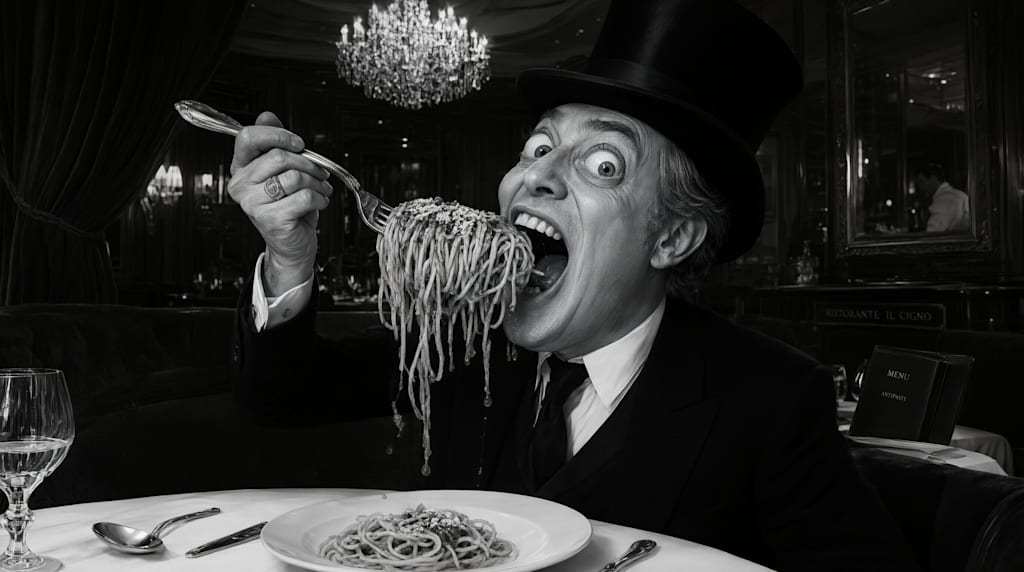
We have grown so accustomed to the restaurant, to the feverish, by now almost weekday, habitual ritual of “eating out,” that when we sit down at our glorious table we forget who is starving a few yards away. We fail to realize that the restaurant trade today performs the very function once reserved for the banquets in the palaces of the lords. The bourgeois little theatre of the luxury restaurant is born at table with Don Rodrigo, over whom hover the semi-spectral shades of Charlemagne and Arthur, where the dish is mere ostentation of status and the serving man a piece of the furnishings. Literature noticed long ago; it is we who have laid a delicious slice of San Daniele ham over our eyes so as not to see the privilege we are unwilling to give up.
Carlo Emilio Gadda mocked the bourgeois lunch more than once, in the lavish restaurants of the postwar years, with waiters in white gloves, tightly buttoned patrons, professors, critics and opulent ladies. There the customer paid not so much (what a banality!) to feed his body like a battery hen as to gratify his longing to be treated as one of those who-really-count, by unctuous waiters wagging their tails around the chair-backs of their respective tables. What, then, does etiquette prescribe: is it better to eat in silence, or rather to converse, quarrel, philosophize, flirt, while the staff behind the screen curse and damn this or that customer?
The bourgeois lunch in the starred restaurant is an aristocratic charade, in which the diners play at being lordlings and the waiters wear a tailcoat with no shirt underneath: surface, appearance. Gadda calls them “osso buco–devouring mannequins.” It is a deeply learned satire with precedents in Parini, who already in the century of the Enlightenment made sport of gastronomic luxury through the disenchanted gaze of the tutor who, praising in words the habits of the young nobleman, exposes the perfect uselessness of the ritual. It is a ceremonial of idleness in which mythological figures sit around the table as masks in a filthy pantomime: one lady parading her vegetarianism and her sensitivity to animals, another lamenting some offence or other to her “virgin lapdog,” and no pity for the waiter bitten by the thoroughly spoiled beast.
And what of that swaggering lout Don Rodrigo, whose faithful bootlickers sit and eat with their heads bowed, never protesting, smiling and approving whatever he says, well aware that their personality counts for nothing at the host’s table, where all that matters is that his own be magnified? They talk of chivalry, politics and famine as one might talk today of Bologna FC, of Kimi Antonelli or of Yannick Sinner, while Manzoni’s doctor praises the tyrant’s wine and the banquets at his palace that outdo the suppers of Elagabalus, and outside the people storm the bakeries (the shop windows! the shop windows!).
Where lies the difference between the aristocrats of Manzoni or Parini and that debt-ridden glutton Balzac, who in his tales speaks precisely of a social dependence on refined dining, an indescribable tyranny of the palate that he himself must have known well? The fallen, disgusting parasite Pons would rather give up his dignity than the excellent dinners to which he had been accustomed before his decline. In Parisian restaurants and cafés clandestine couples meet to enjoy their parallel lives (so much for Plutarch!), where the price of the dishes swells precisely because of this licitness of pleasure, this craving to display one’s status, on the backs of slaves who die beneath the sun on the colonial plantations. Dinah de la Baudraye meets her lover in a cabinet particulier and is astonished that he should go so far as to pay five francs for a sole Normande and twenty centimes for a dish of peas. How about that, what strange things life holds!
The delicatessen of Quenu and Lisa described by Zola is fitted out with marble, mirrors, gilding, a great chandelier. The shop, banally a seller of cured meats, aspires to be a temple of the cornucopia, with its polished surfaces and its meats displayed in a light and a play of reflections that multiply their appearance to infinity for the customer. The whole neighbourhood (those who can afford it) goes on pilgrimage to that sanctuary to show itself among the elite of good society, until, when business worsens, the shop itself seems to fall ill with the most shameful of maladies, poverty: the meats lose their freshness, the marble turns cold, sepulchral, the look of the wares inspires melancholy.
Maupassant’s Bel Ami stages a private dining room at the exclusive Café Riche, with fine silverware, candelabra, Ostend oysters, trout, lamb cutlets, champagne and foie gras, describing the luxury of the table with an almost erotic sensuality, a sort of Marinettian food porn that seems to anticipate the luncheons of the Marchesa d’Ateleta in D’Annunzio’s Il Piacere, with her porcelain, her crystal, her flowers and candelabra, her Watteau-style decorations. Whoever offers the meal displays a subtle power over the guest. How could one not think of the bottle of the worst possible port, at the most brazen possible price, that Pickwick and Magnus order at the inn in Dickens’s masterpiece?
From Parini to Gadda, by way of Manzoni, Balzac, Zola, Maupassant and Dickens, the bourgeois lunch in the fashionable establishment thus reveals itself as a theatre in miniature, where each plays his part under the direction of an invisible puppeteer: the master, the customer, the parasite, the guest, the servant, the lover. The eternal, grotesque comedy of power.
About the Creator
Federico Berti
Writer, composer, actor. Internationally known as a performer, one‑man band, and audiobook narrator. Expert in the art of memory.
Enjoyed the story? Support the Creator.
Subscribe for free to receive all their stories in your feed.
Comments
There are no comments for this story
Be the first to respond and start the conversation.