
The Consent Of The Persuaded, THE MISCOMMUNICATION TRILOGY, “The Tower Of Babble, Vol. III”, Part 9
Book Review

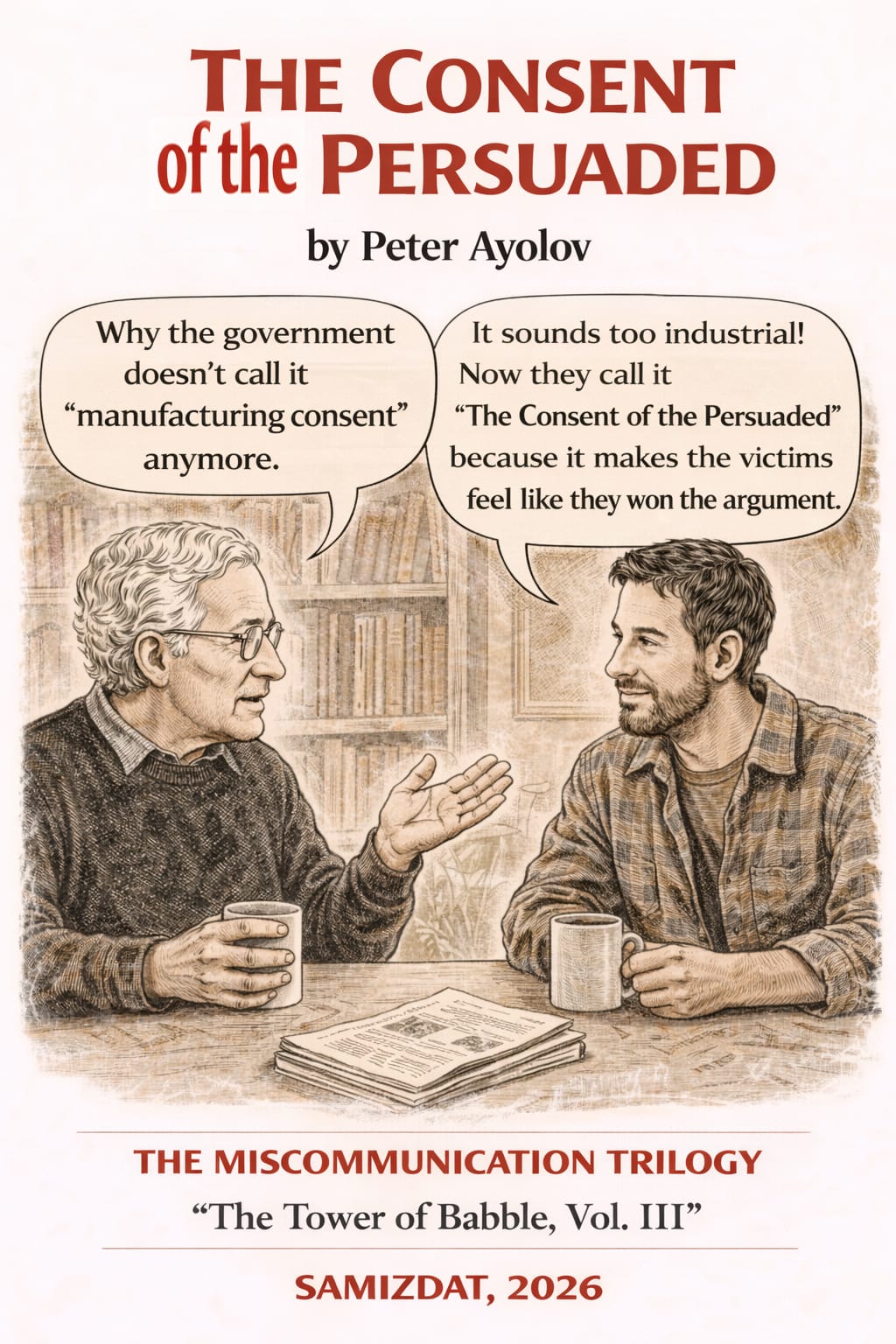
The Manufacture of Agreement: A Review of The Consent of the Persuaded
Language, Power, and the Architecture of Consent
The Consent of the Persuaded stands as one of the most ambitious and intellectually provocative contributions to The Tower of Babble, Vol. III. Situated within the broader framework of The Miscommunication Trilogy, the book extends the trilogy’s central investigation into the planned obsolescence of language by focusing on one of the most consequential questions of modern civilization: how consent is produced. Rather than accepting conventional democratic assumptions that consent emerges naturally from free individuals making rational choices, the volume asks how beliefs, loyalties, opinions, and public attitudes are formed within environments saturated by institutions, media systems, educational structures, ideological narratives, and cultural expectations. What immediately distinguishes this work is its interdisciplinary breadth. Drawing upon political philosophy, social theory, organizational studies, educational theory, social movement research, media criticism, and historical analysis, the book presents a remarkably comprehensive examination of the relationship between communication and power. The central argument is both simple and unsettling. Modern societies no longer depend primarily upon visible coercion. Instead, they increasingly rely upon the management of perception. Citizens participate willingly in systems of authority because the language through which they understand reality has already shaped the boundaries of acceptable thought.
Throughout the volume, language is treated not merely as a neutral instrument of communication but as a battlefield where legitimacy is constructed and contested. Political systems, corporations, educational institutions, and cultural organizations all compete to define meanings. Terms such as democracy, freedom, security, justice, equality, progress, and tolerance are shown to function not simply as descriptions but as persuasive symbols. Whoever controls the interpretation of these symbols acquires considerable influence over public understanding. The book’s discussion of Herbert Marcuse’s critique of one-dimensional thought is particularly effective in establishing the philosophical foundation of its argument. Marcuse’s concerns about technological rationality and the reduction of critical thought are skillfully connected to contemporary conditions. The volume demonstrates how modern discourse often eliminates contradiction by narrowing the range of acceptable interpretations. What appears as openness frequently conceals subtle forms of intellectual closure. Citizens are encouraged to debate issues, but only within conceptual frameworks established by institutions that benefit from maintaining existing arrangements.
Perhaps the greatest strength of this section lies in its refusal to reduce social life to simple conspiratorial explanations. The author does not suggest that consent is manufactured through centralized manipulation alone. Rather, persuasion emerges through a complex interaction of culture, technology, institutions, habits, economic incentives, and social expectations. This nuanced approach elevates the work beyond conventional political criticism and transforms it into a sophisticated philosophical inquiry into the nature of belief itself. The result is a compelling exploration of how language becomes both the medium of communication and the instrument through which authority secures legitimacy.
Dissent as the Last Refuge of Democratic Life
One of the most powerful aspects of The Consent of the Persuaded is its sustained defense of dissent. Throughout the volume, dissent is presented not as a disruption of democracy but as one of its essential conditions. Drawing upon an impressive range of sources—from Gene Sharp’s analysis of nonviolent resistance to studies of educational discourse, organizational ethics, protest movements, and intellectual history—the book constructs a persuasive argument that democratic vitality depends upon disagreement. The treatment of nonviolent action is especially noteworthy. Through the examination of Gene Sharp’s theories, the book reveals that power ultimately rests upon cooperation. Governments, institutions, and organizations remain functional because individuals continue to obey, participate, and comply. Nonviolent resistance becomes significant because it exposes this dependency. By withdrawing cooperation, ordinary individuals reveal the fragility of systems that appear invulnerable. The discussion of preparation, leadership, openness, strategic planning, and moral courage illustrates how dissent can challenge authority without reproducing the destructive logic of violence.
Equally compelling is the book’s exploration of protest as a cultural and moral phenomenon. Drawing extensively from James Jasper’s work, the text moves beyond simplistic interpretations of protest as merely a struggle over resources or political interests. Protest is presented as an act of imagination. It allows individuals and communities to articulate alternative visions of reality, challenge prevailing assumptions, and expand the boundaries of public discourse. In this framework, protest resembles artistic creation as much as political activity. Both involve the redefinition of meaning and the invention of new possibilities. The volume’s analysis of educational institutions further strengthens its argument. The discussion of civic understanding demonstrates how authentic democracy depends upon environments where disagreement is encouraged rather than suppressed. The classroom becomes a microcosm of democratic society itself. When students learn to engage respectfully with conflicting perspectives, they acquire habits of critical reflection essential for responsible citizenship. Conversely, when dissent is discouraged in the name of order, efficiency, or consensus, democratic capacities gradually erode.
The examination of organizational dissent provides another important contribution. The book highlights how institutions frequently celebrate innovation while simultaneously punishing criticism. Organizations that suppress principled dissent may achieve short-term stability, but they often sacrifice long-term adaptability and ethical integrity. Dissenters emerge as individuals who preserve organizational health by exposing hidden problems, challenging complacency, and defending moral standards against bureaucratic conformity. Perhaps the most emotionally powerful sections involve the discussion of intellectual dissent. The examination of Orwell, Hitchens, and the politics of exclusion illustrates the dangers that arise when defenders of free thought become gatekeepers of acceptable opinion. The volume demonstrates how dissent can be betrayed when criticism is transformed into a mechanism for enforcing orthodoxy. This insight reinforces the book’s broader argument that freedom requires more than the formal right to speak. It requires social conditions in which alternative perspectives can genuinely be heard.
The Planned Obsolescence of Language and the Future of Freedom
As part of The Miscommunication Trilogy, The Consent of the Persuaded contributes significantly to the overarching thesis concerning the planned obsolescence of language. This concept serves as the unifying framework that connects the volume’s diverse subjects. The argument is not that language is disappearing but that its communicative function is gradually being displaced by its persuasive function. Words increasingly serve strategic, managerial, ideological, and promotional purposes rather than facilitating genuine understanding. The book presents a society in which communication becomes saturated with competing attempts to shape perception. Political campaigns become exercises in branding. News becomes narrative management. Education becomes social conditioning. Corporate communication becomes reputation control. Public discourse increasingly prioritizes emotional impact over intellectual clarity. In such conditions, language risks losing its capacity to function as a shared medium for discovering truth.
What makes this argument especially compelling is the author’s ability to connect large-scale social transformations with everyday experiences. The planned obsolescence of language is not presented as an abstract theoretical concept but as a lived reality. Citizens encounter it through political slogans, media narratives, institutional jargon, organizational speech, and cultural rituals that gradually narrow the space available for critical reflection. The consequence is a society in which individuals often mistake familiarity for truth and consensus for legitimacy. Yet despite its critical tone, the book avoids pessimism. The concluding vision remains fundamentally humanistic. Throughout the volume, dissent, protest, education, dialogue, and intellectual courage appear as forces capable of resisting the reduction of language to mere persuasion. The possibility of renewal remains open because human beings retain the capacity to question, imagine, create, and communicate differently.
The Consent of the Persuaded ultimately succeeds because it combines philosophical depth with political relevance. It challenges readers to examine assumptions they may never have consciously questioned. It reveals how authority increasingly depends upon communication and how communication increasingly shapes authority. Most importantly, it reminds us that freedom is not simply a political condition but an intellectual practice requiring constant vigilance. As a contribution to The Tower of Babble, Vol. III, this volume stands as a powerful meditation on the relationship between language, power, and belief. It transforms familiar discussions of democracy, protest, and dissent into a broader reflection on the fate of communication itself. In an age increasingly dominated by persuasion, information management, and symbolic control, The Consent of the Persuaded offers an important reminder that genuine understanding remains both the foundation of freedom and the most effective antidote to manipulation. The result is a thoughtful, challenging, and highly relevant work that deepens the trilogy’s exploration of how language shapes civilization and how its gradual corruption threatens the very possibility of democratic life.
About the Creator
Peter Ayolov
Peter Ayolov’s key contribution to media theory is the development of the "Propaganda 2.0" or the "manufacture of dissent" model, which he details in his 2024 book, The Economic Policy of Online Media: Manufacture of Dissent.
Enjoyed the story? Support the Creator.
Subscribe for free to receive all their stories in your feed.
Comments
There are no comments for this story
Be the first to respond and start the conversation.