
The Collapsus of Meaning, THE MISCOMMUNICATION TRILOGY, “The Entropy of Communication, Vol. II”, Part 11
Book Review

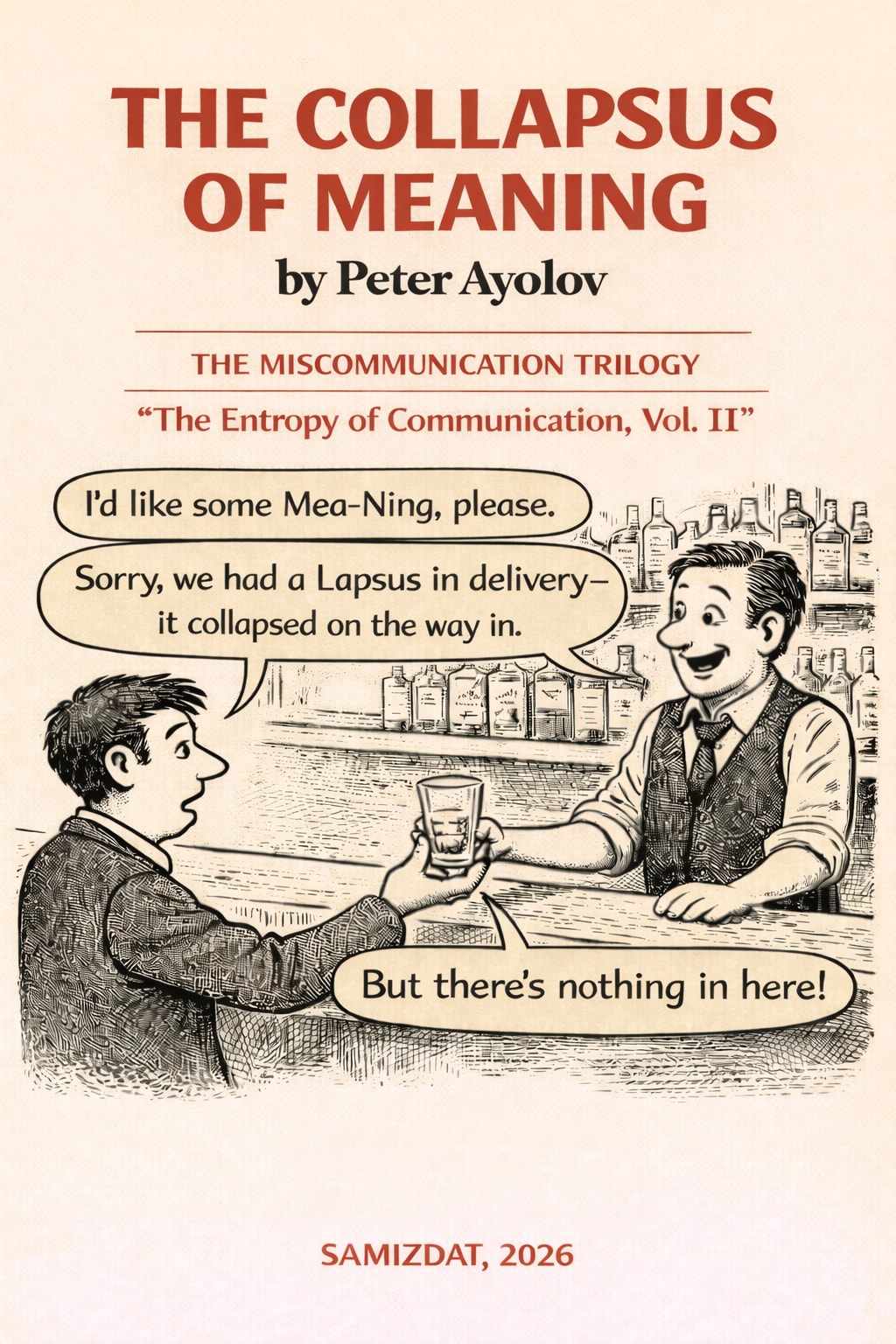
The Collapse of Truth – A Review of The Collapsus of Meaning
Part I: The Funeral of Shared Reality
The Collapsus of Meaning, Part 11 of THE MISCOMMUNICATION TRILOGY: The Entropy of Communication, Vol. II, is not simply a critique of media culture or a commentary on misinformation. It is a philosophical autopsy of modern communication itself. The book explores the growing inability of contemporary societies to maintain stable meaning, shared truth, or coherent public discourse in a digital civilization overwhelmed by information, ideology, and algorithmic mediation. At its center lies the concept of the Planned Obsolescence of Language: the idea that modern systems of communication no longer preserve meaning but continuously exhaust and replace it in order to maintain political, economic, and technological power.
The book opens with the recognition that the crisis of the twenty-first century is not merely political or technological but symbolic. Human societies depend on common linguistic structures in order to preserve cooperation, memory, morality, and collective identity. Once these structures become unstable, all institutions begin to fragment. The author argues that the Internet age has accelerated this instability to unprecedented levels. Communication technologies have multiplied human interaction while simultaneously eroding the very possibility of mutual understanding. Every event now generates competing realities, ideological reinterpretations, emotional reactions, and algorithmically amplified distortions before any stable interpretation can emerge.
What makes the book especially compelling is its refusal to simplify the problem into a binary struggle between truth and lies. Instead, The Collapsus of Meaning presents modern communication as a battlefield where all actors—governments, corporations, media organizations, activists, influencers, fact-checkers, and audiences themselves—participate in the production and circulation of unstable meanings. The result is not merely propaganda in the traditional sense but a broader entropy of communication in which the distinction between fact, interpretation, opinion, and emotional performance gradually collapses.
The chapters devoted to content moderation and social media censorship are among the strongest in the volume. The author examines the industrial logic behind platforms such as Facebook and Tumblr, showing how moderation operates less as moral judgment and more as a form of logistical management. Human expression becomes data to be filtered, ranked, hidden, promoted, or deleted according to opaque systems designed for scalability rather than understanding. The discussion of breastfeeding controversies on Facebook is especially effective because it reveals how seemingly technical moderation decisions become deeply political acts that shape visibility, identity, and public legitimacy.
One of the most powerful themes throughout the book is the fragmentation of public reality. Platforms no longer create a single public sphere but multiple overlapping realities governed by algorithms, user preferences, regional restrictions, and invisible filtering systems. Two users may inhabit entirely different informational worlds while believing they share the same digital environment. This phenomenon transforms communication into a system of isolated symbolic tribes rather than a shared civic dialogue. In this sense, the “collapse of meaning” is not merely semantic but civilizational.
The book also demonstrates remarkable sensitivity to the emotional dimensions of digital communication. Online discourse is not portrayed as rational debate but as a continuous circulation of outrage, humiliation, tribal loyalty, and performative identity. The architecture of platforms rewards emotional escalation because conflict generates engagement, visibility, and profit. As a result, language itself becomes increasingly hyperbolic, moralized, and detached from empirical reality. Euphemisms and dysphemisms replace descriptive speech. Political slogans substitute for analysis. Viral narratives overpower careful reasoning.
Throughout Part I, the work succeeds in presenting communication not as neutral information transfer but as a ritual process through which societies create symbolic order. Once that ritual becomes corrupted by commercialization, ideological warfare, and technological acceleration, societies begin to lose the capacity to distinguish between representation and reality. The result is a culture trapped inside permanent interpretive instability.
Part II: Fact-Checkers, Propaganda, and the Architecture of Trust
The middle section of The Collapsus of Meaning shifts toward the rise of political fact-checking and the broader institutional struggle over truth in modern democracies. This part of the book is particularly impressive because it refuses simplistic narratives. Fact-checkers are neither dismissed as propagandists nor celebrated as heroic defenders of truth. Instead, they are presented as participants in a much larger historical transformation in journalism and political communication.
The analysis of organizations such as PolitiFact, FactCheck.org, and the Washington Post’s Fact Checker is detailed and intellectually balanced. The author traces the evolution of fact-checking from traditional newsroom verification practices into a public, performative form of political arbitration. Fact-checkers no longer merely verify information internally; they publicly evaluate political actors and assign symbolic judgments through systems such as the Truth-O-Meter or Pinocchio ratings. This transformation reflects the decline of trust in traditional journalism and the emergence of a fragmented media ecosystem where authority must constantly be performed and defended.
What makes this section especially sophisticated is the discussion of “institutional facts.” The author demonstrates that many political disputes cannot be resolved through simple empirical verification because they depend on contested definitions, interpretations, and ideological frameworks. Debates over healthcare, immigration, war, race, or national identity involve language whose meanings are unstable and politically charged. Fact-checkers therefore operate in a paradoxical position: they seek objective truth while constantly navigating subjective interpretation.
The book repeatedly returns to the idea that modern journalism no longer functions within a stable consensus reality. During earlier eras of mass communication, major institutions could still impose relatively unified narratives upon national audiences. Today, however, every claim immediately enters a decentralized battlefield of counterclaims, conspiracies, ideological reinterpretations, memes, and emotional reactions. Fact-checkers attempt to restore coherence within this chaos, yet they themselves become targets of suspicion because every judgment appears politically consequential.
The chapters on Breitbart, fake news, and media polarization further deepen this argument. Rather than presenting one side as uniquely guilty, the book demonstrates how all ideological camps increasingly weaponize accusations of misinformation. Competing political tribes construct parallel media ecosystems that reinforce their own narratives while delegitimizing outsiders. “Fake news” becomes less a category of false information than a rhetorical weapon used to undermine institutional trust itself.
The discussion of media ownership and elite networks is equally important. The author carefully traces relationships between media executives, political figures, corporations, philanthropic organizations, and advocacy groups, arguing that the collapse of trust in journalism cannot be understood without examining these overlapping institutional structures. Yet the work avoids descending into simplistic conspiracy thinking. Instead, it portrays modern media systems as structurally entangled with political and economic power in ways that inevitably shape editorial priorities, ideological framing, and public perception.
One of the most provocative sections concerns the concept of soft power in media research. Here the book critiques commissioned studies, think tanks, NGOs, and ideological research institutions that present politically motivated analyses as neutral science. This argument is especially effective because it broadens the discussion beyond journalism into the wider field of communication research itself. The author warns that when media research becomes subordinated to political agendas, communication science loses its credibility and transforms into another mechanism of symbolic manipulation.
The analysis of euphemisms, dysphemisms, and linguistic framing during the Ukrainian crisis is particularly insightful. The same events are shown to acquire radically different meanings depending on the language used to describe them. Terms such as “liberation,” “occupation,” “terrorism,” “democracy,” or “fascism” become ideological instruments rather than stable descriptors. The book convincingly demonstrates that modern propaganda often functions not through outright lies but through selective framing, emotional connotation, and symbolic association.
This middle section ultimately reveals that the crisis of communication is inseparable from the crisis of trust. Institutions that once mediated public reality—journalism, academia, science, and political authority—have become contested and fragmented. Every source is accused of bias. Every fact becomes politicized. Every narrative is interpreted through tribal suspicion. In such conditions, the possibility of objective discourse becomes increasingly fragile.
Part III: The Entropy of Language and the Future of Human Communication
The final section of The Collapsus of Meaning is its most philosophical and perhaps its most unsettling. Having examined the technological, political, and institutional dimensions of communication collapse, the book turns toward a broader civilizational diagnosis. The central claim is that language itself is undergoing entropy: meanings decay faster than societies can stabilize them.
This argument is developed through the recurring idea that modern digital culture operates through acceleration rather than preservation. Information circulates at extraordinary speed, but understanding does not. Words are continuously repeated, repurposed, weaponized, and emptied of stable content. Political slogans, viral hashtags, outrage cycles, and algorithmic amplification create an environment in which communication becomes increasingly performative and emotionally reactive rather than reflective or deliberative.
The author repeatedly emphasizes that this process affects not only politics but also personal identity and social relationships. Online communication encourages individuals to construct fragmented public selves shaped by visibility, attention, and group loyalty. Communication becomes less about mutual understanding and more about signaling belonging within ideological tribes. The individual no longer speaks primarily to persuade but to demonstrate moral allegiance before a digital audience.
The notion of the “production of dissent” is especially compelling. According to the book, modern systems of communication often profit from division rather than consensus. Polarization generates clicks, engagement, emotional investment, and political mobilization. Media institutions, political actors, and platforms therefore possess structural incentives to maintain perpetual conflict. The result is a society trapped in endless symbolic warfare where every issue becomes morally absolutized and every disagreement escalates into existential confrontation.
Yet despite its deeply critical tone, the book does not descend into total pessimism. Beneath the critique lies a defense of communication itself as a fundamentally human activity tied to community, cooperation, and shared meaning. The author argues that the future of communication research must move beyond outdated propaganda models and embrace a more ethical understanding of media as a space for human connection rather than manipulation.
The discussion of Denis McQuail’s “new paradigm” is especially significant here. The old model of centralized mass communication treated audiences as passive masses subject to top-down influence. The Internet shattered that model by enabling interactive, decentralized, and community-based communication. However, the collapse of centralized control also produced new forms of fragmentation, tribalism, and instability. The challenge of the future, according to the book, is not to restore old systems of propaganda but to develop ethical forms of communication capable of sustaining pluralistic societies without collapsing into chaos.
Stylistically, The Collapsus of Meaning is ambitious and dense. At times, its scope can feel overwhelming because it attempts to synthesize media theory, political philosophy, communication studies, sociology, digital culture, propaganda analysis, and linguistics into a single narrative. Yet this intellectual breadth is also one of the work’s greatest strengths. The book captures the overwhelming nature of contemporary media environments precisely because it mirrors their complexity and interconnectedness.
Perhaps the most striking achievement of the volume is its insistence that communication is never merely technical. Every platform design, moderation policy, algorithmic filter, fact-check, euphemism, and media narrative shapes how societies imagine reality itself. The collapse of meaning is therefore not an abstract academic concern but a direct threat to democratic culture, social trust, and collective identity.
In the end, The Collapsus of Meaning stands as one of the most intellectually ambitious sections of The Entropy of Communication, Vol. II. It is a dark but deeply relevant exploration of how digital civilization destabilizes language, truth, and public discourse. More importantly, it forces readers to confront an uncomfortable possibility: that the greatest crisis of the twenty-first century may not be the collapse of political systems or economies, but the gradual collapse of humanity’s ability to communicate shared reality at all.
About the Creator
Peter Ayolov
Peter Ayolov’s key contribution to media theory is the development of the "Propaganda 2.0" or the "manufacture of dissent" model, which he details in his 2024 book, The Economic Policy of Online Media: Manufacture of Dissent.
Enjoyed the story? Support the Creator.
Subscribe for free to receive all their stories in your feed.
Comments
There are no comments for this story
Be the first to respond and start the conversation.