
The Bullshit Language, THE MISCOMMUNICATION TRILOGY, “The Tower OF Babble, Vol. III”, Part 3
Book Review

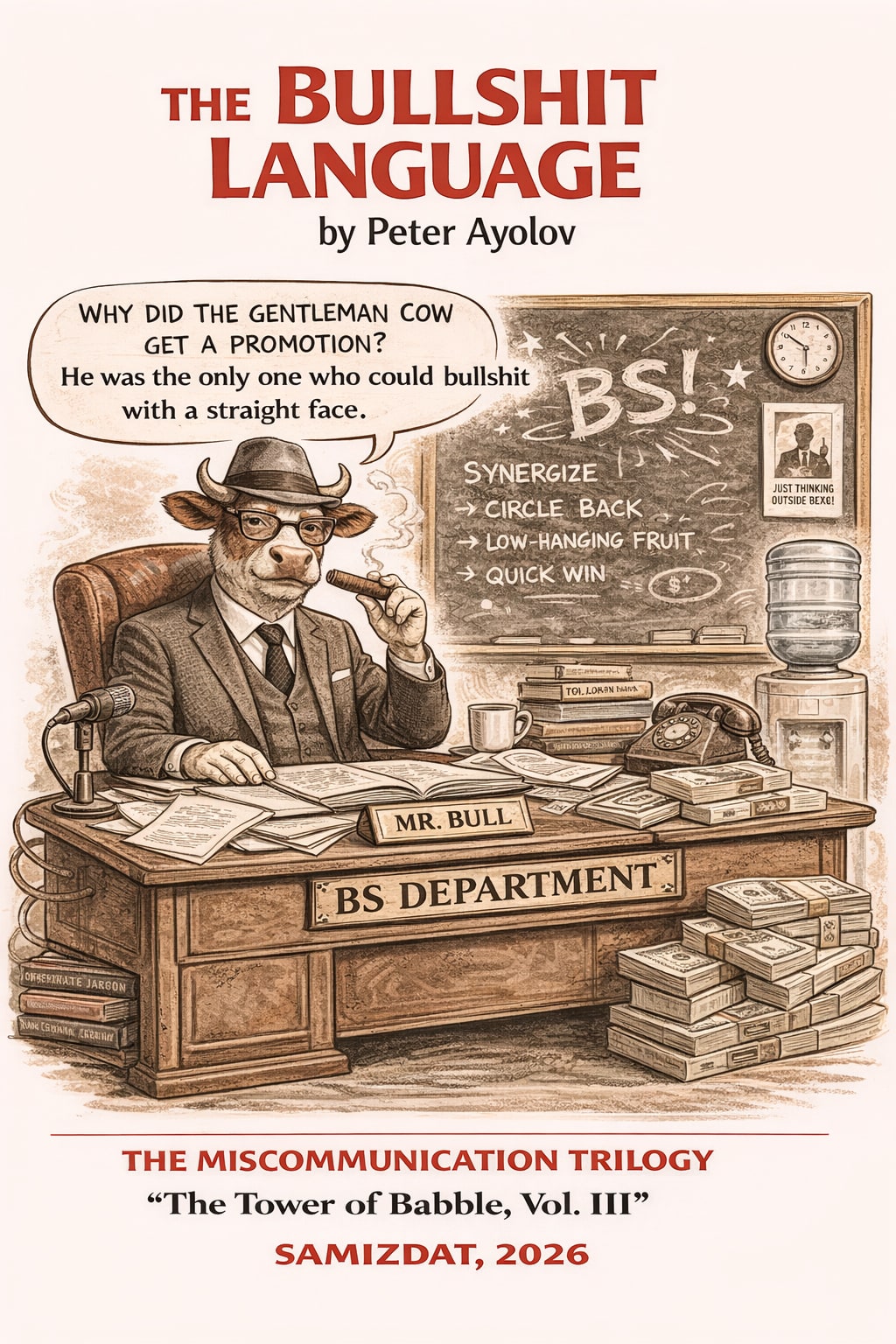
The Babel of Nonsense: A Review of The Bullshit Language
The Triumph of Empty Speech
The Bullshit Language stands as one of the most original and provocative contributions to The Tower of Babble, the third volume of The Miscommunication Trilogy. At first glance, the subject appears almost humorous. The term “bullshit” is often associated with vulgarity, casual speech, or everyday complaints about politics and business. Yet this book demonstrates that bullshit is not merely a colloquial expression but one of the defining communicative conditions of contemporary civilization. Through a broad exploration of philosophy, sociology, economics, organizational studies, political rhetoric, and linguistics, the work argues that modern societies increasingly operate through forms of communication that are detached from truth while remaining highly effective in shaping perception. The central distinction around which the book revolves is the difference between lying and bullshit. The liar still acknowledges the authority of truth because deception requires awareness of reality. Bullshit, by contrast, reflects indifference toward truth itself. The producer of bullshit is not primarily concerned with whether statements correspond to facts. Instead, communication becomes a tool for impression management, identity construction, status enhancement, and symbolic performance. This seemingly simple distinction opens a profound investigation into the structure of contemporary communication.
The book’s examination of organizational culture is particularly illuminating. Drawing upon André Spicer’s studies of management discourse, the text reveals how modern institutions often generate linguistic environments where jargon flourishes while meaning deteriorates. Terms such as innovation, transformation, synergy, alignment, intentionality, strategic vision, sustainability, and disruption appear repeatedly across organizations, yet their meanings often remain vague and unstable. These expressions create an illusion of expertise and progress while frequently obscuring the actual realities they supposedly describe. The discussion of Kronese, the peculiar language that emerged from management training programs at Pacific Bell, serves as a powerful example. Employees were taught a specialized vocabulary intended to elevate consciousness and improve organizational effectiveness. Instead, the result was often confusion, longer meetings, reduced clarity, and the creation of a linguistic barrier between insiders and outsiders. Yet even after the program disappeared, its vocabulary survived and became integrated into broader corporate culture. The lesson is profound: bullshit does not survive because it is useful in a practical sense. It survives because it fulfills symbolic functions.
The book demonstrates that modern organizations increasingly reward the production of symbols rather than the production of understanding. Managers are expected to articulate visions. Consultants are expected to generate frameworks. Executives are expected to present strategies. Whether these symbolic constructions correspond to reality often becomes secondary to their ability to create confidence and legitimacy. In this environment, communication gradually becomes detached from substance. The analysis extends beyond business culture into politics and public discourse. Political rhetoric frequently operates according to the same logic. Public figures are rewarded for emotional resonance rather than factual precision. The famous controversy surrounding Bill Clinton’s interpretation of the word “is” illustrates how language itself becomes an arena of strategic manipulation. Rather than serving as a medium for clarifying reality, words become instruments for managing interpretations of reality.
Throughout these discussions, the book consistently returns to a larger philosophical concern: the relationship between language and truth. Language originally emerged as a tool that enabled human beings to coordinate action, share knowledge, and construct civilization. Yet the same symbolic capacity that allows language to communicate reality also allows it to obscure reality. The Bullshit Language argues that contemporary society increasingly exploits this second possibility. The result is a communicative environment saturated with words but increasingly starved of meaning.
The Bureaucracy of Meaninglessness
One of the book’s most compelling contributions is its exploration of meaningless labor and the expansion of what David Graeber famously described as “bullshit jobs.” These chapters move beyond the analysis of language itself and investigate the social structures that encourage the production of communicative emptiness. The result is a powerful critique of modern economic life. The book explores a troubling paradox. Technological progress has dramatically increased productivity. Many thinkers, including John Maynard Keynes, predicted that such advances would allow people to work fewer hours and enjoy greater leisure. Yet the opposite appears to have occurred. Large numbers of individuals now spend their working lives engaged in tasks that they privately regard as pointless. Bureaucratic procedures expand. Administrative structures multiply. Meetings generate more meetings. Reports justify additional reports. Entire professions emerge whose primary purpose appears to be maintaining the appearance of activity. The concept of bullshit jobs provides a framework for understanding this phenomenon. Unlike unpleasant but socially useful work, bullshit jobs are characterized by the perception that they serve no meaningful purpose. The tragedy lies not merely in inefficiency but in the psychological consequences of meaninglessness. Individuals increasingly find themselves performing activities they cannot justify even to themselves. Work becomes disconnected from contribution.
The book skillfully connects this development to broader changes within contemporary capitalism. Rather than eliminating inefficiencies, modern organizations often generate new layers of administration, management, compliance, branding, and supervision. The result is a growing class of workers whose labor is devoted primarily to symbolic rather than productive functions. This symbolic economy depends heavily upon language. Reports, evaluations, mission statements, presentations, frameworks, strategic plans, and performance indicators become ends in themselves. The discussion of productivity culture deepens this critique. Modern workers are encouraged to optimize themselves continuously through productivity systems, personal branding, self-management techniques, and entrepreneurial self-presentation. Yet these solutions frequently intensify the very problems they claim to solve. Rather than eliminating meaningless tasks, they merely make individuals more efficient at performing them. The worker becomes both manager and managed, creating additional layers of self-imposed bureaucracy. Particularly insightful is the book’s analysis of personal branding. Traditional professional identities increasingly give way to marketable personas. Individuals are encouraged to present themselves as products, cultivating images designed to maximize visibility and competitiveness. Language becomes a tool for self-marketing rather than self-expression. The distinction between authenticity and performance becomes increasingly blurred.
The political implications of these developments are explored with considerable sophistication. Bullshit jobs are not presented simply as economic inefficiencies. They function as mechanisms of social control. A population occupied with endless administrative tasks possesses less time and energy for political participation, intellectual reflection, or collective action. Work becomes not merely an economic necessity but a disciplinary institution. The book avoids simplistic explanations by recognizing that these developments arise from complex interactions between economic incentives, organizational structures, cultural values, and political interests. Bullshit jobs persist not because they are useful but because they serve important symbolic functions. They maintain hierarchies, generate legitimacy, justify authority, and reinforce existing power relations. In examining these dynamics, The Bullshit Language expands beyond a critique of communication and becomes a broader diagnosis of contemporary civilization. Meaninglessness is not confined to speech. It increasingly characterizes labor, institutions, and social relationships themselves. The book suggests that the crisis of communication may ultimately reflect a deeper crisis of purpose.
Profanity, Power, and the Planned Obsolescence of Language
The final sections of the book broaden the discussion further by exploring profanity, taboo language, blasphemy, and linguistic transgression. At first glance these topics might appear disconnected from earlier discussions of corporate jargon and bureaucratic communication. In fact, they represent an essential extension of the book’s central argument. Profanity occupies a unique position within language because it exposes the emotional, symbolic, and social dimensions of communication. The book draws upon historical, psychological, and linguistic studies to demonstrate that profanity cannot be dismissed as mere vulgarity. Swear words function as emotional releases, markers of identity, tools of social bonding, acts of rebellion, and forms of artistic expression. Their significance lies not primarily in their literal meanings but in their social effects. The discussions of Michael Adams, G. T. W. Patrick, and other scholars reveal how profanity challenges conventional assumptions about language. Swearing often expresses emotional truths more directly than formal discourse. It bypasses the polished surfaces of institutional communication and exposes underlying frustrations, anxieties, and desires. In this sense, profanity sometimes functions as the opposite of bullshit. While bullshit conceals reality behind empty language, profanity frequently strips away pretension and reveals emotional authenticity.
The examination of blasphemy further enriches the analysis. Historically, blasphemy laws sought to protect sacred symbols from verbal challenge. Modern debates about free speech continue to revolve around similar tensions. Who controls language? Which words may be spoken? Which ideas are considered permissible? These questions reveal that language is never merely a neutral medium. It is always intertwined with power. The discussion of writers such as Paul Beatty illustrates this point particularly well. Beatty’s insistence that “no one owns language” serves as a powerful challenge to attempts at linguistic control. Language is portrayed as a shared human resource whose vitality depends upon experimentation, appropriation, and creative risk-taking. This perspective aligns closely with the broader themes of the book, which consistently resists efforts to restrict communication through ideological, bureaucratic, or institutional mechanisms. What ultimately distinguishes The Bullshit Language is its ability to connect these diverse subjects into a coherent theoretical framework. Corporate jargon, political rhetoric, meaningless labor, profanity, blasphemy, branding, management fads, and public discourse are all presented as manifestations of a larger historical process: the gradual separation of language from reality.
This insight connects the book directly to the overarching theme of The Miscommunication Trilogy: the planned obsolescence of language. Throughout the trilogy, language appears not merely as a tool of communication but as a contested social technology whose functions are increasingly distorted by modern institutions. In The Bullshit Language, this process reaches perhaps its most advanced stage. Communication becomes abundant, yet understanding becomes scarce. Information multiplies, yet meaning erodes. Language survives, but its capacity to connect individuals with reality grows increasingly fragile. The Bullshit Language is therefore much more than a study of deceptive speech. It is an ambitious exploration of the cultural, political, economic, and psychological forces reshaping communication in the twenty-first century. Combining philosophical depth with contemporary relevance, it offers a penetrating analysis of one of the defining problems of modern civilization. As a contribution to The Tower of Babble, it stands as one of the strongest chapters in the trilogy. It reveals how language can become detached from truth, how institutions can become dependent upon symbolic performance, and how societies can become overwhelmed by communication while simultaneously losing the ability to understand themselves. The result is a thoughtful, provocative, and highly original work that challenges readers to reconsider the relationship between words, reality, and power in an age increasingly dominated by noise.
About the Creator
Peter Ayolov
Peter Ayolov’s key contribution to media theory is the development of the "Propaganda 2.0" or the "manufacture of dissent" model, which he details in his 2024 book, The Economic Policy of Online Media: Manufacture of Dissent.
Enjoyed the story? Support the Creator.
Subscribe for free to receive all their stories in your feed.
Comments
There are no comments for this story
Be the first to respond and start the conversation.