
The Art of Listening, THE MISCOMMUNICATION TRILOGY, “The Tower of Babble, Vol. III”, Part 21
Book Review

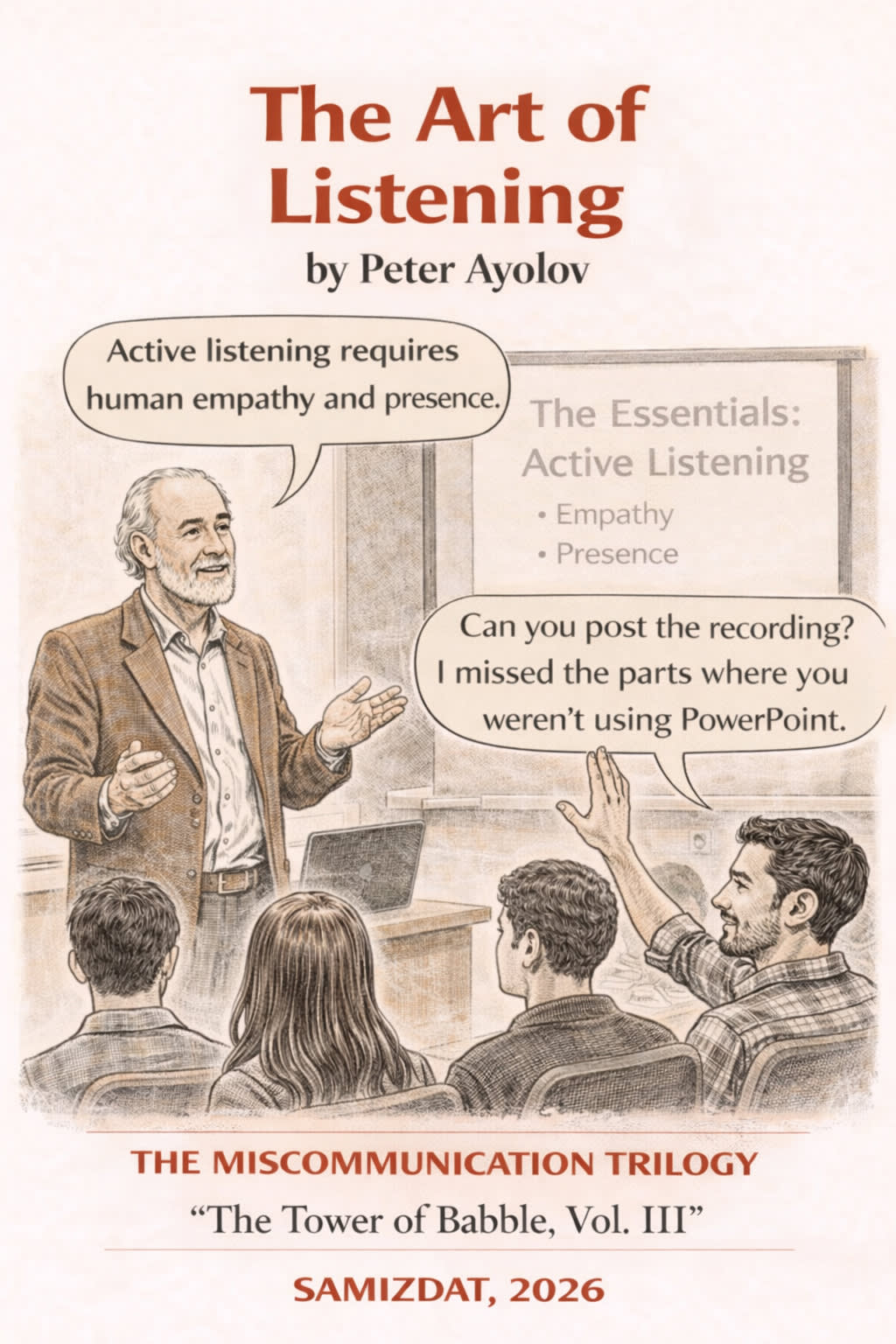
The Echo of Understanding: A Review of Listening, Silence and Human Connection
The Forgotten Half of Communication
The Art of Listening occupies a distinctive position within contemporary reflections on communication because it reverses a long-standing intellectual habit. Most discussions of language begin with speech, writing, rhetoric, persuasion, information, or expression. This volume begins elsewhere. It starts from the observation that every communicative act depends upon a listener and that the history of communication can therefore be understood not only as the history of speaking but also as the history of hearing, interpreting, and understanding. The book develops this proposition with remarkable breadth, drawing together contributions from communication theory, psychology, philosophy, sociology, linguistics, cultural studies, literary criticism, music, and the study of silence. Rather than treating listening as a passive accompaniment to speech, it presents it as one of the most sophisticated human activities, involving attention, memory, interpretation, empathy, anticipation, and ethical responsibility. One of the volume’s greatest strengths lies in its refusal to reduce listening to a simple technique. Contemporary communication manuals often present listening as a collection of practical skills that can be acquired through training. While acknowledging the value of such approaches, the book moves far beyond them. Listening appears here as a mode of existence, a way of inhabiting relationships with other people, cultures, ideas, and even oneself. The chapters repeatedly demonstrate that understanding cannot be separated from the conditions under which attention is directed and sustained. Every act of listening requires selection. Human beings constantly navigate overwhelming amounts of sensory and symbolic information, and listening becomes the process through which certain signals are transformed into meaningful experience. The volume shows how fragile this process can be. Misunderstanding is not treated as an accidental interruption of communication but as one of its permanent possibilities. The listener is never a neutral receiver. Memory, expectation, emotion, prejudice, social position, and cultural background all influence what is heard and what remains unheard. Through this perspective, the book transforms listening into a central problem of human existence. Particularly compelling is its examination of contemporary conditions. Digital technologies have dramatically increased the volume of communication while simultaneously fragmenting attention. The book convincingly argues that communication abundance does not necessarily produce greater understanding. On the contrary, excessive stimulation often undermines the concentration required for genuine listening. Information becomes plentiful while meaning becomes elusive. This diagnosis provides the volume with considerable relevance. Rather than lamenting technological change in simplistic terms, it explores the deeper psychological and cultural consequences of living in environments saturated with messages. The result is a sophisticated account of why listening has become increasingly difficult and increasingly necessary. By placing listening at the center of communication rather than its margins, the book offers a corrective to prevailing assumptions and reveals dimensions of human interaction that often remain unnoticed despite their fundamental importance.
Silence as Meaning, Presence and Cultural Experience
A second major achievement of the volume lies in its treatment of silence. In much of Western thought, silence has often been interpreted negatively, as absence, passivity, emptiness, or communicative failure. This book challenges such assumptions by demonstrating that silence possesses its own forms of meaning, structure, and communicative power. Drawing from diverse cultural traditions and intellectual perspectives, it reveals silence as an active participant in human communication rather than a void between words. The discussions of communicative silence, monastic silence, mystical silence, political silence, poetic silence, and cultural silence collectively create one of the book’s most intellectually rich sections. Silence emerges as a phenomenon that can express contemplation, resistance, reverence, authority, intimacy, grief, discipline, creativity, and wisdom. Particularly illuminating are the cross-cultural explorations that challenge universal assumptions regarding communication. The volume demonstrates that silence carries radically different meanings across societies. What may appear awkward or threatening in one context can signify respect, patience, attentiveness, or spiritual depth in another. The discussions of American Indian traditions of generative silence and Japanese conceptions of silence are especially valuable because they expose the limitations of communication theories developed within narrowly Eurocentric frameworks. These chapters reveal how silence can function as a productive, creative, and culturally valued mode of interaction rather than merely a temporary absence of speech. Equally impressive is the volume’s engagement with literary and artistic treatments of silence. Through examinations of figures such as Samuel Beckett, Nathalie Sarraute, and numerous poets and theorists, the book demonstrates how silence operates within artistic expression as both a theme and a formal strategy. Language repeatedly encounters its own limits, discovering that some experiences resist direct articulation. Yet these limitations do not signal defeat. Instead, they generate new forms of expression that rely upon suggestion, ambiguity, absence, and restraint. Silence becomes a creative force precisely because it reveals the boundaries of language. The book’s treatment of music further extends this argument. Silence appears not as the opposite of sound but as one of its necessary conditions. Musical pauses, intervals, and moments of stillness shape meaning just as profoundly as notes themselves. This insight resonates throughout the volume. Communication is repeatedly shown to depend upon what remains unsaid as much as upon what is spoken. Such observations give the book a philosophical depth that distinguishes it from more narrowly technical studies of communication. Silence becomes not merely a topic but a lens through which broader questions about knowledge, perception, consciousness, and social life can be examined. By integrating these diverse perspectives into a coherent framework, the volume successfully demonstrates that understanding communication requires attention not only to language but also to its absences, interruptions, and limits.
Listening in an Age of Planned Communicative Obsolescence
Perhaps the most significant contribution of The Art of Listening emerges when the volume is considered within the broader intellectual context of contemporary communication crises. Although its immediate subject is listening, the book ultimately addresses a larger problem: the gradual erosion of meaningful communicative capacities within modern societies. Across its chapters, a recurring concern becomes visible. Human beings increasingly inhabit environments characterized by speed, distraction, fragmentation, and informational excess. Public discourse becomes polarized, attention becomes commodified, and communication itself risks being reduced to performance rather than understanding. Against this backdrop, listening emerges as a form of resistance. The book repeatedly suggests that the future of communication depends not upon generating more speech but upon recovering the ability to receive meaning. This argument gives the volume considerable philosophical and cultural significance. Listening is presented not merely as a practical skill but as an ethical orientation. To listen is to recognize the existence of another perspective. It requires humility because understanding demands openness to revision. It requires patience because meaning unfolds through time rather than instant reaction. It requires courage because genuine listening exposes individuals to ideas capable of challenging their assumptions. Throughout the volume, listening becomes inseparable from questions of responsibility, recognition, and coexistence. Particularly noteworthy is the book’s refusal to offer simplistic solutions. It does not suggest that listening can eliminate conflict or produce universal agreement. Instead, it argues that meaningful disagreement itself depends upon listening. Without it, communication collapses into parallel monologues incapable of genuine engagement. This insight is especially relevant in contemporary societies where public discourse often rewards certainty while discouraging reflection. The volume therefore offers a powerful defense of intellectual openness and communicative complexity. Its interdisciplinary range occasionally creates challenges, as the diversity of materials demands considerable attention from the reader. Yet this breadth ultimately serves the book’s purpose. Listening is shown to be too important and too multifaceted to remain confined within a single discipline. Psychology, philosophy, sociology, linguistics, literature, music, theology, and cultural studies all contribute indispensable perspectives. The result is a work that succeeds both as a theoretical investigation and as a meditation on one of the most neglected dimensions of human existence. By the end, listening appears not simply as a communicative function but as a condition of meaningful life. The book leaves the reader with a profound realization: communication begins not when someone speaks but when someone is willing to listen. In an age increasingly overwhelmed by its own voices, this insight gives The Art of Listening both its intellectual power and its enduring relevance.
About the Creator
Peter Ayolov
Peter Ayolov’s key contribution to media theory is the development of the "Propaganda 2.0" or the "manufacture of dissent" model, which he details in his 2024 book, The Economic Policy of Online Media: Manufacture of Dissent.
Enjoyed the story? Support the Creator.
Subscribe for free to receive all their stories in your feed.
Comments
There are no comments for this story
Be the first to respond and start the conversation.