
The Architecture of Instability: A Review of Language at the Edge of Collapse
Review

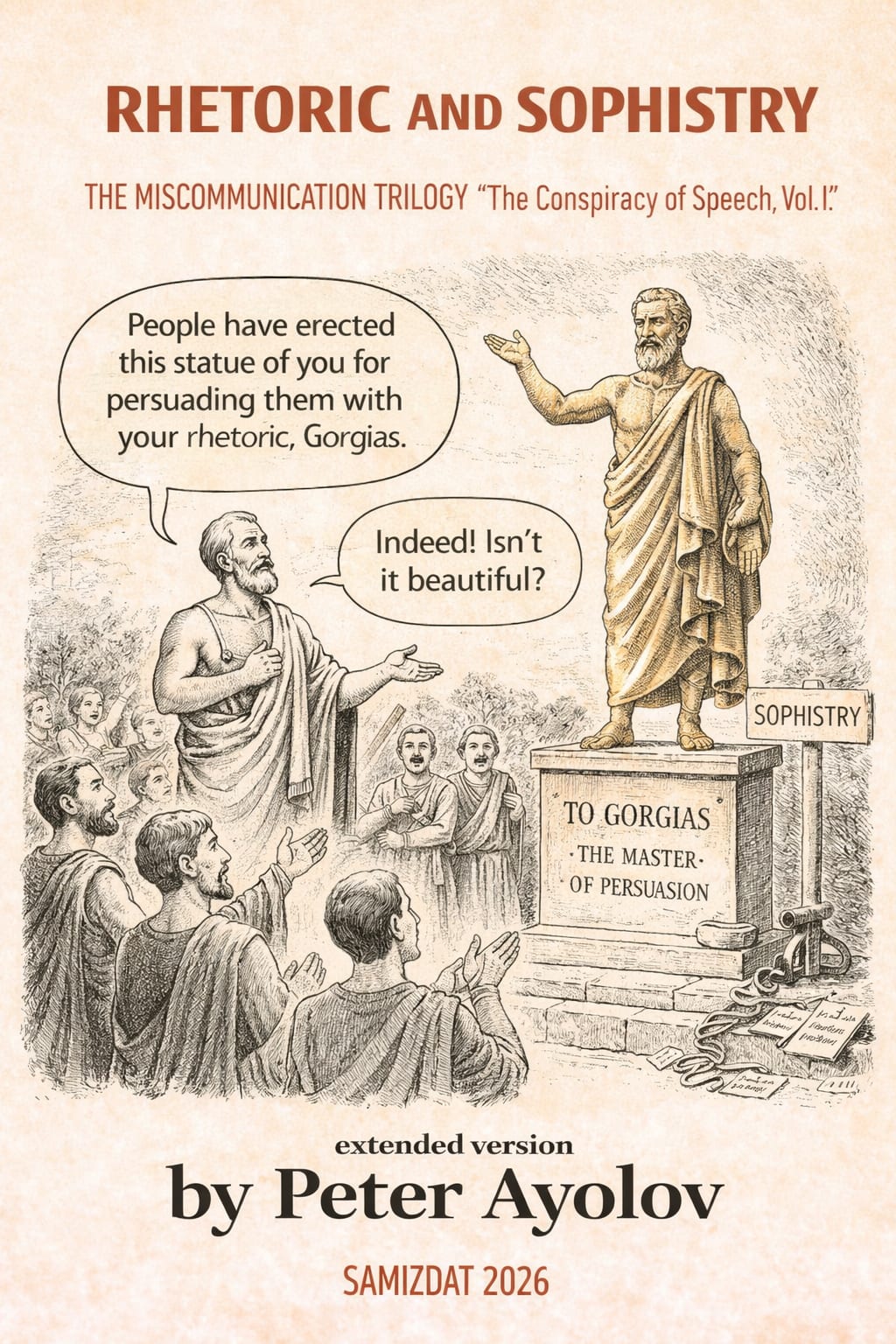
This book, situated within The Miscommunication Trilogy, offers a sustained and uncompromising investigation into the condition of language in a world where communication has become both omnipresent and increasingly unreliable. Rather than treating language as a transparent medium for conveying thought, it presents it as a dynamic and unstable field in which meaning is continuously constructed, contested, and dissolved. The central concept that organizes the work—the planned obsolescence of language—serves not merely as a metaphor but as a structural diagnosis of contemporary discourse. Language, in this account, is no longer a repository of accumulated meaning but a system subject to cycles of rapid production and replacement, where expressions are valued for their immediacy rather than their durability. The review must begin by acknowledging the ambition of this thesis, which extends beyond linguistics into philosophy, rhetoric, cognitive science, and media theory, attempting to account for the transformation of communication across multiple domains.
One of the book’s most compelling contributions lies in its reconfiguration of rhetoric. Rather than presenting rhetoric as a historical discipline confined to classical theory, the text positions it as an inherent condition of language itself. This move allows the author to dissolve the traditional boundary between rhetoric and everyday communication, revealing that all speech operates within a framework of persuasion, adaptation, and contextual negotiation. The historical chapters, particularly those engaging with pre-Platonic discourse and early Greek thought, are notable for their methodological caution. They resist the temptation to impose modern categories retrospectively, instead emphasizing the difficulty of identifying rhetorical awareness in contexts where the terminology did not yet exist. This approach aligns with contemporary historiographical debates and demonstrates a sensitivity to the complexities of intellectual history. The use of sources that examine rhetoric before its formal naming reinforces the argument that rhetorical practice precedes theoretical articulation, grounding the book’s broader claims in a carefully constructed historical framework. The treatment of sophistry is equally significant. The book does not simply reproduce the classical opposition between rhetoric and sophistry but interrogates it, showing how both operate within the same linguistic field. The figure of the sophist becomes a lens through which the instability of language is explored, embodying the tension between truth and appearance. This perspective is particularly effective in the sections that engage with modern theoretical developments, where the boundaries between persuasion, representation, and simulation are increasingly blurred. The discussion of contemporary media environments and the transformation of representation into a structuring force of reality demonstrates the book’s ability to connect ancient concerns with modern conditions. By extending the concept of rhetoric into these domains, the text offers a framework for understanding how language functions in contexts where meaning is no longer anchored in stable referents.
Another strength of the work is its emphasis on the material and social conditions that shape language. The analysis of rhetoric as emerging from economic, political, and cultural structures provides a necessary counterpoint to purely abstract theories of language. The sections that situate the rise of rhetorical practices within the context of expanding social complexity and economic exchange are particularly persuasive, illustrating how communication evolves in response to practical needs. This grounding in material conditions prevents the argument from becoming overly speculative and reinforces the claim that language cannot be understood independently of the systems within which it operates. The integration of these perspectives with the broader thesis of planned obsolescence highlights the ways in which contemporary communication is influenced by similar forces, albeit on a much larger and more accelerated scale. The book’s engagement with neurolinguistics and the embodied nature of speech adds another layer to its analysis. By emphasizing that language is not an abstract system but a practice rooted in perception, movement, and interaction, the text challenges models that treat communication as purely symbolic. The discussion of the feedback loop between speaking and hearing, and the role of the body in shaping linguistic experience, aligns with current research in cognitive science and provides a necessary corrective to disembodied accounts of language. This perspective also reinforces the book’s broader argument about instability, as it highlights the variability inherent in human perception and interpretation. The multiplicity of linguistic experiences that individuals carry further complicates the possibility of a unified language, supporting the claim that communication is always mediated by subjective and contextual factors.
The exploration of universal language projects serves as an effective counterpoint to the theme of obsolescence. By tracing historical attempts to create a single, stable system of communication, the book demonstrates the persistence of the desire for linguistic unity even in the face of repeated failure. The analysis shows that such projects are driven by the same impulse that underlies the planned obsolescence of language: the desire to control and standardize communication. However, while universal language projects seek stability through design, contemporary communication achieves instability through acceleration. This contrast highlights the tension between order and multiplicity that runs throughout the book, revealing that both extremes ultimately fail to capture the complexity of language as a social practice. The discussion of sense and nonsense is another notable aspect of the work. The book does not simply critique the presence of ambiguity or rhetorical excess but examines the conditions under which they become problematic. The analysis of pseudo-scientific language, political discourse, and public communication is particularly sharp, demonstrating how language can be used to create the illusion of meaning without its substance. At the same time, the text avoids a purely normative stance, recognizing that ambiguity and expressive variation are inherent features of language. This balanced approach allows the book to critique the misuse of language without reducing communication to a purely technical function. The emphasis on the need for critical awareness in education and public discourse underscores the practical implications of the argument, suggesting that the problem of miscommunication is not merely theoretical but has significant consequences for social stability and knowledge production.
Despite its many strengths, the book is not without its challenges. Its density and scope may present difficulties for readers who are not already familiar with the theoretical frameworks it engages. The integration of multiple disciplines, while enriching the analysis, can also make the argument difficult to follow at times, particularly when the text moves rapidly between historical, philosophical, and contemporary perspectives. Additionally, the concept of planned obsolescence, while compelling, may benefit from further empirical grounding. The book relies heavily on theoretical interpretation, and while this is appropriate given its aims, a more detailed examination of specific linguistic practices in contemporary media could strengthen the argument. These critiques, however, do not undermine the overall contribution of the work but rather indicate areas for further development. What ultimately distinguishes this book is its refusal to offer easy solutions. It does not attempt to restore a lost stability or to propose a definitive model of communication. Instead, it insists on confronting the instability of language as a fundamental condition, one that must be understood rather than eliminated. This approach is both its greatest strength and its most challenging aspect, as it requires the reader to engage with the complexity of language without the reassurance of resolution. The conclusion reinforces this position, emphasizing that language persists not despite its instability but because of it, as a dynamic and adaptive practice that continues to shape human experience.
In evaluating the book as a whole, it becomes clear that it makes a significant contribution to contemporary discussions of language, rhetoric, and communication. Its integration of historical analysis, theoretical reflection, and contemporary critique provides a comprehensive framework for understanding the transformations of language in the modern world. The concept of the planned obsolescence of language offers a powerful lens through which to examine these changes, highlighting the ways in which communication is shaped by broader systems of production and exchange. While the book may challenge its readers with its complexity, it rewards careful engagement with insights that extend beyond the boundaries of any single discipline. This is a work that does not seek to comfort but to unsettle, to reveal the conditions under which language operates and to question the assumptions that sustain our understanding of communication. It invites the reader to reconsider the role of language in shaping thought, perception, and social interaction, and to recognize the extent to which meaning is contingent, negotiated, and subject to change. In doing so, it not only contributes to the study of rhetoric and linguistics but also to a broader reflection on the nature of human communication in an age of instability.
About the Creator
Peter Ayolov
Peter Ayolov’s key contribution to media theory is the development of the "Propaganda 2.0" or the "manufacture of dissent" model, which he details in his 2024 book, The Economic Policy of Online Media: Manufacture of Dissent.
Enjoyed the story? Support the Creator.
Subscribe for free to receive all their stories in your feed.
Comments
There are no comments for this story
Be the first to respond and start the conversation.