
The Alienation Of Speech, THE MISCOMMUNICATION TRILOGY, “The Tower Of Babble, Vol. III”, Part 10
Book Review

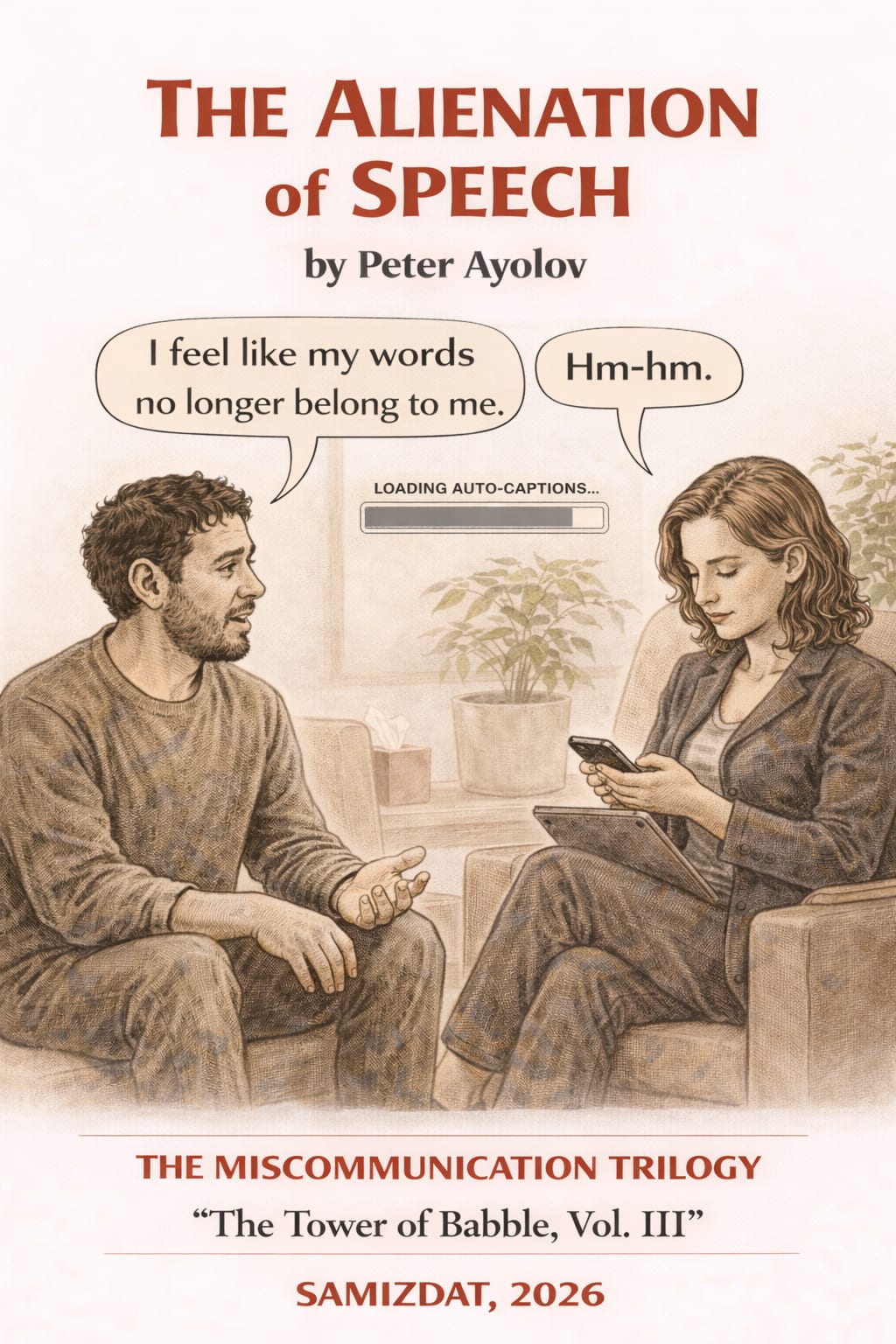
The Language That No Longer Belongs to Us: A Review of The Alienation of Speech
Diagnosing the Crisis of Communication
The Alienation of Speech is one of the most ambitious and intellectually provocative contributions to the broader project of The Miscommunication Trilogy. Rather than approaching language as a neutral tool for transmitting information, the book treats communication as one of the fundamental conditions of human existence. Its central argument is that speech itself has become alienated. Human beings increasingly find themselves surrounded by words, messages, narratives, and symbolic systems that shape their lives while simultaneously becoming detached from their direct control and understanding. In this sense, the book extends classical theories of alienation into the realm of communication, suggesting that modern individuals are becoming estranged not only from their labor, institutions, and communities but also from the language through which they interpret reality.
One of the book’s major strengths is its ability to connect diverse intellectual traditions into a coherent narrative. The discussion moves comfortably between sociology, linguistics, media studies, political theory, communication theory, and philosophy without becoming fragmented. Instead of treating these disciplines as isolated domains, the text demonstrates how they converge around a common concern: the growing separation between language and meaning in modern society. Speech is examined not merely as a collection of words and grammatical structures but as a living social practice that reflects broader transformations in culture and power.
The book’s treatment of alienation is particularly effective because it avoids reducing the concept to a purely economic or political phenomenon. Alienation appears as a condition that penetrates every level of communication. Words become detached from experience. Public discourse becomes detached from truth. Social interaction becomes detached from understanding. Language increasingly functions through institutional systems that shape meaning before individuals have the opportunity to participate in its construction. This theme gives the work a remarkable coherence despite the diversity of topics explored.
Another notable achievement is the book’s insistence that communication cannot be understood independently of the social structures within which it operates. Language is never presented as an autonomous system. Instead, speech is shown to be embedded within political institutions, educational systems, media organizations, technological platforms, and cultural traditions. This approach enables the author to demonstrate how communication simultaneously reflects and reinforces broader social realities.
The discussion of automation, technological mediation, and information overload is especially relevant to contemporary readers. In an age where communication technologies have expanded opportunities for expression beyond anything previously imaginable, the book asks a provocative question: why has the explosion of communication not produced a corresponding increase in understanding? Rather than celebrating technological abundance uncritically, the text explores the possibility that the acceleration of communication may itself contribute to misunderstanding, fragmentation, and symbolic estrangement. This observation forms one of the central insights of the book and establishes the foundation for its broader critique of contemporary communication culture.
Speech, Power, and the Fragmentation of Meaning
Perhaps the most compelling aspect of The Alienation of Speech is its analysis of the relationship between language and power. Throughout the text, communication appears not simply as a means of exchanging information but as one of the primary arenas in which social struggles are conducted. Speech becomes a site where competing groups attempt to define reality, establish legitimacy, shape identities, and exercise influence. The book demonstrates that communication is never politically innocent. Every vocabulary, narrative, and symbolic framework carries assumptions about the world and about the people who inhabit it.
The chapters addressing speech codes, political correctness, message discipline, inclusive language, and public discourse illustrate this point with considerable sophistication. Rather than presenting these issues through simplistic ideological categories, the book explores the underlying tensions that make them so controversial. On one side stands the desire to create more inclusive and respectful forms of communication. On the other stands the concern that linguistic regulation may become a mechanism of conformity and symbolic control. The text does not offer easy resolutions to these tensions, nor does it reduce them to partisan disputes. Instead, it reveals them as manifestations of a deeper conflict concerning the role of language in social life.
Particularly impressive is the book’s treatment of speech codes as cultural phenomena rather than merely legal or institutional regulations. Drawing upon sociolinguistic theories, the discussion shows that every community develops systems of communicative expectations that shape how members speak, interpret, and evaluate one another. These codes are not simply imposed from above; they emerge through historical processes and become woven into everyday interactions. The result is a nuanced understanding of communication that avoids both deterministic and individualistic explanations.
The analysis of social class speech, linguistic divergence, and retribalisation further enriches this perspective. The book argues that language is not merely a reflection of social divisions but an active participant in their creation and maintenance. Speech serves as a marker of identity, belonging, and distinction. Differences in vocabulary, style, and communicative practice become mechanisms through which social boundaries are established and reproduced. In this sense, language simultaneously unites and divides. It creates communities while generating exclusions. It facilitates cooperation while reinforcing differences.
The discussion of media and public discourse is equally powerful. Modern communication systems are portrayed as environments saturated with competing narratives, ideological performances, and symbolic conflicts. Individuals are exposed to unprecedented quantities of information while simultaneously facing increasing difficulty in determining what deserves trust. The book’s exploration of this paradox is particularly insightful. Information abundance does not necessarily produce understanding. On the contrary, excessive communication may generate confusion, skepticism, and fragmentation. Public discourse becomes a struggle among narratives rather than a collective search for truth.
These observations connect directly to the book’s broader argument concerning alienation. Speech becomes alienated not because communication disappears but because it expands beyond the capacity of individuals to interpret and control it. Words circulate through networks of power, technology, and institutional authority that transform communication into something increasingly autonomous. Speakers become participants in symbolic systems that shape their perceptions before they can consciously reflect upon them. The result is a communicative environment characterized by both extraordinary connectivity and profound misunderstanding.
A Philosophical Reflection on the Future of Language
Beyond its sociological and political analysis, The Alienation of Speech succeeds as a philosophical meditation on the human condition. At its deepest level, the book is concerned with the relationship between language and freedom. Communication is presented as one of the defining characteristics of humanity, the medium through which individuals construct meaning, establish relationships, and participate in collective life. When speech becomes alienated, the consequences extend far beyond communication itself. The crisis of language becomes a crisis of human existence.
One of the most valuable contributions of the book is its refusal to embrace either technological optimism or cultural pessimism. While the text is sharply critical of many contemporary developments, it does not suggest that meaningful communication has become impossible. Nor does it propose a nostalgic return to an imagined past characterized by linguistic purity and social harmony. Instead, the book acknowledges that language has always been characterized by ambiguity, conflict, and transformation. What distinguishes the present moment is the scale and intensity of these processes.
The book’s concluding reflections on education, critical thought, and communicative responsibility are particularly effective. Rather than advocating censorship or unrestricted expression as universal solutions, the text emphasizes the importance of cultivating the capacities necessary for meaningful dialogue. Understanding communication requires more than access to information. It requires historical awareness, interpretive skill, intellectual independence, and ethical responsibility. These qualities are presented not as optional virtues but as essential conditions for preserving meaningful public discourse.
The work also offers a compelling defense of institutions devoted to inquiry and dialogue. Universities, journalism, libraries, scientific communities, and democratic forums are portrayed as imperfect but indispensable mechanisms for resisting communicative fragmentation. Their importance lies not in possessing absolute truth but in maintaining practices through which truth can be pursued collectively. In a world increasingly characterized by symbolic conflict and information overload, such institutions provide crucial resources for preserving the possibility of understanding.
As a contribution to The Miscommunication Trilogy, The Alienation of Speech occupies a central position. It deepens the trilogy’s overarching investigation into the planned obsolescence of language by demonstrating how communication can become separated from meaning even while remaining omnipresent. The book shows that linguistic decline is not simply a matter of deteriorating vocabulary or changing grammar. It is a broader social process involving institutions, technologies, ideologies, identities, and power structures that reshape the conditions under which communication occurs.
Ultimately, The Alienation of Speech is a challenging, wide-ranging, and intellectually ambitious work. It invites readers to reconsider assumptions about language, communication, freedom, and social life. Its greatest achievement lies in demonstrating that speech is never merely a technical instrument. It is the symbolic foundation upon which human communities are built. When that foundation becomes unstable, the consequences reach every aspect of collective existence. The book therefore serves not only as a study of communication but as a profound reflection on the future of culture, democracy, and human understanding in the modern world.
About the Creator
Peter Ayolov
Peter Ayolov’s key contribution to media theory is the development of the "Propaganda 2.0" or the "manufacture of dissent" model, which he details in his 2024 book, The Economic Policy of Online Media: Manufacture of Dissent.
Enjoyed the story? Support the Creator.
Subscribe for free to receive all their stories in your feed.
Comments
There are no comments for this story
Be the first to respond and start the conversation.