Discussion
I Am Not Sexy
"I am not sexy." These four words used to haunt me like an unfinished sentence. In a world where allure is currency, and beauty opens doors faster than brains or kindness ever could, not being “sexy” felt like being left behind. Forgotten. Unwanted. But as I stand today—not in defiance, but in clarity—I realize that not being sexy was never the end of my story. It was the beginning of a quieter, deeper, richer narrative. One where I learned that worth has nothing to do with seduction and everything to do with substance. This is not just my confession; this is my reclamation. --- The Weight of the Mirror From a young age, we’re handed mirrors—not just the physical ones that reflect our skin and features, but invisible ones crafted by magazines, TV ads, social media filters, and judgmental glances. Mirrors that shout what we’re missing. Bigger eyes. Fuller lips. Flawless skin. Thinner waist. And of course—confidence, but only the kind that comes wrapped in mascara and mini-skirts. I was 14 when I first realized I didn’t meet the “sexy standard.” My friends were already experimenting with makeup and hair straighteners. They giggled over compliments and boys’ texts. I, on the other hand, was still hiding behind oversized clothes, acne scars, and a deep-rooted belief that beauty was a prize I would never win. By the time I was 18, I had perfected the art of invisibility. I was the smart one, the kind one, the “like-a-sister” type. People appreciated me, but no one longed for me. No one looked at me like I mattered beyond my usefulness. And the worst part? I believed them. --- Redefining the Word The turning point came in my final year of university. I was interning at a small NGO that worked with acid attack survivors. My job was to document stories, record interviews, and help raise awareness. That’s when I met Samra. She had half a face. The other half had been taken away by fire—deliberate, cruel, and unforgettable. But what stunned me wasn’t the scar; it was her smile. Her confidence. The way she sat in meetings, voiced her opinions, and laughed with her whole chest. One day, I asked her, “How do you do it? How do you still feel… powerful?” She leaned back and said something I will never forget: > “They took my beauty, not my worth. I am still whole where it matters.” That night, I cried. Not just for her, but for every year I had spent shrinking myself into invisibility. I realized then that being sexy is not about the body. It’s about presence. Power. Peace. --- Healing the Inner Voice It wasn’t easy, unlearning years of self-criticism. I started writing letters to myself—letters filled with compassion, not criticism. I surrounded myself with people who valued depth over display. I stopped following social media accounts that made me feel small. I took up walking in the morning, not to lose weight, but to hear my thoughts again. The more I distanced myself from the noise, the more I heard my inner voice say: “You are not sexy—and that’s okay. You are wise. You are kind. You are rare.” It felt strange at first. Like wearing shoes that didn’t quite fit. But eventually, those shoes became mine. --- Invisible Powers I’ve learned that there are other kinds of beauty. Quieter kinds. The beauty of patience. Of listening without interrupting. Of making someone feel safe in your silence. Of remembering birthdays and favorite songs. Of loving someone when they feel most unlovable. No one writes songs about that beauty. No one makes movies about girls who remember to pack their friend’s anxiety pills before a trip or hold space for a grieving colleague at work. But I’ve come to believe: that kind of beauty changes lives. I’m not sexy. But I’m unforgettable to those who’ve known my honesty, my loyalty, my capacity for care. --- To the Ones Who Feel Less This story is for you. For the girl who avoids mirrors. For the boy who thinks he’ll never be noticed. For the woman in her thirties who’s never been kissed. For the man who believes being gentle makes him weak. For anyone who feels like their value has an expiration date. You are not your waistline. You are not your skin tone. You are not your hair texture, or your follower count, or your ability to turn heads in a room. You are the sum of your kindness, your choices, your courage in moments no one sees. Let the world keep its definitions. You are enough. Even if you’re not sexy. --- Conclusion “I am not sexy.” I still say it. But now, I say it without shame. I say it like a quiet anthem of self-acceptance. Like a whisper to all the parts of me that never felt enough. And in this acceptance, I’ve found something more lasting than attraction. I’ve found freedom. Because once you stop chasing someone else’s idea of beauty, you begin to live in your own.
By Farhat ullahabout a year ago in BookClub
Book Review, RICH DAD POOR DAD
The Enduring Spark and Flawed Flame of Rich Dad Poor Dad Book Review for by Zahir Shah Robert Kiyosaki’s Rich Dad Poor Dad isn't just a personal finance book; it’s a cultural phenomenon. Since its 1997 debut, it has sold over 32 million copies, challenged conventional wisdom, and ignited fierce debate. For a competition review aiming for simplicity, attractiveness, and excellence, we must navigate beyond the hype and the hate to uncover the core spark that ignited a global conversation about wealth, while honestly examining its enduring flaws. This is not merely a summary, but a critical exploration of its legacy and lessons.
By Zahir Shahabout a year ago in BookClub
Strange Sally Diamond. Top Story - June 2025.
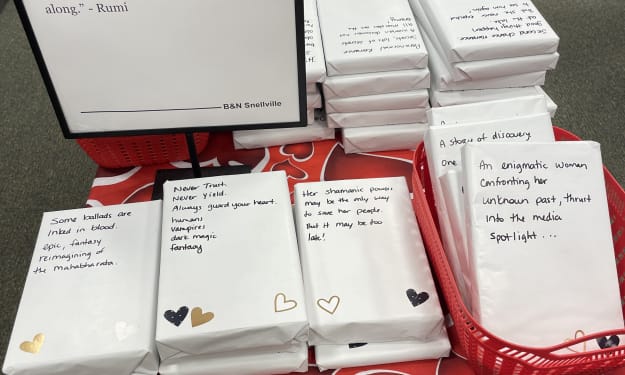
I picked up this book at the B&N’s Blind Date With a Book display. I loved the entire concept of selecting a mystery book based on a one-sentence teaser. Especially because they were lovingly wrapped by hand and the handwriting must have taken good effort (if they used the cursive it would have been even more attractive). As a public relations professional I think this marketing technique is brilliant, tapping into the book lovers’ serendipitous desire to be surprised with something new.
By Lana V Lynxabout a year ago in BookClub
The Last Letter from My Grandfather. Content Warning.
When my grandfather passed away, I felt nothing but emptiness. He was always quiet, never told stories, and I assumed he had taken all his thoughts with him. But one week later, my mother handed me an old envelope hidden inside a drawer. What I read in that letter broke me — and rebuilt me at the same time. The letter was handwritten, on yellowing paper with faded ink. The envelope had only one word on it: “For You.” I opened it with trembling hands. “My dear,” it began, “if you’re reading this, then I’m no longer beside you. But I hope these words will walk with you for a long time. I was never good with emotions, but there’s so much I want to say…” My heart tightened. He continued, writing about his youth. How he once dreamed of becoming a writer, how he gave up on it to take care of the family, how he worked in silence while the stories inside him died unread. “I wanted you to dream, even if I couldn’t. I watched you growing up, chasing light, always asking why. That’s the spark I lost. But you — you still have it.” I never knew he noticed. I thought he was distant. But this letter? It was warmth I never knew he held. The next part stunned me. “There is a box in my old cabinet, bottom drawer. Inside it, you’ll find my unfinished novel. You can throw it away. Or… finish it.” I couldn’t breathe for a moment. I went straight to his room. The drawer creaked open like a secret long buried. And there it was — a leather-bound notebook, half-filled with his handwriting. It wasn’t perfect. But it was beautiful. I spent the next six months finishing his story. Every page I wrote felt like a conversation with him — like I was holding his hand across time. The book, titled **“The Whispering Oak”**, wasn’t just his dream. It became mine. I self-published it, just for our family. But somehow, it reached others too. Someone read it. Shared it. And one day, I got an email: “This book changed my life.” That night, I sat in silence, letter in hand. My grandfather never spoke much. But in the end, he said everything that mattered. And I finally understood… We don't have to be famous to leave something behind. We just have to leave love, words, and courage. --- I still have the letter. Folded gently in a small wooden box. Sometimes, on quiet days, I open it — and hear him again. Not with words. But with the dreams he left behind for me to carry.
By Qasim khanabout a year ago in BookClub
The letter that changed everything
Tania was 28, and from the outside, everything looked perfect. She worked as a customer relationship officer at a prestigious bank in Lahore. Her hair was always tied neatly, her heels clicked with authority, and her phone buzzed constantly with updates, approvals, and balance sheets. Her family was proud. Society approved. She was “settled.” But Tania knew she wasn’t happy. Her days felt like they were stitched from the same gray fabric—wake up, work, eat, sleep, repeat. She had started living for weekends, and even those disappeared in hours of mindless scrolling, shopping, and sleeping. Something inside her felt… dead. One rainy evening, while she was rearranging her old wooden cupboard in the storeroom, she stumbled upon a small blue box. It was dusty and taped shut. She almost threw it away but stopped at the last second. Her childhood initials were scribbled in pink on the top: “T.K.” She sat on the cold floor and opened it. Inside were dried pens, a faded diary, and a few origami stars. Beneath them all, she found an envelope addressed to: > "To Future Me — Please Read This When You’re Big. From: Your Little Self 💜" She laughed, but her hands trembled as she opened it. A letter in clumsy, oversized handwriting greeted her. --- > Dear Tania, I hope you are big and pretty and still writing stories. I hope you didn’t forget how we wanted to be a famous author. I hope you still believe in magic and love and happy endings. Please don’t be too busy to dream. If you are reading this, remember — you promised never to stop writing. Love, 12-Year-Old You 🌸 --- Tania stared at the letter until the words blurred with tears. It hit her like thunder — she had completely forgotten. She once wrote every night. She created stories about fairy queens, astronauts, broken hearts, and brave girls. Writing had been her escape, her passion, her everything. But somewhere between career goals and social expectations, she had buried her dream without even saying goodbye. That night, she dusted off her old laptop. The keyboard was sticky, the screen flickered, but she didn’t care. She opened a blank Word document and typed: > "Once upon a time, a little girl forgot her dream..." Words flowed like rain from a broken sky. She wrote until 2 a.m., smiling and crying at once. It wasn’t perfect, but it felt real. From then on, she made a promise to herself. One story every Sunday. No excuses. At first, she posted them on a quiet blog named “Letters to Myself”. No one read it. She had zero likes, zero comments. But she didn’t care. For the first time in years, she felt alive. Three months later, one of her stories—a raw piece about depression, love, and self-rediscovery—was shared on a mental health forum. It went viral. Tania was flooded with messages: “Thank you for putting this into words.” “I felt this in my soul.” “Please keep writing.” Suddenly, her blog had thousands of followers. A literary agent contacted her, asking if she had ever considered writing a book. With trembling hands, she said yes. Her debut novel, “The Forgotten Girl”, was published within the year. It was semi-autobiographical—a story of a woman rediscovering herself through the voice of her 12-year-old self. It became a bestseller. But more than the fame, it was the letters that mattered most. Girls from India, Pakistan, Egypt, Canada, and even Kenya sent her emails. Many said the same thing: “I used to dream too. Maybe it’s not too late.” Tania quit her bank job on her 30th birthday. Not because she was running away, but because she was finally running toward something that made her heart beat faster. She traveled. She gave workshops to schoolgirls on creative writing and self-belief. She started a mentorship program for women who wanted to write but didn’t know how. Two years later, while packing for a book tour in Turkey, she slipped that old letter back into her suitcase. It had yellowed with time but still smelled faintly of ink and dreams. She smiled as she reread it. And whispered softly to the air, “Thank you, little me. You saved us.”
By Shehzad khanabout a year ago in BookClub
The Girl, the Tiger, and the Elemental Bond. Content Warning.
In the heart of a forest untouched by time, where the trees whispered ancient secrets and rivers sang forgotten lullabies, lived a girl named Elara. She was no ordinary girl. Born during a celestial storm, her eyes shimmered like the stars, and the wind often played with her hair as if it knew her soul. Villagers believed she was chosen by the Elements — the powers of Fire, Water, Earth, and Air — to bring balance to the world one day. But Elara had no idea of her destiny. She only knew one thing — she felt different. One dusky evening, while wandering deeper into the woods than ever before, she heard a growl. Not one of fear, but power. Emerging from the shadows was a magnificent tiger — his fur glowing faintly like molten gold, eyes like burning sapphire. They stared at each other. Time paused. Instead of running, Elara stepped forward. The tiger didn’t attack — instead, he bowed his head, as if recognizing her. That night, under the silver moon, Elara dreamed of a time long ago — four guardians who kept the world in balance: a girl, a tiger, a mountain, and a storm. The vision ended with a prophecy: “When the Elements cry, the Bond shall rise.” When she awoke, the tiger was beside her, watching protectively. From that moment on, Elara and the tiger — whom she named Kael — became one soul. They ran through the forests, swam across rivers, climbed high cliffs, and slept beneath stars. The world was awakening, and so was the power within her. One evening, as thunder cracked the skies and the earth trembled, dark shadows descended upon the forest — the Elemental Spirits had gone rogue. The balance had been broken by greed and destruction from the world beyond the forest. Elara knew her time had come. With Kael roaring beside her, she called upon the winds — and they listened. She touched the ground — and it pulsed. Her voice whispered to the fire — and flames danced around her hands. The river bent to her path. In a blaze of power and light, Elara stood with Kael at the edge of the cliff, the elemental signs glowing in the air around her. She was no longer a girl. She was the Guardian. And as the storm cleared, and balance returned, legends whispered of the girl and the tiger who walked with the Elements… and still do, whenever the forest breathes.
By Qasim khanabout a year ago in BookClub
Power of I AM
Note: For the TL;DR please go the final paragraph. “The Power of I Am: Two Words That Will Change Your Life Today,” (2016) by Joel Osteen is a self-help book which presents Positive Thinking as a Christian principle. Positive Thinking is the idea that our words or thoughts manifest into reality. For Osteen, these thoughts are “I am” statements which “will bring either success or failure,” (1) because “whatever you follow the “I am” with, you’re…giving it permission to be in your life.” (2). Osteen presents this idea as a Christian principle by using Bible passages, and writes that when your “I Am”s align with ‘who God says you are’ you “invite the goodness of God,” (7). Despite this affirmation of belief, a closer examination of Osteen’s message reveals disconnects from core Christian teachings.
By Judah LoVatoabout a year ago in BookClub
Every Mirror in This House Lies Differently
The first time I noticed something wrong with the mirrors was the day after my mother’s funeral. I was brushing my teeth in the upstairs bathroom, the one she always kept too clean, and out of the corner of my eye, I saw her. Not her ghost or some shadowy presence — no, it was her, alive and vibrant, humming some old song while brushing her hair, just like she did every night.
By Zohaib Khanabout a year ago in BookClub