Club
Whispers of the Moonfire Forest. Content Warning.
Not all forests are silent, and not every moon glows softly. Some places exist only between dream and memory — and if you find them, they never let you go. Aurelia had never meant to wander so far. She had heard the legends. The Moonfire Forest — where the moon burned like flame, and the trees whispered riddles only the lonely could understand. It was said those who entered never returned the same. Some found answers. Others found madness. But Aurelia wasn’t looking for either. She was only trying to run from a life that never fit. The moment she crossed the tree line, the world shifted. The air shimmered with silver dust. Leaves glowed from within. The moon above burned orange, casting shadows that danced like spirits. And in the silence, she heard it — whispers. Not words, but memories. Her memories. Aurelia followed them deeper, past rivers that hummed and stones that blinked like eyes. Hours passed like seconds. Or maybe days. Time didn’t care here. Then she saw them. Wolves. Not made of fur and bone — but light. Glowing wolves of starlight with galaxies in their eyes. They didn’t growl. They watched. Protected. Guided. One stepped forward, placing its glowing paw beside hers. The forest fell silent. And then she knew. She wasn’t lost. She had been called. The Moonfire Forest was not a place of punishment — it was a place of becoming. Of truth. Of return. The whispers she heard were her own soul, long buried beneath years of silence. As the wolves surrounded her, a mark of moonlight appeared on her hand — a glowing spiral. The forest had accepted her. No… it had **always** belonged to her. And in that moment, Aurelia stopped running. She walked forward, not as a girl, but as the Guardian of Whispers. And the forest sang her name.
By Qasim khanabout a year ago in BookClub
The letter that changed everything
Tania was 28, and from the outside, everything looked perfect. She worked as a customer relationship officer at a prestigious bank in Lahore. Her hair was always tied neatly, her heels clicked with authority, and her phone buzzed constantly with updates, approvals, and balance sheets. Her family was proud. Society approved. She was “settled.” But Tania knew she wasn’t happy. Her days felt like they were stitched from the same gray fabric—wake up, work, eat, sleep, repeat. She had started living for weekends, and even those disappeared in hours of mindless scrolling, shopping, and sleeping. Something inside her felt… dead. One rainy evening, while she was rearranging her old wooden cupboard in the storeroom, she stumbled upon a small blue box. It was dusty and taped shut. She almost threw it away but stopped at the last second. Her childhood initials were scribbled in pink on the top: “T.K.” She sat on the cold floor and opened it. Inside were dried pens, a faded diary, and a few origami stars. Beneath them all, she found an envelope addressed to: > "To Future Me — Please Read This When You’re Big. From: Your Little Self 💜" She laughed, but her hands trembled as she opened it. A letter in clumsy, oversized handwriting greeted her. --- > Dear Tania, I hope you are big and pretty and still writing stories. I hope you didn’t forget how we wanted to be a famous author. I hope you still believe in magic and love and happy endings. Please don’t be too busy to dream. If you are reading this, remember — you promised never to stop writing. Love, 12-Year-Old You 🌸 --- Tania stared at the letter until the words blurred with tears. It hit her like thunder — she had completely forgotten. She once wrote every night. She created stories about fairy queens, astronauts, broken hearts, and brave girls. Writing had been her escape, her passion, her everything. But somewhere between career goals and social expectations, she had buried her dream without even saying goodbye. That night, she dusted off her old laptop. The keyboard was sticky, the screen flickered, but she didn’t care. She opened a blank Word document and typed: > "Once upon a time, a little girl forgot her dream..." Words flowed like rain from a broken sky. She wrote until 2 a.m., smiling and crying at once. It wasn’t perfect, but it felt real. From then on, she made a promise to herself. One story every Sunday. No excuses. At first, she posted them on a quiet blog named “Letters to Myself”. No one read it. She had zero likes, zero comments. But she didn’t care. For the first time in years, she felt alive. Three months later, one of her stories—a raw piece about depression, love, and self-rediscovery—was shared on a mental health forum. It went viral. Tania was flooded with messages: “Thank you for putting this into words.” “I felt this in my soul.” “Please keep writing.” Suddenly, her blog had thousands of followers. A literary agent contacted her, asking if she had ever considered writing a book. With trembling hands, she said yes. Her debut novel, “The Forgotten Girl”, was published within the year. It was semi-autobiographical—a story of a woman rediscovering herself through the voice of her 12-year-old self. It became a bestseller. But more than the fame, it was the letters that mattered most. Girls from India, Pakistan, Egypt, Canada, and even Kenya sent her emails. Many said the same thing: “I used to dream too. Maybe it’s not too late.” Tania quit her bank job on her 30th birthday. Not because she was running away, but because she was finally running toward something that made her heart beat faster. She traveled. She gave workshops to schoolgirls on creative writing and self-belief. She started a mentorship program for women who wanted to write but didn’t know how. Two years later, while packing for a book tour in Turkey, she slipped that old letter back into her suitcase. It had yellowed with time but still smelled faintly of ink and dreams. She smiled as she reread it. And whispered softly to the air, “Thank you, little me. You saved us.”
By Shehzad khanabout a year ago in BookClub
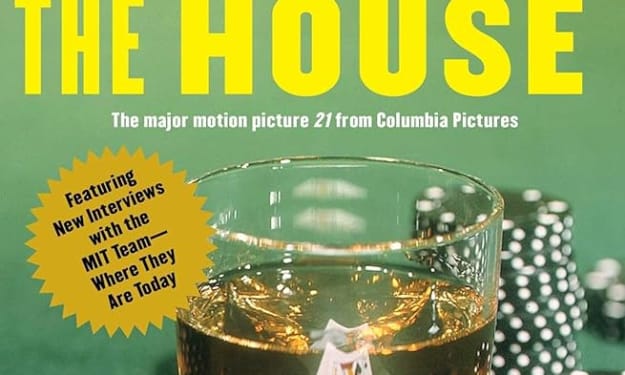
True Crime Book Club: "Bringing Down the House" by Ben Mezrich. Content Warning.
Synopsis: Real life all too rarely offers stories that are quite as satisfying as fiction. Bringing Down the House is one of the exceptions- a real-life action thriller oozing with money, sex and some extremely dodgy dealing... Cheating in casinos is illegal; card-counting - making a record of what cards have so far been dealt to enable the player to make some prediction of what cards remain in the deck - is not. But casinos understandably dislike the practice and make every effort to keep card-counters out of their premises. Bringing Down the House tells the true story of the most successful financial scam ever, in which teams of brilliant young mathematicians and physicists won millions of dollars from the casinos and blackjack tables of Las Vegas, in the process getting drawn into the high life of drugs, sex and spending big. Bringing Down the House is an insight into a closed, excessive and utterly corrupt world of gambling in Las Vegas.
By Kristen Barenthalerabout a year ago in BookClub
50 Alone and Depressed Quotes That Speak the Silent Pain
50 Alone and Depressed Quotes That Feel Exactly Like What You're Going Through Why Do Alone and Depressed Quotes Matter? When someone searches for "alone and depressed quotes" they're not just browsing random sad lines. They're often in a vulnerable space, looking for words that capture what they’re feeling deep inside but struggle to express aloud. It might be after losing someone, feeling misunderstood, or simply being mentally and emotionally drained.
By Owais Ahmedabout a year ago in BookClub
Johann Goethe, Germany’s icon who read the Quran, attacked the Church, and shocked the world with his defense of the Prophet Muhammad
Johann Goethe: The German genius who defied the Church, reflected on Islam and the spirit of humanity Did Johann Goethe convert to Islam before his death? Did you know Napoleon once told him, “You have killed more than I have”? Why is Goethe considered in Germany as the ideal man, embodying the essence of the German soul? He was a literary genius who astonished the entire world when he first read the Quran in German. Goethe was a unique individual, and his relationship with Islam and the Prophet of Islam was truly remarkable, while his relationship with the Church was complex and unusual. He literally said: “There is nothing like Muhammad in human history.” He ended his life with a strange act you wouldn’t imagine a German man doing—I’ll tell you about it later.
By amerelintqamabout a year ago in BookClub
The Book That Made Me Forgive My Inner Child
I used to believe that survival was the same as living. That moving forward—day after day, year after year—meant I had healed. But I hadn’t. I had merely become good at pretending. Pretending that the past was over. That I had grown beyond the tears of a child who only wanted to be heard. That I was strong.
By Muhammad Sabeelabout a year ago in BookClub
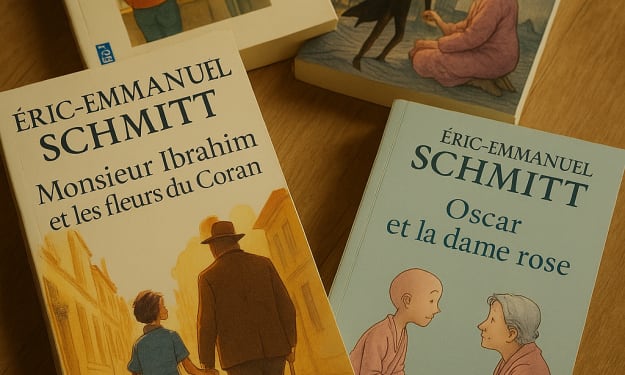
French Stories That Change You
Emotional French Books That Are Simple, Powerful, and Hard to Forget Can a book be both easy to read and deeply meaningful? For beginner and intermediate French learners, the challenge is real: you want to be touched, surprised, even changed by a story—but without having to decode complicated grammar or old-fashioned language. Luckily, French literature offers a treasure trove of short, modern, and unforgettable novels that combine emotion, philosophy, and simplicity. These are not boring “learning tools”—they’re real books, written to move you. And yes, you can understand them. Here’s your gateway to French that speaks to your soul.
By Bubble Chill Media about a year ago in BookClub
Robin Hood
The forest was unusually quiet that morning, as if Sherwood itself held its breath. Mist clung to the trees like a secret, and every bird's song seemed half-sung. In a clearing by the old oak — known as the Greenwood Throne — Robin Hood knelt, tightening the string on his longbow.
By Muhammad Saeedabout a year ago in BookClub