
Satirical Speech, THE MISCOMMUNICATION TRILOGY, “The Tower Of Babble, Vol. III”, Part 12
Book Review

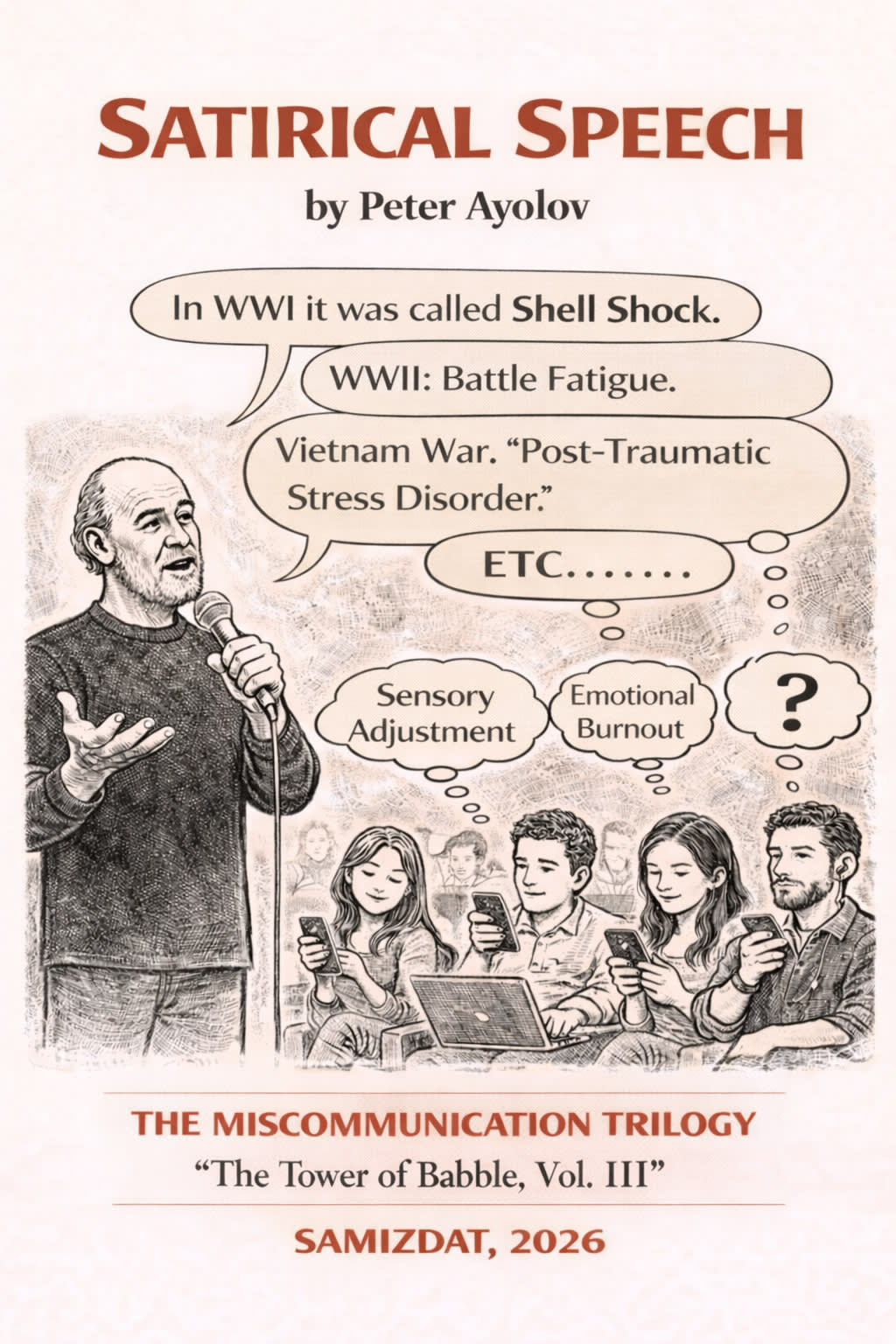
Laughing at the Ruins: A Review of Satirical Speech and the Crisis of Communication
Mapping the Landscape of Satirical Communication
Satirical Speech occupies a distinctive place within The Tower of Babble, Vol. III, and serves as one of the most ambitious examinations of humour, irony, cynicism, parody, and ideological critique within the broader framework of the planned obsolescence of language. Rather than treating satire as a marginal literary genre or a collection of humorous techniques, the volume approaches it as a fundamental mode of communication that emerges whenever official language begins to lose its credibility. The central achievement of the book lies in its ability to connect a vast range of intellectual traditions—including philosophy, psychoanalysis, political theory, literary criticism, cultural studies, media analysis, and communication research—into a coherent investigation of how humour functions within contemporary society. The volume proceeds from a deceptively simple premise: satire becomes necessary when language ceases to describe reality and begins primarily to manage perception. This insight allows the book to move beyond conventional studies of comedy and into a much broader exploration of how modern societies organize meaning through symbolic structures.
One of the strengths of the work is its refusal to reduce satire to a single definition. Instead, the book presents satirical speech as a dynamic communicative phenomenon that appears in multiple forms and historical contexts. Irony, parody, sarcasm, cynicism, black humour, political mockery, religious inversion, and symbolic transgression are examined not as isolated techniques but as interconnected responses to linguistic and ideological tensions. Throughout the volume, satire is shown to perform a dual function. On the one hand, it exposes contradictions within systems of power. On the other hand, it reveals contradictions within those who oppose power. This refusal to romanticize satire distinguishes the book from many contemporary treatments that celebrate humour as an inherently liberating force.
Particularly noteworthy is the volume’s engagement with thinkers such as Hegel, Freud, Lacan, Sloterdijk, Heidegger, Benjamin, and Žižek. Rather than presenting these figures as isolated intellectual authorities, the book places them into dialogue around recurring questions concerning ideology, belief, cynicism, sacrifice, freedom, and symbolic order. Through these discussions, satire emerges as more than a cultural practice. It becomes a diagnostic instrument capable of revealing hidden structures of social reality. The result is a work that continuously moves between historical examples, philosophical reflection, psychoanalytic interpretation, and contemporary political analysis without losing its thematic coherence.
What ultimately makes this first dimension of the book compelling is its recognition that humour is inseparable from communication itself. Satire is not merely something added to language; it is generated by language’s internal contradictions. Whenever words fail to correspond fully to reality, whenever institutions rely upon narratives they cannot completely justify, and whenever individuals discover discrepancies between official ideals and lived experience, the conditions for satirical speech emerge. The volume successfully demonstrates that satire is not an accidental cultural by-product but an inevitable consequence of humanity’s symbolic existence.
Cynicism, Ideology and the Self-Aware Society
The most intellectually provocative sections of Satirical Speech are those devoted to the relationship between humour and ideology. Here the volume departs from traditional theories of satire and enters territory that is both philosophically ambitious and politically relevant. The book repeatedly returns to a central paradox of contemporary life: people often recognize deception, manipulation, and contradiction while continuing to participate in the systems that produce them. This condition, described through various discussions of cynicism and ideological awareness, forms one of the conceptual cores of the volume.
The treatment of cynicism is particularly effective because it avoids simplistic moral judgments. Cynicism is not presented merely as a character flaw or an attitude of pessimism. Instead, it is analyzed as a structural feature of modern communication. Contemporary subjects frequently know that political rhetoric is exaggerated, that advertising manipulates desire, that institutional narratives are selective, and that public performances often conceal strategic interests. Yet this knowledge rarely produces disengagement. Instead, individuals continue to participate in the very systems they criticize. The volume demonstrates how modern ideology has adapted to awareness itself. Rather than depending upon naïve belief, it often survives through a combination of skepticism and participation.
The discussions of kynicism offer an important counterpoint to this analysis. Kynical humour, with its irreverence, vulgarity, and refusal of official seriousness, appears as a possible form of resistance. Yet the book carefully avoids presenting kynicism as a solution. Throughout the volume, there is a persistent recognition that even critical humour may be absorbed by the structures it opposes. Irony becomes fashionable. Rebellion becomes commercialized. Dissent becomes part of the entertainment industry. This insight allows the book to move beyond romantic celebrations of satire and confront its limitations directly.
Another major contribution is the integration of psychoanalytic perspectives into discussions of ideology and communication. The analyses of fetishism, sacrifice, belief, shame, and symbolic authority deepen the study of satire by showing that humour often addresses conflicts that remain inaccessible to straightforward rational discourse. Satirical speech functions not only at the level of conscious criticism but also at the level of desire, fantasy, and unconscious investment. This psychoanalytic dimension gives the book a depth rarely found in studies of humour.
Equally significant is the volume’s treatment of religion and political belief. Discussions of Christianity, Judaism, Gnosticism, revolutionary politics, and ideological commitment reveal that satire frequently emerges at moments of historical rupture. Whenever established symbolic orders encounter crises of legitimacy, humour becomes a means of negotiating uncertainty. Through these analyses, the book demonstrates that satire is deeply connected to broader questions concerning freedom, authority, and collective identity. Humour becomes a way of confronting realities that cannot easily be addressed through conventional political or philosophical language.
The Significance of Satirical Speech in the Age of Linguistic Decline
The greatest accomplishment of Satirical Speech lies in its contribution to the larger argument of The Miscommunication Trilogy. The volume demonstrates that the decline of meaningful communication cannot be understood solely through technological, political, or cultural explanations. It must also be examined through the transformations occurring within language itself. The concept of the planned obsolescence of language provides the broader framework through which the book’s diverse themes acquire coherence. As language becomes increasingly saturated by media spectacle, ideological competition, institutional jargon, promotional narratives, and digital performances, communication begins to lose its capacity to generate shared understanding. Words continue to circulate, but their connection to reality becomes increasingly unstable.
Within this context, satire assumes a special significance. It becomes one of the few communicative forms capable of revealing the contradictions produced by linguistic inflation. While official discourse often attempts to stabilize meaning, satirical speech continually destabilizes it. This does not mean that satire provides access to an uncontaminated truth. On the contrary, one of the book’s central insights is that satire itself remains entangled within the symbolic structures it critiques. Nevertheless, satire retains value because it prevents language from becoming entirely closed. It reopens questions that official narratives seek to settle permanently.
The volume is particularly successful in showing how contemporary communication increasingly resembles theatre. Political leaders become performers. Media institutions become stages. Citizens become audiences and participants simultaneously. Public discourse becomes dominated by narratives competing for emotional investment rather than rational evaluation. Satirical speech exposes the performative dimension of these processes by highlighting their absurdities and contradictions. In doing so, it preserves a space for reflection within environments increasingly dominated by persuasion and spectacle.
As a contribution to communication theory, cultural criticism, and contemporary social analysis, Satirical Speech is both ambitious and timely. Its interdisciplinary approach allows it to address complex questions concerning language, ideology, humour, belief, power, and freedom without reducing them to simplistic formulas. The volume’s greatest strength lies in its willingness to embrace ambiguity. Rather than offering definitive solutions, it encourages readers to confront the contradictions shaping contemporary existence. This openness reflects the very nature of satire itself, which rarely provides final answers but consistently challenges established certainties.
Ultimately, Satirical Speech succeeds because it recognizes that humour is not peripheral to human communication but central to it. The book demonstrates that laughter can reveal truths inaccessible to solemn discourse and that irony often exposes realities hidden beneath official narratives. More importantly, it shows that the struggle over language remains inseparable from the struggle over meaning itself. In an age characterized by information overload, ideological fragmentation, and communicative excess, Satirical Speech provides a compelling exploration of why satire remains one of the most powerful tools available for understanding the modern world.
About the Creator
Peter Ayolov
Peter Ayolov’s key contribution to media theory is the development of the "Propaganda 2.0" or the "manufacture of dissent" model, which he details in his 2024 book, The Economic Policy of Online Media: Manufacture of Dissent.
Enjoyed the story? Support the Creator.
Subscribe for free to receive all their stories in your feed.
Comments
There are no comments for this story
Be the first to respond and start the conversation.