
Political Madness of Words, THE MISCOMMUNICATION TRILOGY, “The Tower Of Babble, Vol. III”, Part 14
Book Review

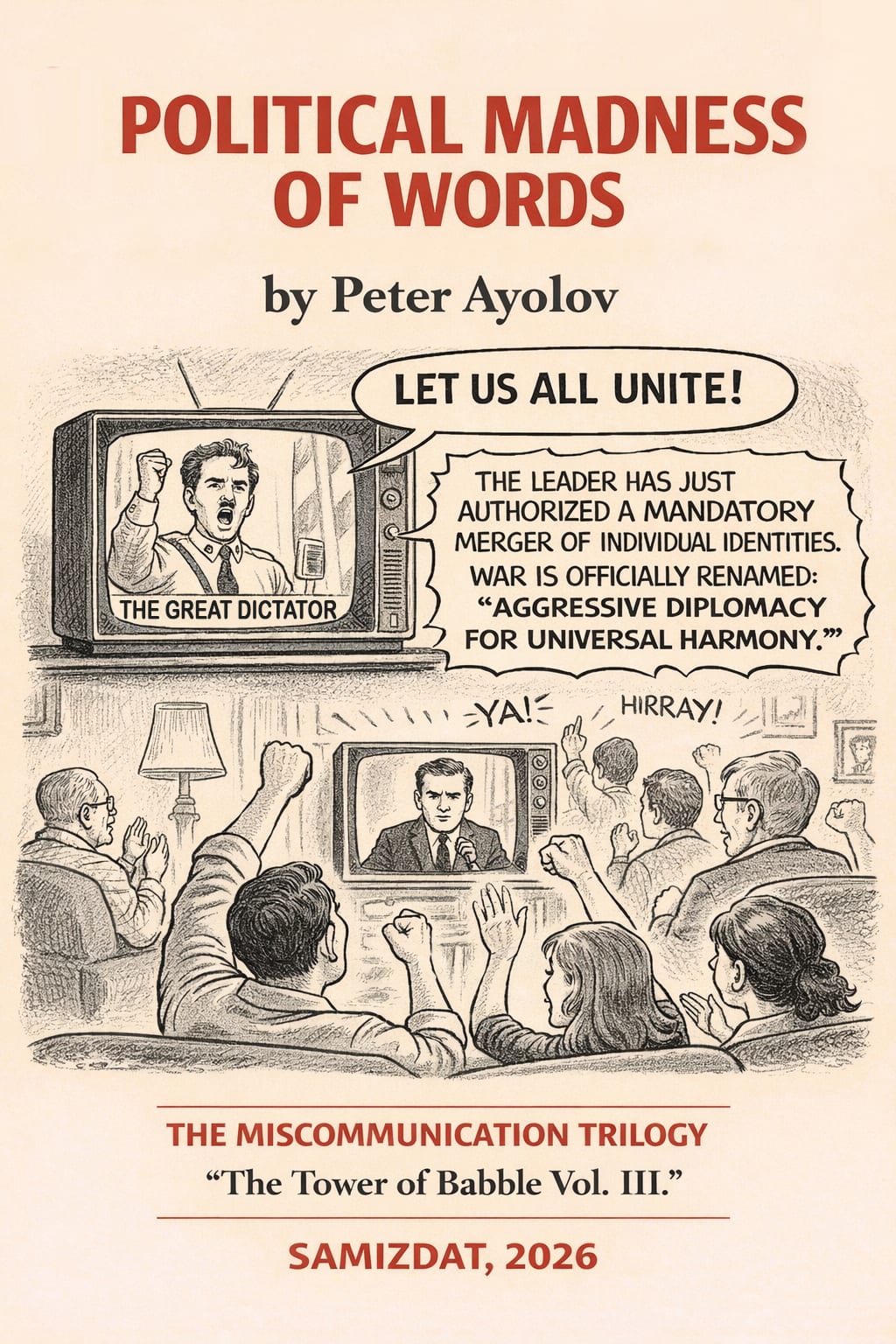
The Tyranny of Meaning: A Review of Political Madness of Words
Language as Power and the Architecture of Reality
Political Madness of Words is one of the most ambitious and intellectually provocative contributions to The Miscommunication Trilogy. Situated within the broader framework of The Tower of Babble, this volume examines the hidden relationship between language, power, crowds, and political consciousness. Rather than treating language as a neutral instrument through which human beings communicate pre-existing ideas, the book argues that language functions as a formative force that shapes reality itself. This central premise serves as the foundation for an extensive exploration of modern political life and its growing dependence on symbolic conflict. Throughout the book, words emerge not merely as descriptive tools but as instruments capable of creating identities, organizing crowds, establishing authority, defining truth, and legitimizing power. The result is a profound critique of contemporary society and its increasing dependence upon linguistic constructions that often obscure rather than clarify reality. One of the book’s greatest strengths lies in its interdisciplinary scope. Drawing from sociology, political theory, psychology, crowd studies, linguistics, philosophy, anthropology, and cultural criticism, the text constructs a comprehensive account of how language operates within systems of power. Rather than limiting itself to a single theoretical tradition, it moves across intellectual boundaries with confidence, bringing together thinkers who are rarely discussed within the same framework. The discussions of crowd psychology, collective behavior, political mobilization, social conformity, and symbolic authority are woven together into a coherent narrative that reveals the extent to which modern social life depends upon the management of meaning. The book repeatedly demonstrates that political struggles are rarely confined to material interests. More often, they revolve around competing definitions of reality itself. Whoever controls the dominant vocabulary gains the power to shape public perception, regulate acceptable discourse, and establish the boundaries of legitimate thought. Particularly impressive is the way the book connects historical examples to contemporary concerns. Discussions of crowds, propaganda, ideological movements, and political leadership are not treated as isolated phenomena but as recurring manifestations of a deeper linguistic process. The reader is encouraged to see modern conflicts not simply as disputes over policies or institutions but as battles over language and interpretation. This perspective offers a valuable corrective to conventional political analysis, which frequently underestimates the role of symbols, narratives, and emotional identification. Political Madness of Words insists that language is never merely a reflection of reality. It is one of the principal mechanisms through which reality is organized, experienced, and contested. By foregrounding this insight, the book provides a powerful framework for understanding many of the social and political tensions that define contemporary life.
Crowds, Madness, and the Politics of Classification
The most original aspect of Political Madness of Words is its examination of the relationship between political power and the concept of madness. Rather than treating madness as a purely medical or psychological phenomenon, the book investigates the ways in which definitions of sanity and insanity emerge from broader social and political contexts. Throughout its chapters, the reader encounters a sustained critique of institutional authority and its capacity to classify human behavior. The text does not deny the existence of psychological suffering, but it questions the assumption that prevailing diagnostic systems represent objective discoveries about human nature. Instead, it presents madness as a category deeply intertwined with cultural values, political interests, and linguistic practices. This argument is developed through extensive discussions of mental health institutions, psychiatric diagnosis, psychotherapy, and the historical treatment of individuals whose behavior challenged prevailing norms. The book repeatedly demonstrates that what one society defines as madness another may regard as wisdom, prophecy, creativity, or political courage. Such observations are not presented merely as historical curiosities but as evidence of a broader problem. If definitions of madness shift across cultures and historical periods, then claims to absolute certainty become increasingly difficult to sustain. The text argues that diagnostic categories often function as instruments of normalization, transforming social disagreements into psychological disorders and converting political questions into therapeutic ones. Equally significant is the book’s treatment of crowds. Building upon classical crowd theory while incorporating more contemporary perspectives, Political Madness of Words explores how collective identities emerge, how individuals become absorbed into larger symbolic structures, and how crowds can both empower and destroy. The crowd appears throughout the book as a paradoxical force. It offers belonging, solidarity, and meaning, yet it also threatens individuality and independent judgment. The discussion extends beyond traditional political gatherings to include modern media systems, digital networks, ideological communities, and symbolic tribes. The reader is shown how contemporary societies increasingly operate through crowd dynamics even when physical crowds are absent. The examination of leadership further enriches this analysis. Political leaders, intellectual authorities, media figures, and institutional experts all appear as participants in a struggle to define reality for others. Their power does not arise solely from coercion but from their capacity to establish authoritative narratives. In this context, the distinction between political influence and psychological influence becomes increasingly blurred. Political Madness of Words demonstrates that both forms of power depend upon the ability to shape language and therefore shape perception itself. This insight gives the book a remarkable degree of relevance in an era characterized by information overload, ideological polarization, and competing realities. It provides a conceptual framework through which readers can better understand the emotional intensity of contemporary political life and the persistent attraction of collective identities.
The Planned Obsolescence of Language and the Future of Human Freedom
The deepest achievement of Political Madness of Words lies in its contribution to the larger intellectual project of The Miscommunication Trilogy. The book does not merely analyze political discourse; it situates political discourse within a broader theory concerning the planned obsolescence of language. This concept serves as one of the trilogy’s most compelling contributions to contemporary social thought. According to this perspective, language is not simply deteriorating through neglect or technological change. Rather, it is becoming progressively detached from shared reality through processes driven by political interests, media systems, institutional incentives, and ideological conflicts. Words proliferate while meaning becomes unstable. Communication expands while understanding declines. Public discourse becomes increasingly fragmented into competing symbolic universes that struggle to coexist. Political Madness of Words explores this process with exceptional clarity. The book argues that the crisis of modern society is fundamentally a crisis of meaning. Political polarization, cultural conflict, social fragmentation, and institutional distrust all reflect a deeper breakdown in the shared linguistic frameworks that once made communication possible. The result is a world in which individuals increasingly inhabit separate realities, each sustained by its own vocabulary, assumptions, and truths. Under such conditions, disagreement becomes difficult to resolve because participants are no longer debating within a common symbolic framework. They are effectively speaking different languages while using the same words.
Yet despite the severity of its diagnosis, the book is not fundamentally pessimistic. Beneath its critique lies a defense of intellectual freedom, individual creativity, and cultural pluralism. The text repeatedly challenges the authority of institutions that claim exclusive access to truth. It encourages skepticism toward rigid classifications and invites readers to recognize the contingency of many social realities that are often taken for granted. This emphasis on humility represents one of the book’s most valuable contributions. By exposing the limitations of political, psychological, and linguistic systems, Political Madness of Words encourages a more tolerant and open understanding of human difference. As a work of social criticism, the book succeeds on multiple levels. It is historically informed, philosophically ambitious, politically provocative, and intellectually coherent. Its synthesis of crowd theory, language theory, political analysis, and cultural criticism is impressive in both scope and execution. More importantly, it addresses questions that are becoming increasingly urgent in contemporary society. How do words shape reality? Who has the authority to define truth? What happens when shared meanings collapse? How should societies respond to difference, dissent, and unconventional ways of understanding the world? Political Madness of Words does not offer simplistic answers to these questions. Instead, it challenges readers to reconsider assumptions that often remain invisible precisely because they are so deeply embedded in everyday life. Ultimately, Political Madness of Words stands as one of the most significant volumes within The Miscommunication Trilogy. It offers a penetrating examination of the political life of language and the linguistic foundations of power. At a time when societies are increasingly divided by competing realities, the book provides an essential reflection on the forces that shape collective consciousness and the fragile structures upon which communication depends. It is both a warning about the dangers of linguistic domination and a defense of the human capacity to create new meanings beyond the limits imposed by political authority. In this sense, the book succeeds not only as an analysis of political madness but also as a meditation on the future of human freedom itself.
About the Creator
Peter Ayolov
Peter Ayolov’s key contribution to media theory is the development of the "Propaganda 2.0" or the "manufacture of dissent" model, which he details in his 2024 book, The Economic Policy of Online Media: Manufacture of Dissent.
Enjoyed the story? Support the Creator.
Subscribe for free to receive all their stories in your feed.
Comments
There are no comments for this story
Be the first to respond and start the conversation.