
Phenomenology and Reason, THE MISCOMMUNICATION TRILOGY “The Conspiracy of Speech, Vol. I.” Part 14
REVIEW

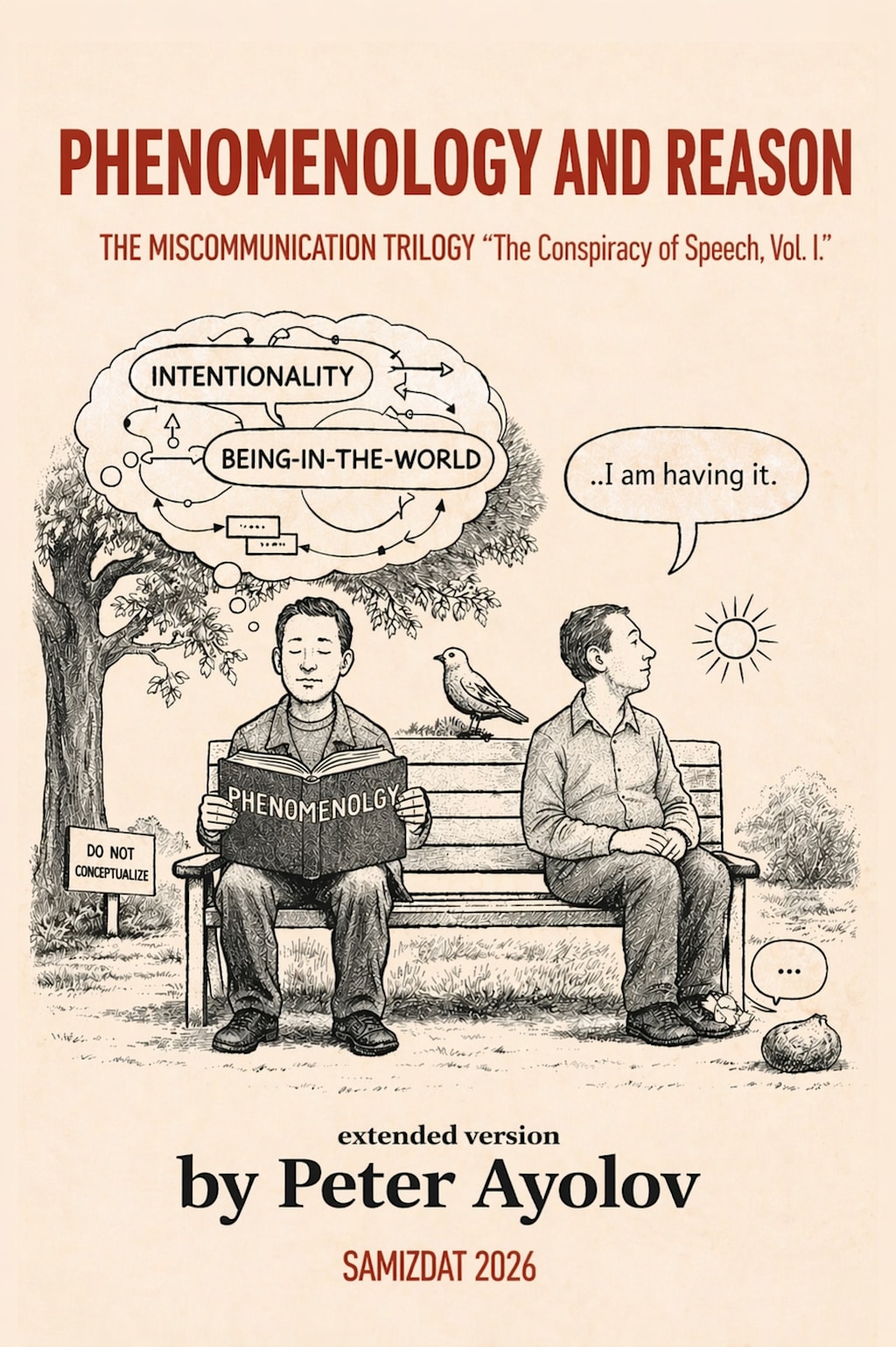
Review
The Collapse of Meaning: A Review of The Conspiracy of Speech, Vol. I, Part 14 Phenomenology and Reason
The Miscommunication Trilogy, The Conspiracy of Speech, Vol. I, Part 14 Phenomenology and Reason presents itself not as a conventional philosophical treatise but as a dense and multi-layered confrontation with the condition of language in late modernity. Drawing extensively on phenomenology, generative linguistics, analytic philosophy, deconstruction, and the sciences of information, the text constructs a sustained argument that language is no longer a stable medium of thought and communication but has entered a phase of accelerated transformation best described as the planned obsolescence of language. This central thesis is not introduced as a metaphor but as a structural diagnosis: language is increasingly shaped by systems that demand constant renewal, replacement, and circulation, thereby undermining its capacity to sustain meaning over time.
What distinguishes this work from many contemporary discussions in the philosophy of language is the breadth of its synthesis. Rather than privileging a single theoretical framework, it moves across traditions, allowing tensions between them to remain visible and productive. The phenomenological perspective, particularly as it emerges from reflections on language as a mode of revealing the world, establishes the initial horizon. Language is not treated as a mere instrument but as the very condition through which reality becomes intelligible. However, this foundational insight is immediately destabilized by the recognition that the medium of disclosure itself is no longer secure. The text shows how the act of speaking, once understood as a bringing-into-presence of meaning, is now entangled in processes of repetition, circulation, and displacement that fracture the relation between expression and what is expressed. This instability is further developed through engagement with modern linguistic theory, especially the research program associated with generative grammar. The idea of a language faculty, an innate and structured capacity that allows humans to generate an infinite range of expressions, provides a counterpoint to the phenomenological emphasis on lived meaning. Yet the text does not treat this as a resolution. Instead, it highlights the tension between the apparent stability of underlying grammatical principles and the variability of the linguistic environments in which they are realized. The process of language acquisition, described as the setting of parameters within a broader universal framework, is shown to depend on input that is increasingly fragmented and mediated. As a result, the languages that emerge are not simply variations within a stable system but products of conditions that themselves lack continuity.
A particularly strong aspect of the book is its treatment of the relationship between competence and linguistic outputs. Drawing on the distinction between internal capacities and external manifestations, it argues that grammar should be understood not merely as a psychological representation but as a theory of linguistic reality. This move allows the text to shift focus from the internal states of speakers to the structures of the expressions they produce. However, it also introduces a crucial complication: if linguistic outputs are increasingly shaped by external systems—technological, social, and economic—then the autonomy of linguistic reality becomes questionable. The rules that govern language may remain intact, but the conditions under which they are applied are transformed, leading to outputs that reflect not only internal competence but external pressures. The critique of representational views of language, particularly those associated with Chomsky’s notion of internalized rules, is handled with nuance. Rather than rejecting the idea that language has a psychological basis, the text questions whether competence requires the explicit representation of rules at all. It suggests that speakers can produce and understand language without possessing propositional knowledge of its structure, thereby shifting attention to the embodied and practical dimensions of linguistic activity. This position aligns with broader philosophical critiques of the idea that meaning is grounded in mental representations, reinforcing the view that language operates through use and practice rather than through internal models.
The book’s engagement with philosophical accounts of meaning is one of its most compelling features. It traces the limitations of both referential theories, which tie meaning to objects in the world, and mentalist theories, which locate meaning in thought. In doing so, it moves toward a more dynamic understanding in which meaning arises from the interplay between linguistic structure and social practice. The discussion of truth-based theories, including those influenced by Frege and Davidson, is particularly effective in showing how the concept of truth conditions attempts to account for the compositional nature of meaning while still leaving unresolved questions about reference and interpretation. The text does not dismiss these theories but situates them within a broader field of inquiry in which their explanatory power is both recognized and limited. Wittgenstein’s later philosophy provides a crucial turning point in this analysis. The rejection of the Augustinian picture of language, with its emphasis on naming and reference, opens the way for a conception of language as a series of practices or language-games. The idea that meaning is determined by use rather than by reference or mental content aligns closely with the book’s broader argument about the instability of language. However, the text also highlights the implications of this view for the possibility of shared understanding. If meaning depends on communal practices, then the fragmentation of those practices in contemporary society undermines the very conditions that make meaning possible. The concept of family resemblance, which replaces the search for a single essence of language, reinforces this sense of multiplicity and openness but also contributes to the difficulty of establishing stable criteria for meaning.
The treatment of rule-following and the critique of private language further deepen this analysis. By showing that understanding a rule cannot be reduced to an internal mental act but must be grounded in shared practices, the text emphasizes the inherently social nature of language. At the same time, it reveals the fragility of this social grounding in a context where shared practices are no longer stable. The argument against private language, which depends on the necessity of public criteria for meaning, becomes particularly significant in a world where communication increasingly occurs through mediated and individualized channels. The engagement with deconstruction introduces another layer of complexity. The idea that meaning is always deferred, that it emerges through a system of differences in which no sign is fully present, resonates strongly with the book’s central theme. The concept of the trace and the critique of phonocentrism challenge the traditional privileging of speech over writing and highlight the ways in which language operates independently of any single speaker’s intentions. The notion that there is nothing outside the text is not treated as a denial of reality but as an acknowledgment that meaning is always shaped by the contexts and practices in which language is used. This perspective reinforces the idea that language cannot provide a final or stable foundation for meaning.
One of the most ambitious aspects of the book is its extension of the analysis of language into the domain of information theory and the natural sciences. The shift from a materialist understanding of reality to one centered on information introduces a new framework for thinking about language. Information is defined not by what is present but by what is absent, by the constraints that shape possible states. This negative characterization provides a powerful way of understanding how language can have causal effects despite the instability of its meanings. The discussion of Shannon’s theory of information, with its focus on entropy and the transmission of signals, highlights the gap between syntactic information and semantic content. While we can measure the capacity of a medium to carry information, we struggle to explain how that information comes to mean something. The incorporation of biological and evolutionary perspectives adds further depth to this analysis. The idea that living systems are fundamentally informational, that they interpret and respond to signals in ways that sustain their existence, suggests that meaning is not an intrinsic property of signals but arises from the dynamics of the systems that interpret them. This perspective aligns with the view that language is not a self-contained system but one that is embedded in broader processes of interaction and adaptation. The discussion of DNA as a form of coding information, as well as the distinction between syntactic, semantic, and pragmatic information, provides a useful framework for understanding the different dimensions of meaning.
The book’s exploration of the relationship between information, consciousness, and reality is both provocative and speculative. The suggestion that consciousness may be a fundamental aspect of reality, rather than a byproduct of physical processes, challenges conventional scientific assumptions. The idea that the universe itself can be understood as an informational system, potentially guided by a principle of selection or value, introduces a metaphysical dimension that connects the analysis of language to broader questions about existence. While these arguments are not fully developed, they serve to expand the scope of the inquiry and to situate the problem of language within a larger philosophical context. The theological dimension of the text, particularly in its discussion of information as an analogy for divine action, is handled with a degree of caution. Rather than attempting to translate theological claims into scientific terms, the text emphasizes the role of analogy in understanding concepts such as meaning, purpose, and value. The idea that the universe can be seen as an informational system through which meaning emerges allows for a reinterpretation of traditional theological concepts without reducing them to empirical claims. The discussion of noise and redundancy, as well as the balance between order and randomness, provides an interesting framework for thinking about the presence of contingency and structure in the world.
Despite its many strengths, the book is not without its challenges. Its ambition, while impressive, sometimes leads to a density that can be difficult to navigate. The integration of multiple theoretical frameworks, while intellectually rich, occasionally results in a lack of clear transitions between different domains of inquiry. The speculative nature of some of its later sections, particularly those dealing with cosmology and theology, may also be seen as a departure from the more grounded analyses of language and meaning that characterize earlier parts of the text. However, these issues do not detract significantly from the overall coherence of the work; rather, they reflect the difficulty of addressing a problem as complex and multifaceted as the one the book undertakes. Ultimately, The Miscommunication Trilogy, The Conspiracy of Speech, Vol. I, Part 14 Phenomenology and Reason succeeds in presenting a compelling and original diagnosis of the contemporary condition of language. By bringing together insights from diverse traditions, it reveals the extent to which language is implicated in broader transformations in knowledge, reality, and human existence. The concept of the planned obsolescence of language provides a powerful lens through which to understand these changes, highlighting the ways in which language is shaped by forces that both enable and undermine its function. The book does not offer easy solutions or definitive answers. Instead, it invites the reader to confront the instability of language and to reconsider the assumptions that underlie our understanding of meaning and communication. In doing so, it opens a space for further inquiry, one that recognizes the limits of language while continuing to engage with its possibilities.
About the Creator
Peter Ayolov
Peter Ayolov’s key contribution to media theory is the development of the "Propaganda 2.0" or the "manufacture of dissent" model, which he details in his 2024 book, The Economic Policy of Online Media: Manufacture of Dissent.
Enjoyed the story? Support the Creator.
Subscribe for free to receive all their stories in your feed.
Comments
There are no comments for this story
Be the first to respond and start the conversation.