
Obscenity and Hate Speech, THE MISCOMMUNICATION TRILOGY, “The Tower OF Babble, Vol. III”, Part 5
Book Review

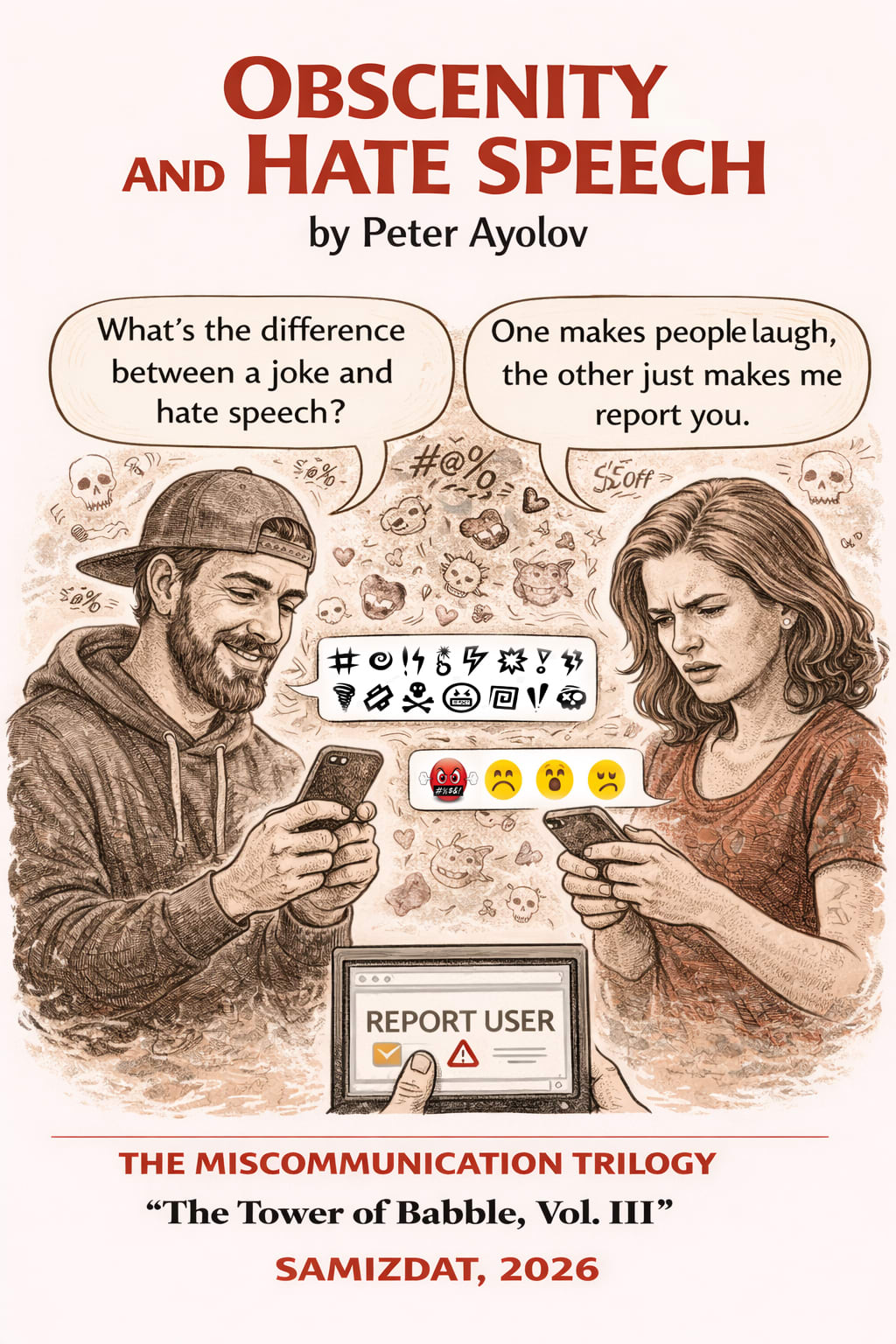
The War of Words: Language, Power and the Architecture of Offense
A JOURNEY INTO THE DARKEST REGIONS OF COMMUNICATION
Obscenity and Hate Speech, the fifth volume of The Tower of Babble and a key installment in Peter Ayolov’s Miscommunication Trilogy, is an ambitious and intellectually provocative examination of one of the most contentious subjects in modern society: the relationship between language, violence, censorship, identity, and power. While many books approach profanity, hate speech, or offensive language as isolated social problems, this volume situates them within a much larger framework. It argues that obscenity and hate speech are not merely linguistic curiosities or legal dilemmas but symptoms of a deeper communicative crisis that affects contemporary civilization. The book’s central contribution lies in its ability to connect seemingly unrelated phenomena—swearing, cyberbullying, terrorism, propaganda, political euphemisms, workplace harassment, online outrage, and censorship—into a coherent narrative about the deterioration of meaningful communication.
The volume begins from a simple but powerful premise: words matter. They shape perceptions, construct realities, establish identities, and influence behavior. Throughout the book, language is presented not as a passive medium through which information travels but as an active force capable of producing social and political consequences. The reader is guided through an extensive exploration of how societies determine which words become taboo, how offensive language acquires its power, and why attempts to suppress certain forms of speech often intensify their symbolic significance. This examination of profanity is particularly effective because it moves beyond simplistic moral judgments. Rather than asking whether swearing is good or bad, the book investigates why some words possess extraordinary emotional power while others do not. In doing so, it reveals the social mechanisms that create linguistic taboos and sustain them across generations.
One of the volume’s greatest strengths is its interdisciplinary scope. Drawing from linguistics, psychology, communication theory, political science, sociology, media studies, and history, the author constructs a panoramic view of offensive language in all its forms. The reader encounters discussions of profanity research, studies of hate speech detection, analyses of bullying and cyberbullying, examinations of extremist discourse, and critiques of official political rhetoric. These diverse topics are united by a common concern: the ways language can be used to dominate, manipulate, exclude, or dehumanize. Rather than treating language as neutral, the book consistently demonstrates that communication is embedded within systems of power.
The historical dimension of the work is equally impressive. The discussion of political rhetoric, military euphemisms, and totalitarian language highlights the continuity between past and present forms of linguistic manipulation. References to propaganda, bureaucratic discourse, and ideological language reveal that the struggle over words is as old as organized society itself. Yet the book avoids becoming merely historical. Its primary focus remains contemporary, addressing the communicative challenges of the digital age. Social media platforms, online communities, and algorithmic communication systems are shown to amplify conflict, reward outrage, and accelerate the spread of offensive discourse. The result is a communicative environment in which language increasingly functions as a weapon rather than a bridge.
THE POLITICS OF OFFENSE AND THE ECONOMY OF HATRED
Perhaps the most compelling aspect of Obscenity and Hate Speech is its exploration of the relationship between language and power. Rather than portraying hate speech simply as a collection of offensive words, the book examines the broader social processes through which language becomes harmful. Hate speech is shown to operate through narratives, stereotypes, metaphors, and symbolic systems that transform social differences into moral hierarchies. In this respect, the volume moves beyond legal debates and enters the territory of cultural analysis. It asks not only what hate speech is, but why societies repeatedly generate it.
The chapters dealing with extremist discourse are among the strongest in the volume. Drawing upon research into jihadist rhetoric, propaganda texts, and radicalization processes, the author demonstrates how language can be used to normalize violence and recruit supporters. Particularly insightful is the analysis of the continuum between moderate, fringe, and extreme discourses. Rather than presenting radicalization as a sudden transformation, the book portrays it as a gradual process of linguistic and ideological reorientation. Readers are shown how concepts such as brotherhood, victimhood, obligation, purity, and justice are strategically redefined within extremist texts. The result is a persuasive account of how language functions as a mechanism of ideological socialization.
Yet one of the book’s most original contributions is its refusal to isolate extremist language from mainstream political discourse. Throughout the volume, a recurring argument emerges: the rhetorical strategies used by terrorists, cults, and extremists often resemble those employed by states, governments, and institutions. This comparison is particularly striking in discussions of military euphemisms such as “collateral damage,” “friendly fire,” and “shock and awe.” The analysis reveals how official language frequently performs the same function as extremist rhetoric—transforming violence into necessity, obscuring suffering behind abstraction, and creating moral distance between action and consequence. While some readers may find this comparison controversial, it serves an important analytical purpose by exposing the common linguistic mechanisms through which violence is legitimized.
The treatment of bullying and cyberbullying further strengthens the book’s argument. These chapters illustrate how power imbalances operate at interpersonal as well as institutional levels. The discussion moves beyond simplistic narratives of victims and perpetrators to examine the social conditions that make bullying possible. The analysis of academic bullying is especially noteworthy, exposing the hidden hierarchies and informal power structures that often characterize universities and research institutions. By placing cyberbullying alongside propaganda, hate speech, and political rhetoric, the author demonstrates that linguistic violence exists across multiple scales of social life.
Another notable strength is the book’s attention to technology. Social media emerges not merely as a communication platform but as an environment that actively shapes discourse. The speed, anonymity, and reach of digital communication create new opportunities for harassment, radicalization, and symbolic conflict. The book argues persuasively that technological innovation has transformed the conditions under which offensive language circulates. At the same time, it warns against simplistic technological determinism. Social media may amplify hostility, but the underlying mechanisms remain rooted in human psychology, social identity, and political conflict.
TOWARD A THEORY OF COMMUNICATIVE CIVILIZATION
Beyond its analysis of obscenity, hate speech, and linguistic violence, the book ultimately offers a broader reflection on the condition of contemporary civilization. The volume’s deepest concern is not profanity itself but the erosion of meaningful communication. Throughout the text, offensive language serves as a lens through which larger questions about truth, identity, power, and social cohesion are examined. The book repeatedly returns to the idea that modern societies are experiencing a crisis of communication in which words increasingly lose their capacity to foster understanding and instead become tools of manipulation and conflict.
This concern connects the volume directly to the larger intellectual project of the Miscommunication Trilogy. The concept of the Planned Obsolescence of Language provides the framework within which the book’s diverse themes acquire coherence. According to this perspective, language is undergoing a process of degradation similar to the planned obsolescence found in consumer products. Words become disposable, meanings become unstable, and communication becomes increasingly fragmented. Political slogans replace arguments. Identity markers replace dialogue. Emotional reactions replace reflection. In such an environment, misunderstandings are not accidental but systemic.
The volume does not succumb to pessimism, however. One of its most valuable features is its exploration of alternatives. The discussions of nonviolent communication, empathy, restorative dialogue, and compassionate language provide a constructive counterpoint to the darker material. These chapters suggest that language can also serve as a force for reconciliation and understanding. By emphasizing observation, feelings, needs, and requests rather than judgment and blame, nonviolent communication offers a radically different vision of human interaction. Whether one fully accepts this model or not, its inclusion enriches the volume by demonstrating that communication need not be confined to domination and conflict.
As a work of intellectual synthesis, Obscenity and Hate Speech is remarkably successful. It brings together an enormous range of material while maintaining a clear thematic focus. Its greatest achievement lies in demonstrating that offensive language is not a marginal issue but a central feature of modern social life. Profanity, hate speech, bullying, propaganda, and euphemism are revealed as interconnected elements within a broader communicative ecology. By tracing the relationships among these phenomena, the book offers readers a deeper understanding of how language shapes both individual experience and collective reality.
Ultimately, Obscenity and Hate Speech is not merely a book about offensive words. It is a book about the human condition in an age of communicative excess. It challenges readers to reconsider the assumptions that govern public discourse and to recognize the profound power of language in shaping perception, behavior, and social order. As part of The Tower of Babble and the wider Miscommunication Trilogy, it stands as a significant contribution to contemporary discussions about language, power, and the future of communication. It is a thoughtful, provocative, and timely work that asks one of the most important questions facing modern society: what happens when the very tool designed to connect us becomes the principal mechanism through which we divide ourselves?
About the Creator
Peter Ayolov
Peter Ayolov’s key contribution to media theory is the development of the "Propaganda 2.0" or the "manufacture of dissent" model, which he details in his 2024 book, The Economic Policy of Online Media: Manufacture of Dissent.
Enjoyed the story? Support the Creator.
Subscribe for free to receive all their stories in your feed.
Comments
There are no comments for this story
Be the first to respond and start the conversation.