
Moments of Craft in “The Dream Hotel” by Laila Lalami
Let’s look at a few shining moments of craft from a Pulitzer Prize Finalist.


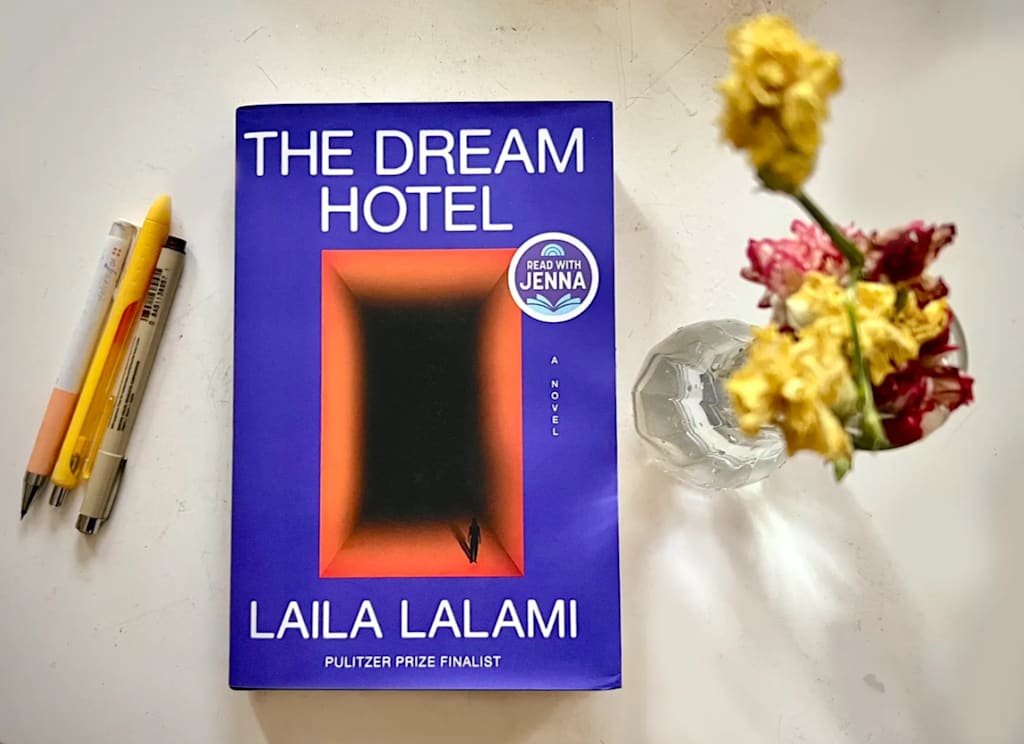
Moments of Craft is a series of essays where I share examples of excellent writing in books I read. The Dream Hotel is an incredible literary sci-fi novel with literary fiction inclinations, like deep character work. I’m an MFA grad, and I try to pay attention to moments of excellent craft in every book I read.
This is nowhere near an exhaustive list of every moment of brilliant craft in The Dream Hotel. These are passages that jumped out to me and embody principles of the craft of writing that could be useful for all of us writers to pay attention to.
I picked up The Dream Hotel since I was intrigued by the near-future sci-fi premise. I’m a nerd about dreams; I’ve researched things like studies on manipulating dreams and advocated for writers to keep a dream journal, since they explore creative parts of our subconscious mind that may not come out in any other way. Basically, my intrigue in dreams is nothing new.
1. Strategic character descriptions that shed light on the setting
Explaining the setting takes work in any genre, but sci-fi has it a little extra hard. Let’s take a look at a character description early in the novel.
“This morning his hair looks freshly cut, bringing out his cheekbones and bright, hungry eyes. But his fine features are muddled by the burn scar that runs along the base of his neck, just above the stiff collar of his uniform. The scar is a frequent subject of gossip at Madison. Some people say Hinton was injured in the Tujunga complex fire, which burned his house to the ground and killed his dog, supposedly a German shepherd. Others point out that the scar looks old, so it must be the mark of a youthful accident, a mishap with a firecracker, say, or a brawl around a campfire. Who knows? But the scar gives him substance, rescues his looks from bland perfection.”
First of all, we have an organic reason why Sara is noticing Hinton’s cheekbones and bright, hungry eyes. He just got a haircut. That’s a change that makes her paying attention to his features feel justified.
Additionally, we get so much information in this paragraph. Here are some of the things we learn:
- Detainees gossip frequently
- These facilities for dreamers with risky dreams have had problems in the past
- Hinton is a perfectionist and maintains his uniforms well
We could mine this for more, but these are key pieces of information implied so seamlessly.
2. Moments of seamless exposition for worldbuilding
In a seamless shift from present to past, our protagonist, Sara, remembers the early months of caring for her newborn twins. Like most new moms, she’s exhausted and sleep deprived. However, her husband, Elias, “had a Dreamsaver, so the minute he went to bed he fell asleep, and woke up from his four-hour long nap as refreshed as if he had slept eight hours. Lucky bastard.”
I loved the little inclusion of lucky bastard, since it reminds us we are in a specific character’s perspective, not just infodumping backstory elements onto our readers. It adds personality to the prose and even a little bit of humor.
The excellent worldbuilding continues from there:
“She couldn’t go on like this, she just couldn’t. She’d been reluctant to get a Dreamsaver because she was squeamish about the procedure, but when she scheduled the appointment, a brochure appeared in her inbox that put her fears to rest. The original device had been designed in the 2000s”(…)
Again, we’re leading more about how this miraculous sci-fi device works, but we’re staying grounded in Sara’s experience of the world. Exposition is hard to include for mindful writers of infodumping.
3. Meaningful inclusion of multimedia or non-standard narrative formatting
I love insertions of things like transcripts, letters, forms, and headlines. Lalami isn’t the first person to do this; authors like Rebecca Ross do it seamlessly in Divine Rivals, and going further back, Frederick Pohl takes it to the extreme in his sci-fi novel Gateway and sprinkles in things like ads for bizarre sci-fi services we could see in the future.

We have a few inclusions of meeting minutes throughout the book, but I wanted to include this early one.

4. Creating a throughline from past to present to ground sci-fi
The Dream Hotel is near-future, so it is a bit easier to keep grounded than a space opera. But Lalami makes brilliant connections to the historical contexts of her work.
“In any case crime is relative, its boundaries shifting in service of the people in power. Once upon a time, adultery and miscegenation used to be crimes; now they aren’t. Burning flags and collecting rainwater were once legal; now they aren’t. A crime isn’t the same as a moral transgression. The law delineates the former, never the latter. I have done nothing wrong, Sara thinks. It’s only that the line of legality has moved, and now I’m on the wrong side of it.”
I was recently chatting with a teetotaler friend of mine about the over-normalization of binge alcohol consumption in media. Specifically, episodic TV series, where there’s a problem every weekly episode (because we need drama, of course!), but the characters who are supposed to be healthy doctors partake in binge drinking often enough to warrant a discussion that they might have a problem, if we think too much about the frequency. And then I mentioned how I’ve been back and forth with other friends about which is really worse for once a week consumption–alcohol or marijuana, since the latter has been legal in NJ and NY for a while now.
The line of legality is always moving. We see it in our current lives, there’s a historical precedent for it, and it’s basically guaranteed to keep happening in the future. This is an excellent moment of craft because it reminds us why the premise, being detained in a prison-like center for a risky dream,
5. How much worldbuilding can you do with a single piece of punctuation?
A lot.
“The sound of elevator doors reminds her of the task at hand: a donor event on the tenth floor. Just as she’s about to enter the elevator, out come two men. One is a young politician whose face is familiar, but whose name she can’t recall, and the other is Albert Finney. Albert Finney!”
This part jumped out at me because I have several important politicians in my sci-fi novel, all of whom I’ve failed to convey their importance. But Lalami does it so simply and so in the voice of her character. The paragraph goes on to describe Finney’s yellow tuxedo and how “she’s tempted to point the actor out”. With so few words spent, I understand that Finney is a celebrity in this world, and the revelation that he is an actor is mixed into action. Just spot on.
There are so many other moments of craft I bookmarked in The Dream Hotel, but I don’t want to reveal any spoilers, since it’s a fantastic novel that I recommend reading to any sci-fi fan.
About the Creator
Leigh Victoria Phan, MS, MFA
Writer, bookworm, sci-fi space cadet, and coffee+tea fanatic living in Brooklyn. I have an MS in Integrated Design & Media and an MFA in Fiction from NYU. I share poetry on Instagram as @SleeplessAuthoress.
Enjoyed the story? Support the Creator.
Subscribe for free to receive all their stories in your feed. You could also become a paid subscriber, letting them know you appreciate their work.
Comments
There are no comments for this story
Be the first to respond and start the conversation.