
Miscommunication and Obfuscation, THE MISCOMMUNICATION TRILOGY “The Conspiracy of Speech, Vol. I.” Part 21
Book Review

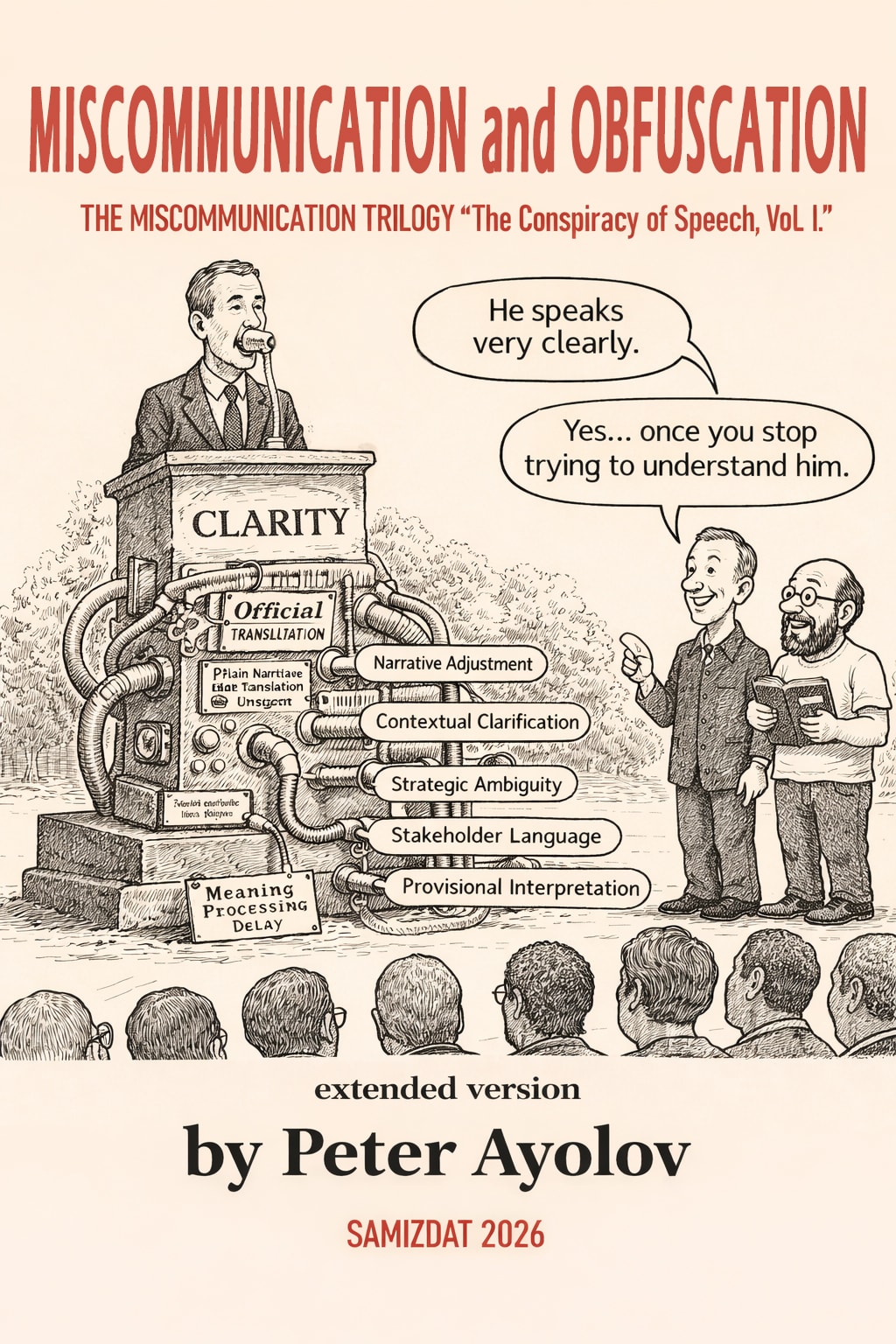
The Architecture of Miscommunication: A Radical Reassessment of Language, Power, and Human Origins
This book is an ambitious, provocative, and deeply polemical intervention into one of the most fundamental questions of human existence: what is language, and what does it mean to be human? Positioned at the intersection of linguistics, anthropology, philosophy, and political theory, it challenges not only dominant scientific paradigms but the very conditions under which knowledge about language has been produced and legitimized in the modern world. What emerges is not a neutral survey of competing theories, but a sustained critique of what the author sees as a profound distortion at the heart of contemporary thought—a distortion that has turned language from a collective human achievement into an instrument of fragmentation, obscurity, and control.
At its core, the book advances a bold and uncompromising thesis: language did not originate as an internal, computational system located within the individual brain, but as a social, political, and cooperative breakthrough in human evolution. This position stands in direct opposition to the dominant Chomskyan paradigm, which has framed language as an innate biological faculty—often described as a “mental organ”—whose primary function is the generation of thought rather than communication. The author does not merely disagree with this view; he subjects it to an extensive historical, philosophical, and ideological critique, arguing that it reflects not only a scientific stance but a broader political and institutional context that has shaped the trajectory of modern linguistics. One of the book’s most striking features is its insistence that theories of language cannot be separated from the conditions under which they emerge. The rise of formal linguistics in the mid-20th century is presented not as a purely intellectual development but as something deeply entangled with Cold War politics, military funding, and a broader cultural shift toward abstraction and technical specialization. In this context, the Chomskyan focus on syntax, formal rules, and internal structures appears not as a neutral scientific choice but as part of a wider movement to detach knowledge from social and political realities. The result, according to the author, is a theory of language that is elegant, powerful, and internally consistent—but fundamentally disconnected from the lived, communicative, and cooperative dimensions of human life.
This critique is not limited to linguistics. It extends to the broader structure of modern knowledge, which the book portrays as increasingly fragmented and compartmentalized. The proliferation of specialized disciplines, each with its own terminology and methods, has created a situation in which communication across fields becomes difficult, if not impossible. Science, which once functioned as a communal enterprise grounded in shared inquiry, now risks becoming a collection of isolated silos. In this sense, the book’s title theme—miscommunication and obfuscation—is not merely descriptive but diagnostic. It identifies a systemic condition in which the very tools designed to produce understanding have become barriers to it. Against this backdrop, the book offers an alternative vision grounded in evolutionary anthropology and social theory. Drawing on the work of figures such as Michael Tomasello, Sarah Hrdy, and especially Chris Knight, the author reconstructs the origins of language as part of a broader “human revolution.” In this account, the emergence of symbolic culture is inseparable from the development of cooperation, empathy, and collective action. Language arises not from a solitary mutation or a sudden computational leap, but from a transformation in social relations—one that enabled early humans to coordinate behavior, establish shared norms, and create stable systems of meaning.
The emphasis on cooperation is particularly important. Where traditional models often highlight competition, dominance, and individual advantage, this book foregrounds solidarity, mutual dependence, and the capacity for collective organization. The argument that early human culture may have been shaped by forms of gender solidarity, especially among women, is one of the more controversial aspects of the work. Drawing heavily on Knight’s theory of the “sex strike” and the role of menstrual synchrony, the book presents a vision of human origins in which the regulation of sexual and social relations played a निर्णative role in the emergence of symbolic systems. Whether one accepts this specific model or not, it serves to underscore the book’s broader point: that language cannot be understood apart from the social and political conditions that made it possible. The book’s engagement with myth, ritual, and symbolism is another notable strength. Rather than dismissing these as primitive or irrational, it treats them as early forms of collective knowledge—ways of encoding and transmitting crucial information about social organization, cooperation, and survival. In this sense, myth is not opposed to science but represents a different stage in the development of human understanding. This perspective allows the author to draw connections between ancient symbolic systems and modern scientific paradigms, suggesting that both are shaped by underlying structures of power and collective practice.
At the same time, the book is careful to maintain a distinction between science and myth. It rejects extreme forms of relativism that would reduce all knowledge to mere social construction, arguing instead for a more nuanced view in which scientific knowledge is both socially situated and capable of progressive refinement. Science, in this account, is defined not by its detachment from society but by its capacity to be shared, tested, and validated collectively. It is a form of knowledge that expands human power—understood not as domination but as the ability to understand, predict, and transform the world in ways that benefit the species as a whole. This emphasis on collective validation leads to one of the book’s most compelling claims: that the true measure of knowledge is its accessibility. A theory that cannot be communicated, challenged, and understood beyond a narrow elite fails not only as a social practice but as a scientific one. In this sense, the book’s critique of technical language and specialized jargon is not anti-intellectual but deeply democratic. It calls for a form of inquiry that remains rigorous while also being open, transparent, and responsive to broader human concerns.
The discussion of scientific revolutions, drawing on Thomas Kuhn, adds another layer to the analysis. The book argues that major shifts in knowledge are not purely logical or empirical but involve deep social and political transformations. Paradigms persist not only because they explain data but because they are embedded in institutional structures that resist change. When anomalies accumulate, they do not automatically lead to new theories; they must first overcome the inertia of established systems. This perspective is applied to linguistics, where the dominance of the Chomskyan paradigm is portrayed as both an intellectual achievement and a form of institutional entrenchment. Despite its many strengths, the book is not without its challenges. Its tone is often polemical, and its critique of Chomsky can at times feel overly personalized. While the author raises important questions about the limitations of formal linguistics, some readers may feel that the argument would benefit from a more balanced engagement with the diversity of contemporary research in the field. Similarly, the reliance on specific anthropological models—particularly those associated with Chris Knight—may strike some as speculative or insufficiently supported by empirical evidence.
There is also a risk that the book’s sweeping narrative, which connects language, politics, science, and human evolution into a single framework, may oversimplify complex debates. The desire to overcome fragmentation is understandable, but it raises the question of whether all forms of specialization can or should be integrated into a unified perspective. The tension between unity and complexity, which the book identifies as a central problem, is not easily resolved. Nevertheless, these concerns do not diminish the book’s overall significance. Its greatest strength lies in its ability to reframe familiar questions in unexpected ways. By placing language within a broader context of social practice and power, it opens up new avenues for thinking about communication, knowledge, and human nature. It challenges readers to reconsider assumptions that are often taken for granted and to reflect on the conditions that shape their own understanding.
In its concluding sections, the book turns from critique to possibility. It suggests that the same capacities that once enabled the emergence of language—cooperation, empathy, and collective reasoning—remain available to us today. The problem is not that we lack the ability to communicate, but that our systems of knowledge and power inhibit its full realization. Overcoming miscommunication, therefore, is not simply a matter of improving individual skills but of transforming the structures that produce and sustain fragmentation. This vision is both inspiring and demanding. It calls for a reorientation of science toward its communal roots, a breaking down of disciplinary barriers, and a renewed commitment to shared understanding. It also implies a political project: the creation of conditions in which knowledge can serve the interests of humanity as a whole rather than those of a privileged few. Whether such a transformation is achievable remains an open question, but the book makes a compelling case that it is necessary.
In conclusion, this is a work that resists easy categorization. It is at once a critique of linguistics, a theory of human origins, a philosophy of science, and a political manifesto. Its arguments are bold, its scope is wide, and its ambitions are unmistakably grand. Not all readers will agree with its conclusions, and some will find its approach contentious. But it is precisely this willingness to challenge established boundaries that makes the book so valuable. It forces us to confront the possibility that our deepest assumptions about language and knowledge may be part of the problem—and that understanding them differently could open the way to a more coherent, collective, and genuinely human future.
About the Creator
Peter Ayolov
Peter Ayolov’s key contribution to media theory is the development of the "Propaganda 2.0" or the "manufacture of dissent" model, which he details in his 2024 book, The Economic Policy of Online Media: Manufacture of Dissent.
Enjoyed the story? Support the Creator.
Subscribe for free to receive all their stories in your feed.
Comments
There are no comments for this story
Be the first to respond and start the conversation.