
Matter in Revolt: How Diamat Becomes History
The Architecture of Chaos in the 21st Century

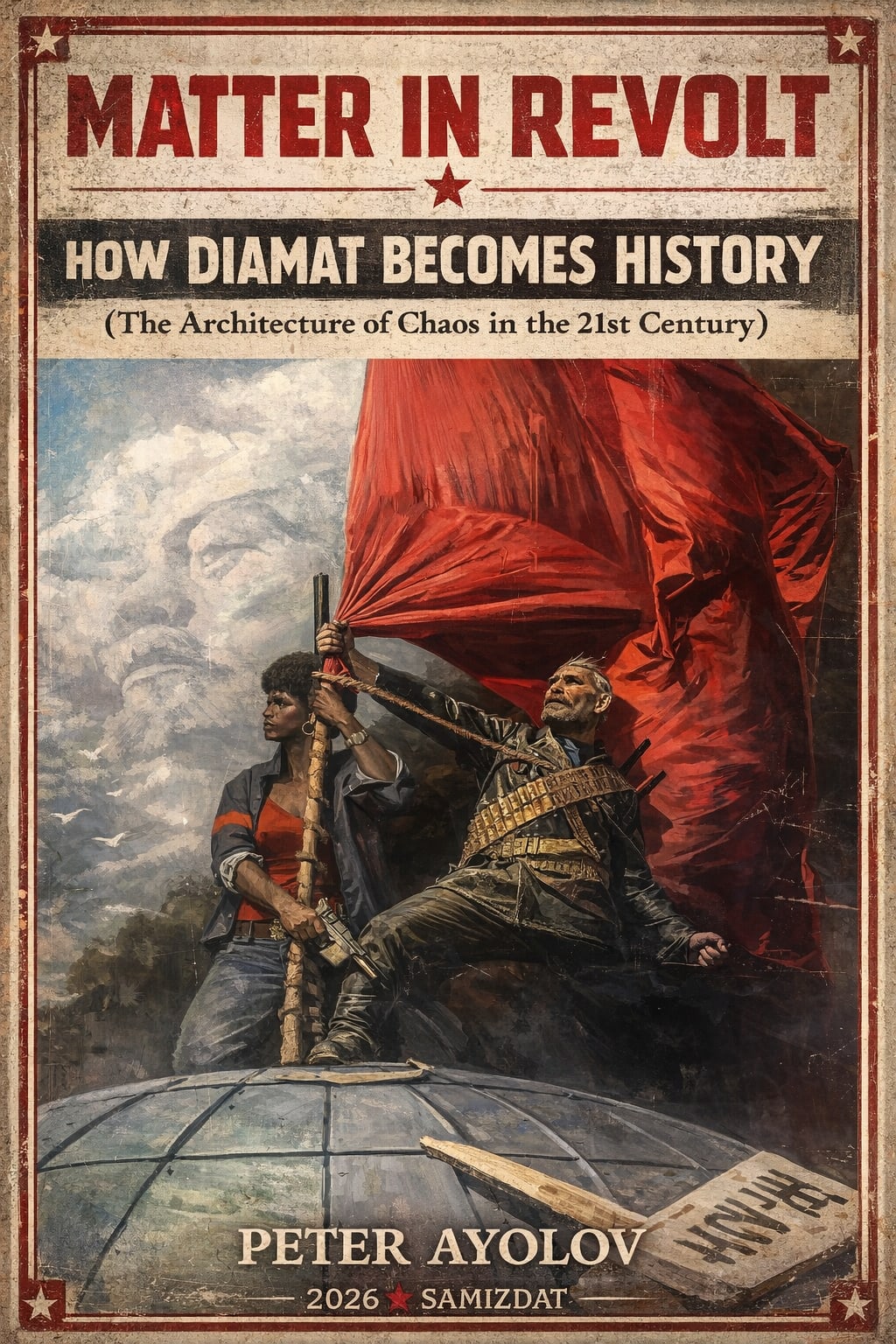
Matter in Revolt: How Diamat Becomes History
(The Architecture of Chaos in the 21st Century)
2026
Peter Ayolov
Introduction: The Forgotten Compass: Why Diamat Deserves a Second Look
Today it may be useful to look back at dialectical materialism without the anger, fear, and ideological passions that surrounded it throughout much of the twentieth century. Beneath political conflicts, historical controversies, and competing interpretations lies a remarkable intellectual ambition: the attempt to create a universal framework capable of explaining social reality in a manner accessible to ordinary people rather than restricted to specialists, priests, or ideological guardians. If materialism is understood not merely as matter in a narrow physical sense but as the totality of concrete processes, relationships, structures, technologies, institutions, energies, and forms of existence that shape human life, then dialectical materialism becomes far more than a historical doctrine. It becomes a method for understanding how reality develops through interaction, contradiction, and transformation. Unlike systems that depend upon sacred authority, inherited dogma, or rituals whose meaning is accepted without examination, dialectical thought insists that explanations should remain open to observation, criticism, revision, and public discussion. Its attraction lies in its aspiration to provide a common language for understanding society without requiring adherence to supernatural beliefs or exclusive cultural traditions. In an increasingly fragmented world divided by competing identities, incompatible moral systems, and mutually incomprehensible narratives, such an ambition deserves renewed attention. From this perspective, dialectical materialism appears not merely as a philosophy of history but as a possible framework for coexistence. Because its foundations rest upon a shared material reality rather than a particular religion, ethnicity, nation, or cultural identity, it possesses a universal character that few modern ideologies can claim. Its promise is the possibility of analysing social development without dividing humanity into permanent camps of believers and unbelievers, insiders and outsiders. Whether one accepts all of its conclusions or not, its enduring significance lies in its effort to construct a vision of reality broad enough to include everyone and flexible enough to adapt to a world in constant motion.
The Last Honest Doctrine: Why the Dialectic Still Matters
The history of dialectical materialism, often known as Diamat and developed through the works of thinkers such as Karl Marx, Friedrich Engels, Georgi Plekhanov and later Soviet interpreters, deserves reconsideration not through the passions of ideological conflict but through a calm examination of its explanatory power. The twenty-first century has become an age of confusion in which societies are increasingly divided between incompatible belief systems, competing identities, rival moralities, and mutually incomprehensible narratives. In such circumstances, many doctrines promise universal explanations, yet few possess the capacity to account for the complexity of social reality without resorting to mythology, sacred authority, inherited dogma, or the demand that individuals publicly affirm convictions they privately doubt. The enduring significance of dialectical materialism lies precisely in its attempt to explain reality through observable processes rather than transcendent certainties. If materialism is understood not merely as the study of matter in the narrow physical sense but as the investigation of all concrete processes, structures, relationships, institutions, technologies, energies, and forms of existence that shape human life, then its scope becomes considerably broader than many critics assume. Under this interpretation, society itself becomes a dynamic field of interacting forces rather than a theatre directed by invisible agencies. Economic systems, technological transformations, ecological pressures, demographic changes, and cultural developments appear not as isolated phenomena but as interconnected expressions of a larger movement. The attraction of such a perspective is that it remains open to revision while retaining a commitment to reality. Unlike systems that depend upon immutable revelation or unquestionable authority, the dialectical method assumes that knowledge develops through contradiction, conflict, adaptation, and change. It therefore offers a framework capable of addressing new conditions without abandoning its fundamental principles. In an era characterised by information overload, ideological fragmentation, and institutional distrust, the appeal of a worldview grounded in concrete processes rather than metaphysical certainties becomes increasingly evident.
The contemporary world presents a remarkable paradox. Humanity possesses unprecedented scientific knowledge and technological capacity, yet social cohesion appears weaker than at any point in recent history. Communities fragment into increasingly specialised identities. Political movements construct moral universes that cannot communicate with one another. Religious traditions, secular ideologies, and cultural narratives frequently compete for legitimacy while offering incompatible accounts of reality. Under such conditions, the possibility of a genuinely universal framework becomes increasingly valuable. The historical ambition of dialectical materialism was precisely to provide such a framework. Its universalism did not rest upon common ethnicity, language, religion, or cultural heritage but upon participation in the same material world. Every human being inhabits physical reality, depends upon resources, participates in production and exchange, and experiences the consequences of technological and environmental transformations. From this perspective, the foundations of social analysis become accessible to all rather than restricted to priesthoods, experts, or guardians of sacred knowledge. The significance of this principle extends beyond traditional political debates. A global society cannot be sustained indefinitely through competing absolutes that define one another as enemies. Every doctrine that divides humanity into permanently opposed camps carries the potential for conflict, exclusion, and dehumanisation. The dialectical approach seeks a different path by treating contradictions as conditions to be understood rather than enemies to be destroyed. Social tensions become problems of development rather than evidence of metaphysical evil. Historical conflict is interpreted as a process through which new forms emerge from older arrangements. Such a perspective does not eliminate disagreement, but it provides a language through which disagreement can be analysed without immediately descending into hatred. In this sense, dialectical materialism represents not merely a theory of history but a theory of coexistence. Its universal claims arise from a shared reality rather than a shared identity, and this distinction remains crucial in a century increasingly defined by polarisation and fragmentation.
The title Matter in Revolt: How Diamat Becomes History captures an insight particularly relevant to the present era. The apparent chaos of contemporary life often conceals deeper patterns that become visible only when viewed through a dialectical lens. Climate instability, technological disruption, artificial intelligence, economic volatility, demographic transformation, and geopolitical uncertainty may appear as unrelated crises, yet they can also be interpreted as manifestations of underlying structural contradictions. What seems chaotic from a short-term perspective may reveal a hidden architecture when examined historically. Matter itself appears to revolt against institutional arrangements that no longer correspond to changing realities. Ecological limits challenge economic assumptions developed under conditions of abundance. Digital infrastructures reshape social relations faster than traditional institutions can adapt. Quantitative accumulations gradually become qualitative transformations, producing sudden historical shifts that surprise observers who mistake stability for permanence. The enduring contribution of dialectical thought lies in its insistence that every structure contains the conditions of its own transformation. For this reason, its relevance extends far beyond its twentieth-century political associations. Whether one agrees with every historical application of the doctrine is ultimately less important than recognising the explanatory power of its central insight: reality develops through motion, contradiction, interaction, and emergence. The architecture of apparent disorder is therefore not arbitrary. Beneath the turbulence of the present lies a process through which new forms are continuously generated from old ones. To revisit dialectical materialism today is not necessarily to recover an obsolete orthodoxy but to reconsider a method that sought to understand how the material foundations of existence shape the trajectory of civilisation itself. In a world increasingly overwhelmed by competing narratives, its greatest strength may be its refusal to abandon the search for a common reality capable of being shared, examined, criticised, and understood by all.
Marx, K. and Engels, F. (1970) The German Ideology. London: Lawrence & Wishart;
Plekhanov, G. (1908) Fundamental Problems of Marxism. St Petersburg: Shipovnik Publishing House.
The Classroom of Contradictions: When Theory Learns to Walk
According to the film Half Nelson directed by Ryan Fleck, one of the most revealing illustrations of how dialectical materialism escapes the pages of philosophy and enters the concrete movement of history can be found not in political revolutions, party congresses, or ideological manifestos, but in the ordinary life of a troubled schoolteacher. What makes this cinematic work remarkable is that it does not present dialectics as an abstract doctrine imposed upon reality from above. Instead, it portrays contradiction as an unavoidable feature of existence itself. The central figure, Dan Dunne, teaches history in a Brooklyn school and refuses to reduce the past to a sequence of dates, heroes, and official narratives. For him, historical development emerges from tension, conflict, opposition, and transformation. His lessons are not lectures about fixed truths but explorations of movement. In one memorable classroom demonstration he turns an arm-wrestling match into a model of historical development, showing students that change arises not from harmony but from competing forces pushing against one another. What appears stable is often merely a temporary balance of pressures. Every institution, every social arrangement, every belief system contains internal tensions that gradually accumulate until transformation becomes unavoidable. The educational significance of these scenes extends beyond the classroom itself. The teacher becomes a symbol of a broader intellectual tradition that seeks to understand reality not as a collection of isolated objects but as a living process. The world ceases to be a museum of completed forms and becomes instead a workshop of perpetual becoming. The dialectical perspective acquires a practical dimension because it teaches individuals to recognise movement where others perceive permanence. The lesson is ultimately historical but also existential. Human beings inhabit structures that appear eternal until the moment they begin to dissolve. The value of dialectical thought lies in its ability to reveal the instability hidden beneath apparent stability and the possibilities concealed within situations that seem fixed beyond repair.
Yet the true power of the story emerges from the contradiction embodied by the teacher himself. The individual who explains transformation to others appears incapable of transforming his own life. While presenting history as a process of overcoming limitations, he remains imprisoned within a destructive addiction that repeatedly undermines his aspirations. This tension between intellectual understanding and practical paralysis forms the emotional centre of the narrative. The title itself refers to a wrestling hold, a position in which movement becomes restricted and escape increasingly difficult. The image serves as a metaphor for the condition of modern humanity. People often possess sophisticated theories about society, politics, economics, and culture while remaining trapped within personal circumstances that seem resistant to change. Knowledge alone does not guarantee liberation. Awareness of contradiction does not automatically resolve contradiction. The protagonist therefore becomes more than a teacher of dialectics; he becomes an example of dialectics in action. His existence demonstrates that conflict is not confined to institutions or historical epochs but penetrates the deepest levels of personal experience. Every individual carries opposing tendencies, incompatible desires, competing obligations, and unresolved tensions. Development emerges through confrontation with these forces rather than through their denial. What makes the narrative especially significant is its rejection of simplistic redemption. The story does not offer miraculous solutions or sentimental resolutions. Instead, it presents change as an uncertain process characterised by setbacks, ambiguities, and incomplete victories. This portrayal aligns closely with a dialectical understanding of reality, where progress is rarely linear and where every advance generates new challenges. Human life unfolds through a sequence of negations and reconstructions rather than through a straightforward march toward perfection. The struggle itself becomes the defining feature of existence.
The relationship between the teacher and his student introduces another dimension of dialectical development, one that resonates strongly with contemporary conditions. Neither character possesses the power to rescue the other completely. Both confront circumstances that exceed their individual capacities. Yet within their interaction emerges a form of solidarity grounded not in ideological conformity but in shared vulnerability. Their connection suggests that transformation is often collective rather than individual. Human beings develop through relationships, mutual recognition, and common struggles. This insight acquires particular significance in the context of the twenty-first century, an era frequently described through the language of fragmentation, isolation, and social disintegration. The film presents a world that appears disordered, unstable, and uncertain. Its visual style reinforces this atmosphere through restless movement, confined spaces, and an emphasis on immediacy. Yet beneath the apparent disorder exists a deeper structure. What initially appears chaotic gradually reveals itself as a network of interconnected contradictions. Personal crises intersect with educational institutions, economic conditions, urban realities, and broader historical processes. The architecture of apparent disorder becomes visible. This perspective reflects a central insight of dialectical thought: chaos is rarely random. Beneath turbulence operate patterns, pressures, and relationships that shape outcomes long before they become visible. The significance of the narrative therefore extends far beyond the experiences of its characters. It becomes a meditation on how individuals navigate periods of historical uncertainty when inherited certainties lose credibility and established structures begin to fracture. In such moments, dialectical thinking functions not merely as a philosophical theory but as a practical method for understanding transformation itself. The world appears unstable because it is changing. Contradictions intensify because existing arrangements can no longer contain emerging realities. What seems like confusion may in fact be the visible surface of a deeper historical movement through which new forms gradually emerge from the limitations of the old.
Fleck, R. and Boden, A. (2006) Half Nelson. New York: THINKFilm; Engels, F. (1940) Dialectics of Nature. Moscow: Progress Publishers.
The Reduction of a Method: How Revolution Became Therapy
According to discussions surrounding the film Half Nelson and the broader tradition of dialectical materialism associated with thinkers such as Karl Marx and Friedrich Engels, one of the most revealing features of contemporary culture is its tendency to transform comprehensive theories of reality into instruments of personal self-management. This tendency reflects a broader intellectual movement in which social explanations are gradually displaced by psychological interpretations and historical processes are reduced to individual experiences. The result is a form of ontological shrinkage. Concepts originally designed to explain the movement of societies, economies, technologies, and institutions are reinterpreted as techniques for navigating private emotional difficulties. Within such a framework, dialectics ceases to be a method for understanding objective development and becomes a vocabulary for discussing personal growth. Yet the original ambition of dialectical materialism was considerably larger. It sought to describe the motion of reality itself. Contradiction was not merely a feature of consciousness but a characteristic of existence. Development occurred because structures contained tensions that generated transformation. The emphasis rested upon objective processes rather than subjective feelings. Consequently, when dialectical thought is treated primarily as a coping mechanism for alienation, frustration, addiction, or psychological uncertainty, a fundamental shift has occurred. The focus moves from reality to perception, from historical movement to personal adjustment, from social dynamics to therapeutic narratives. Such a transition reflects a broader tendency within late modern culture to psychologise every phenomenon. Economic insecurity becomes anxiety. Social fragmentation becomes loneliness. Historical instability becomes trauma. Structural contradictions become personal struggles. In the process, collective realities disappear behind individual experiences. The world is interpreted through the language of emotions rather than through the analysis of material relations. What emerges is not a rejection of dialectics but its domestication. A method originally concerned with explaining large-scale transformations becomes a form of intellectual self-help adapted to the needs of an increasingly individualised society.
The same reduction becomes visible in attempts to explain historical development through interpersonal metaphors. When the clash of opposites is represented through a contest between two individuals, the immense complexity of social contradiction is compressed into a manageable image. Such representations possess undeniable pedagogical value, yet they risk obscuring the scale at which historical processes actually operate. The central concern of historical materialism was never the conflict between isolated personalities but the contradictions embedded within social structures themselves. Modes of production generate tensions that shape institutions, cultural forms, legal systems, and political arrangements. Classes emerge not because individuals choose them but because material conditions organise society in particular ways. Historical change therefore arises from forces that exceed individual intentions. The decisive movements of history cannot be reduced to private relationships, personal virtues, or individual decisions. They unfold through collective processes involving millions of people connected by economic and institutional realities. The tendency to personalise contradiction reflects another characteristic feature of contemporary thought. Structural analysis gives way to narratives centred on identity, experience, and interpersonal connection. Social forces become background scenery while individual stories occupy the foreground. The result is a reversal of emphasis. Instead of asking how material conditions shape consciousness, attention turns toward how consciousness interprets material conditions. Instead of examining economic structures, focus shifts toward emotional responses to those structures. The collective disappears behind the personal. Historical movement is replaced by biography. The contradiction between labour and capital becomes less visible than the contradiction within a troubled individual. Such a perspective may produce compelling drama, but it simultaneously distances dialectical thought from the domain for which it was originally developed. The world becomes a stage for personal transformation rather than a field of objective development governed by interacting material processes.
This displacement reaches its culmination when awareness itself is treated as the primary engine of change. The assumption that understanding contradiction is sufficient to overcome contradiction represents a return to a fundamentally idealist position in which consciousness occupies the commanding role. Yet one of the defining insights of materialist philosophy was precisely the opposite proposition. Human thought develops within concrete conditions rather than existing independently from them. Economic arrangements, technological capacities, institutional structures, and forms of social organisation shape the horizons within which consciousness operates. Knowledge remains important, but knowledge alone does not alter reality. Historical transformations occur when material conditions generate pressures that existing structures can no longer contain. The transition from one social form to another is not merely an intellectual event but a practical reorganisation of life itself. For this reason, the history of dialectical materialism has often been associated with projects of extraordinary scale. It was employed to analyse industrial development, economic planning, technological modernisation, military logistics, and the management of complex social systems. Whether these applications succeeded or failed in particular instances is less important than recognising the magnitude of their ambition. The method was conceived as an instrument for understanding large-scale development rather than personal adaptation. Its subject was society in motion. Its concern was the architecture of historical transformation. From this perspective, the most significant moments of development are not gradual reconciliations but qualitative leaps through which entirely new conditions emerge. The passage from one form to another often involves rupture, discontinuity, and structural reorganisation. History advances not merely through reflection but through transformation. The enduring significance of dialectical materialism therefore lies not in its ability to provide comfort amid uncertainty but in its attempt to explain how reality itself moves from one stage of development to another through contradictions that eventually become impossible to contain.
Marx, K. (1867) Capital: A Critique of Political Economy, Vol. 1. Hamburg: Otto Meissner Verlag; Engels, F. (1880) Socialism: Utopian and Scientific. Paris: Revue Socialiste.
The Tamed Hammer: When a Theory of History Becomes a Moral Accessory
According to the film Half Nelson by Ryan Fleck and the wider discussions surrounding dialectical materialism associated with Karl Marx and Friedrich Engels, one encounters a revealing example of a broader tendency that has come to define much of contemporary Western culture: the reduction of large historical theories into instruments of personal meaning. This tendency does not openly reject grand explanatory systems. Instead, it domesticates them. Concepts originally developed to analyse the movement of societies, states, economies, technologies, and historical epochs are translated into the language of personal fulfilment, emotional resilience, and individual self-understanding. The result is not the destruction of a doctrine but its miniaturisation. A framework conceived on the scale of civilisations is reduced to the dimensions of personal psychology. Within such a transformation, dialectical materialism ceases to function as a theory of objective development and becomes a form of moral guidance for navigating everyday uncertainty. The scale changes completely. Historical motion becomes personal growth. Structural contradiction becomes emotional tension. Social transformation becomes self-improvement. What is lost in this transition is not merely political content but the very magnitude of the original intellectual ambition. The dialectical tradition emerged as an attempt to explain the laws governing development within nature, society, and history. Whether one accepts or rejects its conclusions, its aspirations were undeniably vast. It sought to understand how entire systems emerge, evolve, conflict, and eventually transform into new forms. Industrialisation, technological development, class formation, institutional organisation, and state power occupied its field of vision. Yet contemporary interpretations frequently relocate these concerns into the realm of personal experience. The question ceases to be how societies develop and becomes how individuals cope. The contradiction ceases to be historical and becomes psychological. What was once presented as an instrument for analysing objective reality becomes a therapeutic vocabulary for discussing subjective experience. The transformation reveals much about a culture that often appears more comfortable discussing feelings than structures, perceptions than institutions, and identities than historical processes.
This shift becomes particularly visible when the material foundations of social life disappear behind narratives of consciousness. One of the defining propositions of materialist philosophy was that social existence shapes forms of thought rather than the reverse. Human consciousness develops within specific economic, technological, and institutional environments. Ideas do not float above reality but emerge from it. Yet modern cultural representations frequently invert this relationship. Awareness is presented as the primary source of change. Enlightenment becomes more important than organisation. Reflection becomes more important than structure. The individual who understands contradiction is portrayed as somehow closer to transformation than the society that produces contradiction. Such an inversion gradually reintroduces assumptions more commonly associated with idealist traditions. Consciousness occupies the centre of the stage while material conditions retreat into the background. Social realities become scenery for personal dramas. Economic systems provide atmosphere rather than explanation. Urban decline appears as a setting rather than a consequence of larger processes. The contradiction embedded within institutions becomes secondary to the contradiction experienced by individuals. This perspective dramatically narrows the scope of historical analysis. The emphasis shifts away from the forces that shape collective existence and toward the internal experiences of particular persons. Yet the development of societies cannot be adequately explained through psychology alone. Cities are not transformed because individuals acquire insight. Economic arrangements do not change because people become more self-aware. Institutions do not emerge from personal reflection. Historical development unfolds through interactions among technologies, resources, productive capacities, political structures, and social relations operating on a scale far larger than individual experience. The reduction of these realities to questions of consciousness therefore represents not merely a different interpretation but a fundamental change in explanatory framework. Matter becomes subordinate to thought, structure becomes subordinate to perception, and historical movement becomes subordinate to biography.
The consequences of this reduction become most apparent when examining the disappearance of the state from contemporary narratives. One of the most distinctive characteristics of dialectical materialism in its historical applications was its concern with large-scale organisation. Whether expressed through industrial planning, economic coordination, infrastructural development, military logistics, technological modernisation, or administrative systems, its attention remained fixed upon the management of complex societies. Its field of operation was not primarily the individual but the collective. It addressed questions of sovereignty, production, organisation, and historical development. The state occupied a central position because it represented the mechanism through which large-scale transformations could be coordinated and sustained. Yet many contemporary reinterpretations remove this dimension almost entirely. Political structures fade into the background. Classes become indistinct. Institutions appear peripheral. The immense machinery of social organisation is replaced by personal encounters and individual journeys. What remains is a dramatically reduced vision in which historical forces are experienced but never analysed. Contradictions are felt but not explained. Development is desired but not organised. The result is a world populated by individuals struggling within circumstances whose origins remain obscure. Against this tendency stands a broader conception of historical movement. From this perspective, the decisive drama of modernity is not the internal conflict of isolated individuals but the transformation of entire social systems under the pressure of accumulating contradictions. The central question becomes not how one person survives uncertainty but how societies reorganise themselves when existing structures can no longer contain emerging realities. The movement from one historical form to another constitutes the true scale of dialectical development. The great transformations of history arise not from private reconciliation but from structural reorganisation. They emerge when contradictions cease to be manageable within an existing framework and compel the creation of new forms. The focus therefore shifts from the small dialectics of personal adaptation to the larger dialectics through which historical orders are constructed, challenged, and ultimately transformed.
Marx, K. and Engels, F. (1848) Manifesto of the Communist Party. London: Workers' Educational Association; Engels, F. (1878) Anti-Dühring. Leipzig: Genossenschaftsbuchdruckerei.
The Unexpected Return: Why Dialectical Thought Refuses to Disappear
According to recent works by thinkers including David Bohm, John Bellamy Foster, Slavoj Žižek, Russell Sbriglia, Peter H. Sawchuk and others, one of the most surprising intellectual developments of the twenty-first century has been the reappearance of dialectical materialism in fields far removed from the political battles that once defined its public image. For decades many commentators assumed that the tradition had been relegated to the archives of intellectual history, surviving primarily as an object of historical curiosity. Yet the reality has proven considerably more complex. As contemporary societies confront increasingly interconnected crises, scholars from diverse disciplines have rediscovered the usefulness of a method concerned with contradiction, development, emergence, and transformation. What makes this revival particularly significant is that it is occurring not through ideological nostalgia but through engagement with problems that resist conventional explanations. Questions arising from quantum physics, ecological instability, digital capitalism, global pandemics, technological disruption, and cultural fragmentation increasingly require frameworks capable of understanding complex systems in motion. Static categories often prove inadequate when confronting realities characterised by uncertainty, feedback loops, nonlinearity, and rapid transformation. Under such conditions, dialectical thinking reappears not as a relic of a previous century but as a method capable of analysing processes rather than merely describing states. The renewed interest in David Bohm's reflections on quantum mechanics provides an especially revealing example. Here dialectical concepts are employed not to explain political events but to investigate the structure of physical reality itself. The significance of such developments lies in their demonstration that dialectical reasoning extends beyond any particular political system. It represents an attempt to understand how change occurs within complex environments where opposing tendencies coexist and interact. The return of these questions suggests that the disappearance of dialectical materialism may have been greatly exaggerated. What seemed obsolete under one historical configuration acquires renewed relevance when confronted with new forms of complexity generated by technological civilisation.
The ecological crisis has provided another important arena for this revival. Climate instability, biodiversity loss, resource depletion, and environmental degradation have exposed the limitations of approaches that separate humanity from nature or treat economic activity as independent from ecological constraints. Contemporary ecological thinkers increasingly emphasise relationships, interdependence, and systemic interactions. These concerns resonate strongly with themes that have long occupied dialectical analysis. Rather than viewing natural and social processes as isolated domains, dialectical approaches emphasise their mutual influence and continuous interaction. The significance of this perspective becomes evident when examining global environmental challenges that emerge from the intersection of technological development, economic organisation, political decision-making, and ecological systems. The boundaries separating these domains become increasingly difficult to maintain. A disturbance in one sphere generates consequences across multiple levels of reality. The same tendency can be observed in analyses of digital capitalism and technological transformation. Information networks, artificial intelligence, automation, financial systems, communication infrastructures, and global logistics form intricate structures that cannot be adequately understood through isolated categories. Contemporary researchers increasingly confront realities characterised by interconnected processes operating across different scales simultaneously. In such contexts, contradiction appears not as an anomaly but as a defining feature of development. Technological progress generates new forms of dependency. Increased connectivity produces both integration and fragmentation. Innovation creates opportunities while simultaneously disrupting established arrangements. These tensions cannot be resolved through simplistic models because they emerge from the very dynamics of development itself. The renewed engagement with dialectical approaches therefore reflects an attempt to understand a world in which change has become both accelerated and increasingly difficult to predict. The central question is no longer whether contradictions exist but how they generate the transformations shaping contemporary civilisation.
Equally significant is the continued re-examination of the intellectual foundations of dialectical materialism itself. New editions of classical works, historical surveys of Soviet philosophy, reinterpretations of Marxian methodology, and philosophical debates concerning materialism demonstrate that the tradition remains a living field of inquiry rather than a closed chapter of intellectual history. Thinkers working in different traditions often disagree profoundly about the meaning of materialism, the role of the subject, the relationship between consciousness and reality, and the implications of contemporary science for philosophical theory. Yet these disagreements themselves reveal the continuing vitality of the discussion. A genuinely obsolete doctrine does not generate new debates, reinterpretations, and theoretical innovations. The persistence of such activity suggests that fundamental questions remain unresolved. How should matter be understood in an age of information technologies and quantum physics? What forms of causality operate within complex social systems? How do human consciousness and material conditions interact? How should historical development be analysed under conditions of global interdependence? These questions continue to provoke investigation because they concern problems that remain central to contemporary existence. The growing body of recent scholarship demonstrates that dialectical materialism survives not because of institutional protection or ideological loyalty but because many of the realities confronting modern societies continue to raise questions about development, contradiction, and transformation. The architecture of the twenty-first century increasingly appears as a landscape of interacting processes whose behaviour cannot be understood through static categories alone. In this context, the return of dialectical thought may be interpreted not as a resurrection of the past but as a response to the demands of the present itself.
Bohm, D. (2026) Dialectical Materialism and Quantum Physics: The Unpublished 1957 Lectures of David Bohm in Israel. Oxford: Oxford University Press;
Foster, J.B. (2020) The Return of Nature: Socialism and Ecology. New York: Monthly Review Press;
Žižek, S. (2014) Absolute Recoil: Towards a New Foundation of Dialectical Materialism. London: Verso.
Beyond the Ruins of Orthodoxy: The Scientific Afterlife of Dialectical Thought
According to recent contributions by scholars such as Sanjay Kumar, John Bellamy Foster and numerous contemporary authors working in ecology, political economy, education, and the philosophy of science, one of the most remarkable developments of recent decades has been the migration of dialectical materialism from the battlegrounds of twentieth-century ideology into the laboratories, ecological studies, technological analyses, and interdisciplinary research programmes of the twenty-first century. This transformation is significant because it challenges the widespread assumption that dialectical materialism belongs exclusively to the political history of the previous century. Instead, many contemporary researchers increasingly approach it as a methodological framework for analysing systems characterised by complexity, emergence, contradiction, instability, and transformation. The emphasis has shifted from political orthodoxy toward scientific inquiry. This change does not imply a return to older doctrinal forms but rather an attempt to recover a mode of thinking capable of addressing realities that appear resistant to static explanation. Modern science increasingly confronts phenomena that cannot be reduced to simple linear causation. Quantum processes, ecological systems, biological evolution, networked technologies, and global social structures exhibit behaviours that emerge through interaction rather than isolation. Under such conditions, the language of contradiction, development, interdependence, and qualitative transformation acquires renewed relevance. Researchers examining the philosophical implications of quantum mechanics have become particularly interested in questions concerning matter, motion, indeterminacy, and interconnectedness. Traditional mechanical models often struggle to account for realities in which observation, probability, emergence, and relational structures play decisive roles. Dialectical approaches attempt to address these challenges by focusing on processes rather than fixed entities. Reality appears not as a collection of completed objects but as an evolving field of relationships whose properties emerge through interaction. The significance of these debates extends beyond academic philosophy. They suggest that the questions which originally motivated dialectical inquiry have not disappeared. Rather, they have reappeared in new scientific contexts generated by advances in knowledge itself. What once seemed confined to political theory now intersects with fundamental discussions concerning the nature of matter, causality, and development.
The ecological crisis has provided an equally important arena for the contemporary revival of dialectical analysis. Climate instability, biodiversity loss, environmental degradation, and the growing awareness of planetary limits have challenged assumptions inherited from models of endless growth and unrestricted exploitation. Increasingly, ecological researchers emphasise the interconnected character of natural and social processes. Human societies cannot be separated from the ecosystems upon which they depend. Economic activity transforms natural environments, while ecological conditions simultaneously shape economic possibilities. This reciprocal relationship has encouraged renewed interest in dialectical perspectives capable of examining interactions across multiple levels of reality. Contemporary eco-social analyses frequently describe the relationship between humanity and nature as a dynamic process characterised by tensions, disruptions, feedback mechanisms, and unintended consequences. The concept of a metabolic relationship between society and the natural world has become particularly influential because it captures the idea that human development occurs within ecological limits rather than outside them. Such approaches challenge simplistic oppositions between nature and society by emphasising their mutual constitution. Similar developments can be observed in debates surrounding new materialist philosophies and theories of non-human agency. Rather than treating these perspectives as incompatible with materialist traditions, many scholars seek points of convergence capable of explaining how human and non-human forces interact within larger systems of accumulation, production, and transformation. The significance of these debates lies in their recognition that contemporary problems transcend disciplinary boundaries. Ecological crises emerge simultaneously as environmental, economic, technological, and political phenomena. No single perspective appears sufficient on its own. The growing appeal of dialectical approaches reflects a search for methods capable of understanding these interconnections without reducing complexity to simplistic formulas. The emphasis remains firmly upon movement, interaction, contradiction, and development rather than static categories or isolated variables.
Equally revealing is the application of dialectical analysis to the digital transformation of contemporary society. The rise of algorithmic governance, artificial intelligence, platform capitalism, digital labour systems, and global information networks has generated new forms of economic and social organisation that challenge established theoretical frameworks. Contemporary researchers increasingly explore how digital infrastructures produce novel contradictions while simultaneously intensifying older forms of inequality and dependency. Information appears immaterial, yet it depends upon vast material systems involving energy consumption, mineral extraction, logistical networks, data centres, communication cables, and global labour chains. The digital economy therefore reveals a paradox that dialectical analysis is particularly suited to investigate. The most seemingly immaterial aspects of modern life often depend upon extraordinarily material foundations. Similar concerns appear in discussions of artificial intelligence and large language models, where questions concerning value extraction, labour, automation, ownership, and technological control have become increasingly important. Researchers investigating these developments frequently emphasise the contradictory character of digital modernity. Technologies designed to expand access to information simultaneously enable new forms of surveillance. Automation promises liberation from repetitive labour while generating insecurity and displacement. Connectivity creates unprecedented forms of communication while contributing to fragmentation and social isolation. Such contradictions cannot be understood through frameworks that assume linear progress or simple causality. They require methods capable of analysing development as a process shaped by competing tendencies and interacting forces. The growing presence of dialectical materialism within educational theory, medical training, ecological economics, and digital studies therefore reflects more than a historical curiosity. It indicates that contemporary reality increasingly presents itself as a field of dynamic relationships whose behaviour demands explanations sensitive to complexity, emergence, and transformation. The persistence of dialectical inquiry demonstrates that the fundamental questions concerning motion, contradiction, and development remain as relevant today as they were when the tradition first emerged. Far from disappearing into history, dialectical materialism continues to evolve alongside the changing realities it seeks to understand.
Foster, J.B. (2026) ‘Eco-Marxism and the Reconstruction of Materialist Dialectics’, Monthly Review, 77(9);
Kumar, S. (2024) ‘Dialectical Materialism in the Mirror of Quantum Physics’, Marxism & Sciences, August issue;
Zwart, H. (2020) ‘Emerging Viral Threats and the Simultaneity of the Non-Simultaneous’, Journal of Bioethical Inquiry, 17(4), pp. 635–648.
The Canon and the Compass: Why a Small Soviet Text Shaped a Century
According to Joseph Stalin in his work Dialectical and Historical Materialism, one of the most ambitious intellectual projects of the twentieth century was the attempt to condense an entire worldview into a concise and accessible philosophical guide capable of being understood by millions. Few texts illustrate this ambition more clearly than the short treatise that appeared as part of the history of the Communist Party in 1938 and subsequently became one of the most widely distributed philosophical works in modern history. Its influence cannot be measured merely by its length, for its significance derived from its function. It was designed to serve as a common intellectual foundation for an immense social system stretching across continents, languages, cultures, and educational backgrounds. In this respect, the work represented something unusual in the history of philosophy. Most philosophical texts are written for specialists, scholars, or small intellectual circles. This work sought precisely the opposite objective. It attempted to formulate a comprehensive account of reality in a form accessible to factory workers, engineers, soldiers, administrators, teachers, and students alike. The result was a remarkable act of conceptual compression. Complex debates inherited from centuries of philosophical development were reduced to a small number of organising principles intended to explain both nature and society. The famous laws of dialectics were presented not as abstract speculations but as descriptions of the movement visible throughout reality itself. Change emerged through contradiction. Gradual accumulation generated sudden transformation. Development unfolded through the overcoming of earlier forms. These principles were then extended into the social sphere through historical materialism, where economic development, social organisation, and political institutions were interpreted as interconnected aspects of a larger historical process. Whether one accepts these formulations or not, the intellectual ambition remains striking. The text attempted nothing less than the construction of a universal explanatory framework capable of connecting physics, biology, economics, politics, and history within a single conceptual architecture. Its enduring importance lies not merely in its political influence but in the scale of the explanatory project it represented.
The extraordinary success of the text was inseparable from its limitations. Precisely because it sought clarity, certainty, and accessibility, it often sacrificed the ambiguities, tensions, and open-ended inquiries that characterise more exploratory philosophical traditions. Critics within the Marxist tradition itself frequently argued that the transformation of dialectical thought into an official doctrine produced a certain rigidity. Concepts originally developed as instruments for investigating reality risked becoming formulas repeated independently of concrete analysis. The desire for intellectual unity occasionally conflicted with the experimental spirit that had animated earlier philosophical investigations. Yet such criticisms should not obscure the historical problem the text attempted to solve. Large societies require common intellectual frameworks if they are to coordinate collective action across immense scales. The challenge is not merely political but epistemological. How can millions of people participate in a shared understanding of reality without reducing knowledge to specialist expertise inaccessible to the majority of the population? The attraction of simplified philosophical systems arises precisely from this dilemma. They provide common conceptual maps through which diverse populations can interpret social experience. In this respect, the success of the Soviet philosophical project revealed something significant about modern mass society. Advanced industrial civilisation requires forms of knowledge capable of functioning simultaneously at elite and popular levels. The tension between complexity and accessibility therefore becomes unavoidable. Every large-scale worldview faces the same challenge. Excessive complexity limits public participation, while excessive simplification risks intellectual stagnation. The debates surrounding Soviet philosophy can therefore be understood as manifestations of a broader contradiction inherent in modern societies themselves. The desire for universal understanding confronts the complexity of the realities being explained. The resulting tension continues to shape contemporary discussions concerning education, expertise, democracy, and the production of knowledge.
The subsequent development of Soviet philosophy demonstrates that the intellectual history of dialectical materialism did not end with official formulations. Later thinkers sought to recover dimensions of philosophical inquiry that appeared constrained within earlier presentations. Among the most influential was Evald Ilyenkov, whose investigations into dialectical logic attempted to re-engage with the deeper methodological questions associated with Hegel and Marx. Rather than treating dialectics as a collection of finished principles, he explored it as a living mode of analysis concerned with the development of concepts themselves. Similarly, the continuing influence of Vladimir Lenin reflected the importance of earlier debates concerning materialism, knowledge, science, and the relationship between thought and reality. These discussions reveal that the tradition remained considerably more diverse than simplified depictions often suggest. Behind official formulations existed ongoing arguments concerning logic, epistemology, science, culture, and historical development. What makes these debates relevant today is not their association with a particular political system but their engagement with enduring questions about how reality should be understood. The relationship between matter and consciousness, structure and agency, stability and change, necessity and contingency continues to occupy contemporary philosophy and science. The persistence of these questions explains why texts written under vastly different historical circumstances continue to attract attention. The search for a coherent understanding of development remains unfinished. New technologies, ecological crises, global interdependence, and scientific discoveries constantly generate new problems requiring interpretation. In this context, the significance of the classic Soviet texts lies not in their status as final answers but in their role within a much larger intellectual effort to understand how complex realities emerge, evolve, and transform through time. Their historical influence reminds us that philosophy becomes most powerful when it attempts to speak not merely to specialists but to entire societies seeking orientation within an increasingly complicated world.
Stalin, J. (1938) Dialectical and Historical Materialism. Moscow: Foreign Languages Publishing House; Ilyenkov,
E.V. (1977) Dialectical Logic: Essays on Its History and Theory. Moscow: Progress Publishers;
Lenin, V.I. (1909) Materialism and Empirio-Criticism. Moscow: Zveno Publishers.
The Architecture Revealed: When Matter Becomes History
The long journey through the history, criticism, reinvention, and contemporary revival of dialectical materialism ultimately returns us to a simple yet profound observation: reality moves. Nothing remains fixed. Institutions that appear permanent dissolve. Economic systems that seem invincible encounter limits. Technologies celebrated as symbols of progress generate unexpected contradictions. Cultural certainties fragment. Political arrangements lose their legitimacy. Entire civilisations discover that stability was often only the temporary appearance of deeper processes operating beneath the surface. The significance of dialectical thought lies in its refusal to mistake the appearance of permanence for permanence itself. Its central insight is neither ideological nor mystical. It is the recognition that existence unfolds through movement, interaction, contradiction, and transformation. What appears chaotic often conceals an underlying logic. What seems accidental frequently emerges from long-developing tendencies. What looks like sudden rupture is often the visible culmination of pressures accumulating over decades or centuries. Throughout the twenty-first century, humanity has become increasingly aware of living within such a moment. Climate instability, technological acceleration, demographic shifts, geopolitical realignments, artificial intelligence, ecological limits, and economic volatility all point toward a world in transition. The architecture of the present appears unstable because it is being reshaped by forces larger than any individual actor. The great value of dialectical materialism is not that it provides ready-made answers to every problem but that it offers a method for understanding how problems emerge in the first place. It encourages us to look beneath events and examine the structures that generate them. It reminds us that contradictions are not anomalies to be ignored but signals of processes demanding explanation. In this sense, the continuing relevance of dialectical thinking derives not from loyalty to a historical tradition but from its capacity to illuminate the dynamics of a world increasingly defined by complexity and change.
The article has also revealed another important lesson. The history of dialectical materialism is itself dialectical. The doctrine that sought to explain historical development became subject to historical development. It inspired states, movements, educational systems, and intellectual traditions. It generated creativity and rigidity, innovation and dogmatism, insight and oversimplification. At times it became a tool of statecraft. At other times it survived within philosophy, ecology, economics, and scientific inquiry. In contemporary culture it has even been transformed into a language of personal growth and psychological resilience. These varied interpretations demonstrate not the failure of the tradition but its remarkable adaptability. Yet they also reveal the dangers of reducing large-scale explanations to individual experience. The movement from the collective to the personal, from historical processes to therapeutic narratives, risks obscuring the material realities that shape human existence. The great questions addressed by dialectical materialism remain larger than the individual. They concern the organisation of societies, the development of technologies, the interaction between humanity and nature, the emergence of new forms of power, and the transformation of historical systems. To focus exclusively on personal consciousness is to lose sight of the wider structures within which consciousness develops. The challenge for contemporary thought is therefore not to repeat earlier formulations mechanically but to recover the capacity to analyse reality at its proper scale. The problems confronting humanity today are planetary in scope. They require methods capable of understanding interdependence, contradiction, emergence, and transformation across multiple levels of existence. In this respect, the renewed engagement with dialectical approaches in physics, ecology, digital studies, and political economy suggests that the search for such methods remains very much alive.
Ultimately, Matter in Revolt is not a story about a particular ideology, state, philosopher, or historical period. It is an attempt to understand why reality repeatedly exceeds the categories through which human beings attempt to contain it. Every historical order constructs institutions designed to stabilise existence. Every generation develops concepts intended to explain the world. Yet the world continues to change. New contradictions emerge. Unexpected developments alter established assumptions. What once appeared impossible becomes inevitable. Matter, understood in its broadest sense as the totality of concrete processes shaping existence, refuses to remain passive. It continually generates new conditions that challenge inherited structures. History is therefore not a sequence of isolated events but the visible expression of deeper transformations occurring within the material foundations of life itself. The architecture of chaos is not chaos at all. It is a hidden order of development revealed only when one learns to perceive motion beneath stability and transformation beneath continuity. Whether dialectical materialism ultimately remains the most convincing framework for understanding these processes is a question that future generations will continue to debate. Yet its enduring achievement lies in preserving a crucial intellectual intuition: reality is not a finished structure but an unfinished process. To understand history is therefore to understand becoming. To understand becoming is to recognise that every form contains the seeds of its own transformation. And to recognise that truth is to see that matter, in its endless movement, does not merely occupy history—it becomes history.
Marx, K. and Engels, F. (1970) The German Ideology. London: Lawrence & Wishart;
Engels, F. (1878) Anti-Dühring. Leipzig: Genossenschaftsbuchdruckerei; Foster,
J.B. (2020) The Return of Nature: Socialism and Ecology. New York: Monthly Review Press.
About the Creator
Peter Ayolov
Peter Ayolov’s key contribution to media theory is the development of the "Propaganda 2.0" or the "manufacture of dissent" model, which he details in his 2024 book, The Economic Policy of Online Media: Manufacture of Dissent.
Enjoyed the story? Support the Creator.
Subscribe for free to receive all their stories in your feed.
Comments
There are no comments for this story
Be the first to respond and start the conversation.