
Lying and Dishonesty, THE MISCOMMUNICATION TRILOGY “The Conspiracy of Speech, Vol. I.” Part 18
Book Review

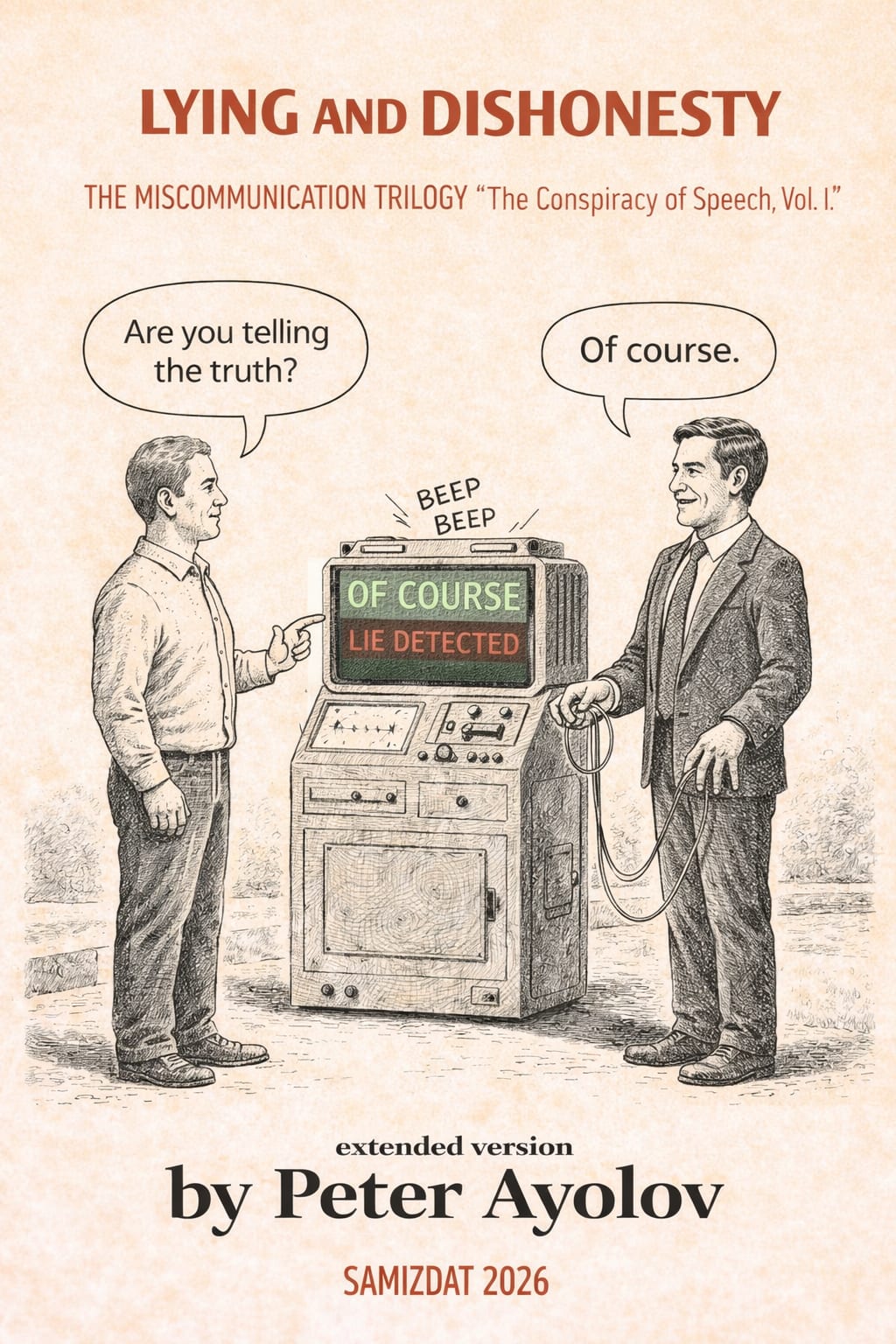
The Erosion of Meaning: A Review of Lying and Dishonesty
Lying and Dishonesty stands as one of the most conceptually ambitious and unsettling volumes within The Miscommunication Trilogy. Rather than treating deception as a marginal ethical concern, the book repositions it as a central structural feature of language, cognition, and social organization. What might initially appear to be a thematic study of lying quickly unfolds into a far broader philosophical argument: that language itself is undergoing a gradual loss of reliability, not through accident, but through its very conditions of use.
The book’s central strength lies in its refusal to isolate lying as a discrete act. Instead, it dissolves the boundary between truth and falsehood by examining the processes through which reality is translated into language. This translation is shown to be inherently reductive. Words compress experience, select details, and frame interpretation. In doing so, they create not a mirror of reality, but a version of it. From this perspective, deception does not begin when language is misused; it begins when language is used at all.
This argument is developed with notable philosophical depth. The text engages with a wide range of intellectual traditions, from theological condemnations of lying to Enlightenment debates about moral duty and truthfulness. Figures such as Augustine, Rousseau, and Kant appear not as historical ornaments, but as stages in the evolution of thinking about deception. Augustine’s total rejection of lying contrasts sharply with Rousseau’s sociological explanation of its emergence, while Kant’s absolutism highlights the tension between moral purity and practical necessity. The book uses these contrasts to demonstrate that lying has never been a stable concept; it has always been entangled with broader questions about human nature, society, and knowledge.
Yet the book’s originality lies less in its historical synthesis than in its integration of modern cognitive science. One of its most compelling claims is that deception is not merely something we do to others, but something the mind does to itself. Drawing on research into perception, decision-making, and neural processing, the text shows how the brain constructs coherent narratives from incomplete information. This process, often described as confabulation, reveals that self-deception is not an anomaly but a necessity. Without it, the mind would be overwhelmed by inconsistency and uncertainty. In this sense, lying is not simply a social act; it is a cognitive function.
This insight is extended into the domain of social interaction. The book convincingly argues that everyday communication depends on subtle forms of dishonesty. Politeness, diplomacy, and social cohesion often require the selective presentation of truth. What we say is shaped not only by what is accurate, but by what is appropriate, acceptable, or advantageous. Over time, these small adjustments accumulate, producing a culture in which the distinction between honesty and deception becomes increasingly blurred. The result is not a society of deliberate liars, but a system in which distortion is normalized.
The analysis becomes particularly powerful when it turns to media and political systems. Here, the book demonstrates how structural features of modern communication amplify the tendencies already present in language and cognition. Information is no longer evaluated primarily on the basis of truth, but on its ability to attract attention, circulate widely, and influence perception. Media institutions, rather than functioning as neutral transmitters of information, are shown to be active participants in the construction of reality. Through selection, framing, and repetition, they shape not only what people know, but how they understand what they know.
One of the book’s most striking contributions is its treatment of statistics and data. Numbers are often perceived as objective and immune to manipulation, yet the text reveals how easily they can be framed to produce misleading impressions. The presentation of data—through graphs, percentages, and comparisons—can create narratives that obscure more than they reveal. This analysis is particularly relevant in an era where quantitative information dominates public discourse. By exposing the rhetorical dimensions of statistics, the book challenges the assumption that data alone can guarantee truth.
The concept of planned obsolescence of language provides the theoretical framework that unifies these diverse analyses. According to this concept, language gradually loses its effectiveness as a tool for conveying meaning. Words become overused, redefined, and diluted. Concepts that once carried precise meanings are stretched across multiple contexts, eventually becoming vague or ambiguous. This process is not necessarily intentional, but it is driven by the demands placed on language in a rapidly changing and highly mediated world. As language adapts to new uses, it also becomes less stable.
This instability has profound implications for democratic life. The book engages with contemporary political theory to explore how truth functions within democratic systems. It highlights the tension between the ideal of rational deliberation and the reality of political communication, which often relies on rhetoric, simplification, and strategic ambiguity. The analysis of democratic epistemology is particularly nuanced. Rather than dismissing democracy as inherently flawed, the book acknowledges its epistemic potential while emphasizing its vulnerabilities. Public discourse depends on shared meanings and trust, both of which are undermined when language becomes unreliable.
The discussion of trust is especially compelling. In a complex society, individuals cannot verify all information directly; they must rely on sources. The credibility of these sources becomes crucial. However, as the book shows, the same mechanisms that enable communication also enable manipulation. When trust is eroded, skepticism increases, but this skepticism can become indiscriminate. Instead of distinguishing between reliable and unreliable information, individuals may come to doubt everything. The result is not greater clarity, but a state of epistemic uncertainty in which all claims appear equally questionable.
Another notable aspect of the book is its treatment of pseudohistory and misinformation. It demonstrates how distorted narratives about the past are constructed and sustained through language. These narratives often serve ideological or political purposes, but they also fulfill psychological needs. They provide coherence, identity, and a sense of meaning. By analyzing the mechanisms through which such narratives are created, the book sheds light on the broader problem of how truth is contested and redefined.
The writing itself is dense and conceptually demanding, but it is also carefully structured. The arguments build progressively, moving from individual cognition to social interaction, and from there to institutional and systemic analysis. This layered approach allows the book to maintain coherence despite the breadth of its subject matter. At times, the prose can feel uncompromising, even relentless, in its refusal to simplify complex ideas. However, this intensity is also part of its intellectual appeal. The book does not aim to comfort; it aims to confront.
If there is a limitation, it lies in the book’s relative lack of concrete solutions. Having diagnosed the instability of language and the pervasiveness of deception, the text offers only indirect guidance on how to address these issues. It emphasizes awareness, critical thinking, and institutional reform, but these suggestions remain largely implicit. This absence may frustrate readers seeking practical strategies. Yet it is also consistent with the book’s overall argument: that the problems it identifies are not easily resolved, because they are embedded in the very structures that make communication possible.
Despite this, the book’s contribution is significant. It provides a framework for understanding why contemporary communication often feels unreliable, fragmented, and overwhelming. By linking individual cognition with social and institutional dynamics, it offers a comprehensive account of how deception operates across different levels of human experience. It challenges readers to reconsider assumptions about truth, language, and knowledge, and to recognize the complexity of the systems in which they participate.
Lying and Dishonesty ultimately succeeds not because it resolves the tensions it explores, but because it makes them visible. It reveals that the crisis of communication is not simply a matter of misinformation or bad actors, but a deeper problem rooted in the nature of language itself. This insight is both unsettling and illuminating. It suggests that the pursuit of truth cannot rely on language alone, but must involve a continuous effort to examine, question, and reinterpret the words through which reality is constructed.
In this sense, the book is less a critique of deception than a meditation on the conditions of meaning. It does not ask whether we can eliminate lying, but whether we can understand the processes that make it inevitable. By doing so, it opens a space for reflection that is both intellectually rigorous and profoundly relevant. In an age defined by information overload and contested realities, such reflection is not optional; it is essential.
About the Creator
Peter Ayolov
Peter Ayolov’s key contribution to media theory is the development of the "Propaganda 2.0" or the "manufacture of dissent" model, which he details in his 2024 book, The Economic Policy of Online Media: Manufacture of Dissent.
Enjoyed the story? Support the Creator.
Subscribe for free to receive all their stories in your feed.
Comments
There are no comments for this story
Be the first to respond and start the conversation.