
Languaging and Usage, THE MISCOMMUNICATION TRILOGY “The Conspiracy of Speech, Vol. I.” Part 15
REVIEW

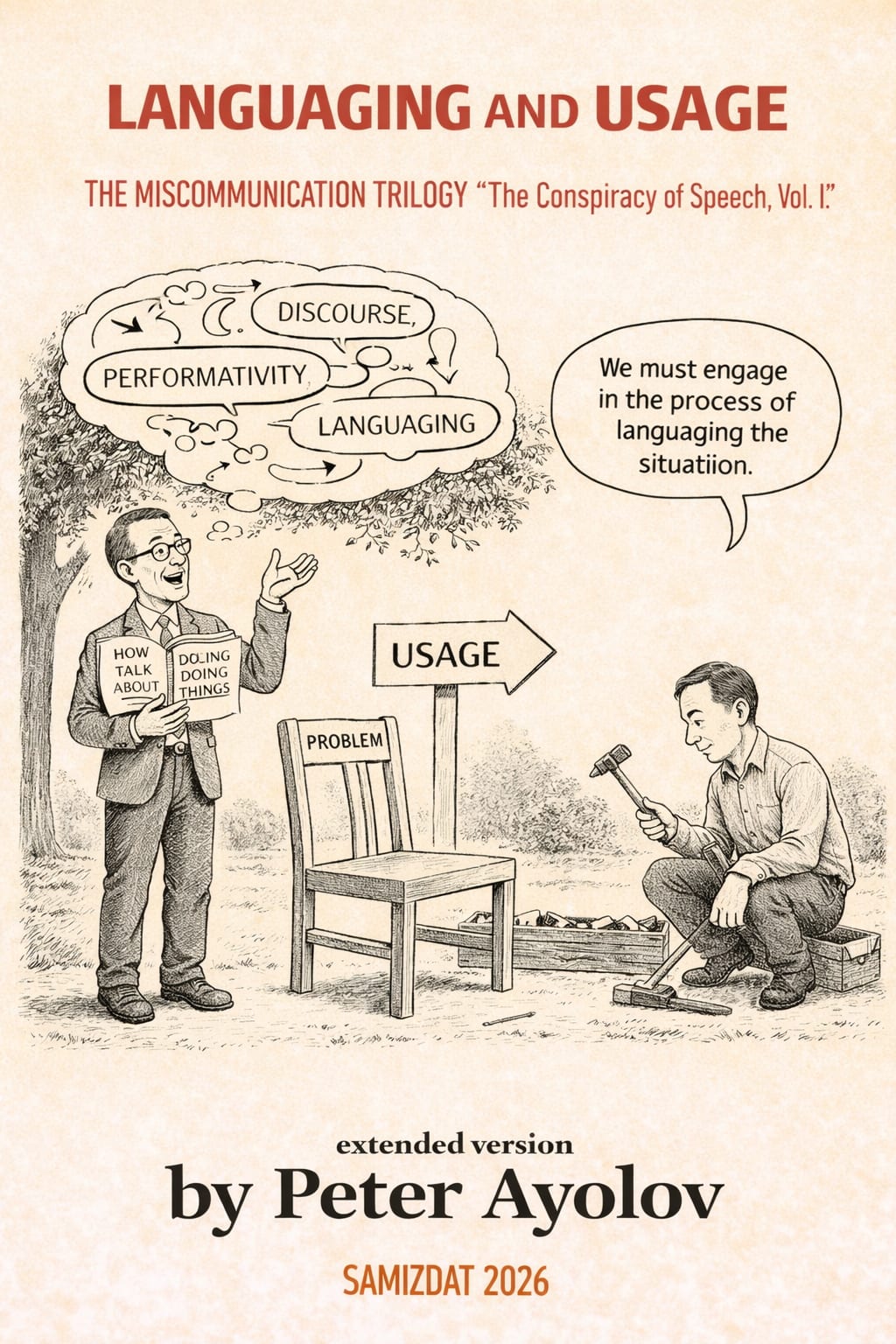
The Drift of Structure: A Critical Review of a Usage-Based Theory of Language
This volume, situated within a broader exploration of language as a dynamic and often unstable human practice, advances a sustained argument for understanding grammar not as a fixed system of rules but as an emergent product of use. Across its chapters, the book develops a coherent theoretical position grounded in usage-based linguistics, exemplar models, and the concept of language as a complex adaptive system. The result is an ambitious synthesis that seeks to dissolve traditional oppositions—between synchrony and diachrony, rules and analogy, competence and performance—by tracing all linguistic structure back to repeated acts of communication.
The early chapters establish the foundation: language is composed not of abstract rules applied to discrete categories, but of stored exemplars—experienced utterances and fragments of utterances that accumulate in memory. These exemplars form networks based on similarity, frequency, and co-occurrence. From this perspective, constructions emerge through chunking: sequences of linguistic material that become entrenched through repetition. Crucially, these constructions are not static templates but flexible patterns with schematic slots that can accommodate variation. This allows the system to be both stable and productive. The treatment of analogy is central to the book’s argument. Rather than viewing linguistic creativity as the application of symbolic rules, the author proposes that new utterances arise through analogical extension from existing patterns. Analogy is defined broadly as the process by which a speaker uses a novel item within a familiar construction. This process is guided by similarity to prior exemplars—phonological, semantic, and structural. The examples provided across morphological, syntactic, and phonological domains demonstrate that linguistic innovation is not arbitrary but constrained by what has been previously experienced. Even seemingly irregular formations can be explained as the result of similarity-based attraction within networks of stored forms.
The discussion of similarity deepens this argument by showing that acceptability judgments are not binary but gradient. Speakers evaluate novel expressions based on their proximity to frequent, conventionalized patterns. Corpus studies and experimental evidence reinforce this claim, revealing that high-frequency constructions serve as analogical anchors for less frequent variants. The implication is profound: grammaticality itself is not an inherent property of forms but a reflection of usage patterns. The chapters on child language acquisition provide compelling support for this model. Research cited throughout demonstrates that children do not begin with abstract rules but with lexically specific patterns. Their early utterances are heavily based on rote-learned expressions and limited constructions. Through processes such as juxtaposition and superimposition, children gradually expand these patterns, building more complex structures over time. Importantly, this development is continuous rather than abrupt, mirroring the gradual nature of language change. The evidence suggests that abstraction emerges from experience rather than preceding it.
The book then turns to diachronic processes, particularly analogy in language change. Here, the author reinterprets traditional concepts such as analogical leveling and extension in terms of usage-based mechanisms. Changes are not seen as the elimination of irregularities but as the introduction of new forms through the application of productive constructions. Frequency plays a decisive role: high-frequency forms resist change due to their strong representation, while low-frequency forms are more susceptible to restructuring. This provides a unified explanation for why irregular forms persist in common words while rare forms tend to regularize. The notion of productivity is also reconceptualized. Rather than being an all-or-nothing property of rules, productivity is treated as a gradient phenomenon influenced by type frequency and schematicity. Highly schematic constructions with many instances are more likely to extend to new items, while narrowly defined patterns remain limited in scope. This approach allows for a nuanced understanding of why some patterns spread while others do not.
The comparison between analogy and rules is one of the book’s most critical interventions. The author challenges dual-processing models that posit separate mechanisms for regular and irregular forms, arguing instead for a single analogical process operating across all levels of language. Rules, in this view, are not independent entities but abstractions that emerge from patterns of usage. This eliminates the need for a strict division between lexicon and grammar, replacing it with a continuum of constructions varying in generality and frequency. The chapters on grammaticalization extend this argument into the domain of morphosyntax. Grammaticalization is presented as the primary mechanism through which new grammatical structures arise. Lexical items, through repeated use in specific contexts, become grammatical markers, undergoing phonetic reduction, semantic generalization, and increased autonomy. The example of the development of future markers from movement verbs illustrates how similar processes occur across unrelated languages, suggesting the operation of shared cognitive mechanisms.
A key insight here is that grammaticalization creates new constructions rather than merely modifying existing ones. The process is not instantaneous but gradual, involving multiple interacting factors such as frequency, inference, and contextual expansion. This reinforces the book’s broader claim that grammar is an emergent property of usage rather than a pre-existing system. The explanatory power of diachrony is further emphasized in the analysis of syntactic patterns. Features that appear arbitrary from a synchronic perspective—such as word order or the placement of negation—are shown to have clear historical origins. By tracing these developments, the author demonstrates that many properties of grammar can only be understood in terms of their evolution. This challenges theories that attempt to explain linguistic structure solely through synchronic principles.
The critique of generative approaches is explicit throughout these sections. The author argues that the assumption of discrete, invariant structures is incompatible with the evidence for gradience and variability. Moreover, the idea that language change occurs primarily during acquisition is rejected in favor of a usage-based account in which change is continuous and distributed across speakers of all ages. Empirical studies of variation support this view, showing that children replicate the probabilistic patterns present in adult speech rather than introducing abrupt innovations. The discussion of reanalysis offers an alternative to the traditional notion of sudden structural change. By reconceptualizing grammatical categories as gradient and variable, the need for covert reanalysis is eliminated. The development of the English auxiliary system serves as a case study, illustrating how new categories can emerge through the gradual spread of constructions and the shifting distribution of forms. This approach aligns with the broader framework of language as a system shaped by frequency and usage.
In the final chapters, the book situates these findings within a larger theoretical context. Language is described as a complex adaptive system in which global patterns emerge from local interactions. Cross-linguistic similarities are not attributed to innate universals but to shared cognitive processes and recurrent paths of change. Concepts such as chunking, categorization, and inference are proposed as the fundamental mechanisms underlying linguistic structure. The treatment of universals reflects this perspective. Rather than positing fixed properties common to all languages, the author identifies tendencies that arise from usage patterns and processing constraints. Frequency, discourse organization, and cultural practices all contribute to shaping grammatical systems. This results in a view of universals as dynamic and emergent rather than static and predetermined.
The final discussion of grammaticality and frequency reinforces the central thesis. Acceptability is shown to depend on familiarity and similarity, linking individual judgments to broader patterns of usage. The relationship between frequency and grammaticality extends across languages, explaining why certain constructions are widespread while others are rare or nonexistent. The integration of cognitive, social, and cultural factors provides a comprehensive account of linguistic variation. Overall, the book offers a compelling and cohesive alternative to rule-based theories of language. Its strength lies in its ability to unify diverse phenomena—acquisition, change, variation, and typology—under a single explanatory framework grounded in usage. By emphasizing the role of frequency, similarity, and repetition, it provides a nuanced understanding of how language evolves and functions. At the same time, the approach raises important questions. The reliance on exemplar models and analogical processes invites further investigation into how these mechanisms are represented cognitively. The balance between abstraction and specificity remains a central issue, particularly in accounting for highly general patterns. Nevertheless, these challenges do not diminish the book’s contribution; rather, they point to avenues for future research.
In conclusion, this work redefines the study of language by shifting the focus from static structures to dynamic processes. It presents language as a system that is constantly being shaped by its use, where stability and change are two aspects of the same phenomenon. By grounding its analysis in empirical data and integrating insights from multiple domains, the book offers a powerful and innovative framework for understanding the nature of linguistic structure.
About the Creator
Peter Ayolov
Peter Ayolov’s key contribution to media theory is the development of the "Propaganda 2.0" or the "manufacture of dissent" model, which he details in his 2024 book, The Economic Policy of Online Media: Manufacture of Dissent.
Enjoyed the story? Support the Creator.
Subscribe for free to receive all their stories in your feed.
Comments
There are no comments for this story
Be the first to respond and start the conversation.