
Language Frontiers, THE MISCOMMUNICATION TRILOGY, “The Tower of Babble, Vol. III”, Part 18
Book Review

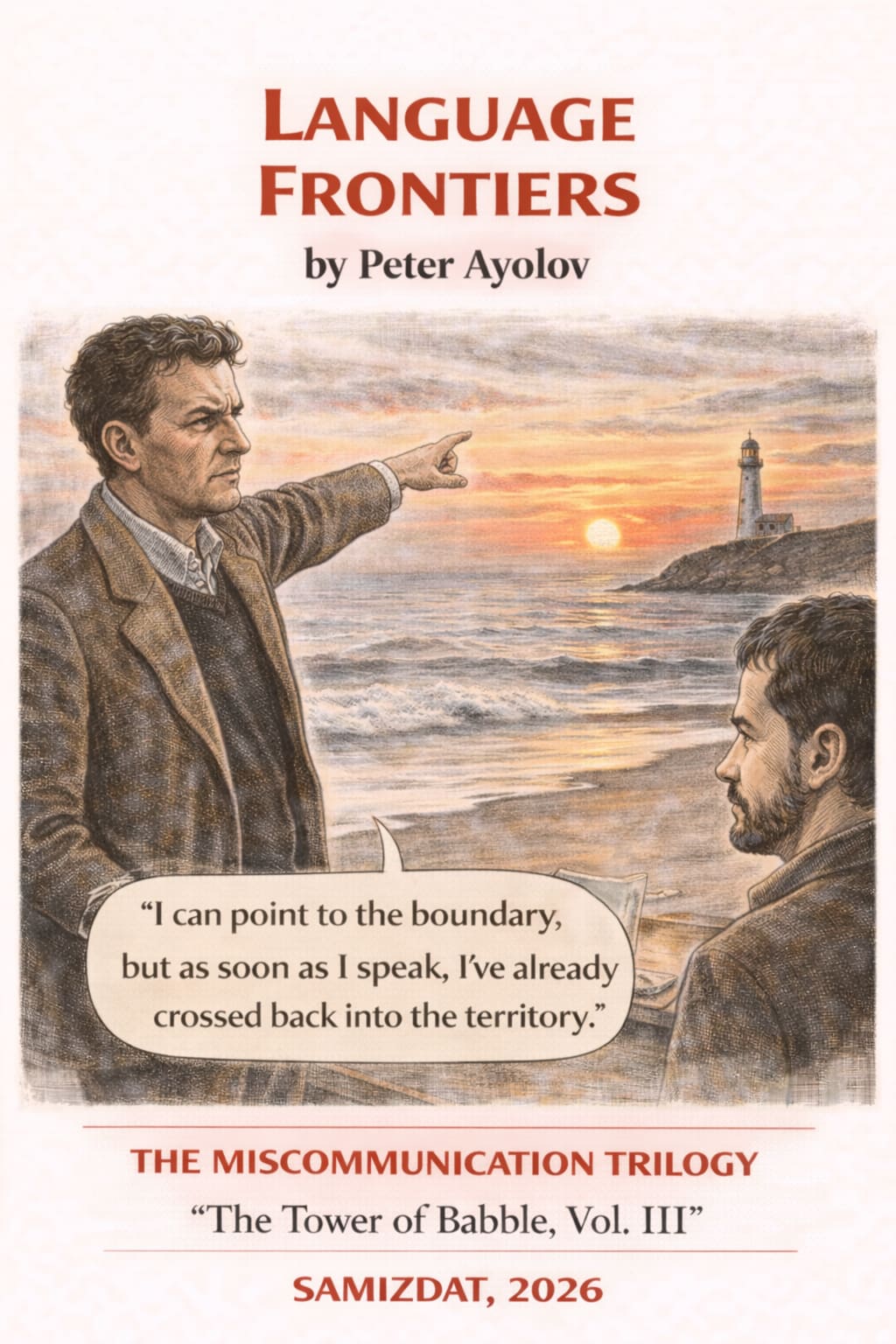
The Frontier Where Words Collapse
The eighteenth part of The Tower of Babble, Peter Ayolov’s Language Frontiers stands as one of the most intellectually ambitious volumes in the Miscommunication Trilogy. If the earlier books explored the corruption, degradation, manipulation, alienation, and fragmentation of communication, this volume moves directly toward the outer edge of the problem itself. It asks a deceptively simple question: what happens when language reaches its limits? The answer unfolds across an extraordinary intellectual landscape populated by philosophers, linguists, literary theorists, physicists, semioticians, novelists, and mystics. Yet this is not merely an anthology of theories about language. It is a sustained exploration of the instability of meaning and the impossibility of securing a final foundation for communication. Throughout its pages, language appears less as a transparent instrument than as an uncertain frontier where reality, imagination, power, interpretation, and silence constantly intersect.
One of the book’s greatest strengths lies in its refusal to isolate language from the wider structures that shape human experience. The discussion moves effortlessly between Wittgenstein’s logical investigations, Derrida’s textual play, Borges’ metaphysical labyrinths, Heisenberg’s reflections on quantum physics, Lyotard’s differend, Volosinov’s dialogism, Althusser’s ideology, and numerous other perspectives. Instead of presenting these thinkers as participants in separate academic disciplines, the book reveals their common concern with the same fundamental dilemma: language simultaneously reveals and conceals reality. Every attempt to establish certainty through words produces new ambiguities. Every effort to define meaning creates new zones of uncertainty. Every discourse contains silences, exclusions, and contradictions that undermine its own claims to completeness. The result is a portrait of language that is profoundly dynamic. Rather than treating communication as the successful transfer of information between stable subjects, the book portrays meaning as an ongoing process of negotiation in which speakers, listeners, texts, institutions, and social contexts continuously reshape one another. This perspective transforms what might appear to be a study of linguistics into a broad philosophical inquiry into the human condition itself. Language becomes the environment within which human beings live, struggle, create, misunderstand, dominate, resist, remember, and imagine. The frontier in the title is therefore not merely a linguistic boundary but a civilizational one, marking the limits of knowledge, identity, and social order. The reader quickly discovers that every frontier crossed reveals another frontier beyond it, generating a feeling of intellectual openness that defines the entire volume.
The book is particularly effective in demonstrating how modern thought has repeatedly attempted to overcome the instability of language only to rediscover it in new forms. Rationalist philosophies sought clarity through logical structures. Structuralism sought stability through systems of signs. Phenomenology sought certainty through consciousness. Marxist theories sought explanatory frameworks in ideology and social relations. Poststructuralism exposed the instability lurking beneath all these systems. Yet none of these approaches succeeds in eliminating ambiguity. Instead, ambiguity returns again and again, not as a defect but as a constitutive feature of meaning itself. Language Frontiers traces this recurring pattern with remarkable clarity. The discussion of Horst Ruthrof’s theories is particularly important in this regard. Ruthrof’s concepts of modal opacity, propositional opacity, and semiotic opacity become powerful tools for understanding why language never achieves complete transparency. Meaning emerges through interactions between linguistic and non-linguistic systems rather than through fixed definitions. Words gain significance through contexts, gestures, institutions, histories, expectations, and interpretations that exceed language itself. By emphasizing these interconnections, the book challenges simplistic assumptions about communication while avoiding the temptation to descend into relativism. Meaning may be unstable, but it is not arbitrary. Communication may be imperfect, but it remains possible. The instability of language is not presented as a catastrophe but as the very condition that allows creativity, adaptation, and social transformation. In this respect the book successfully balances philosophical scepticism with an appreciation for the productive dimensions of uncertainty. The frontier becomes not merely a boundary but a space of possibility, where new meanings emerge precisely because old certainties fail.
Language Against Itself
One of the most fascinating aspects of Language Frontiers is its examination of texts and thinkers who confront language with its own limitations. Wittgenstein’s Tractatus, Borges’ stories, Taoist philosophy, quantum physics, and theories of silence all appear as different attempts to approach what lies beyond articulation. The book repeatedly returns to the paradox that language can speak about its own inability to speak. This paradox generates some of the volume’s richest discussions. Borges emerges as a central figure because his fiction dramatizes the impossibility of perfectly representing reality. Stories such as The Aleph, Funes the Memorious, and Tlön, Uqbar, Orbis Tertius become philosophical laboratories in which language’s ambitions and failures are exposed. Borges recognizes that language generalizes while reality consists of particulars, that naming simplifies what experience endlessly complicates. Yet he continues writing despite this awareness. His work embodies the tension between linguistic insufficiency and linguistic necessity that permeates the entire book. Wittgenstein occupies a similar position. Whether in the Tractatus or in the later investigations of language-games, he reveals how the limits of language shape the limits of the world we can describe. Yet these limits do not produce resignation. Instead, they redirect attention toward practice, use, and forms of life. The book skillfully connects these philosophical concerns with broader cultural and political questions. The problem of language is never merely academic. Every attempt to define reality involves acts of inclusion and exclusion. Every discourse privileges certain perspectives while marginalizing others. Every language-game contains implicit structures of power. Consequently, questions about meaning become inseparable from questions about ideology, authority, and social organization.
The sections dealing with political discourse are especially compelling because they demonstrate how language functions as a mechanism of both domination and resistance. Discussions of Althusser, Foucault, Pecheux, and related thinkers reveal how institutions reproduce social order through linguistic practices. Schools, media, bureaucracies, and political systems do not simply communicate information; they shape subjects. Language interpellates individuals, assigning identities and roles while presenting those assignments as natural and inevitable. Yet the book also emphasizes the possibility of interruption. Discourses are never completely closed. Alternative interpretations, competing voices, and unforeseen contexts continually destabilize official meanings. This insight connects directly to the trilogy’s broader concern with the planned obsolescence of language. If language is constantly transformed through social conflict and historical change, then no discourse can maintain permanent authority. Every linguistic order eventually encounters forces that exceed its capacity to contain them. Political language, scientific language, religious language, and cultural language all undergo cycles of stabilization and disruption. The frontier therefore becomes a site of struggle where competing realities seek expression. By framing communication as a contested field rather than a neutral medium, the book offers a sophisticated account of how language participates in historical change. Readers interested in ideology, media, politics, and cultural theory will find these sections particularly rewarding because they reveal the profound connections between linguistic forms and social power.
The Silence Beyond the Frontier
Perhaps the most memorable achievement of Language Frontiers lies in its exploration of silence. Silence appears throughout the volume not as the absence of communication but as its hidden foundation. The discussions of Taoism, Wittgenstein, mystical traditions, phenomenology, and existential philosophy converge around the idea that language continually points toward what it cannot fully express. This theme culminates in reflections on silence as both a limit and a possibility. Rather than treating silence as a failure of speech, the book presents it as a dimension of meaning that accompanies every utterance. Words emerge from silence and eventually return to it. Communication depends upon shared assumptions, intuitions, experiences, and forms of understanding that can never be completely articulated. The most profound realities—love, death, beauty, suffering, transcendence, wonder—often resist linguistic capture. Yet language remains indispensable precisely because it gestures toward these realities without fully possessing them.
This insight gives the book a remarkable emotional and philosophical depth. Although much of the discussion engages with complex theoretical material, the underlying concern is profoundly human. The frontier of language is also the frontier of self-understanding. To recognize the limits of language is to recognize the limits of certainty, control, and mastery. Yet this recognition is not portrayed negatively. On the contrary, the book suggests that genuine intellectual freedom begins when the illusion of complete mastery dissolves. The planned obsolescence of language, the central theme of the trilogy, is therefore not merely a diagnosis of linguistic decline. It is also a recognition of language’s vitality. Words become obsolete because human beings continually create new realities, new experiences, and new forms of life that demand new forms of expression. The instability of language is inseparable from the creativity of culture. Language survives precisely because it cannot remain fixed.
As a contribution to the Miscommunication Trilogy, Language Frontiers serves as both culmination and expansion. It gathers themes developed throughout earlier volumes and places them within a broader philosophical horizon. The result is a work that transcends disciplinary boundaries and challenges readers to reconsider their assumptions about communication, knowledge, reality, and human existence. Rich in intellectual ambition, theoretical sophistication, and philosophical imagination, it demonstrates that the limits of language are not barriers to understanding but invitations to further exploration. The frontier remains open, and it is within that openness that the enduring significance of the book resides.
About the Creator
Peter Ayolov
Peter Ayolov’s key contribution to media theory is the development of the "Propaganda 2.0" or the "manufacture of dissent" model, which he details in his 2024 book, The Economic Policy of Online Media: Manufacture of Dissent.
Enjoyed the story? Support the Creator.
Subscribe for free to receive all their stories in your feed.
Comments
There are no comments for this story
Be the first to respond and start the conversation.