
Hermeneutics and Exegetics, THE MISCOMMUNICATION TRILOGY “The Conspiracy of Speech, Vol. I.” Part 20
Book Review

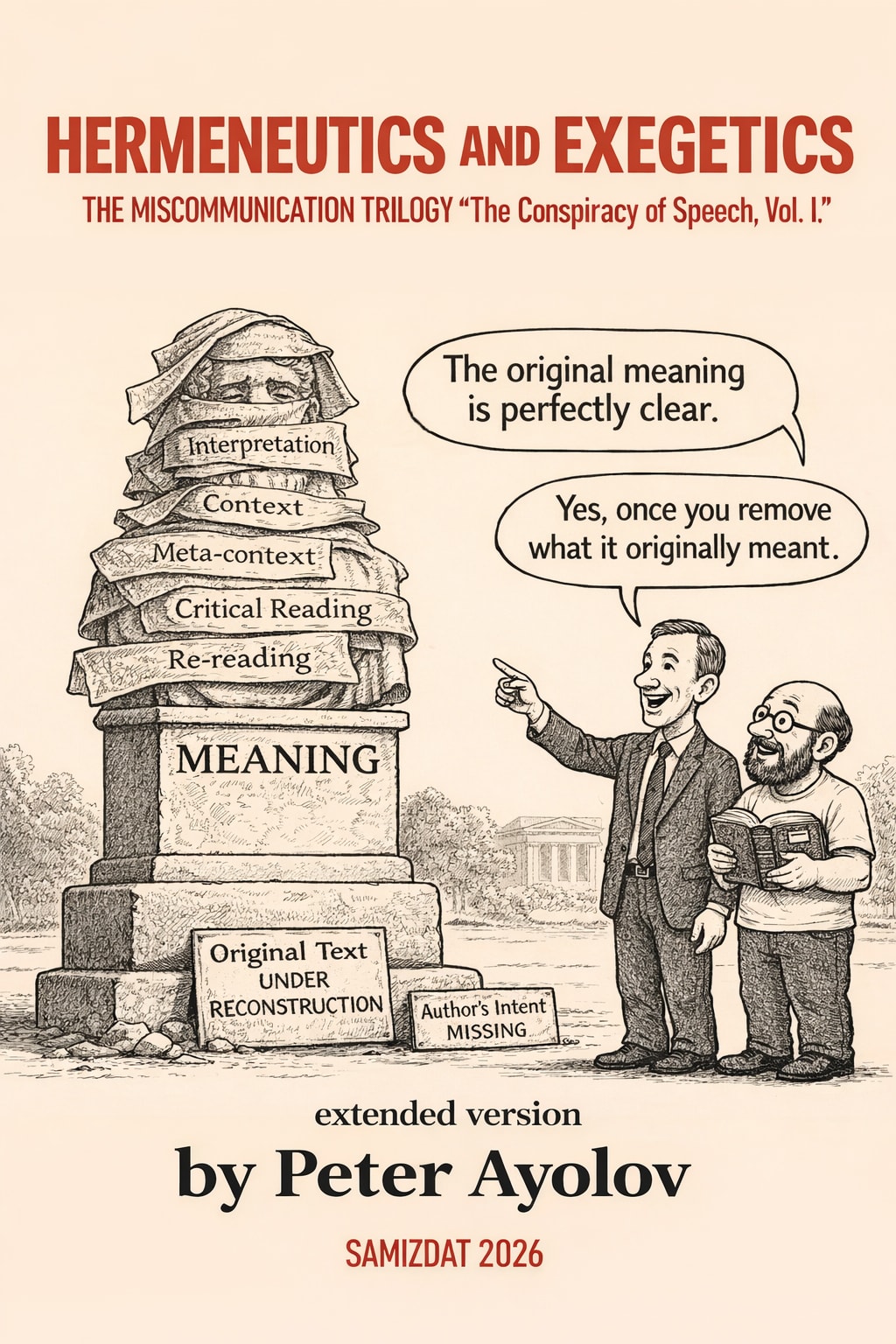
The Vanishing Word: Interpretation and the Planned Obsolescence of Language
Hermeneutics and Exegetics presents itself not simply as a philosophical study of interpretation, but as a sustained meditation on the instability of language and the inevitability of misunderstanding. As part of the Miscommunication Trilogy, the book situates itself within a broader intellectual project that interrogates the limits of communication, culminating here in a focused examination of interpretation as both the condition and the crisis of meaning. Its central theme—the Planned Obsolescence of language—provides a powerful conceptual lens through which the entire work unfolds, offering a provocative account of how language continually undermines its own claims to stability.
From the outset, the book challenges the conventional assumption that language serves as a neutral medium for conveying pre-existing ideas. Instead, it advances a more unsettling thesis: that language is inherently interpretive, and that every act of communication is already an act of transformation. Meaning does not precede language as a fixed entity waiting to be expressed; it emerges within the act of expression itself, shaped by context, intention, and reception. This position aligns the work with the broader tradition of philosophical hermeneutics, yet it pushes further by insisting that interpretation is not merely a methodological concern but the very essence of language. One of the most compelling aspects of the book is its ability to weave together a wide range of intellectual traditions into a coherent argument. Drawing on biblical hermeneutics, medieval typology, modern literary theory, and contemporary discussions of cognition and perception, the text demonstrates how the problem of interpretation transcends disciplinary boundaries. The discussion of typology, for instance, reveals how early theological methods of reading scripture as a system of recurring patterns laid the groundwork for narrative thinking more generally. Events and characters become intelligible not in isolation, but as instances of broader types, creating a framework that continues to shape historical writing and literary representation.
This historical dimension is one of the book’s strengths. By tracing the development of interpretive practices from religious contexts into secular domains, the author shows how the logic of interpretation has permeated all forms of discourse. The eighteenth-century transformation of historical narrative into literary art, for example, is presented as a direct consequence of typological thinking. Historians and novelists alike begin to organize events into patterns that resonate with universal human experience, demonstrating how the boundary between fact and fiction becomes increasingly porous. This insight reinforces the book’s central claim that meaning is always constructed rather than discovered. At the same time, the work does not romanticize the power of interpretation. On the contrary, it offers a sustained critique of the human tendency to overinterpret, highlighting the risks inherent in the search for meaning. Concepts such as apophenia, pareidolia, and parallelomania are used to illustrate how easily the mind can impose patterns on random or ambiguous data. These discussions are particularly effective in showing that the mechanisms of interpretation are not inherently reliable; they can generate both insight and illusion. The same cognitive processes that allow us to recognize meaningful connections also predispose us to see connections where none exist.
This tension between meaning and illusion is further explored through the analysis of narrative structures. Devices such as foreshadowing, metaphor, and symbolic correspondence are shown to create coherence by linking disparate elements into a unified whole. Yet this coherence is often retrospective, imposed after the fact rather than inherent in the events themselves. The narrative gives the impression of inevitability, but this impression is constructed through selective emphasis and interpretive framing. In this way, the book reveals how storytelling functions as a powerful tool for organizing experience, while also exposing its potential to distort reality. The discussion of metaphor and metonymy adds another layer to this analysis. Drawing on linguistic theory, the book distinguishes between the operation of similarity and the operation of contiguity, showing how different modes of expression shape the way meaning is produced. Metaphor expands meaning by linking elements across different domains, while metonymy grounds it within a specific context. The balance between these two modes becomes crucial for maintaining coherence, particularly in realistic narratives where excessive metaphor can disrupt the sense of continuity. This framework provides a valuable tool for understanding the stylistic choices that underlie different forms of writing.
Perhaps the most original contribution of the book lies in its articulation of the Planned Obsolescence of language. This concept reframes linguistic change not as a gradual evolution but as a structural necessity. Language, by its very nature, cannot remain stable, because its meanings are constantly reshaped by new contexts and new interpretations. Each act of communication introduces the possibility of reinterpretation, rendering previous meanings incomplete or outdated. Obsolescence is thus not an external condition imposed on language, but an internal dynamic that drives its continuous transformation. This argument becomes particularly compelling when the book turns to the impact of digital technologies. The process of digitization, which breaks language into discrete units, is shown to intensify the fragmentation of meaning. While digital systems increase efficiency and precision, they also disrupt the continuity of experience, making it more difficult to integrate information into a coherent whole. The result is a paradox: the more information becomes available, the harder it becomes to understand. In this context, the need for interpretation becomes even more urgent, as individuals must actively reconstruct meaning from fragmented data.
The treatment of sacred language and exegetics provides a fitting culmination to the book’s argument. By examining how religious texts have been interpreted across different traditions, the author demonstrates that the challenges of interpretation are not limited to modern contexts but have always been central to human attempts to understand meaning. Exegetics, in this sense, becomes a model for all forms of interpretation, illustrating how meaning is drawn out of a text through engagement rather than extracted as a fixed content. The sacred text, far from being immune to reinterpretation, exemplifies the endless process through which meaning is renewed. Stylistically, the book maintains a philosophical tone that is both rigorous and accessible. Its continuous, flowing structure mirrors the argument it presents, emphasizing the ongoing nature of interpretation. Rather than offering definitive conclusions, it invites the reader to engage with the material as part of a larger process of understanding. This approach is consistent with the book’s central thesis, reinforcing the idea that meaning is never final but always open to revision.
At times, the density of the argument may present a challenge, particularly for readers unfamiliar with the theoretical traditions being discussed. The text assumes a certain level of familiarity with philosophical and literary concepts, and its refusal to simplify complex ideas may limit its accessibility. However, this difficulty can also be seen as a strength, as it reflects the complexity of the subject matter and the seriousness with which it is treated. As part of the Miscommunication Trilogy, Hermeneutics and Exegetics stands as a crucial contribution to a larger exploration of language and its limitations. While the earlier parts of the trilogy address different aspects of miscommunication, this volume brings the focus to interpretation itself, revealing it as both the source of meaning and the cause of its instability. The concept of Planned Obsolescence of language provides a unifying thread that ties together the diverse themes of the book, offering a powerful framework for understanding the dynamics of communication.
In conclusion, Hermeneutics and Exegetics is a thought-provoking and ambitious work that challenges readers to reconsider their assumptions about language and meaning. By demonstrating that interpretation is not a secondary activity but the foundation of all communication, it offers a compelling account of why language can never fully achieve the clarity it promises. Its exploration of the Planned Obsolescence of language provides a timely reflection on the conditions of communication in the modern world, where the proliferation of information makes understanding both more necessary and more difficult. As part of the Miscommunication Trilogy, it not only contributes to a broader intellectual project but also stands on its own as a significant work of philosophical inquiry.
About the Creator
Peter Ayolov
Peter Ayolov’s key contribution to media theory is the development of the "Propaganda 2.0" or the "manufacture of dissent" model, which he details in his 2024 book, The Economic Policy of Online Media: Manufacture of Dissent.
Enjoyed the story? Support the Creator.
Subscribe for free to receive all their stories in your feed.
Comments
There are no comments for this story
Be the first to respond and start the conversation.