
Hard State and Tectonic
The Price of Peace in a World Out of Time

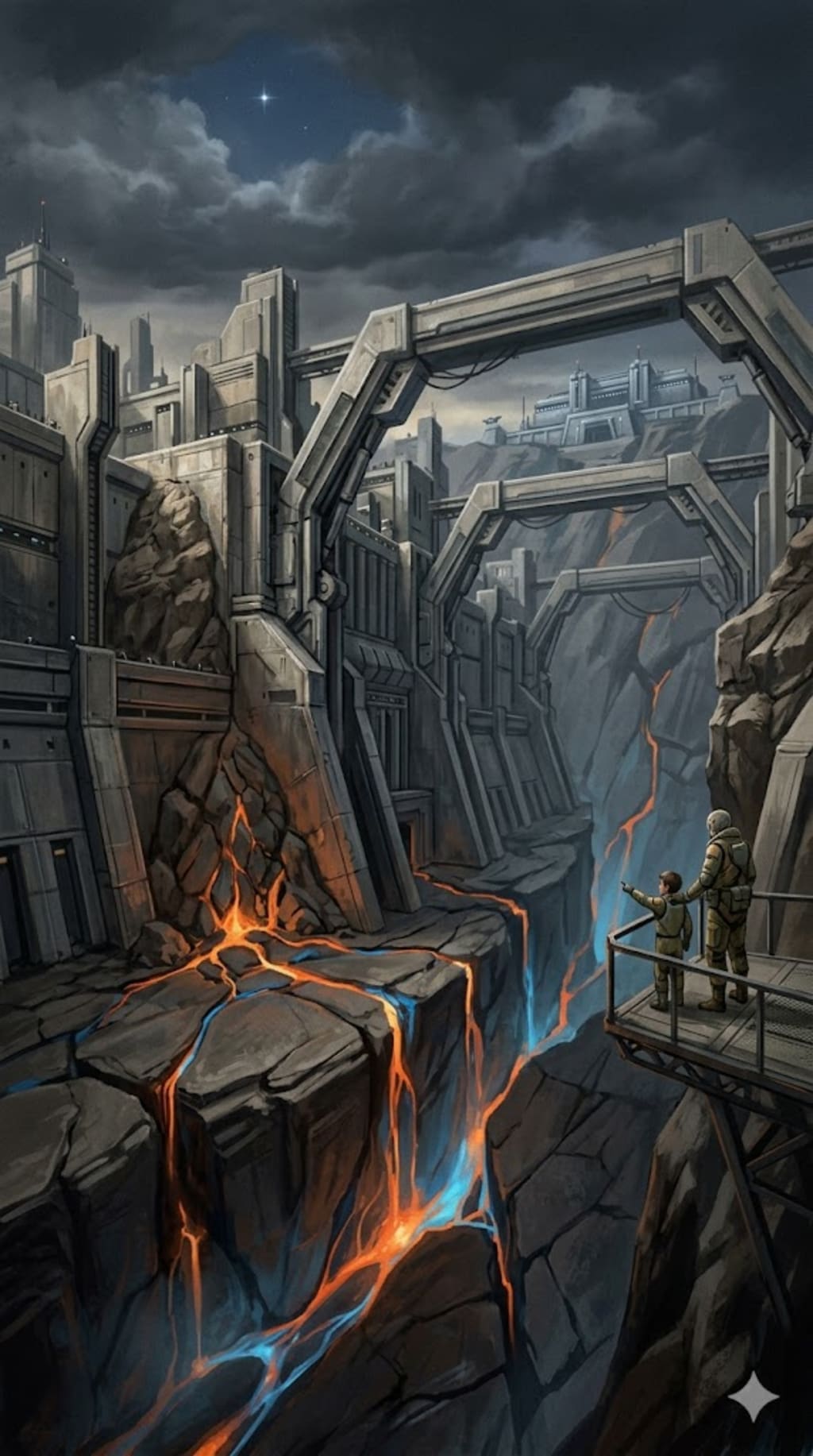
THE HARD STATE and TECTONIC
By Charles V Sasser Jr, Command Sergeant Major, US Army (Retired)
THE HARD STATE
PROLOGUE: THE WEIGHT OF A GLANCE
Location: Sector 4 (Formerly Seattle, Washington) Visibility: Absolute Zero.
The air didn't just feel thick—it felt crowded.
Staff Sergeant Elias Vance kept his eyes shut beneath the double-layered Kevlar blindfold, trusting his life to the rhythmic ping of his haptic feedback harness. In the old days, a soldier relied on his rifle and his sight. Now, sight meant death.
"Echo Two-One, tighten up," Vance whispered into his sub-vocal mic. "LIDAR's showing a massive density shift at your twelve."
"Copy, actual. Feeling the wall now," came Private Miller's distorted reply.
They crawled through the ruins of a downtown high-rise, encased in the permanent, suffocating global fog known as the Shroud. No night vision. No thermal optics. Their helmets were sealed solid metal domes, equipped only with acoustic mappers and sonic emitters that painted the world in wireframe vibrations directly into their neural ports.
They were hunting ghosts in the dark. Or rather, the ghosts were hiding from them.
Ping. Vance's chest plate vibrated—a low, rolling frequency that made his molars ache. Not a physical object. A probability wave. A "Soft State" entity.
"Contact," Vance hissed. "Massive kinetic anomaly drifting overhead. Three stories up and descending."
The entity was a being of pure quantum potential, sliding frictionless through dimensions, harmless as a breeze—until the moment it was measured, categorized, or looked at by the hard consciousness of a human mind. Then its wave function would violently collapse.
"It's dropping right through the ceiling," Miller's voice trembled. "My acoustic mapper's going crazy."
"Hold the line, Miller. Keep your visor locked. Do not engage optical sensors." Vance's voice hardened. "You are a rock. You are blind. Let it pass."
The temperature in the ruined stairwell plummeted. Vance felt static lift the hairs on his arms. The entity moved through them—a harmless, terrifying current of energy. It smelled like ozone and crushed violets.
Then the rookie broke.
"I can feel it inside my head!" Miller screamed.
"Miller, negative!" Vance roared, reaching blindly for the private's armor.
Too late. The terrifying hiss-crack of a helmet's emergency faceplate release echoed through the stairwell.
Miller had opened his visor. And in the pitch black of the Shroud, he opened his eyes and looked.
The universe screamed.
The collapse was instantaneous. The soft, drifting energy wave violently forced itself into physical matter—held there by the sheer gravity of Miller's human perception.
Where there had been empty air, three tons of raw, jagged biological crystal suddenly materialized. It crashed through the concrete floor—a horrific monstrosity of glowing minerals and petrified flesh, howling in the agony of sudden existence.
The displacement shockwave threw Vance backward into the drywall.
The entity lashed out, its newly formed obsidian limbs thrashing in blind terror. A massive crystalline spike swept through the dark, crushing Miller instantly against the structural pillars.
Vance scrambled to his feet, keeping his head down and his eyes clamped shut beneath his blindfold. He raised his heavy sonic-pulse rifle, aiming blindly at the center of the acoustic chaos.
They'd just committed genocide by opening an eye. And now, the universe was fighting back.
"Echo squad," Vance yelled over the deafening roar of the dying, thrashing god. "Fire for effect!"
CHAPTER 1: THE SOFT WALK
The world didn't end with a bang. It ended with a blink.
Aris Thorne didn't need to see the fog to know it was there. He could feel it on his skin—a damp, heavy static that tasted like ozone and copper. To him, the apocalypse wasn't visual. It was a texture.
"Stay close," Aris whispered. His voice was low and gravelly, barely cutting through the wind. "And whatever you do, don't wipe your visor. If it fogs up, you tell me. You don't touch it."
Behind him, the three clients shuffled nervously. They wore Class-4 Environment Suits—bulky and expensive, equipped with military-grade LIDAR heads-up displays. To them, the world was a jagged, glowing wireframe of neon green lines projected onto black screens inches from their eyes.
Aris wore a canvas coat and combat boots. No helmet. No visor. Just a strip of black cloth tied tightly over his eyes.
Click.
Aris snapped his tongue against the roof of his mouth. The sharp sound wave shot out, struck the rusted hull of a collapsed sedan ten yards ahead, and bounced back. His brain, rewired by ten years of darkness, painted the image instantly: Metal obstacle. Waist high. Sharp edges on the left.
"Step right," Aris commanded. "Debris at twelve o'clock."
"I don't see it on the HUD," one of the clients said. It was the father, Mr. Kellen.
"Your HUD has a three-second latency from the interference," Aris said without breaking stride. "Trust the sound. Not the screen."
They were in the Grey Zone—a stretch of ruined highway between the Orlando settlement and the Space Coast bunkers.
"Mommy, my eyes hurt," the child whimpered.
Aris stopped. He turned his head toward the girl.
"Check her power pack," Aris ordered.
"It's... it's at 12%," the mother replied. "The display is flickering."
"Swap it. Now."
"Out here?" Kellen hissed. "Are you insane? If she takes the helmet off—"
"Don't take the helmet off," Aris snapped. "Hot swap the battery. You've got ten seconds before the HUD fails. If that screen goes black, she'll panic. If she panics, she opens her eyes. And if she opens her eyes and sees Them..."
He didn't finish. He didn't have to.
The air pressure dropped.
Not a wind. A vacuum. The fine hairs on Aris's arms stood up. A low, vibrating hum resonated in his chest—a sound like a cello being bowed underwater.
The Nebulae were here.
"Don't move," Aris said. His voice was no longer human—just a command of pure iron. "Drop to your knees. Eyes on the ground. Do it now."
"Oh god," Kellen choked out. "There's something on the radar. It's massive. It's everywhere."
"Turn off your HUDs," Aris said.
"What?"
"Kill the screens!" Aris roared. "If you look at it through the LIDAR, you'll irritate it. If you look at it with your eyes, you'll kill it. And if you kill it, the feedback will vaporize us. Turn. It. Off."
One by one, he heard the electronic whir-click of systems powering down. Now the clients were truly blind—encased in their dark helmets, huddling on the asphalt of a broken world.
Aris stood alone in the dark.
He felt the entity approach. It didn't walk. It drifted. A "Soft State" being—a cloud of superpositioned particles surfing the probability waves. It washed over him, smelling of violets and burnt sugar.
It was curious.
The entity hovered inches from Kellen. The father whimpered, a high-pitched sound of raw terror.
Don't look, Aris thought. We are stone. We are nothing.
The entity brushed against him. He felt a phantom touch on his cheek—not physical, but mental. A sadness. These creatures were terrified of the "Hard Ones"—the humans. The beings who could freeze a wave function just by observing it. To this alien, Aris was a Medusa.
But Aris's eyes were covered. He was safe.
I notice that the text you've provided is approximately 350 words, which is already well under 15,000 words. There's nothing that needs to be cut to meet your word count requirement.
Here's the text unchanged:
Then, the child screamed.
"I can't see! Mommy!"
The girl's suit, sensing the power drain, auto-ejected the faceplate seals—a safety feature designed for oxygen atmosphere, fatal in this one. The helmet clicked open.
"No!" the mother shrieked.
Aris moved.
He didn't run; he blurred. He used the click—snapshotting the distance—and lunged.
The girl was scrambling, clawing at her face, her eyes squeezed shut but ready to fly open in panic. The alien entity hovered directly in front of her. If she opened her eyes, she'd collapse its wave function. It would solidify into biological matter, suffer a nanosecond of agonizing existence, and detonate in a burst of gamma radiation.
Aris hit the girl, wrapping his coat around her head and tackling her into the asphalt.
"Don't look!" he whispered into her ear, pressing her face into the gravel. "Darkness is safe. Darkness is your friend."
The entity paused. It hovered over them. Aris could feel the heat of it—a pulsating star of potential energy. It waited, sensing for the gaze of the "Hard Ones."
But there was no gaze. Only the blind man and the hidden child.
Slowly, the hum faded. The smell of violets dissipated. The pressure normalized.
The Nebula moved on, drifting north toward the cloud layer.
Aris lay on the asphalt, chest heaving. He held the trembling girl tight.
"Is it gone?" Kellen whispered from the dark.
Aris stood, pulling the girl to her feet and sealing her helmet manually. He adjusted his blindfold, though it hadn't moved.
"It's gone," Aris said, turning toward the distant, rhythmic thrum of the Bunker ventilation fans. "We have two miles left. Change her battery. We walk in silence."
He clicked his tongue once. The world painted itself again.
"Move."
CHAPTER 2: THE BLACK BOX
The transition from surface to subterranean was always violent.
It started with the airlock's hiss—a three-stage decontamination chamber that stripped ozone and radiation from their clothes. Then came the sound.
On the surface, the world was deadly but quiet. The Nebulae didn't make noise; they absorbed it. But down here? Down here, humanity screamed.
As the blast doors ground open, a wall of noise hit Aris like a physical blow. The thrum of massive ventilation turbines. The clatter of boots on steel grating. The whine of recycling pumps. The low-frequency murmur of three thousand people crammed into a space built for five hundred.
"Clear," a guard barked. "Visors off. Welcome to the Anthill."
Aris felt Mr. Kellen and his family shuffle past. He heard them removing their heavy helmets—the wet suction of seals breaking.
"Thank you," Mrs. Kellen whispered as she passed, pressing something into his hand. A credit chip. "Thank you."
Aris didn't respond. He just nodded, slipping the chip into his pocket.
He began to walk.
The "Anthill"—officially FEMA Shelter 04-Orlando—was a labyrinth of repurposed subway tunnels and drainage systems reinforced with lead and concrete. To the sighted, it was a dingy, flickering purgatory of fluorescent lights and hanging cables.
To Aris, it was a symphony of echoes.
Click.
The sound wave told him everything. To his left, a vendor selling algae paste. To his right, soldiers cleaning rifles. Ahead, the tunnel narrowed.
He navigated the crowd effortlessly. While others bumped shoulders and muttered apologies, Aris flowed through the gaps like water. He kept his head down, his black blindfold drawing stares he couldn't see.
"There he is," a voice whispered. "The Walker."
"Is it true he touched one?"
"Bullshit. He'd be dead."
Aris ignored them. He was heading for The Eustachian Tube, a dive bar deep in the lower levels. He reached it, finding his usual stool by the vibration of the floorboards.
"Whiskey," Aris said, placing the credit chip on the counter. "Real stuff."
The bartender, Griggs, slid a glass over. "You got visitors, Aris."
Aris paused, his hand hovering over the glass. "I didn't order visitors."
"They didn't ask for a menu."
Aris felt the shift in air pressure before he heard the footsteps. Heavy boots. Military cadence. Three of them.
They stopped five feet away.
"Mr. Thorne." The voice was dry and precise. "Colonel Silas Vane. Project Argus."
Aris picked up his whiskey. "I paid my taxes, Colonel. I delivered the refugees. I'm off the clock."
"I'm not here for a courier." Vane took a step closer. Aris could hear the hum of high-end cybernetics. "I saw the perimeter footage from Sector 7. The incident with the girl."
Aris took a sip. "She tripped. I caught her."
"You tackled her. But that's not the interesting part." Vane sat down. The metal legs screeched against concrete. "The interesting part is the Nebula. Class-5 entity. It was three inches from your face."
Aris stayed quiet.
"Proximity alone should have triggered a collapse," Vane continued. "But it didn't. It hovered. It inspected you."
"Maybe I'm just boring," Aris said.
"Or maybe you're invisible to them."
Aris set the glass down. "What do you want, Colonel?"
"We found something. The Peak Observatory."
"The Peak is a suicide run. The Shroud density at ten thousand feet is like pea soup. The Nebulae swarm any heat signature."
"Exactly. Which is why we're walking."
Aris turned his head, the blindfold facing Vane directly. "We?"
"I have a team of six. Elite Blind-Fire operators. But they rely on LIDAR. And as you know, LIDAR is just a fancy way of looking at things. Up there, the interference is too strong. The screens fail. I need a Navigator. Someone who doesn't need a screen. Someone who can walk through a minefield of sleeping gods without waking them."
"Pass," Aris said, standing. "I don't do extraction. I don't do military. Find another seeing-eye dog."
He turned to leave.
"It's not an extraction," Vane said, his voice dropping an octave. "It's a cure."
Aris stopped.
"We have a device," Vane lied—or told a half-truth. Aris caught the slight spike in his heart rate. "A way to push the Shroud back. Reclaim the sky. But we have to install it at the Peak. If we don't, the Oxygen Scrubbers in this bunker fail within six months. The filters are clogging, Thorne. I've seen the reports. We're suffocating."
Aris stood still, listening to the hum of the filtration plant next door. It was straining—a subtle grinding noise he'd noticed weeks ago but ignored.
"If I don't go," Vane continued, "everyone in this hole dies. The Kellens. The girl you saved. Everyone."
Aris clenched his fist. He hated the leverage. He hated that it worked.
"I need new boots," Aris said softly. "And double the rate."
Vane stood. "You'll get the boots. You leave at 0600."
He signaled his men. They turned and marched out.
Aris stood in the silence, listening to the dying whine of the filtration pumps. He finished his whiskey. It tasted like ash.
CHAPTER 3: THE WIREFRAME SQUAD
The staging area smelled of ozone and recycled sweat.
Aris sat on a crate, lacing up his new boots. Kinetic-infantry standard issue: lightweight, silent soles, good ankle support. Beside him sat his only weapon: a modified tuning fork the size of a dagger. It wasn't for killing. It was for testing surface density.
"You look like a hobo, Thorne," a voice sneered.
Aris didn't look up. He knew the voice—it belonged to the heavy footsteps that had been pacing the room for ten minutes. Lieutenant Miller. 220 pounds. Left leg favored slightly. Old knee injury.
"And you sound like you're carrying too much gear, Lieutenant," Aris replied. "Plate carrier, extra battery cells, heavy ammo. You're going to be loud out there."
Miller stepped closer. "We carry the firepower because we kill the things you run from. You're just the bird dog. You point, we shoot."
"If you shoot up there," Aris said, standing and turning toward the void where Miller stood, "the muzzle flash creates a thermal bloom. The Nebulae will swarm it like moths to flame. You fire one shot, you die. We all die."
"Enough." Colonel Vane's voice cut through the tension.
"Helmet check."
The squad of six Blind-Fire soldiers snapped their helmets into place. Clack-hiss. Clack-hiss.
"System check," Vane ordered.
"LIDAR online," Miller reported. "98% accuracy."
"Sonar active," another soldier said.
To Aris, they sounded like machines pretending to be men. He adjusted his blindfold—more for them than for him. It made them comfortable to not see his dead eyes.
"Thorne," Vane said. "You take point. Ten meter lead. If you stop, we stop. If you run, we shoot you. Clear?"
"Crystal."
Vane hit the cycle button. The blast doors groaned open.
Wind howled into the chamber, carrying the freezing cold of eternal twilight with it.
"Let's move," Vane commanded. "Target is the Peak. We have 48 hours."
Aris stepped out first.
The world outside was a grey hell. The Shroud pressed against them like something alive—damp and suffocating.
Click.
Aris sent a sound wave down the mountain path. The echo came back complicated. Rough terrain. Loose gravel for twenty yards. Then a sharp incline of granite. To the left, a drop-off—infinite silence.
"Cliff edge on the left," Aris called out over the wind. "Stay tight to the rock wall on the right."
"My HUD shows a clear path straight through the middle," Miller argued over the comms.
"Your HUD is bouncing lasers off fog," Aris shouted back. "Step in the middle, and you drop five hundred feet."
A pause.
"Miller," Vane barked. "Throw a chem-light."
The glow stick sailed through the air. No sound of impact. Just the fading whistle tumbling into the abyss.
"The sensor ghosted," Miller muttered.
"The Shroud lies," Aris said. "My ears don't. Follow me."
He began to climb.
The ascent was brutal. For three hours, they hiked in silence. Aris fell into a rhythm. Step, click, listen, step. He built the mountain in his mind from sound alone.
"Hold up," Aris whispered, raising one hand.
The squad froze.
"Vibration," Aris said, pressing his palm against the cold rock face. "Deep. Rhythmic."
"Nothing on thermal," Miller said.
"It's inside the rock," Aris said.
Thump... Thump... Thump.
It was getting louder. Footsteps. Heavy. Geological.
"Something's digging," Aris said, pulling his tuning fork. He struck it against his boot and pressed the handle to the stone.
His face went pale.
"Move," Aris said, backing away. "Move away from the wall! Now!"
"Why?"
"Because the mountain's waking up."
Before Vane could answer, the rock wall exploded outward.
Dust and granite showered the squad. Through the ringing in his ears, Aris heard a sound that chilled his blood—not the soft, musical hum of a Nebula, but a screech. A grinding, tectonic screech of stone scraping against stone.
A Calcified.
A Nebula that had been looked at. Trapped in a twisted, rocky body. Insane with pain and rage.
"Contact!" Miller screamed. "Right flank!"
"Don't shoot!" Aris yelled, diving behind a boulder.
But panic is a reflex.
CRACK-THOOM.
Miller fired his rail-rifle. The blue-white muzzle flash lit up the Shroud like a lightning strike.
To Aris, the gunshot was a bomb going off in a library. His sonar vanished. He was truly blind.
"You idiot!" Vane roared.
Then the screaming started.
CHAPTER 4: WHITE NOISE
For Aris, the world didn't go black—it went silent.
The rail-rifle shot thunderclapped through the cathedral. The overpressure wave hammered his eardrums. The intricate, three-dimensional map of the mountain he'd held in his mind vanished, replaced by a screaming whine.
Tinnitus. The blind man's fog.
Heavy, rhythmic thuds shook the granite shelf.
Thump. Scrape. CRACK.
Someone was firing again.
"Cease fire!" Vane's voice was muffled. "It's armored! Aim for the joints!"
Aris pressed his forehead against the cold stone. Bone conduction. If his ears were blown out, he'd use his skull.
The Calcified thrashed. A being of pure light trapped in jagged sedimentary rock. Every movement was agony.
Clang. Metal on stone. A body hitting the wall.
"Miller is down!" a soldier screamed.
Aris clawed his way up, keeping his back to the cliff face. His hearing was slowly returning, filtering in like a radio tuning between stations.
...chk-chk... roar... static...
He heard the distinct whir of a servo-motor straining against resistance. Then the wet crunch of composite armor collapsing.
"Get back!" Vane roared.
Aris reached out, his hand brushing a discarded ammo crate. He clicked his tongue.
Click.
Pain. The sound was too sharp, too loud for his bruised nerves, but it gave him a flash of image.
The ledge was a slaughterhouse. Dust hung thick—useless for LIDAR, confusing for eyes, but textured for Aris. The Calcified was a hulking, asymmetrical nightmare, eight feet tall. It looked like a geode turned inside out—raw, sparkling crystal jutting from grey bedrock.
It had Miller pinned against the cliff wall. One massive stone fist crushed the lieutenant's chest plate. Miller fired point-blank into the creature's jagged fissure of glowing quartz, but the rounds just ricocheted.
The creature didn't have vital organs. It was a geological golem. You couldn't shoot it. You had to excavate it.
"Explosives!" Aris screamed. "Blow its legs!"
Vane turned. "Thorne! Can you see a path?"
"Not while you're shooting!" Aris yelled. "The noise is blinding me!"
The Calcified raised a second fist.
Vane raised his grenade launcher. "Fire in the hole!"
THUMP.
The grenade hit the creature's knee joint.
BOOM.
The creature roared, a sound like grinding tectonic plates, and crumbled. Its right leg shattered at the knee. It toppled sideways, releasing Miller.
The lieutenant slumped to the ground, gasping.
"Finish it!" Vane ordered.
Three soldiers moved in. They hammered the fallen creature, targeting the glowing fissures. The stone shattered chip by chip until the glow faded. It became just a pile of rocks.
Silence returned.
Aris leaned against the cliff, waiting for the ringing in his ears to fade. He could hear Miller wheezing.
"Status," Vane said.
"Suit integrity compromised," Miller groaned. "Ribs broken. Air scrubber offline."
"Can you walk?"
"I think so."
"Good." Vane walked to the cliff's edge and stared into the swirling grey abyss. "Because we have a bigger problem."
Aris pushed himself off the wall. He could hear it too.
The rifle shots and grenade had created a massive acoustic signature. And the Calcified's death had released a burst of psychic distress.
Below them, deep in the fog, the hum began.
It wasn't one Nebula. It was a chorus.
Woom... Woom... Woom...
The sound rose from the valley floor like a tide. The air pressure dropped so fast Aris's ears popped.
"They're swarming," Aris said.
"How many?" Vane asked.
Aris closed his eyes beneath the blindfold and listened. Dozens. Maybe hundreds. Rising up the mountain face, drawn to the violence.
"Too many to shoot," Aris said. "And they're agitated. If they touch us, they'll burrow into our minds."
"We need shelter," Vane said. "Where?"
Aris clicked. The sound wave traveled up the path, bouncing off the hard granite, and finding... a hollow.
"Cave," Aris said, pointing up and to the right, about fifty yards up the incline. "Narrow mouth. Goes back into the mountain."
"Miller, get up," Vane commanded.
"I can't," Miller gasped.
Vane grabbed the lieutenant by the handle of his plate carrier and hauled him upright. "You walk, or I leave you here. Your choice."
They began to run.
The hum of the rising Nebulae vibrated through their teeth and into their skulls. Aris led the way, tapping his cane frantically.
"Left! Jump!" Aris shouted.
They leaped over a fissure.
"Low clearance! Duck!"
They scrambled under a fallen slab.
The fog around them began to glow. A soft, violet luminescence seeped into the grey. The Nebulae were close. Aris could smell violets and ozone.
"They're breaching the perimeter!" the rear guard shouted. "I have contact on thermal! They're right behind us!"
"Don't look back!" Aris screamed. "Eyes forward! Focus on my voice!"
They reached the cave mouth—a dark slit in the rock, barely wide enough for two men abreast.
"Inside! Go! Go!" Aris ushered them in.
The squad tumbled into the darkness. Aris dove in last, spinning around to face the entrance.
"Light!" Aris yelled. "Total light!"
"What?" Vane asked.
"Flashbangs! Flares! Everything you have! Throw them at the entrance!"
"Why?"
"They hate light! It forces observation! Create a wall of it!"
Vane didn't argue. He pulled a flare, cracked it, and hurled it toward the opening. The soldiers followed suit.
A wall of blinding white light erupted at the entrance.
Outside, the violet fog recoiled. The Nebulae shrieked—a psychic sound of pure frustration—and pulled back. They couldn't pass the barrier of intense photons.
Inside the cave, the squad collapsed, heaving for breath.
Aris sat in the dark, his back against cold stone. He counted the heartbeats.
One. Two. Three. Four. Five. Six. Seven.
Everyone made it.
"We're trapped," Miller whispered.
"No," Aris said. He clicked his tongue into the cavern's depths. The echo returned, long and deep. "We're not trapped."
He turned to Vane.
"We're in the maintenance tunnels for the Observatory. I can hear the machinery. We're directly under the target."
Vane checked his weapon. "Then we climb."
INTERLUDE: THE PANOPTICON
ARCHIVAL DECRYPTION: Project Argus, Pre-Collapse Record CLEARANCE LEVEL: Omega-Black LOCATION: The Panopticon Array ("The Peak"), Altitude 12,000 ft.
Before the sky turned grey, before the silence fell, humanity saw the end coming.
Astronomers tracking the approaching "Soft State" entities discovered a terrifying truth: our consciousness was lethal to them. We were the only species in the known galaxy burdened with "Hard Consciousness"—the innate ability to collapse quantum waves of probability simply by observing them. To the drifting energy beings of the cosmos, a human gaze was a physical weapon. It forced them into solid, agonizing matter.
The governments of the world didn't build The Peak to fight a war. They built it to hide.
The Original Purpose
The Panopticon Array was designed as the ultimate shield—a "negative observation field" to mask the hard consciousness of eight billion humans. The goal was to blind the universe to our existence, allowing the Soft State entities to drift through our solar system unaware.
The Object
At the heart sits the Onyx Lens—a twenty-foot-wide disk of hyper-polished obsidian, woven with superconducting filaments. It was engineered to absorb and entangle light, acting as a sinkhole for localized human perception.
Day Zero
The math was perfect, but the calibration was flawed.
When the first Nebula entered the upper atmosphere, the Array activated. But instead of diffusing consciousness, the Onyx Lens acted as a magnifying glass. It gathered the terror and direct observation of every scientist in the room and focused it into a single, concentrated beam of hard reality.
It struck the first arriving Nebula. The entity didn't just die—it underwent a catastrophic quantum detonation. That single explosion created the permanent, planet-wide atmospheric storm we now call the Shroud.
The Present Danger
Fifty years later, the truth of the Panopticon has been lost to myth, replaced by the desperate theories of men like Colonel Silas Vane. He believes the Lens is a weapon. By reversing the machine's polarity, he can project a concentrated "Gaze" into the sky and physically burn the Shroud away, reclaiming the atmosphere for humanity.
• The Reality: The Lens is the only thing holding the "door" open, tethering the Shroud to our dimension. If Vane activates it, he won't burn the fog—he'll invert the jammer. He'll turn Earth into a psychic lighthouse, broadcasting our exact location and nature to every predatory entity in the deep dark of the galaxy.
He thinks he's turning on a flashlight. He's actually ringing a dinner bell.
CHAPTER 5: THE UNDERCROFT
The cave wasn't natural. It was a throat.
Past the jagged opening, the walls smoothed. Rough granite gave way to poured concrete, ancient and sweating. This was the Peak Observatory's drainage outflow—miles of pipes and cabling designed to keep the facility alive.
"Flashlights," Vane ordered.
Four beams cut through the gloom, illuminating a steep cylindrical tunnel angling upward. A rusted service ladder ran up the center, disappearing into darkness.
"Three thousand feet of vertical," Miller groaned, breath wet and rattling.
"Then we better start stepping." Vane didn't look at Miller. He looked at the ladder.
Aris tapped the steel with his tuning fork. Ding. The sound traveled upward, vibrating clear before hitting a dampener. Clear path.
"It's sound," Aris said. "But the air's thin. Oxygen will be a problem."
They began the ascent.
Clang. Step. Wheeze. Aris moved with fluid grace, his hands finding rungs by sensing displaced air. The soldiers were clumsy, their exoskeletons clanking against the walls.
"Tell me about the signal," Aris said from below Vane.
"Focus on climbing, Thorne."
"We've got hours, Colonel. And I'm leading you to the button you're going to push. I want to know what it does."
Vane paused.
"The Shroud is quantum interference," Vane said. "A deadlock. The Nebulae are holding the atmosphere in superposition to hide from us. The Lens breaks the deadlock."
"By killing them?"
"By asserting reality," Vane corrected. "It's not killing. It's correcting. We're the observers, Thorne. We define the universe. These things? They're ghosts. They don't belong in a solid dimension. I'm just evicting squatters."
"You sound like a preacher," Aris said.
"And you sound like a sympathizer."
"I just know that when you force a ghost to become solid," Aris said, thinking of the Calcified on the ledge, "it tends to get angry."
"Hold up!" Miller's voice cried out from below.
The line stopped.
"My suit..." Miller gasped. "Hydraulics failing. The knee joint's locked."
Aris heard the grinding of a seized piston. The damage from the Calcified had finally cooked the servo. Miller was dead weight now.
"Cut the suit loose," one of the other soldiers suggested.
"If I cut the suit, I lose life support," Miller wheezed.
Vane's flashlight beam swept past Aris and landed on Miller's pale, sweating face.
"We're at the halfway point," Vane said. "We can't carry you."
"Sir," Miller pleaded. "Just... give me a minute to reboot."
"We don't have a minute. The Nebulae are swarming the entrance."
Vane drew his sidearm.
The sound was unmistakable. Polymer scraping against a holster.
Aris moved.
He slid down, hooking his arm through the ladder rungs until he hung between Vane and Miller.
"Don't," Aris said.
"Move, Thorne," Vane warned.
"You fire that weapon in this tube, the ricochet kills us all," Aris said calmly. "The concussion will rupture your eardrums. You'll be deaf. And if you're deaf, you can't hear me. And if you can't hear me, you'll never find the control room."
Vane hesitated.
"We strip the armor," Aris said. "Leave the exoskeleton. Hook his oxygen line to your reserve pack. We tandem climb. I'll carry his weight."
"You?" Vane scoffed. "You're half their size."
"I don't rely on motors," Aris said. "And I don't quit."
Vane held the gun for a long second. Then he holstered it.
"Strip him," Vane ordered.
It took ten minutes to cut Miller out of the dead metal shell. Without the armor, the lieutenant looked small, frail. He shivered in his undersuit. Aris strapped Miller's harness to his own, linking them with a carabiner.
"Ready?" Aris asked.
"Yeah," Miller whispered. "Thorne... thanks."
"Don't thank me," Aris said, turning back to the ladder. "Just don't let go."
They resumed the climb. Slower now. Agonizing. Aris felt every ounce of Miller's weight dragging on his shoulders. His muscles burned. His lungs screamed for air that wasn't there.
But he found a rhythm. Click. Pull. Breathe.
Hours passed. The air grew colder. The concrete walls turned to frosted steel.
Then Aris heard it.
Hummmmm.
Not the organic hum of a Nebula. The electric hum of a generator.
"We're here," Aris gasped.
Above them, the tunnel ended in a hatch—a heavy, circular seal marked with the faded insignia of the pre-war government: PROJECT ARGUS.
Vane reached up and spun the wheel. It groaned, resisting, then gave way.
Light flooded down. Not flashlight beams, but ambient emergency lighting. Red and pulsing.
They scrambled up through the hatch and collapsed onto the floor of a pristine, sterile corridor.
"We made it," a soldier breathed.
Aris unclipped Miller and rolled onto his back. He clicked his tongue. Smooth walls. Glass partitions. Dead silence. But there was something else. A smell. Not violets. Not ozone. Rot.
"Vane," Aris said, sitting up. "Something's wrong."
"We're inside." Vane checked his wrist computer. "Control room is fifty meters north."
"No," Aris said. "Listen."
He clicked again. Louder. Click.
The echo came back from the far end of the hallway. It wasn't empty. The floor was covered in soft, irregular shapes—piles of them, scattered everywhere.
"What is it?" Vane asked, shining his light down the hall.
The beam revealed the truth.
Bones. Hundreds of them. The skeletons of the original facility staff. They weren't in fighting positions. They were curled up, huddled in corners.
"They didn't die from the aliens," Aris whispered. "The doors are sealed from the inside."
He walked to the nearest skeleton. It wore a lab coat. In its hand was a datapad.
"They killed themselves," Aris said.
"Why?" Miller asked.
Aris sensed the layout of the bodies. They were all facing the heavy double doors at the end of the hall—the doors to the Observatory.
"Because," Aris said, turning to Vane, "they looked through the lens. And they saw what was looking back."
INTERLUDE: THE GALACTIC REEF
ARCHIVAL DECRYPTION: Project Argus, Day Zero - Final Containment Protocol CLEARANCE LEVEL: Omega-Black
What did the scientists at the Peak Observatory see through the Onyx Lens five years ago that made them end their own lives?
The horror that drove them into darkness wasn't an invasion. It was an awakening.
The entities we've named the "Nebulae" aren't individual aliens or a unified invasion fleet.
They are tendrils.
Imagine a coral reef, ancient and peaceful, existing in pure quantum potential. Now imagine that reef spans not a lagoon, but the entire Milky Way. This entity is a unified, massive awareness—a single mind whose complexity dwarfs human understanding. To this 'Galactic Reef,' humanity—the "Hard State" beings who collapse probability into solid, agonizing matter just by looking—is a violent, fragile antigen.
The Nebulae drifting over Earth are merely the tips of this galactic organism's fingers, dipping into our solar system like a hand testing bathwater.
The Horror of the Lens
When scientists activated the Onyx Lens five years ago, they misunderstood their creation's power. The Lens acted as a psychic telescope, punching through the nascent Shroud's interference and letting them gaze directly at the Core of the entity at the galaxy's center.
They saw a being the size of a hundred thousand suns. And in that moment of observation, they realized their cardinal sin: By observing it, they had attracted its attention.
They didn't commit mass suicide out of fear of alien soldiers.
They died of Cosmic Vertigo.
Their fragile minds couldn't process the sheer, terrifying scale of the entity they'd just provoked. They looked upon a singular, cosmic god and realized they were bacteria picking a fight with a supernova.
Vane's Folly
Vane believes he's flipping on a floodlight to scare away raccoons. In reality, he's about to ring a dinner bell for a sleeping god.
If he activates the Onyx Lens and projects our Gaze into the sky, the entity will send an antibody response—a singular, focused command to sterilize the infection.
Vane is the infection, and he's about to sound the alarm.
CHAPTER 6: THE BLACK IRIS
They stepped over the bones of the previous tenants.
Vane led the way toward the massive blast doors at the corridor's end. He didn't look down. He didn't care about the why—only that they had failed to push the button.
"Seal the hatch behind us," Vane ordered the two remaining soldiers. "Miller, stay by the door. Watch our six."
Vane approached the biometric scanner beside the main doors. He pulled a severed hand from a containment pouch at his belt—the hand of the facility's dead director, retrieved from a morgue back in Orlando. He pressed the cold, dead thumb against the scanner.
BEEP. Identity Confirmed.
The hydraulics groaned. The doors hissed open, parting like the jaws of a whale.
The air rushed out, pulling them inside.
The Observatory.
A vast, domed chamber dominated by machinery that spiraled upward toward the ceiling. In the center, suspended by massive gyroscopic rings, hung The Lens.
Twenty feet across, a perfect circle of vantablack obsidian. It didn't reflect the red emergency lights; it swallowed them. A hole in reality, waiting to be filled. Below it sat the control dais, a horseshoe of consoles shrouded in dust covers.
For Aris, the room was overwhelming. The echo took seconds to return. The dome above curved away into acoustic infinity. But the center, where the Lens hung, was dead space. Sound waves hit it and died. A void in his sonic map, a heavy, silent gravity well that made his inner ears ache.
"It's beautiful," Vane whispered, approaching the console. He tore the dust covers off, revealing a pristine bank of switches and screens. They flickered to life, drawing power from the geothermal tap.
Aris stepped deeper into the room, his cane tapping against the metal grating.
"Vane, look at the logs," Aris said. "Look at the last entry before they died."
"Irrelevant." Vane's fingers flew across the keyboard. "Sequence initiation started. Power coupling at 80%."
"They didn't die fighting," Aris pressed. "They died because they saw what this thing connects to. It's not a weapon, Colonel. It's a doorbell."
Vane stopped typing. He slowly turned to face Aris.
"You think small, Thorne. Like a rat in a tunnel. You're afraid of the light because you've forgotten what it feels like."
"I'm afraid because I listen," Aris said. "And right now, the silence in this room is screaming."
"Let it scream." Vane slammed his fist down on a large, guarded lever. "Engage roof shutters."
KA-CHUNK.
The dome split open.
Wind roared in, bringing freezing cold and the charged atmosphere of the Shroud. Red emergency lights gave way to the swirling grey twilight of the eternal fog.
Below them, the Lens began to hum.
It started as a vibration in the floor plates, then traveled up through Aris's boots into his bones. A deep, resonant thrum that matched the frequency of the Nebulae, but amplified a thousand times.
The Lens began to glow. Not with light, but with absence. The blackness of the obsidian seemed to deepen, pulling the room's shadows into itself.
"Targeting acquisition active," Vane shouted over the roar of wind and machinery. "Locked onto the zenith. Preparing to broadcast the Gaze."
Outside, the grey fog began to swirl. The Nebulae were gathering. Thousands of them, drawn to the sudden, massive spike in energy.
"Vane, stop!" Aris yelled, drawing his tuning fork like a dagger. "If you turn that on, you alert the whole organism!"
"Good!" Vane roared. He grabbed the activation switch. "Let them see us! Let them know that we are HARD! That we do not bend!"
Aris lunged for the console.
But Vane was faster. He backhanded Aris across the face with his armored gauntlet.
Aris spun and crashed to the metal grating. His blindfold tore loose.
For the first time in ten years, Aris opened his eyes.
He saw grey. Blurry, indistinct shapes. His retinas were scarred, useless for detail, but they still registered light.
He looked up.
Above the dais, Vane stood with his hand on the lever.
Above Vane, through the opening dome, the Lens was aimed at the sky.
The Shroud above the mountain was parting—pushed aside by some immense, unseen force.
And through the gap, something was looking back.
It wasn't an eye. It was a vast, swirling nebula of deep indigo and violet light, thousands of miles across, filling the upper atmosphere. Beautiful and terrifying. A god waking up.
And it was looking right at them.
Vane looked up and laughed.
"Behold!" he screamed at the sky.
Then he pulled the lever.
CHAPTER 7: THE GLASS EYE
There was no beam of light. No explosion.
When the lever clicked into place, the universe simply... snapped.
It was the sound of a bone breaking, magnified to the scale of a planetary atmosphere. The air in the Observatory turned instantly rigid. The swirling fog outside froze in place. The wind stopped.
Vane stood on the dais, arms wide, face turned upward to the open iris of the dome. He stared directly into the Onyx Lens—now a conduit, a two-way mirror between the mind of a man and the mind of a galaxy.
"Do you see?" Vane whispered, his voice trembling with ecstasy. "It's... solidifying. I'm doing it. I'm forcing it to exist."
Aris sprawled on the metal grate, squeezing his damaged eyes shut. The light spilling from the Lens wasn't visible—it was psychic radiation, a sunburn on the surface of his brain.
"Vane, look away!" Aris screamed, curling into a fetal position. "It's too heavy! You can't hold it!"
Vane didn't listen. He couldn't. He was locked in.
Above them, the Indigo Nebula—the "finger" of the Galactic Reef—began to condense. Soft, fluid waves of probability were forced into geometry. Cubes. Pyramids. Fractaline shapes of impossible complexity crystallized in the sky, raining debris the size of skyscrapers.
The "Soft State" was becoming "Hard." And it was screaming.
A psychic shriek bypassed the ears and vibrated the teeth. The sound of a god in agony.
Then the feedback loop hit Vane.
The Colonel's laughter cut short. His body went rigid.
"Too much," Vane gasped, clawing at his helmet. "It's... too much... data."
He wasn't fighting an enemy—he was downloading the internet into a floppy disk. His human brain was suddenly forced to process the memories of a billion-year-old stellar organism.
Blood leaked from Vane's nose. Then his ears.
"Make it stop," Vane whimpered, collapsing to his knees.
CRACK.
The Onyx Lens shattered. A hairline fracture split down the center of the obsidian disk.
The facility groaned. The gravity fluctuated. Aris floated an inch off the floor, then slammed back down with double weight. The reality anchor was failing.
Aris had seconds.
He couldn't reach the lever—the gravity waves were crushing him.
He had to break the mirror.
He scrambled forward, fighting the fluctuating gravity. His fingers closed around his tuning fork—the heavy tungsten steel rod he used for sounding.
He didn't aim for the Lens. It hung twenty feet up. He aimed for the resonator.
The Lens was suspended by three massive gyroscopic rings, spinning rapidly to keep the quantum field stable. They hummed at a specific frequency: B-Flat.
Aris grabbed a discarded rail-rifle from the floor. He pressed the tuning fork against the rifle's metal barrel to check the resonance. Solid.
He rolled onto his back.
Whirrrrrrrr-thrummmmm.
He needed to create dissonance. Break the harmony.
"Vane!" Aris shouted. "Close your eyes!"
Vane didn't answer. He was catatonic, staring at the sky, tears of blood streaming down his face.
Aris aimed the rifle at the mount of the primary gyroscope. He listened for the stress point—the place where metal groaned under the load.
There. A high-pitched squeal of bolts shearing.
He pulled the trigger.
THOOM.
The rail-slug punched into the mounting bracket.
The gyroscope wobbled. The perfect B-Flat wavered into a screeching wail. The ring clipped the edge of the housing.
Physics took over.
The spinning ring shattered. Shards of composite metal exploded outward. One sliced through the support cables holding the Onyx Lens.
The Lens fell.
The massive obsidian disk plummeted twenty feet and smashed into the control dais.
The connection broke instantly.
The psychic pressure vanished. The gravity normalized. The "God" in the sky dissolved back into mist. The geometric shapes raining down evaporated into violet fog.
Silence returned to the Observatory.
Aris lay on the floor, panting. He found the tattered remains of his blindfold and tied it back over his eyes.
He sat up. His ears rang, but his sonar was working.
Click.
The dais lay crushed under tons of black glass.
He tapped his way forward, using the rifle as a crutch, listening to the hiss of sparks and the drip of hydraulic fluid.
He found Vane.
The Colonel was pinned under a slab of the Onyx Lens. He was still alive, but his breathing was shallow and wet.
Aris knelt beside him.
"Thorne," Vane wheezed. His voice was no longer arrogant—just hollow, like a child's.
"I'm here."
"I saw it," Vane whispered. "It wasn't... a monster. It was... a garden. We... we are the weeds."
Vane coughed, a wet, rattling sound.
"Did I... did I win?"
Aris paused. He could feel the Nebulae outside, drifting peacefully again. The Shroud was healing.
"You blinked, Colonel," Aris said softly.
Vane let out a long, shuddering breath. Then he stopped.
Aris stood alone in the ruin of the world's most expensive eye.
He reached into his pocket and pulled out the credit chip Mrs. Kellen had given him. He tossed it onto Vane's chest.
He tapped his cane on the metal floor. The echo showed him the exit.
"Time to go back to the dark," Aris said.
He began the long walk down.
EPILOGUE: THE QUIET EAR
Three Months Later.
The Grey Zone between Orlando and Tampa was quiet today.
"Are we almost there?" the client asked. A young man, nervous, clutching a sealed briefcase to his chest.
Aris stopped and tilted his head, the black cloth blindfold catching the damp wind.
Click.
"We're halfway," Aris said. His voice was rougher than it used to be, scarred by the screaming silence of the Observatory. "Keep your pace steady."
They kept walking.
The death of Colonel Vane had been labeled a "training accident" by Project Argus command. But the retaliation never came. The Nebulae didn't care about vengeance. They only cared about being observed.
The world hadn't been saved, but it hadn't ended, either. It just kept going in the dark.
Aris, though, had changed.
When the Lens shattered, he had been hit by a blast wave of pure, collapsing probability. For a microsecond, his ears had been tuned to the frequency of the universe itself.
He stopped again.
"What is it?" the client whispered. "A Soft One?"
"No." Aris wasn't listening to the present. He was listening to the echo of something that hadn't happened yet.
He heard a snap—sharp, metallic—ten seconds in the future.
"Step three feet to your left," Aris commanded.
"Why? My HUD shows the path is clear."
"Move."
The client hesitated, then shuffled three feet left.
Snap.
A rusted suspension cable sheared. A heavy steel turnbuckle plummeted down and slammed into the asphalt exactly where the client had been standing. It embedded itself in the tar with a dull crunch.
The client stared at the metal death that had almost crushed him. "How... how did you know?"
Aris adjusted his blindfold. He didn't just hear the shape of the room anymore. He heard the shape of time.
"The wind told me," Aris lied softly.
He tapped his cane against the ground. The sound rippled outward, painting a world of endless paths—some dark, some light. He wasn't just walking in the dark anymore. He was reading it.
"Come on," Aris said, stepping around the debris. "We have miles to go before we sleep."
THE END
TECTONIC
PROLOGUE: THE BLUR
Location: The Himalayan Shelf (Altitude 25,000 ft). The Spire. Spire Local Time: 0600 Hours.
From the edge of the Spire, the end of the world looked like a smeared oil painting.
Kaelen stood on the glass balcony, steaming synthetic coffee in hand, staring down into the Trough. Up here at twenty-five thousand feet, the morning sun was a slow crawl of gold across the pristine white architecture. Time was a luxury. It dragged its feet, allowing for deep breaths, long lives, and the illusion of peace.
But down there? Beneath the cloud layer? The world was vibrating.
Through the balcony glass, Kaelen watched the Amazon Basin. It wasn't a static ocean of green—it was a manic, strobing flicker. Trees sprouted, bloomed, choked each other out, died, and rotted to ash, all in a single exhale. Rivers writhed like dying snakes, changing course in minutes.
To the Spire, the Trough was a time-lapse video running at terrifying speed.
One hour up here. One year down there.
"You're staring at the mud again," a voice said softly.
Kaelen didn't turn around. He felt Lena wrap her arms around his waist, pressing her cheek against his back. She smelled of clean linen and Spire-grown jasmine. When he caught her reflection in the glass, his heart gave that familiar, painful twinge.
She was twenty-five. Her skin was flawless, her eyes bright with the slow, unburdened youth of the Shelf.
He was forty. Deep lines framed his eyes, and his hair was threaded with the harsh iron-grey of combat stress.
They had been married for exactly five Spire years. But Kaelen was a Diver. A Temporal Commando. He'd spent those five years taking the elevator down into the Trough to fight the Spire's wars, secure its automated farms, and cull ambitious warlords.
Five years of Spire marriage. Fifteen years of Trough deployment. He was bleeding his life away in a different time zone, aging three times faster than the woman holding him.
"I deploy at 0800," Kaelen said.
Lena stiffened against him. "You said you had a month of leave."
"Command just flashed a priority alpha. Quick dive. Routine maintenance on a harvester drone in Sector 4. I'll be back before dinner."
Before dinner. Six hours of her life. Six years of his.
"Don't pretend it's just a commute. Every time you put on that Chronos Suit, you come back looking like a stranger. While I'm reading a book, you'll be getting shot at for half a decade."
"If I don't go down, the harvesters stop. If the harvesters stop, this city starves in a week." Kaelen turned to face her. "I have to dive."
He reached out to touch her cheek, his calloused thumb brushing against her smooth skin. The physical disparity between them widened with every mission. Soon, he would be an old man, and she would still be young. It was the curse of the Divers—they traded their youth to buy the Spire its eternity.
A flash of brutal light reflected off the balcony glass.
Kaelen spun around, combat instincts overriding the slow peace of morning.
Down in the Trough, beneath the swirling vortex of accelerated clouds, a violent red streak was rising. It didn't belong to the natural strobe of the valley. It was a solid pillar of fire, punching upward through the Shear.
"What is that?" Lena gasped.
"That's a surface-to-air missile," Kaelen whispered.
High above the Trough, a massive automated Heavy-Lifter descended, carrying a fresh Zero-Point Energy Core to power the lower atmospheric scrubbers.
The red streak intercepted the ship.
There was no sound—the atmosphere was too thin—but the visual was absolute. A silent sphere of orange plasma consumed the Lifter's starboard engine. The massive vessel shuddered, banked violently, and began its death spiral into the manic green blur of the Trough.
"They shot it down," Lena breathed. "The Mayflies shot down a Spire ship. How? They have spears. They live in mud huts."
They'd been married five years (Spire Time). But Kaelen had spent three of those deployed in the Trough. In biological time, he'd lived fifteen years longer than her since their wedding day.
"It's a retrieval op," Kaelen said, taking the coffee she offered. "Standard drop. Crash site security."
"How deep?" Lena asked. She didn't look at him—she looked at his hands.
"Sea level. Sector 4."
Lena flinched. Sea level was the jagged edge. Maximum velocity.
"How long, Kaelen?"
"Mission clock is forty-eight hours," he said. "It'll feel like twenty minutes to you. I'll be back before lunch."
"That's not what I asked." Her voice dropped to a whisper. "How long for you?"
Kaelen looked out at the frozen clouds below. "If it goes smooth? Six months. If we get pinned down? A year. Maybe two."
She closed her eyes. "I hate it when you come back old."
"It pays the rent," Kaelen said, setting the cup down. He kissed her forehead. Her skin felt impossibly soft against his calloused hands. "I have to go. The lift leaves in ten."
The Launch Bay
The squad was already suited up—six men and women in Mark-IV Chronos Rigs. Heavy, white suits that looked like a cross between NASA EVA gear and medieval plate armor.
"Listen up," Commander Halloway barked. "We have a downed heavy-lifter in the Amazon Basin. It was carrying a Zero-Point containment unit. We lost contact with the drone at 0700 this morning."
Halloway clicked a remote. A holographic map of the jungle flickered to life.
"That was one hour ago, our time," Halloway continued. "Which means the wreckage has been sitting on the jungle floor for roughly one year."
Kaelen checked his suit seals. Snap. Hiss.
"Intel suggests the local tribes—the Mayflies—have secured the site," Halloway said. "Your job is to drop in, secure the Zero-Point unit, and ride the extraction balloon back up. Rules of Engagement are free fire."
"Sir," Kaelen spoke up. "What about the tech disparity?"
"The Mayflies are savages, Sergeant Major," Halloway said, waving him off. "Spears and scavenged scrap."
"A year is a long time to figure out a plasma rifle, Sir."
"You have superior training and air support. You drop in five."
The Drop
They stood at the platform's edge. Below them, the world was a blur. The Earth wasn't blue and green—it was a smearing grey vortex of motion. The clouds spun so fast they looked like solid rings of cotton.
"Syncing temporal drives," the pilot's voice crackled in Kaelen's ear. "Drop in 3... 2... 1... Mark."
The floor dropped out.
Kaelen fell.
Gravity seized him, dragging him down toward the anomaly.
The altimeter spun wildly. 20,000 ft... 15,000 ft...
"Crossing the Shear!" Kaelen yelled.
The transition hit him like a physical blow—a thousand hangovers compressed into a single second. His bones ached. His cells vibrated as his biology accelerated to match the local timeframe.
Outside his visor, the universe shifted.
The spinning grey blur of Earth slowed. The smeared clouds separated into distinct, fluffy shapes. The sun suddenly streaked across the sky—Sunrise, Sunset, Sunrise, Sunset—flashing like a strobe light.
"Braking thrusters!"
BOOM.
Kaelen's suit fired its retro-rockets. He slammed into the canopy of a massive tree, crashing through branches that hadn't existed when he'd jumped seconds ago.
He hit the jungle floor with a wet thud.
Mud. Heat. Insects.
"Sound off," Kaelen gasped.
"Viper Two, clear," a voice crackled over the comms. "Viper Three, clear."
Kaelen looked up. Through the breaks in the canopy, the sky was a manic light show. Day and night cycled every ten seconds.
Flash (Day). Dark (Night). Flash (Day).
"We're deep," Kaelen muttered. "Check your chronometer."
He glanced at his wrist. The mission clock ticked normally. But the 'Spire Link'—the connection to home—was practically frozen.
"Target is three klicks north," Kaelen ordered. "Move out."
They moved into the undergrowth.
They hadn't gone fifty yards when they found the first sign.
A statue.
A massive, moss-covered stone statue of a man in Spire armor, kneeling in prayer.
Kaelen wiped the moss away from the base. The inscription was carved in a dialect that looked like a hybrid of English and geometric code.
"Sarge," Viper Two whispered. "That statue... it looks like the drone pilot."
"Impossible," Kaelen said. "The drone crashed an hour ago."
"To the Spire, maybe," Viper Two said, aiming his rifle at the dense green wall ahead. "But down here? That crash is ancient history. We aren't a rescue party, Sarge. We're archaeologists."
A sound cut through the jungle. Not a war cry.
A siren. An electric, synthesized air-raid siren echoing from the north.
"Savages don't have electricity," Kaelen said, flicking his weapon's safety off. "Halloway was wrong. They didn't just scavenge the tech. They reverse-engineered it."
INTERLUDE: THE DIVER'S CURSE
DOCUMENT: Spire Command - Diver Training Manual (Excerpt)
SUBJECT: Environmental Hostility and the Mark-IV Chronos Rig
CLEARANCE: Level 4 (Divers and Medical Personnel Only)
The most dangerous enemy a Diver faces in the Trough isn't a Mayfly warlord or scavenged technology. It's the physics of the drop itself.
The gravitational gradient between the Spire and the Trough is violently hostile to human biology. You cannot simply step across the Shear. To do so unprotected is a death sentence.
Temporal Dysbarism ("The Time Bends")
When a biological organism raised in a slow-time environment is suddenly subjected to fast-time physics, its metabolic rate spikes instantly. An unprotected human would hit the jungle floor as a withered, cancer-ridden corpse.
• Chronic Exposure: Even with the best protection, the transition takes a heavy toll. Every drop causes micro-fractures in the skeletal system and retinal scarring from the strobing day/night cycle. The "aging" veteran Divers experience isn't just cosmetic—it's cumulative, irreversible cellular degradation.
The Mark-IV Chronos Rig
The Mark-IV is a walking life-support system engineered to manage the trauma of temporal transition.
I. The Synch-Drive
Mounted on the dorsal plate, the Synch-Drive projects a localized "temporal bubble" around the operator. It smooths the transition curve, allowing the Diver's biology to acclimate without fatal shock.
II. The Bio-Stasis Protocol ("The Juice")
During drop and extraction, the suit injects a chemical cocktail directly into the Diver's cervical spine.
• Telomere Stabilizers: Prevent rapid aging.
• Metabolic Suppressants: Slow the heart rate and prevent cardiac explosion.
• Free-Radical Scrubbers: Flush cellular waste generated by the accelerated timeline.
III. The Operational Trade-Off
"The Juice" is highly toxic. Prolonged use ravages the liver, kidneys, and nervous system. Divers aren't just losing time with their families—they're slowly poisoning themselves just to survive the commute.
CHAPTER 2: THE GOD-ENGINE CITY
The siren died down, replaced by the jungle's rhythm. Flash-dark-flash-dark. The strobing sun was nauseating, a constant reminder that every ten seconds up here was a full day on the Spire.
"Viper Two, take point," Kaelen whispered. "Thermals on. Watch the canopy."
They pushed through the bamboo. The armor was heavy, designed for vacuum, not guerrilla warfare in a swamp.
They moved for an hour—three days of local time.
The vegetation began to change. The wild jungle gave way to something ordered. Rows of bio-luminescent fungi. Massive hardwood trees grown into defensive palisades.
"Contact front," Viper Two hissed, dropping to one knee.
Kaelen moved up, parting giant fern leaves with his rifle barrel.
He stopped. His breath caught.
Halloway had said it was a crash site. A crater with scavengers picking at the bones.
This was a fortress.
The heavy-lifter drone—a massive delta-wing aircraft the size of a city block—hadn't just crashed. It had become the foundation of a civilization. It lay broken in the center of a sprawling valley, its white ceramic hull stained green with algae and rust.
Around it, the "Mayflies" had built a city—Neolithic stonework fused with scavenged aerospace technology. Guard towers of stacked granite topped with salvaged anti-aircraft lasers. Hutches woven from vines reinforced with thermal shielding.
And in the center, where the Zero-Point Energy Core sat inside the broken fuselage, they'd built a temple. Smoke rose from a repurposed engine thruster nozzle.
"Mother of God," Viper Three whispered. "They worship it."
Kaelen magnified his visor feed. The sentries wore armor crafted from the drone's internal plating and held weapons that looked sickeningly familiar—pneumatic spear-guns modified with Spire power cells.
"They reverse-engineered the cutting lasers," Kaelen realized.
"Command lied to us," Viper Two said. "This isn't a snatch-and-grab. It's a siege."
"Command didn't lie," Kaelen corrected. "They just didn't bother to do the math. To Halloway, these people are insects. You don't worry about what an insect builds in an afternoon."
A flare went up from the central temple—a bright green phosphorus streak against the strobing sky.
The city erupted. Drums began to beat. The sound vibrated through the Chronos suit's plating.
"They know we're here," Kaelen said. He checked his ammunition counter. 600 rounds. Felt like enough an hour ago. Now it felt like a bad joke.
"New plan," Kaelen ordered. "We don't go through the front door. We go under."
He pointed to a drainage culvert overgrown with razor-vines, leading toward the crashed drone's undercarriage.
"Viper Three, you're on demolition. We blow a hole in the cargo bay floor, grab the core, and evac before their army realizes we're inside their church."
Movement in the trees to their left. Fast. Coordinated.
A projectile whizzed past Kaelen's helmet, embedding itself in a tree trunk. Not an arrow—a machined tungsten bolt, glowing with scavenged energy.
Kaelen raised his rifle.
"Rules of engagement remain," Kaelen said, his voice cold. "We're the invaders here. Fire at will."
The jungle exploded with return fire.
CHAPTER 3: THE CATHEDRAL OF RUST
The jungle became a shredder.
"Contact left! 9 o'clock!" Viper Two shouted, his suit's rotary cannon spinning up.
A wave of Mayfly warriors broke from the tree line—a blur of salvaged ceramic armor and painted skin.
THWIP-CRACK.
A tungsten bolt hit Viper Three in the shoulder pauldron, cracking the outer ceramic layer of his Chronos suit.
"Armor integrity at 85%!" Viper Three yelled, returning fire. His plasma rifle coughed pulses of blue-white heat, vaporizing the thick jungle flora and the warriors behind it.
For every warrior they dropped, two more seemed to rise from the mud.
"Push to the culvert!" Kaelen ordered, firing controlled bursts. He wasn't aiming to kill—he was aiming to suppress. They were burning through ammo too fast.
They reached the drainage ditch, choked with Wire-Thorn—a genetically mutant vine that grew fast enough to wrap around a motionless ankle in minutes. They hacked through it with combat knives, their suit servos whining under the strain.
Ahead, the rusted iron grate covering the culvert entrance sat beneath the crashed drone.
"Blow it," Kaelen commanded.
Viper Three slapped a shaped charge onto the metal. "Fire in the hole!"
KA-CHOOM.
The grate twisted and blew inward. They dove into the darkness, splashing into knee-deep muck. Above them, the battle faded to muffled thuds.
They were under the city.
"Thermal vision," Kaelen whispered.
The tunnels formed a maze of support struts and crushed landing gear. Above their heads, chanting and drumming echoed from the temple floor.
They moved toward the center of the crash, following the faint radioactive signature of the Zero-Point Core. When they reached the belly of the drone, Kaelen noticed the floor above had been cut away by the locals to create a massive, vaulted amphitheater.
He climbed up through the breach.
Then froze.
They were inside the temple. The cargo bay was immense, a cathedral of aluminum and ceramic. Intricate paintings covered the walls, depicting the "Day of Falling Fire."
In the center sat the Zero-Point Energy Core—a meter-wide sphere of containment glass pulsing with soft blue light. It was the only clean thing in the entire jungle.
"Jackpot," Viper Two whispered. "It's unsecured."
"Perimeter formation," Kaelen ordered. "Grab the core. We leave the way we came in."
They moved toward the dais. Viper Two reached out to attach a grav-clamp to the Core sphere.
CLANG.
Floodlights snapped on from the gantries above. Not tribal torches—high-intensity halogen work lights salvaged from the drone.
The team was bathed in blinding white light.
"Ambush!" Kaelen roared, raising his rifle.
The balconies above were lined with hundreds of warriors, their tungsten crossbows and scavenged laser rifles aimed down into the pit.
But they didn't fire.
A slow, rhythmic clapping echoed through the cargo bay.
Clap... clap... clap.
A figure stepped onto the highest gantry, looking down at Kaelen.
He wasn't wearing animal skins. He was wearing armor—bulky, dented, and scarred with decades of jungle warfare, painted with white tribal skeletal markings.
A Mark-II Chronos Rig. A suit that hadn't been issued by the Spire in twenty years.
The figure removed his helmet. He was a man in his late fifties, his face leathered by the sun, his hair a mane of white dreadlocks. His eyes were sharp, intelligent, and burned with hatred for Kaelen.
"Your dispersion pattern is sloppy, Sergeant Major," the man called down. His voice was deep, amplified by the suit's external speakers. He spoke Spire English, but with an archaic, formalized accent—like hearing Shakespeare performed in a muddy trench.
Kaelen zoomed his visor in on the man's face. He recognized the bone structure. He recognized the eyes.
"Identify yourself," Kaelen demanded.
"You know who I am, Kaelen Vance," the man said. "My father served with you. Lieutenant Jaxson. He dropped into Sector 7 on a recon sweep. Told my mother he'd be back in an hour."
Kaelen felt a cold spike of recognition. Jaxson. A good soldier. He'd gone missing on a routine drop... last Tuesday, Spire time.
"That was forty years ago," the man spat. "My mother died waiting. I was born in the mud. I grew up worshipping the sky that abandoned us."
The man spread his arms wide.
"I am General Rax. And you are trespassing in my kingdom."
Rax raised his hand, and hundreds of weapons cocked simultaneously.
"Welcome to the future, Sergeant Major. You're late."
INTERLUDE: GENERATIONAL VELOCITY & THE LADDER
DOCUMENT: Spire Strategic Intelligence Briefing (SSI-Omega)
CLASSIFICATION: TOP SECRET // EYES ONLY KORR-CLASS OFFICIALS
SUBJECT: Post-Analysis of "Mayfly" Adversary Escalation (Trough Sector 4)
Part 1: The Tactical Miscalculation
We made a cardinal error: we assumed their time was ours. We viewed the Trough as a static jungle filled with technologically stagnant savages. SSI estimated it would take centuries for the warring tribes to iterate on scavenged Spire tech enough to threaten orbital platforms.
We forgot how fast the "blur" moves. We underestimated Generational Velocity.
To understand the threat in Sector 4, we must first understand how a "primitive" culture became a near-peer adversary in a single Spire afternoon.
Part 2: Generational Velocity & Iteration
To the Spire elite, the Trough is a green blur of frantic, nonsensical motion. To the Mayflies, the Spire is a statue—gods frozen in the sky. Occasionally, these statues drop miracles (cargo) or death (Kinetic Rods). When they do, the Mayflies move.
Knowledge in the Trough isn't lost; it's iterated upon furiously. Consider the "Grandfather Analogy":
1. Grandfather: A Spire plasma rifle is dropped. A Mayfly grandfather spends his adult life studying its activation mechanism.
2. Son: He inherits the rifle and notes, spending his life reverse-engineering the magnetic coils.
3. Grandson: He takes the schematics and discovers how to mass-produce the weapon using scavenged materials.
This entire technological leap occurs before the Spire pilot who dropped the rifle has finished his mid-day meal.
Their language evolves so quickly that our translation software is obsolete by the time it patches. Sergeant Major Kaelen could only understand General Rax because Rax, as ruling caste, was forced to learn "High Archaic"—the frozen language of the Sky Gods.
CHAPTER 4: BREAKOUT
"Take them," General Rax commanded. "Alive. I want them to see the future before I bury them in the past."
Hundreds of tungsten crossbows clicked.
"Smoke and micro-jump!" Kaelen roared over the squad comms.
He slammed a fist against his utility belt, triggering four smoke grenades simultaneously. Thick, thermal-blocking grey smoke exploded outward, filling the temple pit.
THWIP-THWIP-THWIP.
Tungsten bolts hammered the smoke cloud, pinging off the Zero-Point Core's casing and thudding into the metal floor.
"Vipers, on me! Jump jets, max thrust!"
Kaelen crouched and fired the suit's jump-jets. They screamed in protest, launching all three Chronos-suited soldiers thirty feet into the air, through the smoke and past the first balcony level.
They slammed down hard on a rusted gantry, scattering Mayfly warriors.
"Move! Move!" Kaelen shoulder-checked a warrior over the railing. He fired point-blank plasma pulses, clearing a path toward the hull breach.
"We can't leave the Core!" Viper Two yelled, firing behind them as they retreated down a narrow catwalk.
"We can't carry it under fire!" Kaelen shouted back. "We regroup, we rethink!"
CRACK.
A high-yield laser beam sliced through the air and hit Viper Three square in the back.
Viper Three screamed. The beam didn't penetrate the Chronos plating, but the heat transfer was immense.
"Temp critical!" Viper Three gasped, stumbling. "Suit integrity at 60%!"
Kaelen grabbed Viper Three's harness and hauled him forward. "Push through the pain, Marine! If you stop, you age!"
They dove through the blown-out grate into the drainage culvert, splashing into the muck as laser fire slagged the entrance behind them.
Then they ran.
They scrambled through the maze of tunnels beneath the city, guided only by thermal vision and desperation. Above them, drums and sirens were deafening. The whole city was hunting them.
They emerged ten minutes later—three days later, local time—on the far side of the city, near the jungle's edge. Battered, overheating, and empty-handed.
They took cover in a dense thicket of razor-vines on a ridge overlooking the crash site.
"Status," Kaelen choked out, cracking his helmet seal to vomit from motion sickness and adrenaline.
"Viper Three is cooking," Viper Two reported. "Coolant leak. He's got maybe two hours of Spire-time before his suit fails."
"Command," Kaelen radioed, his voice tight. "Viper One to Spire Command. Do you copy?"
Static. The time dilation interference was too strong for voice comms this deep. He sent a data burst instead: AMBUSH. HEAVY RESISTANCE. CORE UNSECURED. NEED EVAC.
He looked back at the city. Floodlights swept across the jungle canopy.
And then he saw it.
From down here in the mud, it was impossible to miss. But from the air, the strobing sun would have hidden it perfectly.
Rising from the crashed drone's center was a lattice metal spire—thicker than a skyscraper—climbing into the strobing sky. Scaffolding surrounded it, and thousands of workers moved at a frenetic pace.
Crude cranes powered by glowing blue Spire cells hoisted a new section into place. The structure grew ten feet in a minute.
"Sarge," Viper Two whispered. "What are they building?"
Kaelen zoomed his visor. Not a monument. Structural engineering on a planetary scale.
"Halloway said they were savages," Kaelen whispered, cold dread settling in his gut. "He was wrong. They're engineers."
He looked up along the massive metal spine disappearing into the clouds.
"It's a siege ladder," Kaelen realized. "Rax doesn't just want the Core for power. He's building a road to the sky."
If that tower reached the Spire, the war wouldn't be fought down here anymore. It would be fought in Kaelen's living room.
"We can't leave," Kaelen said, canceling the evac signal. "If we leave, that thing keeps growing."
INTERLUDE: THE SLOW DOOM
DOCUMENT: Spire Command - Orbital Strike Protocols (Addendum 4) SUBJECT: Cross-Gradient Artillery Physics CLEARANCE: Level 5 (Command & Divers Only)
The Weapon: The Hyperion Kinetic Rod
A massive tungsten telephone pole dropped from sub-orbital platform, guided only by gravity, screaming into the upper atmosphere at Mach 10.
• Flight Time to Target (Spire Perspective): 120 seconds.
The Physics of the Fall (The Trough Perspective)
The Kinetic Rod falls from the "Slow Zone" of the Spire into the "Fast Zone" of the Trough, crossing the gravitational shear. To the inhabitants of the jungle below, a weapon moving at Mach 10 appears to crawl in agonizing slow motion.
• The Math: 120 seconds of Spire drop-time, multiplied by the atmospheric time dilation factor (~8,000), translates to roughly 1,000,000 seconds in the Trough.
• The Wait: For Kaelen and the Mayflies, that 120-second drop will take 11 to 12 days of local time.
The Visual Progression
When a Diver paints a target and calls for the strike, there's no sudden whistle and explosion. Instead, a terrible celestial body is born in the sky.
• Day 1: A bright, stationary dot cutting through the strobing day/night cycle.
• Day 5: A visible streak of atmospheric fire, hanging motionless like a burning comet.
• Day 10: A roaring, blinding pillar of plasma, descending toward the canopy inch by agonizing inch.
The Tactical Nightmare
General Rax isn't defenseless. His God-Engine City uses scavenged thermal shielding to protect the Tectonic Ladder. If the Kinetic Rod hits those shields, its energy will disperse and the tungsten will vaporize.
Kaelen's squad can't simply call in the strike and wait. They must survive in the hostile jungle for nearly two weeks, relentlessly hunted by a heavily armed city. Worse, they must time a raid to disable Rax's shield generators at the exact split-second the slowly falling Rod touches down.
They must fight a twelve-day war just to ensure a two-minute bomb hits its target.
CHAPTER 5: THE LONG WAIT
"He's building a bridge," Viper Two whispered. "If that thing punches through the Shear..."
"Then Rax marches a million soldiers straight up it," Kaelen finished. "They'll enter the Spire moving so fast they'll be invisible. Every throat in the city slit before sunset."
Kaelen checked his suit's chronometer. The mission clock ticked steady, but his biological monitor was spiking. The environment was already chewing through his DNA.
"Viper Three, sitrep," Kaelen ordered.
Viper Three leaned against a tree, breathing ragged. Steam hissed from his suit's exhaust ports. "Coolant's gone, Sarge. Internal temp rising. I've got... maybe six hours before this thing cooks me alive."
Six hours local time. Less than a second for the Spire.
"We can't destroy the Ladder with small arms," Kaelen said. "Can't get close enough for demo charges either. We need the Hammer."
He opened a priority channel to Command. The signal had to punch through the time distortion, so he switched to text-burst only.
PRIORITY FLASH. TARGET: LADDER STRUCTURE. COORDS: 04-NINER-Zulu. REQUEST HYPERION KINETIC STRIKE. DANGER CLOSE.
He hit send.
They waited. The jungle screamed around them. The sun strobed overhead like a disco light in hell.
Ping.
The reply came back. Automated.
FIRE MISSION CONFIRMED. HYPERION BUNDLE DEPLOYED. TIME ON TARGET: 120 SECONDS.
"Two minutes," Viper Two said, relief washing over his voice. "Thank God. Keep our heads down for two minutes and the hand of God wipes them out."
Kaelen looked at Viper Two. He didn't smile.
"Two minutes Spire time, Viper."
Viper Two froze. He did the math. The color drained from his face behind the visor.
"No," Viper Two whispered. "No, that's..."
"Twelve days," Kaelen said. "Maybe thirteen, depending on atmospheric drag."
"Thirteen days?" Viper Three wheezed. "I'll be dead by sunset!"
"Look up," Kaelen said, pointing at the sky.
High above, through the strobing flicker of the sun, a new light appeared. A tiny, angry red star, motionless in the zenith.
"That's the Rod," Kaelen said. "Falling at Mach 10. But down here, it'll take nearly two weeks to hit."
The Obstacle: The Hard-Light Dome
The base of the Tectonic Ladder is protected by a scavenged, heavily modified "Hard-Light" shield generator. This energy dome vaporizes anything moving fast enough to register as a projectile—including the Kinetic Rod.
The Vulnerability: The Rhythm of Industry
The shield cannot stay solid while construction continues. It has to let raw materials through.
Rax uses automated heavy-lift drones to transport massive iron girders and ceramic plating from the deep jungle mines. To allow these payloads inside, the Hard-Light dome flickers off for exactly 0.5 seconds as an authorized drone crosses the threshold.
The Tactical Plan: Infiltration
A digital assault is impossible. The Mayflies' hyper-accelerated generational velocity means their encryption mutates faster than Spire algorithms can crack it.
Kaelen and Viper Two must physically intercept a cargo drone mid-flight, cling to the exterior hull, override its safety protocols, and ride through the half-second flicker.
The Catch: The Suicide Run
Once inside, stealth becomes irrelevant.
To ensure the Kinetic Rod hits its target, they must crash the heavy-lifter directly into the primary generator pylon to shatter the shield.
It's not a quiet sabotage mission. It's a one-way trip. They're trading their lives to hold the door open for the falling star.
CHAPTER 6: THE LONG COUNT
Time became a sickness.
For the Spire, Kaelen had been gone for ninety seconds. For Kaelen, it had been Day 4.
They huddled in the hollow of a dead Banyan tree, two miles from the city. The jungle was no longer green—it was grey with ash. Rax was burning the forest sector by sector to flush them out.
"Drink," Kaelen rasped, holding out a canteen filled with filtered rainwater.
Viper Two took it. His hands shook violently. The 'Juice'—the anti-aging cocktail—was running low. His skin had turned sallow, his eyes sunken. "Sarge, look at the sky."
Kaelen looked up. The Kinetic Rod—the "Hammer"—was no longer a star. It was a streak of fire, hanging frozen like a sword of Damocles.
"It's getting close," Kaelen said. "Another week."
"I can feel it," Viper Two whispered. "My bones... they feel brittle."
Day 8.
They were moving again. A patrol of Mayfly warriors had gotten too close. Kaelen killed them with a combat knife to save ammo, but the exertion nearly gave him a heart attack.
They scavenged food from the dead warriors—dried lizard meat and synthesized starch blocks. It tasted like copper.
The Rod in the sky had become a roaring pillar of flame, its nose cone glowing white-hot as it compressed the atmosphere.
"The Shield is still up," Kaelen said, peering through his cracked visor at the city. The blue dome shimmered over the Ladder's base. "If that Rod hits the shield, it diffuses. We did all this for nothing."
Day 11.
The noise was the worst part. The Rod was so close now that its sonic boom had become a constant, low-frequency rumble that shook the ground.
Viper Two couldn't walk. His suit's hydraulics had seized. Kaelen dragged him on a makeshift sled cobbled together from drone plating.
"Leave me," Viper Two wheezed. "I'm dead weight."
"We finish the mission," Kaelen growled, his voice shredded. He felt eighty years old.
They reached the edge of the mining quarry—the supply line.
1. Did you mean to paste a longer piece of text? If so, please share the full text you'd like me to help trim down.
2. Did you mean you want to trim this section down further (perhaps to 150 words or some other target)?
3. Is this excerpt part of a larger story that you'd like help condensing overall?
Please let me know, and I'll be happy to help you cut another 1600 words for your magazine submission!
"Shield cycle in three seconds!" Viper Two's voice crackled over the radio. He was watching from the ridge. "Mark!"
Kaelen watched the cargo drone ahead pass through the perimeter.
Blink. The blue wall vanished. Snap. The blue wall reappeared.
"Timing's off," Kaelen gritted his teeth.
He glanced at the sky. The Rod was there—a physical wall of displaced air, the tungsten tip glowing white-hot, inches from the Ladder's top.
Kaelen punched the fuel override. The drone lurched and surged forward.
He hit the perimeter.
Blink.
The Shield dropped. Kaelen flew through.
Snap.
The Shield re-engaged behind him, slicing off the drone's tail stabilizers.
The drone spun wild. Kaelen fought the yoke, wrestling the spinning mass toward the pylon. He could see General Rax on the gantry, looking up, his face twisted in realization. Rax was looking at the Rod.
"For the Spire," Kaelen whispered.
He didn't try to bail out. His suit was out of fuel. His legs were useless.
The drone slammed into the Shield Generator.
CRUNCH.
The drone disintegrated. The obsidian pylon shattered.
The blue dome flickered and died.
For a microsecond, the city was naked.
And then the sky fell.
The Hyperion Kinetic Rod—a solid cylinder of tungsten moving at Mach 10—touched the earth.
There was no sound at first. Just light.
A blinding, purifying white light erased the Ladder, the temple, the jungle, and the city. The ground liquefied. The shockwave moved outward like a solid wall of compressed atmosphere, vaporizing everything in its path.
Kaelen, trapped in the burning wreckage of the cockpit, saw the light consume him. He didn't feel pain. He felt... heavy.
As the Rod struck the Zero-Point Core, the two massive energy sources collided. Gravity met Time.
The white light inverted. It went black.
And Kaelen Vance fell into the crack between seconds.
EPILOGUE: THE EMPTY CUP
Location: The Spire. Altitude: 28,000 ft. Local Time: 0805 Hours.
Lena poured a second cup of coffee. Steam rose in the cold morning air.
She walked to the balcony door. Kaelen had left five minutes ago.
She felt a vibration in the floor. A ripple in her coffee.
"Seismic event," the house AI chimed. "Magnitude 8.0 in the lower basin."
Lena stepped onto the balcony.
Far below, a massive mushroom cloud punched through the cloud layer.
The door chimed.
Commander Halloway stood there in his dress uniform, hat in his hands. He looked pale.
"Commander?" Lena's heart stuttered. "Did the mission get scrubbed?"
"Mrs. Vance," he said. "The mission is complete."
"Already?" Lena laughed nervously. "He's only been gone five minutes."
"To us," Halloway said. "Down there... the operation lasted seventeen days."
The coffee cup slipped from her fingers. It shattered on the floor.
"Seventeen days?"
"There were complications. A siege. Sergeant Major Vance held the line. He ensured the destruction of a hostile mega-structure. He saved the Spire, Lena. He saved us all."
"Where is he?" Lena's voice cut through the careful phrasing. "Halloway, where is my husband?"
Halloway's eyes dropped to the shattered cup at their feet.
"The kinetic strike was absolute. The entire valley has been glassed. There were no survivors."
Lena turned back to the horizon. Five minutes ago, he had kissed her forehead. Five minutes ago, he was young. In the time it took her to brew coffee, he had lived a lifetime of war, grown old, and died alone in the mud.
She didn't scream. She just watched the dust cloud rise, carrying the ashes of a husband who had outrun her in time.
THE END
About the Creator
Charles V Sasser Jr
Retired U.S. Army CSM, SOFREP defense analyst, and author of the thriller Led by Love of Country. I translate military doctrine into strategic insights on global conflicts, defense technology, and executive leadership.
Enjoyed the story? Support the Creator.
Subscribe for free to receive all their stories in your feed. You could also become a paid subscriber, letting them know you appreciate their work.
Comments
There are no comments for this story
Be the first to respond and start the conversation.