

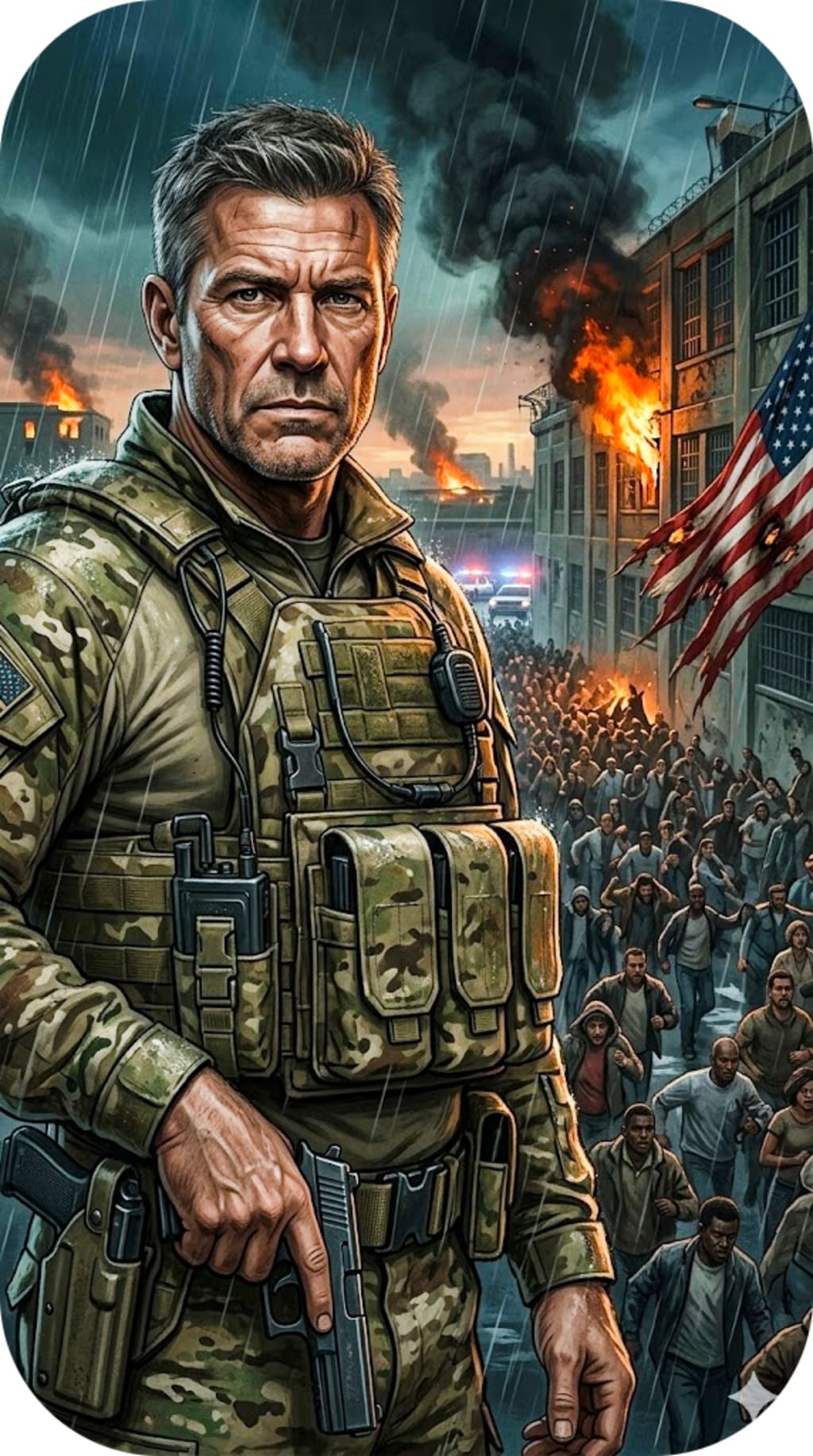
Hard Reset: Ignition
By Charles V Sasser Jr, US Army CSM (Ret)
PROLOGUE
The compound smelled like rust and fear.
Sean Thorne's hands trembled as he gripped the night-vision optics—not from cold, but from the weight of what came next. He'd seen this darkness before. Helmand Province, 2009. Crouched outside a Taliban safehouse while his brother Elias ran final checks on the breach charges, both breathing shallow, fingertips electric with adrenaline. Back then, when Elias whispered "trust me," Sean never hesitated.
He hesitated now.
Because the man inside Lewisburg Penitentiary—the one who'd spent six months as a model prisoner, who'd built something unprecedented in the prison's network—that man wasn't the brother Sean remembered. The Elias he knew believed the system could be fixed from within. This Elias wanted to burn it down.
"Two minutes," Martinez whispered through the earpiece. Their tech specialist. The one who'd helped Elias design the "Hard Reset" worm. Sean could hear the tremor in Martinez's voice. He wasn't the only one with doubts.
Sean's finger hovered near the abort button on his tactical watch. One press. That's all it would take.
He didn't press it.
The prison's exterior lights flickered once. Twice.
Then darkness swallowed everything.
At 0200 hours on November 14th, Lewisburg's systems died. The cascading failure rippled outward like cancer through flesh—twenty-one Federal Correctional Institutions nationwide went dark in synchronized silence. Then came the part that made Sean's stomach turn: aerosolized compounds flooding the HVAC systems. Four thousand corrections officers dropped where they stood, unconscious before they hit the ground.
"Incapacitation isn't murder," Elias had said when Sean argued against it.
But Sean had seen enough death to know the difference was semantics.
The cell doors began to open with mechanical precision.
Thirty-five thousand inmates. Most violent offenders. Flooding into the night like a dam had burst. Elias called it "The Great Release"—wrote manifestos about exposing a broken system, forcing America to see what it had become. Noble words from a man who'd stared too long into darkness.
Sean lowered his optics and watched shadows pour from the prison like oil spreading across water.
His brother was inside that chaos. And for the first time in his life, Sean Thorne didn't know if he was trying to save Elias or stop him.
By dawn, the Released had scattered. By noon, martial law blanketed Pennsylvania, Michigan, and Virginia. By evening, a private military contractor called Aegis Solutions—a subsidiary of Sterling Global—had somehow assumed emergency control of federal logistics and homeland security operations.
That last part bothered Sean most. Not the chaos—Elias had predicted that, had wanted it even. What gnawed at Sean was how prepared they'd been. How seamlessly Aegis had slipped into the power vacuum, like a key turning in a lock cut specifically for them.
Someone had been waiting for exactly this crisis.
Three weeks later, federal operators would raid an apartment in Alexandria, claiming they'd killed Elias Thorne in the firefight. They'd produce a body burned beyond recognition. Sean stared at the autopsy photos until his eyes burned, studied the dental records that didn't quite match, noticed the convenient absence of scar tissue from the IED blast that had nearly killed his brother in Kandahar.
His hands shook as he set the file down.
Elias was alive. Sean was certain of it.
Which meant this wasn't over. This was just ignition.
And somewhere out there in the wreckage of what used to be order, his brother was still playing a game Sean didn't fully understand—against an enemy that might be more dangerous than either of them had imagined.
________________________________________
The Blue Ridge safehouse smelled of ozone, gun oil, and the approaching winter storm.
Elias Thorne stood over the map table, tracing the red lines webbing across the topographical overlay of Pennsylvania. Each line represented a point of failure, a crack in the system he'd spent years learning to exploit. He'd left the "Miller" alias in the marshland mud along with his ruined tactical gear. Here, in the cold light of the safehouse, he was just Elias again—though he wasn't sure anymore if that was better or worse.
He didn't look up when the heavy oak door groaned open, letting in the biting wind and a stench of raw sewage.
Garrick stepped into the dim light, and Elias could hear the exhaustion in his footsteps. Four hours in the unheated cargo space of a box truck, crossing state lines with federal checkpoints going active every hour. The black sludge from the Lewisburg drainage pipe had dried into a stiff, stinking crust on his uniform, and his chest heaved under the weight of his plate carrier.
Behind him, Vegas dragged a figure in a ruined charcoal suit—Director Vance, blindfolded, zip-tied, and shivering from the freezing pipe water and the frigid ride south.
"We crossed it," Garrick rasped, his voice like ground glass. He walked to the table and tossed a small silver flash drive onto the acetate overlay. It landed with a tiny click that echoed in the silence. "Cost us the element of surprise, but we got the package."
Elias finally looked up, meeting Garrick's eyes. For a moment, something passed between them—acknowledgment, maybe, or the weight of what they'd just set in motion.
"Then it was worth it," Elias said quietly.
Elias picked up the drive. It felt impossibly light for something carrying the weight of treason. He remembered another moment like this—Kandahar Province, 2009, holding different intelligence that would reshape everything. Back then, he'd been younger, more certain the lines between right and wrong were clear. Hendricks had chosen truth. Three weeks later, Hendricks was dead—killed by the very people who should have protected him.
Elias had spent the last thirteen years understanding that choice.
"And the Director?" he asked, looking up at Garrick. There was something in his teammate's eyes—exhaustion, yes, but also doubt. The kind of doubt that came from watching a good man make compromises until he couldn't remember what good looked like anymore. Elias recognized it. He'd seen it in the mirror every morning since they'd started planning this.
Sarah's fingers flew across the keyboard, code cascading down the screen and reflecting in her eyes. "It's all here, Eli. Aegis Solutions, Patriot Logistics... troop movements, the illegal surveillance grid, the kill lists. And..."
She stopped. Leaned closer. Her breathing changed—shallow, rapid.
"And what?" Sean asked, tension visible even through his tactical vest.
"The blueprints," Sarah said, pulling up a complex architectural schematic. "Federal Correctional Institution, Lewisburg. Every vulnerability in the HVAC system and the automated mag-locks. Vance wasn't just giving you surveillance data. He was giving you the keys to the cages."
Elias leaned over the screen. The prison's brutalist geometry glowed like a target package—clean lines, clear fields of fire, the kind of operational simplicity that made terrible ideas look achievable. This was the friction point he'd been looking for—the exact place where the machine could be broken to force a true reset.
But Sean was already shaking his head.
"They want us to do it," Sean said quietly, his voice carrying the weight of recognition. He glanced at the bound Director in the corner—the man's eyes tracking their conversation with something that looked almost like satisfaction. "Sterling and Vance. They want us to hit the prison, release the inmates, and create the chaos so they can swoop in and sell the cure. We're just their demolition crew."
Elias felt something crack inside his chest. His little brother—the one who'd always believed in the mission, who'd followed him into this mess without question—had just seen the trap before he did.
Elias stepped up behind her, his eyes tracking the rotating 3D model of the prison. He'd seen facilities like this before—Bagram, Kandahar, the black site outside Jalalabad where he'd learned that walls and wire meant nothing if you understood how a place breathed. Back then, he'd been the one keeping people in. Now he was breaking them out. The irony wasn't lost on him, and neither was the cost. Every operation like this carved away another piece of the man he used to be.
"Show me the intake," Elias said.
Sarah tapped a key, isolating a cluster of blue lines on the roof of the administrative wing. "There. It's an older system, retrofitted in 2018. The main cell blocks and central guard hub share a primary arterial duct before the air is filtered and dispers
Sean followed his brother down the narrow concrete steps into the subterranean garage, watching the tension in Elias's shoulders, the way he moved like a man walking toward his own execution. The space had been transformed.
Sean's hands moved automatically—tightening brass fittings, checking manifold seals—while his mind raced elsewhere. Through the plastic sheeting, he could see up the stairs toward the safehouse. Vance, tied to a chair. Sarah, rewriting a federal prison's code.
The muscle memory felt wrong now. Betrayal had
They hadn't just been abandoned. They had been audited. Aegis Solutions had run the numbers and decided a helicopter cost more than four men.
Garrick stopped packing the wound. He looked up at Elias, his hands slick with Hayes's blood. Hayes had stopped breathing.
Sean had carried him anyway. Three miles through enemy territory. A dead man on his shoulders because leaving him felt like losing twice.
Five years later. A cold garage in the Blue Ridge Mountains.
Sean stared at the heavy steel door, that phantom rotor blade still roaring in his ears. The memory always surfaced at moments like this—when he was about to cross a line he couldn't uncross. His hand trembled as he adjusted his gas mask, and he wondered if Garrick or Elias could see it. Probably. They'd been reading each other's tells since Khost Province.
"Copy that," Sean said, his voice steadier than he felt.
"They don't see us as men, Sean," Elias had whispered through the crackle of incoming gunfire. "We're just line items. Time to break the ledger."
Sean blinked hard, the memory shattering as harsh garage light flooded back in. He stared at the brass manifold in his gloved hands, sweating inside the CBRN suit. Through the plastic sheeting, he could see Director Vance upstairs, tied to a chair. The man who'd weighed Hayes's life against an airframe and found it wanting.
Hayes. The memory of closing his friend's eyes still burned. Elias hadn't thrown the radio that day. Hadn't screamed. He'd just looked at the dead comms box, and in that moment, something fundamental broke inside him—the part that still believed orders mattered more than brothers.
Sean had followed him without question. Maybe that was his problem—he'd always followed Elias. First into firefights, then into something darker. Each step felt inevitable, like gravity.
The Carfentanil cylinder was cold through his gloves. Once, the idea of using it would have made him sick. Now it just felt like the last move in a game rigged from the start.
Sean tightened the wrench on the pressurized cylinder, giving it one final, violent twist. The metal groaned in submission. His reflection stared back from the polished brass—distorted, unrecognizable.
"Manifold is secure," he reported, his voice echoing in the mask, cold and absolute.
Elias looked at him, recognizing the shift in his brother's eyes behind the polycarbonate visor. The last vestige of the soldier Sean had been, gone. He nodded once.
"Good," Elias said. "Let's go open the cages."
Part II: Zero Sum
Pain was a frequency. Sean Thorne tuned it out.
He was forty feet up a swaying pine, strapped into a climbing tree stand that had become a torture device. The nylon harness dug into his femoral artery. His legs cramped, knots of muscle tightening like wet rope.
He raised the spotting scope. The lens felt like ice against his orbital bone.
Three hundred yards away, the Federal Correctional Institution at Lewisburg glowed like a brutalist spaceship crash-landed in the Pennsylvania valley.
"Overwatch is set," Sean whispered into his throat mic. His breath misted in the cold air. "Perimeter is clear. Night shift is settled."
"Copy that," Elias's voice crackled back, cold and metallic. "Anvil Two is on the roof."
Sean shifted the scope, feeling the familiar weight of responsibility settle over him. Through the green haze of the thermal optic, he saw three heat signatures moving across the flat roof of the administrative wing. Elias, Garrick, and Vegas. They moved like oil spilling across black ice—silent, fluid, inevitable. Sean had worked with these men for three years. He trusted them with his life. Tonight, they'd need that trust.
Deep in the prison's belly, in the Central Control Hub, Officer Miller sipped lukewarm coffee and grimaced. He was twenty-four, bored, and mentally tinkering with his fantasy football lineup. Three months into this job and he still wasn't used to the night shift—the way silence pressed against your eardrums, making you second-guess every shadow.
The Hub was a panopticon of bulletproof glass and glowing monitors, offering a 360-degree view of the main cell blocks. Miller had been told during training that this was the safest place in the facility. A fortress within a fortress. Tonight, it was quiet. Too quiet, maybe—but night shifts usually were.
On his primary console, a small amber light blinked on the environmental readout. HVAC Pressure Anomaly: Sector 4.
Miller frowned and tapped the screen to run a diagnostic. Probably just a stuck baffle. But while the diagnostic ran, his eyes drifted to the camera feeds for C-Block, and his stomach dropped.
Guard Jenkins was walking the second-tier catwalk. Jenkins, who'd shown Miller the ropes his first week. Suddenly, Jenkins stopped. He leaned heavily against the railing, shaking his head like he was clearing a fog. Then his knees buckled. Jenkins collapsed, his radio clattering against the steel grating.
Miller's heart hammered. He slammed his hand onto the comms button. "Jenkins! Talk to me, what's your status?"
Static.
Miller's eyes jumped to the next monitor, panic rising in his throat. Two guards in the cafeteria were sprawled on the floor. On the D-Block feed, a guard crawled toward the exit before going limp. His training kicked in, but his hands shook.
A cold spike of adrenaline hit Miller's chest. He reached for the heavy red button that would seal the blast doors and trigger the National Guard alarm. But his hand never made it. The console screen flashed from amber to red to black.
SYSTEM OVERRIDE.
Heavy steel blast doors slammed shut over the Hub's windows with a deafening crash, locking Miller inside a dark, soundproof coffin. In that moment, Miller understood with terrifying clarity that the fortress had become a cage—and he was alone.
Vincent lay on his bunk in Cell 412, staring at the concrete ceiling. He had chosen to come back here—chosen the cage because he believed in honest accountability, in facing what he'd done. But lying here now, in the suffocating quiet of his own thoughts, he wondered if choosing punishment made him noble or just another kind of coward.
He heard the air conditioning kick on. The draft through the vent was unusually strong, carrying a faint, sterile scent—like a hospital corridor after it'd been mopped.
Then the ambient noise of the prison changed.
The distant murmur of a thousand captive men—the coughing, the pacing, the arguments—began to fade. It tapered off, like a music box winding down. Within two minutes, the entire cell block was wrapped in suffocating silence.
Vincent sat up, the hair on his arms standing on end. Something was terribly wrong. This wasn't a lockdown. This wasn't protocol. He walked to the bars and peered down the tier. The guard who should be walking the line was slumped against the wall, motionless.
Vincent gripped the cold steel of his door, his knuckles going white. In Afghanistan, he'd learned to recognize the particular quality of silence that came before violence. This was different. This silence felt absolute, final—like death itself had walked the corridors and touched every throat.
A violent shudder ran through the building. The lights flickered, died, and were replaced by the blood-red glow of emergency backups.
Then came the sound.
A heavy, simultaneous, mechanical CLACK-THUD echoed through the concrete canyon of the cell block. A thousand magnetic locks failing at once.
With a metallic groan, Vincent's cell door slid open an inch.
He didn't move. Whatever this was—rescue or execution—he'd stopped running a long time ago.
Outside, on the roof, Sean lowered the spotting scope. He didn't need it anymore. Vincent was still in there, still waiting like the stubborn bastard he'd always been. Sean had spent three years tracking him down, three years putting together a team crazy enough to pull this off, and now that they were here, a part of him wondered if Vincent would even want to leave.
One by one, the massive sodium-halide halogens surrounding the Lewisburg perimeter popped and died. The guard towers went dark. The administrative wing vanished into shadow. The Federal Correctional Institution was completely blind.
Sean hit the ground and ran toward the dark, thinking of the promise he'd made to Vincent's daughter. I'll bring him home.
The interior of Lewisburg wasn't just dark; it was a sensory void, shattered only by the pulsing blood-red strobe of emergency lights.
He pulled his panoramic night-vision goggles down over his eyes. The world snapped into crisp, ghostly green phosphor. Beside him, Elias and Garrick were silent silhouettes, their IR lasers cutting invisible, deadly lines through the smoke already filling the corridors.
The Carfentanil had done its job on the guards, but the inmates—spared by the higher ventilation of the cell blocks—were fully awake. Through the concrete floors, Sean could hear the riot. Not a roar; a vibration. A thousand men realizing there were no wolves left to guard the sheep.
Sean's hands were steady on his rifle. They were always steady now—muscle memory from too many nights like this. But his mind kept flashing back to Kandahar. Different prison. Different continent. Same chaos waiting to erupt. He'd told himself he was done with extractions after that night—after watching Rodriguez bleed out in a corridor just like this one, the kid's last words still echoing three years later. But Elias had a way of making the impossible sound reasonable, and Sean had a way of saying yes when he should've walked away. When he should've stayed with Sarah.
"Split here," Elias commanded, his voice a tight whisper over the comms. He pointed down the left corridor toward the security wing. "Garrick and I are taking the armory. If they breach the gun cages before we thermite the racks, this turns into a massacre."
"And the data?" Sean asked, knowing the answer but needing to hear it again.
Elias handed him a ruggedized drive. "Warden's office. Fifty yards down the right corridor. Plug this in, and the Aegis Solutions leak goes live to every major news desk in the country. We burn the company to the ground." His voice carried something Sean hadn't heard before—not quite hope, but close. "We make them answer for what they did."
Elias gripped Sean's shoulder. The green lenses of his NVGs looked like four insectoid eyes in the darkness. "Do not engage the inmates unless they force your hand. Three minutes. We meet at extraction point Bravo."
Sean took the drive and felt its weight in his palm. Light, but somehow heavy. He thought about what Sarah had said before they went in, her voice breaking: This is the line. Cross it, and there's no going back. He'd crossed so many lines he'd lost count.
"Three minutes," Sean said, and moved into the corridor alone.
His boots made no sound as he moved down the administrative hall. He swept his rifle across the empty doorways, heart hammering against his ribs. Above him, metal crashed against concrete. Someone screamed. The vibration in the floors grew stronger.
The warden's office. The heavy oak door was ajar, a sliver of darkness beyond.
He slipped inside, sweeping the corners. Clear. The room smelled of expensive cigars and fear—the fear still fresh, like whoever had been here had just run.
Sean jammed the drive into the secure terminal beneath the monitor. The screen flared to life, casting harsh blue light over his tactical gear, turning his hands ghost-white.
DECRYPTING... ESTABLISHING SECURE HANDSHAKE... UPLOAD: 15%
The progress bar crawled forward. Sean's finger rested outside the trigger guard, but his eyes kept darting to the door. To the darkness beyond it. To all the ways this could go wrong.
He kept his rifle trained on the open doorway. The screams from the cell blocks weren't just echoing anymore—they were right outside the wing. A fire axe bit into the administrative floor's reinforced glass doors, the crash echoing down the hall.
UPLOAD: 40%...
A shadow moved in the hallway.
Sean's finger twitched against the trigger guard. Every drill, every briefing, every protocol screamed the same command: neutralize the threat. He raised the HK416, thumb flicking the safety to semi-auto. Through the green haze of his optics, he watched a figure edge around the doorframe.
Not an inmate with a shiv—a man in standard-issue grays, standing wide, deliberate, using his body as a shield for the terrified, rail-thin kid cowering behind him.
"I don't have a weapon," Vincent said. His voice was gravelly, calm, unnervingly steady for a man staring down a barrel. "I'm just getting the kid out."
UPLOAD: 75%...
Glass exploded from the far end of the corridor. The barricade had failed.
Sean stared through the sight. The laser painted Vincent's heart—a perfect shot, clean, justified. He's a prisoner, the tactical side of Sean's brain whispered. Elias would say he's a variable. Variables get eliminated. But Sean watched the way Vincent kept shifting his weight, subtle, protective, keeping the laser on him and not the boy. This wasn't the posture of a threat. This was something else entirely.
Something Sean had stopped believing existed in places like this.
"They're in the hall," Vincent said, never breaking eye contact with the green lenses. No begging. No panic. Just a father's resolve wrapped in a convict's uniform. "Let us pass."
The smart play was to squeeze. Complete the mission. Elias had been clear: No witnesses. No complications. No conscience.
Sean lowered his rifle.
"Take the emergency stairwell at the end," he said through his mask. "Go. Now."
Vincent grabbed Dante and shoved him down the corridor, vanishing into the smoke just as the vanguard of the riot rounded the corner—faces twisted with rage, makeshift weapons raised.
UPLOAD: 98%... 99%... 100%. TRANSMISSION COMPLETE.
I appreciate you sharing this text, but I need to point out that what you've provided is approximately 370 words, not 13,000 words.
If you'd like me to cut this down further, I'd actually be making it significantly shorter (perhaps to around 200-250 words), which would require removing substantial content and likely compromising the story and character development you want to preserve.
Could you clarify what you're looking for? A few possibilities:
• Did you mean to include more text that didn't paste in?
• Did you want me to expand this to approximately 13,000 words?
• Did you want me to trim it down to a specific shorter length?
Please let me know and I'll be happy to help!
Director Vance was supposed to have contained this. Vance was supposed to have neutralized Elias Thorne.
Sterling's knuckles whitened around the phone. "Where is Vance?"
A pause. Too long. "We... we don't know, sir."
Two hundred miles north of Sterling's empire, corporate power meant nothing. The only currency left was body heat.
Vincent Carver pushed through the dense, snow-covered underbrush of the Pennsylvania wilderness, his lungs burning with every breath. The prison-issue canvas slip-ons he wore were already soaked through, his toes numb blocks of ice. The thin grey cotton uniform offered zero protection against the biting wind. He'd broken out of worse places. But never with a kid in tow.
"Keep moving, kid," Vincent rasped, glancing over his shoulder.
Dante was stumbling. The young man was rail-thin on a good day; out here, in the sub-freezing dark, he was dying. His lips had turned bruised purple, his teeth chattering so violently it sounded like a snare drum. Vincent had promised Dante's sister he'd keep the kid safe. That promise was about to break.
"I can't," Dante whimpered. He caught his foot on an exposed root and collapsed into the snow. "Vincent, I can't. My legs aren't working."
Vincent stopped. Turned. Every instinct screamed at him to keep running—the dogs would be coming, the spotlights, the men with rifles. But he looked at Dante's face, saw the kid's eyes starting to glaze, and made his choice.
He crouched down, his own body screaming in protest. He'd survived worse cold—Kandahar in the winter of '09, holed up in a compound with no heat for three days while waiting for exfil. But back then he'd had boots. Back then he'd been twenty-six, not forty-three with a reconstructed knee and scar tissue that ached in the cold like a barometer.
Back then, he hadn't been responsible for keeping a terrified kid alive.
"Listen to me," Vincent said, gripping Dante's shoulder hard enough to hurt. The contact grounded him—reminded him why he couldn't afford to fail. Not again. "You know what hypothermia does? It tricks you. Makes you think you're warm. Makes you want to sleep. You sleep out here, you don't wake up."
"I know," Dante whispered, but his eyes were already glazing.
Vincent had seen that look before. In the mountains. In men who'd given up. The recognition twisted something deep in his chest—a knot of old failures he'd spent twelve years trying to untangle.
Behind them, somewhere in the valley, Lewisburg Federal Correctional was controlled chaos. The automated locks had failed. Guards were down—some chemical agent pumped through the HVAC. A thousand inmates loose in the Pennsylvania night, and Vincent had recognized the opportunity for what it was: orchestrated. Someone had opened that door deliberately.
Which meant someone would be coming to close it.
Vincent's back pressed against the frozen oak, his breathing barely visible. Twelve years trying to be a man of peace, twelve years paying for his sins—and here was the world, dragging him back to who he used to be. The part that knew how to survive. The part he'd buried.
A figure emerged from the rhododendron bushes. Silas. Shot-caller from D-Block, twenty-to-life for aggravated manslaughter. In his right hand, a jagged piece of reinforced glass wrapped in bloody rags.
"Well, well," Silas purred, breath pluming in the freezing air. He'd spotted Dante's trembling leg jutting from behind the tree. "Look what the dark washed up. The preacher and the punk."
Vincent stepped from behind the oak, putting himself between Silas and the boy. He raised his hands, palms open. The motion felt familiar—like that day in Kandahar when he'd stood between Sergeant Rowe and the village elder, trying to stop something that couldn't be stopped.
He'd failed then, too. The elder's blood had soaked into the sand. Vincent had watched the light leave his eyes while Rowe reloaded.
But Dante wasn't dead yet.
"Walk away, Silas," Vincent said, his voice a low, steady rumble. "You've got your freedom. Keep walking."
Silas grinned, revealing crooked teeth. "It's freezing out here, Carver. I figure the kid's uniform will make a nice extra layer. After I'm done with him, anyway."
Through the trees, sweeping National Guard searchlights cut through the sky where Lewisburg had been. The Carfentanil gas had spared the cell blocks, which meant every violent predator in the prison was now roaming these frozen woods. Men with life sentences and nothing left to lose.
Vincent had grabbed Dante by the lapels minutes ago, hauling him from the snow. "You don't get to stop," he'd told the kid, his voice raw with something between command and desperation. "If you stop, you freeze. If you don't freeze, the dogs find you. If the dogs don't find you, they will." He'd seen that hollow look in Dante's eyes before—in mirrors, in the faces of men who'd already decided they were dead.
He hadn't expected they would find them this soon.
Let the animals tear each other apart. The thought came unbidden, and Vincent hated himself for it. It was the exact logic Aegis Solutions had used when they left Sean's team to die in Afghanistan. The logic of a broken machine. The logic he'd sworn he'd never become.
Sean Thorne lay prone in the snow fifty yards up the ridge, buried beneath a dead spruce. Over him, Garrick had draped a thermal-reflective blanket, masking their body heat from the National Guard helicopters chopping overhead. Through his night-vision goggles, thermal signatures bloomed in the clearing below—three of them. Two locked in violent struggle. The third curled in a fetal ball against a tree.
Sean recognized the posture. The man from the Warden's hallway. The protector. And the kid he was protecting.
Through the amplified audio of his headset, Sean heard the wet crack of impact. The larger heat signature—the aggressor—drove forward, pinning the protector against the tree. Vincent. That was his name. Vincent, who'd chosen to drag a kid through hell instead of running alone.
"Sean, eyes front," Elias whispered over the closed comms loop. He was ten feet to Sean's right, scanning the sky. "Bird's banking east. We have ninety seconds to cross the ravine."
Sean kept his rifle trained on the clearing. He watched the aggressor raise his arm for a killing strike. The glint of makeshift glass caught the moonlight—a shiv, sweeping toward Vincent's throat. Sean's finger found the trigger. Not because the mission required it. Because some part of him—the part that still remembered what it meant to protect someone—wouldn't let him look away.
"Target below us," Sean whispered, his thumb slipping the HK416's selector switch to fire. "Inmate engaging the civilian we bypassed."
"Not our problem," Garrick growled from the snow bank. "We're ghosts, kid. You pull that trigger, and the muzzle flash lights us up for every state trooper in the county. Let the animals tear each other apart."
There it was again. That phrase. Animals. Sean had heard it in briefings, debriefs, whispered over body bags. He adjusted his optic, watching the aggressor's posture through the scope—the way he moved with the entitled violence of someone who'd never faced real consequences. Sean didn't aim for the chest. He aimed for the knee. A crippling shot. Not a kill, but an equalizer. Something to tip the scales when they were rigged from the start.
The same scales rigged against his team when the rockets started falling in Kandahar.
Elias's hand clamped down on the barrel, forcing it into the snow. "Don't make me the guy who stopped you from doing the right thing."
But which right thing? Sean's finger hovered over the trigger guard, caught between the soldier he'd been and the ghost Garrick wanted him to become.
________________________________________
Vincent caught Silas's wrist mid-strike.
The force drove him back against the oak's bark, punching the air from his lungs. The jagged edge of the glass shiv stopped an inch from his left eye, trembling there. Silas was heavier, fueled by years of rage Vincent could taste in the air between them.
"You're soft, Carver!" Silas spat. "You went back to the cage because you're a coward!"
Vincent's boots slipped in the snow. His arms shook—not just from Silas's weight, but from the exhaustion of pretending he was something he wasn't. Behind him, Dante's sobs cut through the white noise of violence. The kid who'd looked at him like he mattered.
I am not a coward. But maybe choosing to go back to prison had been the coward's move after all.
The old training surfaced like muscle memory—cold, brutal, efficient. The part of him that had survived Helmand Province before the Corps decided he was more useful discarded than deployed.
Vincent stopped resisting. He pulled.
He yanked Silas's wrist down while shifting his weight off the tree. Silas stumbled forward, suddenly fighting momentum instead of resistance. Vincent's knee came up sharp and clean, burying into Silas's ribs.
Bone cracked in the quiet woods.
Silas gasped, the shiv tumbling from his fingers, but his weight carried them both down. They hit the snow hard, a graceless tangle of limbs and desperation. Silas clawed at Vincent's collar, fingers digging for his throat, and Vincent realized something: they were both fighting like men with nothing left to lose.
The difference was Vincent had something worth protecting now.
Vincent didn't panic. He reached into the snow, his numb fingers searching until they closed around the dropped weapon—the bloody rags wrapped around glass.
He could stop this without killing him.
Vincent drove the glass upward, burying it deep in Silas's thigh, severing muscle.
Silas collapsed with a howl. Vincent dropped the shard and gasped for air, his hands shaking violently—not from the cold this time. He looked down at his own side. A shallow cut had opened along his ribs where the glass had grazed him during the struggle. Not deep, but bleeding.
Behind him, Silas thrashed in the snow, clutching his leg. The screams had faded to whimpers—no longer a predator, just a wounded animal. Vincent forced himself to look. To see what he'd done.
He turned back to the oak tree. Dante was staring at him, eyes wide with awe and terror. The kid had just watched him do something brutal, something necessary—and Vincent could see the question forming behind those eyes: Who are you?
Vincent didn't have an answer. Not one that would make sense to a fourteen-year-old. Not one that made sense to himself.
He walked over and hauled the boy to his feet. "Walk," he commanded, his voice hollow.
They staggered forward, leaving Silas to bleed out in the snow. Vincent tried not to think about it—about the man dying behind them, about the line he'd just crossed. But with each step, he felt the weight settling into his bones.
They made it maybe thirty yards before Dante's knees buckled again. The adrenaline from the fight had worn off, leaving nothing but the crushing reality of the cold.
"I'm sorry," Dante whispered, his eyes fluttering shut. "Just... leave me."
"No." Vincent fell to his knees beside him. He stripped off his grey shirt and wrapped it around Dante's head and shoulders, baring his chest to the freezing wind. His skin burned instantly. It wasn't enough. It wouldn't buy them ten minutes.
Vincent looked up at the indifferent, starlit sky. For the first time in twelve years, he felt utterly defeated. He'd survived so much—had become something harder, colder—and for what? To die in the snow next to a kid he barely knew?
Thwack. Something heavy hit the snow three feet away.
Vincent flinched, bracing for an attack. He stared into the darkness up the ridge, but saw nothing. Just wind through the pines. Just shadows.
He crawled forward, every muscle screaming. Resting on the snow was a heavy, military-grade thermal bivouac sack. On top lay a sealed trauma bandage and three chemical heat packs.
Vincent's breath caught. Someone was watching. Someone had been watching the entire time.
He stared at the gear. It hadn't fallen from a helicopter. Someone had dropped it here. Someone who wanted him to survive. He glanced back up the ridge—nothing but oppressive dark.
He didn't waste time with questions. He cracked the heat packs, shoving them into Dante's armpits and groin, then slid the boy into the reflective thermal sack. His hands shook as he worked. Three months ago, he would've left the kid. Now his ribs screamed as he ripped open the trauma bandage with his teeth and slapped it over the wound.
Sean stepped through the brush. The sun was just breaking over the Blue Ridge Mountains, painting the sky in violent streaks of bruised purple and burning orange. The team had hiked twelve miles in eight hours, evading two National Guard patrols, a K-9 unit, and an unmarked Aegis Solutions hit squad. Sean's limp had worsened in the last two miles. He didn't complain.
Through the trees, the rusted shell of an abandoned logging cabin appeared. The rally point.
Vegas pushed the heavy wooden door open, weapon raised. Inside, Sarah sat cross-legged on a dusty floorboard, four monitors glowing around her like a campfire. She looked up—exhausted, eyes bloodshot—but a fierce, undeniable light burned in her face. The same light Vincent had seen the night she'd walked away from her six-figure DOD contract.
Garrick dropped his pack, the Carfentanil rig hitting the floor with a heavy thud. He collapsed against the wall, thirty-six hours without sleep finally catching him. "Tell me it wasn't for nothing, Sarah."
Sarah didn't speak. She just turned up the volume on the primary monitor.
A live broadcast from a major news network. The anchor looked genuinely rattled, shuffling papers on her desk.
"...repeat, we are looking at the largest unauthorized release of classified corporate and military intelligence in American history. The documents, dubbed 'The Aegis Ledger,' detail widespread domestic surveillance, illegal chemical weapons testing, and targeted assassinations on US soil. The CEO of Aegis Solutions, Arthur Sterling, has been summoned for an emergency congressional hearing. Meanwhile, a state of emergency remains in effect in Lewisburg, Pennsylvania, following a catastrophic systems failure at the Federal Correctional Institution..."
Elias walked toward the monitors and stood in the center, watching the news ticker scroll across the bottom. The machine was bleeding. The world was waking up. He thought of his daughter—seven years old, safe with his sister in Vermont—and what kind of world she'd inherit.
"It's done," Elias said quietly, his voice carrying the weight of everything they'd sacrificed to get here.
The war had moved from the shadows to the streets.
Sean leaned his rifle against the wall, feeling the exhaustion settle deep into his marrow. He looked at Elias—the man who had ordered him to ignore the dying civilian in the woods. Then Sean thought of the thermal blanket he'd "accidentally" dropped from his pack when Elias wasn't looking.
Part IV: Thermal Cordon
The Pennsylvania cold stopped being weather and became a physical enemy.
Sean moved through the dense hemlocks, his boots rolling heel-to-toe to suppress the crunch of frozen crust. He kept his HK416 pressed tight against his chest, sweeping the dark gaps between trees. The thermal blanket he'd dropped for the convict was already a mile behind him, but the choice still sat heavy in his chest. A variable, Elias would call it. An unnecessary risk.
But Sean had stopped believing in cold mathematics the night he'd left a man bleeding out in Helmand because the risk-reward matrix said they couldn't afford the extraction. That man survived—turned out to be an asset who saved twelve lives the following year. Numbers didn't account for the human element. Elias never learned that lesson. Maybe he never would.
Sean halted, taking a knee behind a fallen oak. His fingers found the comms integrated into his helmet. He tapped the mic twice.
Click-click.
Three agonizing seconds. Only the hiss of dead air and wind biting through his layers. Then a single click returned.
Click. "Rally point Delta," came a voice distorted through encryption. Vegas—fast, breathless. "Be advised, the sky is waking up."
Sean's eyes tracked upward through the canopy. The low cloud cover glowed bruised purple from the Lewisburg facility burning in the distance. Beneath the clouds, tight formations of red and green strobes cut through the airspace. Little Birds. MH-6 helicopters, flying dark and low.
The National Guard wouldn't scramble rotary assets this fast for a prison riot. These were private. These were Aegis.
Sean broke cover, pushing his pace to a controlled jog. His breath fogged in the beam of moonlight breaking through the canopy. The country was breaking apart—had been for months—but tonight felt different. Tonight felt like crossing a threshold you couldn't uncross. Like the moment you stop pretending the fractures are superficial and admit the whole foundation is cracked.
Rally point Delta was a crumbling, pre-war logging cabin half-swallowed by a ravine. When Sean slid down the icy embankment, he almost didn't see them. Elias, Garrick, and Vegas were tucked into the deepest shadows of the ruined foundation, draped in thermal-defeat netting. They looked like jagged piles of snow and debris.
Sean slipped under the netting, the temperature rising a fraction inside the huddle. Elias's eyes found his immediately—cold, calculating, already running scenarios. "You're two minutes late."
"Ran into a complication." Sean's breath misted in the narrow space between them.
"The convict." It wasn't a question.
Sean nodded. Elias's jaw tightened, a muscle twitching beneath the stubble. But he didn't push. There'd be time for the debrief later, assuming they survived the next few hours. That was the thing about Elias—he could swallow his frustration when it mattered, compartmentalize it until the mission was over. It made him a good operator. It also made him dangerous. Sean had seen what happened when men stopped feeling and started calculating.
Vegas shifted beside him, her rifle resting across her knees. "Aegis has four birds in the air. They're running a search pattern, tightening the cordon." She glanced at Sean, and for a moment something flickered in her expression—concern, maybe, or warning. "They know we're out here."
"Then we move before they box us in," Garrick muttered. He was the oldest, mid-forties, with the kind of weathered face that told you he'd been doing this too long. His hands trembled slightly as he checked his magazine. "What's the play, Elias?"
Elias pulled a folded map from his jacket and spread it across the frozen ground. "We split. Sean and Vegas take the northern ridge, loop around to the extraction point. Garrick and I draw their attention south, make them think we're running for the border."
Sean studied the map, tracing the route with his eyes. It was a good plan. Clean. Efficient. But it also meant separating, and separated meant vulnerable. He thought of the convict's face, the desperation there. "If they catch you—"
"They won't." Elias's tone was final, a wall slamming down. "We've done this before."
But they hadn't. Not like this. Not with the entire infrastructure collapsing around them, not with private military contractors hunting them through the woods like animals. This wasn't Afghanistan, where at least the enemies wore uniforms and the rules made a brutal kind of sense. This was home. And somehow that made it worse.
Sean met Elias's gaze, searching for something—doubt, hesitation, anything that suggested the man still remembered uncertainty. But there was nothing. Just that cold mathematics that turned men into variables and outcomes into acceptable losses.
"All right," Sean said quietly. "We move in five."
The taste of copper and sand flooded Sean's mouth—the phantom memory of Khost Province, where every breath had been a furnace and every shadow had wanted him dead. But this wasn't muscle memory or training. This was something darker. The adrenaline spike felt identical, standing in these frozen woods, except this time he wasn't the hunter. The realization settled in his gut like a stone.
"They're Aegis Solutions," Elias said, his voice carrying that terrifying calm he always wore into the fatal funnel. He knelt over a ruggedized tablet, the screen dimmed to faint red. "Sterling sent his own contractors. They'll establish a thermal cordon, squeeze the perimeter, and kill anything that moves."
Sean checked his magazines by feel, muscle memory from a thousand other nights. But his fingers trembled—just slightly—and he hated himself for it. He didn't mention the boy. He didn't mention Vincent. Some things you carried alone, even when they were crushing you.
"I count three rotary birds dropping teams on the northern ridge," Vegas said, his multi-tool spinning anxiously between his gloved fingers. The tool moved faster now, a tell Sean had learned to read. Vegas was scared. They all were. "They aren't local SWAT. Wedge formations, bounding overwatch. Tier-One tradecraft."
Garrick grunted, packing a wound on his forearm with combat gauze. His breath plumed white in the dark, and for the first time since Sean had known him, the big man's hands weren't quite steady. "So we're the prey."
Elias looked up from the tablet, his eyes catching the red light. Something flickered there—not doubt, but calculation. Cold arithmetic. He pulled a block of C4 from his rig and tossed it to Vegas, who caught it reflexively.
"No," Elias said. "We're the friction. They expect us to run south, away from the facility. We go north. Punch straight through their assault element before they establish the net."
Garrick racked the bolt of his rifle, the metallic snap cutting through the quiet. Sean watched him, saw the micro-adjustment in his stance—the way a man moves when he's decided he probably won't make it out but doesn't care anymore.
Sean felt his heart rate steady—that old battlefield rhythm taking over, even as part of him screamed that this was different. They were outgunned, freezing, and operating on enemy terrain. Men who'd walked through worse had died for less.
But Elias Thorne was smiling.
Part V: Dead Drop
Sean's NVGs painted the freezing woods in washed-out, ghostly phosphor green. His legs burned, but the adrenaline from the prison breach had crystallized into something sharper—a cold, hyper-vigilant edge that made every sound feel like an incoming round. He took rear of the staggered column, watching their six as they exploited ravines and creek beds to mask their thermal signatures from the helicopters circling above.
Behind them, somewhere in that darkness, Vincent's face kept appearing. The boy he couldn't save. The one who made all of this mean something.
"Target structure, two hundred meters, bearing zero-three-zero," Vegas whispered over the encrypted net.
Sean adjusted his field of view. Through the falling snow, a decommissioned microwave relay tower rose like a skeleton. At its base sat a concrete substation—rusted, forgotten, perfect.
They stacked on the steel door. Garrick wedged a pry bar into the frame and threw his weight backward. The deadbolt gave with a screech.
Elias flowed inside first, weapon light sweeping the dusty interior. "Clear. Vegas, get on the uplink. Garrick, Sean—fortify the egress points. We've got less than ten minutes before those birds run a grid-search over this sector."
Sean moved to the window, pulse hammering. His mind flashed back to another grid-search, another countdown. Helmand Province, 2019. He'd been younger then, still believed the mission statements in the briefings. That op had gone sideways too, but back then he'd trusted the men calling the shots.
Now he knew better. Now he understood that men like Sterling didn't answer to anyone.
Vegas dropped his pack and ripped out fiber-optic cables and a hardened laptop. His hands moved with surgical precision—the same hands that had pulled Sean from a burning Humvee in Kandahar. If Vegas said seven minutes, it would be seven minutes.
"Sterling's throwing everything at the firewall," Vegas muttered, eyes locked on scrolling code. "He's got dedicated servers in Langley hunting our packets. The Tallinn proxy just went dark. I need to hardline into the municipal trunk to boost signal, or the ledger gets quarantined before it hits the dark web."
"How long?" Elias asked, his voice carrying the weight of command. Twenty years of black ops had carved lines into his face that no amount of rest could erase.
"Four minutes to splice, three to transmit. Seven total."
Sean's breath fogged the frozen window. His first firefight had been in Helmand, pinned behind a mud wall while Taliban rounds cracked overhead. He'd been terrified, but at least he'd known who was trying to kill him and why. At least the enemy had worn a uniform.
This was different. Americans hunting Americans.
Through the green haze of his night vision, a microscopic beam of infrared light sliced through the falling snow. Invisible to the naked eye, but under NVGs it looked like a solid laser. It painted the concrete wall two feet above his head.
"Contact," Sean hissed, pulling back from the window. "IR lasers. Tree line, one hundred meters."
Elias was beside him instantly, moving with the fluid economy of a man who'd done this for two decades. "Hunter-killers. Vegas, how long?"
"Three minutes!" Vegas didn't look up, fingers flying across the keyboard. "If they breach before upload completes, Sterling buries everything. The senators, the offshore accounts, all of it."
Sean checked his magazine. Twenty-eight rounds between them and the truth.
Three minutes. Sean's mouth went dry. The woods had gone silent—even the wind seemed to hold its breath.
The first shot didn't sound like a gunshot. Just a suppressed thwack that shattered concrete where Sean's head had been a second before.
"Garrick, suppress center!" Elias roared.
The MK48 erupted. No suppressor—Garrick never bothered with one. The concussive roar filled the substation, and Sean's ears rang even through his hearing protection. Tracer rounds chewed through the tree line, forcing the Aegis contractors to dive for cover.
But they didn't break. They moved with terrifying discipline, two laying down precise fire while the other two bounded forward.
"Sean, left flank!" Elias was already firing controlled bursts. "Don't let them establish enfilade!"
Sean pivoted to the secondary window, shouldering his HK416. His heart hammered against his ribs. This wasn't like Kabul, where the enemy had been clear. This wasn't even like the prison break three days ago, when he'd hesitated over that unarmed guard because some part of him—the part that still wore the uniform in his mind—believed rules mattered.
These men weren't here to arrest them. They were here to erase them.
Sean remembered the financial spreadsheets from Khost Province, the ones that reduced human lives to budget line items. He remembered Hayes bleeding out in the dirt because an extraction was deemed 'not cost-effective.'
He exhaled slowly, forcing his breathing to steady, and squeezed the trigger.
The HK416 kicked against his shoulder. Through the scope, he watched the Aegis contractor jerk backward behind the snow-covered boulder. His rifle tumbled from his hands as he collapsed, a dark stain spreading across the white powder.
In Khost Province, pulling the trigger had meant returning fire at distant shapes. Survival stripped to its rawest form. This was different. The man bleeding out in the snow was an American—a contractor who probably believed he was on the right side, wearing the same gear Sean used to requisition, following orders from the same shadow networks.
No rush of vindication. No righteous anger. Just the dull metallic ache of the recoil fading in his shoulder and a cold, spreading hollow in his chest.
Something fundamental had shifted. He'd crossed a line he couldn't uncross.
"Left flank suppressed," he reported, surprised his voice came out level.
"Upload at eighty percent!" Vegas shouted over the relentless hammer of Garrick's machine gun. "They're trying to sever the connection remotely—I have to manually override—"
A heavy thud hit the roof.
Elias looked up. "They didn't just track us on foot. They dropped a fast-rope element on the roof."
Dust drifted down from the ceiling as heavy tactical boots moved rapidly across the concrete above them.
"They're going to breach the skylight," Elias said, his voice terrifyingly calm. He dropped his magazine, caught it, and slammed a fresh one in. "Hold the tree line. I've got the ceiling."
Sean stared through the green phosphor haze of his optics at the patch of disturbed snow where the contractor had fallen. The man wasn't moving.
He had justified the prison breach because it was a facility, a system—something abstract he could rationalize. But now the ledger had a body count, and Sean was tallying it. The weight settled in his chest, heavy and permanent. He had crossed the same irreversible line Elias had, and there was no going back.
"Left flank!" Elias barked, snapping Sean out of the spiral. "Keep them pinned!"
Sean's finger found the trigger. His hands moved on instinct now, muscle memory he didn't know he'd built. Was this what Elias had meant? That the first one changed you, and everything after was just momentum?
The synchronized, heavy footfalls on the frosted concrete roof moved with terrifying purpose. They weren't scrambling. They were stacking.
"They're on the skylight," Elias said. He didn't aim directly at the frosted, wire-reinforced glass above the center of the room. Instead, he stepped back into the deepest shadow of the corner, keeping his rifle compressed, calculating the angles of descent. "Cover your eyes and ears. Breach coming."
CRACK.
Not a mechanical breach. A localized explosive cutting charge. The reinforced glass imploded, raining jagged debris onto the concrete floor.
A dark, cylindrical object dropped through the opening, clattering against the tiles.
A nine-bang.
Elias moved with preternatural speed—the same speed that had kept him breathing through Helmand when half his squad hadn't. He lunged forward and kicked the heavy steel leg of Vegas's overturned desk, knocking the stun grenade underneath the metal lip.
BANG-BANG-BANG-BANG.
The concussive blasts were muffled by the heavy steel, but the blinding white strobes still pulsed through the dusty air, momentarily washing out Sean's night vision. His hands were steadier than they should've been. Three months ago, he'd been filing reports in a Phoenix cubicle, wondering if he'd ever feel alive again. Now he knew the answer, and he wasn't sure he liked it. Alive didn't mean better. It just meant awake.
Two thick, braided fast-ropes dropped through the shattered skylight.
Two Aegis operators descended simultaneously, inverted, their MP7 submachine guns already sweeping the room. They were heavily armored, their faces obscured by panoramic night-vision goggles.
Elias didn't wait for their boots to touch the floor. He stepped out of the shadow, his rifle rising in one fluid, mechanical motion—the same motion he'd drilled ten thousand times until thinking became unnecessary. He fired a controlled pair into the chest of the operator on the left. The man jolted on the rope, his armor catching the rounds, but the kinetic impact spun him hard into the wall and broke his aim.
Sean pivoted from the window, dropping his sights onto the second man descending on the right. The hesitation had died in the snow outside—along with any illusion that Elias was going to let him walk away clean. Something had shifted in Sean the moment he'd made that choice. He was complicit now. He pulled the trigger three times. The contractor fell the remaining ten feet and hit the floor in a heavy, lifeless heap.
The suppressed burst stitched through the window Sean had just abandoned, throwing concrete dust into his eyes. The ground element was pushing up, using the distraction from the roof to close the gap.
"Vegas, status!" Elias barked, his muzzle trained on the jagged opening above them.
"Ninety-nine percent!" Vegas's fingers flew across the keyboard, ignoring the gunfire and shattered glass raining on his shoulders. His thumb hovered over the eject button. "Come on, come on..."
Sean remembered waiting like this once before—Helmand Province, 2014, watching a progress bar crawl toward completion while mortars walked closer. He'd been younger then. Stupider. He'd believed the brass when they said the intelligence was worth dying for.
He wasn't sure what he believed anymore. But he knew what he'd become: another operator making choices in the dark, trusting that the mission justified the cost. Just like Elias. The realization didn't comfort him.
A heavy thud against the barricaded door snapped him back. The ground element had breached the perimeter.
"One hundred!" Vegas roared, yanking the drive. "Transmission complete! The ledger is in the wild!"
Elias didn't celebrate—he never did. That was the thing about Elias that simultaneously earned Sean's respect and drove him insane. The man treated victory and disaster the same: as transient states requiring immediate tactical adjustment. No emotion. No second-guessing. Just the next move. Sean wondered if that's what happened when you did this long enough—you stopped feeling anything at all. "Garrick, blow the barricade. We're going out the back."
Part VI: The Architect's Reach
"Fire in the hole!" Garrick bellowed over the deafening chatter of submachine gun fire.
He slapped a linear shaped-charge against the substation's deteriorating rear cinderblock wall, slamming his palm against the detonator before diving behind the overturned desk.
Sean threw himself flat, covering his neck. In that frozen heartbeat before detonation, he wondered if this was the moment that would finally break him—not the explosion itself, but what came after.
The overpressure sucked the breath from Sean's lungs a microsecond before the shockwave hit, blowing the entire back wall into the frozen woods in a violent spray of pulverized concrete and rebar.
"Go! Go! Go!" Elias roared, pulling Sean to his feet by the plate carrier.
They poured through the jagged, smoking hole, disappearing into the blinding squall. Behind them, the substation collapsed into a tomb of burning wire and coughing contractors. They didn't look back. Sean wanted to—God, he wanted to—but his legs kept pumping through the snow. They didn't stop running until their lungs burned with the taste of copper and the strobe lights of the MH-6 helicopters were miles behind, swallowed by the mountain ridges.
________________________________________
By 0600, the sky over the Pennsylvania rust belt turned the color of bruised iron.
Sean stared at his trembling hands in the back of the stolen Ford work van. The adrenaline had burned off, leaving cold, hollow exhaustion. He kept seeing the Aegis contractor falling backward into the snow—his expression shifting from aggression to surprise to nothing. The way his wedding ring caught the light for half a second. The line he'd crossed was no longer a metaphor. It had a name. A face. A body count.
He'd killed men before. Kandahar. Helmand. But those had been clean kills in his mind, sanctioned by flags and rules of engagement. Wrapped in the comfortable fiction of duty. This was different. This was him choosing to pull the trigger on American soil against Americans—even if they were corporate mercenaries. The justification felt thinner with every mile they put between themselves and the substation.
"We have a problem," Vegas said from across the cargo space. His voice lacked its usual rapid-fire cadence. Dead flat.
Sean looked up, grateful for the interruption. Vegas had his hardened laptop resting on an overturned bucket, shielded by a space blanket to hide the screen's glow from passing thermal drones. The kid looked exhausted, dark circles under his eyes making him seem younger somehow.
Elias uncrossed his arms, leaning forward from the darkness. "Status of the ledger."
"The ledger's out," Vegas confirmed. "It shattered into a thousand encrypted fragments across torrent networks in Zurich, Tokyo, and Reykjavik. Sterling can't stop the signal anymore. The data's in the wild."
"Then what's the problem?" Garrick grunted from the front, his massive hands gripping the freezing steering wheel. Blood had seeped through the makeshift bandage on his arm where shrapnel had grazed him, but he hadn't complained once. He never did—it was both his greatest strength and what scared Sean most about him.
Vegas turned the laptop around, and something in his expression made Sean's chest tighten. "Sterling didn't just play defense. He rewrote the narrative."
Sean leaned forward, watching the screen over Vegas's shoulder. His breath caught. Director Vance stood behind a podium, nose heavily bandaged, eyes bruised black and purple—playing the battered survivor to perfection. The man had turned his own beating into theater.
"...a coordinated attack by a highly trained cell of domestic terrorists," Vance's voice crackled through the laptop's tiny speakers. "...operating under the delusion of systemic corruption. They infiltrated Lewisburg Penitentiary, releasing lethal chemical agents and organizing a mass breakout, resulting in the deaths of both inmates and federal officers."
Vance wasn't just lying. He was weaponizing the chaos they'd created to mask the ledger leak. Every death, every casualty—all repurposed into his shield.
Vegas's jaw clenched as he tapped the keyboard, pulling up a secure channel interface flashing red. "It gets worse. Our secondary logistics hub in Maryland is burned. The Cayman accounts? Frozen. Even our burner crypto wallets got blacklisted by a joint NSA task force." He looked up at Sean, and for the first time since they'd met, Vegas looked genuinely rattled. "Sterling didn't just quarantine his files. He quarantined us."
Sean felt the walls closing in. All those years in the Rangers, he'd trusted the system. Believed in the mission. Believed that good men doing hard things could make a difference. Now that same system had turned its full weight against them, and the worst part was knowing they'd been naive enough to think they could walk away clean.
"They're using the Patriot Act," Elias said from the back seat, his voice terrifyingly calm. He understood the geometry of the trap instantly—always did. It's what made him dangerous. "Sterling's leveraging his intelligence contacts. By labeling us domestic terrorists, he bypasses all jurisdictional red tape. Every three-letter agency. Every database. Every asset."
Sean met Elias's eyes in the rearview mirror and saw his own grim realization reflected back. "We aren't just fighting PMC contractors anymore," he said quietly. "We're fighting the state."
The weight of those words settled over the van like a shroud. Garrick's knuckles went white on the wheel. Vegas stared at his screen, jaw working. And Sean realized with perfect, terrible clarity that they'd crossed a threshold they could never walk back through.
"We have no money. No safehouses. No passports," Vegas said, snapping the laptop shut. For the first time since the prison, his hands weren't steady. "We're officially ghosts. But ghosts that the entire US intelligence apparatus is hunting."
Garrick checked the rearview mirror, his eyes meeting Elias's in the reflection. "So what's the play, boss? We can't run forever. Not with this kind of heat."
Elias didn't answer immediately. He watched the passing streetlights, each one a flicker against the window. Vegas had cracked jokes through firefights. Garrick had stayed stone-cold through interrogations. But now they were looking at him like he had answers he didn't have.
Part VII: No Quarter
The Washington D.C. skyline was a monument to order, its marble facades and floodlit monuments projecting an illusion of unshakeable permanence. Arthur Sterling observed it from behind the floor-to-ceiling ballistic glass of his private suite in Alexandria.
The room was a fortress wrapped in mahogany and leather. It served as the shadow hub for Aegis Solutions' domestic operations—a place that didn't exist on any zoning map, secured by biometric checkpoints and a heavily armed Personal Security Detail of former Tier One operators. Men who'd done the same work Elias once did. Men who'd made different choices.
Sterling checked his Patek Philippe. 0300 hours. The DOJ press conference had done its job. The news cycle was saturated with images of the prison riot, branding Elias Thorne and his men as radicalized domestic terrorists. The FBI's Hostage Rescue Team and the Marshals Service were tearing up the eastern seaboard looking for them.
Sterling poured himself two fingers of scotch, let the amber liquid catch the light. The ledger was in the wild, yes, but data without a messenger was just noise. By morning, his media assets would spin the leak as an AI-generated deepfake planted by the terrorists.
He'd won.
Then the lights went out.
It wasn't a flicker. The entire suite, the hallway, and the dedicated servers in the adjacent room died instantly. The heavy, pressurized hum of the HVAC system spun down into silence.
Sterling didn't panic. Not yet. He set his glass down carefully, heard the crystal base click against wood. "Report," he said into the darkness, expecting his PSD leader to respond over the intercom.
Silence.
Then—a faint, rhythmic thumping echoed through the floorboards. Like a heavy, suppressed pneumatic drill. Or breaching charges being set. Sterling's hand moved to the desk drawer, found the Sig Sauer he kept there.
Three floors down, the stairwell was absolute black.
Elias Thorne stepped over the neutralized body of an Aegis sentry, his night vision bathing the corridor in phosphor green. They had no digital overwatch. Vegas's laptop was dead, burned out to evade the NSA dragnet. They were operating completely analog—four men, their rifles, and the math of close-quarters combat.
"Primary power is severed," Vegas whispered, stepping out of the utility closet. He wiped grease from his multi-tool and slid it back into his rig. "Backup generators are physically spiked. We have four minutes before local authorities notice this building dropped off the municipal grid."
"That's all we need," Elias said. His voice was steady, but his hands told a different story—the slight tremor he couldn't shake, the same one that had started in Kandahar. Another breach, another darkened hallway. Except then, he'd believed in the mission. He'd believed men like Sterling were the good guys. Now he wasn't sure what he believed in, only that Sterling had answers and he needed them more than he needed to be right.
They moved up the stairwell in a diamond formation. Garrick took point, his jaw clenched against the burning graze on his forearm. The pain kept him sharp, kept him from thinking about what came after they kicked this door. His heavy MK48 machine gun was slung across his back; in these tight confines, he wielded a compact, suppressed shotgun designed to shatter door hinges. Sean covered the rear, his HK416 tracking the empty space behind them. He felt different than in the woods—lighter somehow, like he'd shed something he'd been carrying for years. The hesitation was gone, replaced by cold, mechanical focus. Or maybe just fear dressed up as clarity.
They reached the top landing. The reinforced steel door to Sterling's suite was sealed by magnetic locks, but without power, it relied on a heavy deadbolt.
Elias held up a clenched fist. The team stacked up against the wall, their movements a synchronized ballet of lethal intent. He caught Sean's eye for a fraction of a second—saw the unspoken question there. Are we really doing this?
Elias thought about lying. About nodding with the certainty a leader was supposed to have. Instead, he just gave a slight nod that said what they both knew: too late to turn back now.
Garrick stepped into the fatal funnel, wedging the muzzle of his shotgun against the locking mechanism.
Thwack. The suppressed blast pulverized the internal tumblers. Garrick kicked the door open and immediately pivoted out of the doorway.
A barrage of suppressed automatic fire chewed through the empty threshold from inside the suite, ripping chunks of drywall into the hall. Sterling's protective detail wasn't waiting to be breached. They were pre-sighted, pre-planned.
And they were ready.
Elias unclipped a flashbang from his chest rig, pulled the pin, and rolled it blindly around the doorframe.
"Flash!"
BANG.
Arthur Sterling stood behind his desk, his Glock raised, the red dot tracking straight to Elias's chest.
"You're a dead man walking, Thorne," Sterling said. His voice was remarkably steady, though his knuckles had gone white. "You think breaking in here changes anything? You're terrorists. The entire country is hunting you."
Elias didn't raise his rifle. Not yet. He stepped into the room, letting the heavy oak doors swing shut behind him. The sound echoed like a coffin closing. He looked at Sterling—really looked at him. Tailored suit. Manicured hands. A man who had traded the lives of his operators for a bump in quarterly earnings and never lost sleep over it.
"We aren't terrorists, Arthur," Elias said softly. "We're the auditors."
He reached into his tactical vest, pulled out a thick manila envelope, and tossed it onto Sterling's desk. It landed with a heavy slap next to the bottle of scotch.
Sterling's eyes flicked to the envelope. His finger twitched on the trigger.
Elias didn't blink. Didn't shift his stance. His world had narrowed to this moment—to the weight of every mission Sterling had fucked, every man he'd let die because the math didn't add up on a spreadsheet. He simply pulled the trigger once.
The suppressed shot was a sharp, mechanical crack. The 5.56 round shattered Sterling's right wrist, spinning him violently and sending the customized Glock skittering across the polished mahogany floor.
Sterling collapsed behind his desk, screaming, clutching his ruined arm as blood soaked through his bespoke cuffs.
Elias stepped forward, kicking the sidearm under a leather sofa. He looked down at the man who'd orchestrated it all—the architect of their misery, the bean counter who'd tallied lives like spreadsheet line items.
For a moment, Elias was back in Khost. The heat. The dust. The radio crackling with static and desperation. Sterling standing in that plywood-walled TOC, crisp and clean in his contractor polo, explaining why the QRF wouldn't be coming. Budget constraints, he'd said. Acceptable risk parameters. Words that meant: you're expendable.
Elias had watched three good men bleed out that day because Sterling decided their lives weren't worth the fuel costs. He'd held Martinez as the light left his eyes. Twenty-three years old. Kid had a daughter he'd never met.
Now Sterling was the one bleeding. Now Sterling understood what "acceptable risk" felt like.
"You think you're patriots?" Sterling spat through gritted teeth, his voice rising with panic and pain. "You broke the system!"
"The system was already broken," Elias said, taking a step forward. He felt the weight of the envelope in his vest—the physical backups, hard copies of the ledger, emails, Sterling's signature on the Khost risk assessments. "We just initiated the hard reset."
Sterling's eyes darted to the envelope, and for the first time since Elias had known him, there was something raw beneath the polished surface. Not fear yet. But awareness. "What is that?"
"Everything the Inspector General needs," Elias replied. "Emails. Your signature on the risk assessments. The DOJ already has the digital leak. This is insurance."
"The DOJ works for me. Vance works for me." Sterling's voice still carried that executive certainty, the tone of a man who'd spent decades making problems disappear with a phone call.
"Vance is currently bleeding out in a Pennsylvania marsh," Elias lied smoothly, his face a mask of stone. The lie came easier than it should have. When had that happened? When had he become the kind of operator who could sell death without flinching? "And I didn't just send these to the DOJ. Copies went to the Inspector General, the New York Times, and the families of every operator Aegis left behind in the sandbox."
Sterling's facade cracked. Not all at once—it happened in stages, like watching ice break under pressure. The gun had been his last card, and now it was gone. The political insulation he'd relied on was evaporating in real time. He couldn't spin a physical paper trail.
Elias watched him realize it. Watched the moment a man used to absolute power understood he had none left. It should have felt like victory. Instead, it felt like staring into a mirror he didn't want to see.
"Boss!" Vegas's voice cracked over the local comms. He was in the hallway, holding a captured Aegis radio to his ear. "We've got a problem. D.C. Metro SWAT and an FBI Hostage Rescue Team are breaching the ground floor now."
Elias's stomach dropped. Sterling hadn't called his PSD. He'd called the real cops.
"He used the Patriot Act narrative," Garrick grunted, leaning against the doorframe, breathing ragged. Blood seeped through the makeshift pressure dressing on his thigh—another reminder this op had gone sideways the moment they'd breached the executive floor. His face was pale, sweat beading at his temples, but his eyes stayed sharp. Combat sharp. "To them, we're active shooters holding a federal contractor hostage."
Sterling laughed from the floor, a wet, jagged sound through gritted teeth. Blood flecked his lips. "I told you. You're dead men."
Elias turned from the CEO, his mind already shifting from assassination to evasion. For a moment, Sean saw something flicker across his face—not fear, but calculation. The same look he'd worn in Khost when they'd realized command wasn't sending the QRF. When they'd understood they were on their own. "We do not engage law enforcement. Repeat, we do not drop badges. They're operating on bad intel. We are ghosts."
"How do we ghost fifty SWAT operators in a stairwell?" Sean asked, transitioning his HK416 to his back and drawing his sidearm. His hands were steady, but his pulse hammered in his ears. The weight of what they'd just done pressed down harder than the tactical vest on his chest.
"We don't use the stairs," Elias said. He moved to the floor-to-ceiling ballistic window overlooking the Alexandria streets. Red and blue sirens already painted the fog below in frantic, strobing colors. "Vegas, the charges."
Vegas sprinted into the room, abandoning his position at the hallway. He pulled four blocks of C4 from his rig and slapped them onto the reinforced window frame. "Shaped for outward pressure. Ten seconds before the FBI hits this floor."
"Garrick, Sean, grab the rappel lines from the PSD gear," Elias ordered, pointing to the neutralized contractors on the floor.
The heavy oak doors splintered inward.
"FBI! Drop your weapons!" a voice boomed over a bullhorn, followed by a dozen tactical flashlights slicing through the smoke.
Sean didn't look back. He locked his carabiner, grabbed the rope, and threw himself out the window as the FBI breached the inner sanctum.
He fell through the freezing D.C. air, the rope burning through his tactical gloves. The same burn he'd felt in Kandahar, descending from a Chinook under fire. Different war. Same desperation. But this time, the enemy wasn't wearing a turban or carrying an AK. This time, they were running from the good guys—or at least, the guys who thought they were good.
He hit the asphalt hard, knees bent to absorb the impact. Garrick was already there, covering the alley with his shotgun but holding fire. The old Marine's discipline hadn't faltered—even now, even after everything Sterling had done to them. Sean watched him track the shadows with the Mossberg's barrel, finger indexed along the receiver instead of the trigger. That was the difference between operators and shooters. That discipline was the only thing keeping them from becoming the monsters they'd spent their careers hunting.
Elias landed a second later, the rope whipping down behind him. Sean caught the look in his eyes. Cold. Calculated. The same look he'd worn when he'd made the call to go after Sterling, when he'd convinced them this was about justice and not revenge.
Sean wasn't sure he believed that anymore. Hell, he wasn't sure Elias believed it either.
"Into the storm drains," Elias commanded. "Move."
Part IX: The Ghost Protocol
The subterranean infrastructure of Alexandria was a labyrinth of brick, concrete, and freezing Potomac runoff.
They moved in silence for two hours, navigating by the compass on Elias's wrist. The adrenaline had worn off, leaving them exhausted, soaked, and freezing. Garrick's arm was bleeding again, the combat gauze soaked through, but he didn't complain. He just kept moving, his heavy shoulders scraping against the tight walls of the ancient aqueducts.
Sean watched him. Wondered how much longer any of them could keep this up. How much longer before one of them didn't make it out of a window, didn't land right, didn't move fast enough.
How much longer before this stopped being about what Sterling had taken from them and started being about what they were becoming.
The system that had left Hayes to die in the sand was bleeding out on its own mahogany desk. Sean could still see it—Hayes, face-down in the dust outside Kandahar, radio silent, medevac forty minutes out. Command had called it "acceptable losses." Elias had called it murder.
Sean had called it nothing. He'd swallowed it down like all the other contradictions, filed it away, kept his head down and his record clean.
Not anymore.
Sean walked point through the flooded drainage tunnel, his night vision scanning for movement. Above them, the sun was rising. The news cycles were exploding. The FBI was searching every car leaving the district. Their faces were on every screen in the country.
The Rubicon had faded in the rearview mirror. There was no returning to civilian life. No returning to standard military service.
But as Sean looked back at Elias—moving with that same terrifying, absolute stillness that had kept them alive in Helmand Province—he didn't feel regret. He felt something closer to relief. Like finally letting go of a breath he'd been holding for years.
"Light," Vegas whispered from the rear.
The brick tunnel opened into a massive, rusted drainage grate. Beyond it, the gray, churning Potomac lay shrouded in thick morning mist.
Garrick put his shoulder into the rusted iron, grunting as the metal shrieked and gave way, tumbling into the river. They stepped out onto a muddy embankment, hidden from the roadways above by a thick canopy of weeping willows. The cold bit through their clothes.
Sean's breath came in visible clouds. His hands were numb. Somewhere behind them, sirens wailed—distant but persistent, like wolves on a blood trail.
"Now what?" Sean asked, his voice hoarse. "We have no money. No safehouses. The ledger is out, but we're effectively dead."
Elias turned to face him. His eyes were dark, unreadable. For a moment, Sean saw the old team leader—the one who'd pulled him out of that burning Humvee in Sangin, who'd never left a man behind.
"Now?" Elias said quietly. "Now we decide if we're running from what we did, or running toward what comes next."
Elias stood at the water's edge, looking across the river toward the hazy monuments. Sean wondered if he was thinking about Hayes. Or about the desk. Or about nothing at all—Elias had a way of going still inside himself, like a held breath before the trigger pull.
"We wait," Elias said.
Ten minutes later, the low throbbing of a marine diesel cut through the fog. A weathered, unmarked trawler drifted out of the mist, running lights off. It pulled alongside the embankment.
A man in a heavy fisherman's coat stepped from the wheelhouse. He didn't say a word. Just lowered a boarding ramp.
Vegas let out a long breath, pulling his multi-tool from his pocket and spinning it over his knuckles. "Analog exfil. Sterling can't hack a boat without GPS."
They boarded in silence. Garrick collapsed onto a bench in the cabin, face ashen with pain, letting Vegas tear open a fresh medical kit and work on his arm.
Part X: Dead Reckoning
The trawler cut through the chop of the Chesapeake Bay, the rhythmic thrum of the diesel the only sound in the cramped cabin.
The adrenaline had drained away, leaving bone-deep exhaustion. The cabin smelled of sea salt, old grease, and the metallic tang of Garrick's blood.
Garrick sat heavily on a wooden bench, peeling his ruined combat shirt off. His left bicep was an ugly mess—purple bruising spreading around a jagged, shallow channel where the bullet had grazed muscle. He didn't flinch as Vegas poured antiseptic over the wound, though his jaw tightened.
"Feels like Helmand all over again," Garrick muttered. "Remember that shitshow outside Marjah?"
Vegas's hands were steady as he packed the gauze. "You mean when you took shrapnel and still hauled my ass two klicks to the extract?" He secured the dressing with quick, efficient movements. "Yeah. I remember."
Garrick grunted. "You were lighter then."
"You were dumber then." Vegas tied off the bandage and sat back. For a moment, something passed between them—an acknowledgment of debts that could never be repaid, of a bond forged in blood and sand.
Elias stood near the cabin door, watching the dark water through the salt-stained window. Sean noticed his hand kept drifting to his pocket, where Hayes's encrypted drive sat like a lead weight.
"You gonna tell us what's on that thing?" Sean asked.
I need to point out that the text you've provided is approximately 400 words, not 13,000 words. I think you may have meant to ask me to cut it down to approximately 300 words, or perhaps you intended to provide a much longer text.
Could you clarify what you'd like me to do? If you want me to trim this passage slightly, I can do that. Or if you have a longer text you meant to share, please provide it and I'll help you reduce it to around 13,000 words.
Sean opened his eyes. The giant machine gunner was watching him, a rare look of grim empathy on his scarred face. They were in the cabin now—Vegas slumped against the wall staring at nothing, Elias in the corner methodically field-stripping his HK416.
"I shot an American contractor," Sean said, his voice barely audible. "He wasn't Taliban. He wasn't Al-Qaeda. Just a guy on a payroll."
"A guy sent to put a bullet in your head," Garrick corrected, leaning back against the bulkhead. "The uniform doesn't make the man righteous, Sean. You learned that in Khost. Aegis wore the same flag we did, and they left Hayes to bleed out because it was cheaper than saving him."
Sean looked down at his hands. They were steady now, but he could still feel the trigger pull. "So what does that make us?"
"Survivors," Garrick said. "Same as always."
Sean remembered Hayes. The way his breath had come in short, wet gasps. The way the medevac had been diverted to extract a politician's security detail instead. The way command had shrugged and called it a logistical necessity.
"We're not soldiers anymore. We crossed it. We're insurgents now."
"We're a mechanism of consequence," Elias said, snapping the upper and lower receivers of his rifle back together with a sharp clack. He wiped the bolt carrier group with an oily rag, his face illuminated only by the faint green glow of the instrument panel. He was terrifyingly calm, his movements precise and economical. No shaking, no thousand-yard stare. Just the methodical routine of a man who'd made his choice and wouldn't second-guess it. He racked the charging handle once. "The system relies on men like us following orders, believing the bureaucracy has a moral compass. It doesn't. Arthur Sterling turned the blood of operators into a commodity. We just made it too expensive to trade."
Sean looked up, something shifting behind his eyes. "You said you sent the physical ledgers to other Ghost elements. Other teams."
"I did." Elias met his gaze and held it.
The safehouse was a crumbling concrete structure half-buried in sand, vibrating faintly with the distant, rhythmic thud of artillery fire.
Inside, the heat was suffocating. Three men sat in the gloom, their tactical gear caked in desert dust. They were a sanctioned Joint Special Operations Command (JSOC) hunter-killer team. They didn't exist on paper.
The team leader, a weathered Master Sergeant named Rhodes, wiped sweat from his eyes and stared at the satellite uplink terminal on an overturned crate.
The terminal hadn't received a mission packet in three days. Instead, it was downloading a massive, encrypted file from a dead-drop server in Eastern Europe.
Rhodes's hand hovered over the keyboard. Fallujah came back unbidden—the way it always did when he hesitated. The IED crater. The fire spreading through the Humvee. Thorne's face above him, smoke-blackened, yanking him free while rounds snapped overhead. Thorne hadn't been obligated to go back. He'd done it anyway. Rhodes owed him a life. Now he'd have to decide what that debt was worth.
"Are you sure about this, Top?" the comms specialist asked, his voice tight. "Command said it was a domestic terror attack. They said Elias Thorne went rogue. If we decrypt this... we're violating a direct NSA quarantine order."
Rhodes's jaw tightened. His finger moved to the Enter key.
Rhodes ran his thumb along the scar on his left forearm—a reminder of that fire, of being dragged to safety. "Thorne saved my life in Fallujah," he said, his voice like sandpaper. "He doesn't shoot up prisons for fun." He paused, then met the specialist's eyes. "Run the cipher."
Rhodes found Khost Province in the spreadsheet. He saw the exact dollar amount Arthur Sterling had placed on Elias Thorne's team.
Then he searched for his own team's designation.
The screen populated with a dozen files. Rhodes clicked the most recent—an operation three weeks ago where they'd lost two men to an IED.
He read the file. The intelligence had been flawed—provided by an Aegis subcontractor who'd fabricated the data to secure continued funding. The Department of Defense knew it was flawed. Aegis knew it was flawed. They sent Rhodes's team in anyway, classifying the acceptable casualty rate as a necessary expense to keep the contract active.
Something cracked inside Rhodes's chest.
Martinez had been twenty-three. First deployment. The kid showed Rhodes pictures of his daughter every night before patrol—same crumpled photo, same proud smile. Rhodes could still hear Martinez's voice: "When I get back, Top, I'm teaching her to ride a bike." And Walker, the quiet one who never complained, who'd pulled Rhodes from a burning Humvee in Kandahar two years prior. Walker, who always double-checked everyone else's gear before his own. Both gone because someone needed to justify a budget line item.
Rhodes's jaw tightened. His breathing grew shallow.
The safehouse went dead silent. Even the distant artillery fire seemed to fade.
Rhodes didn't scream. He didn't throw the terminal. He just stared at the screen, watching the cursor blink against those casualty projections. The betrayal sank into his bones like lead, cold and permanent. All those years. All those missions. He'd told himself it meant something—that the flag meant something. That the men giving orders actually gave a damn whether his people came home.
He'd been wrong.
"Top?" the specialist asked. "What is it?"
Rhodes slowly stood. He walked to his gear, picked up his rifle, and checked the chamber. His hands moved with mechanical precision, but his mind was somewhere else—standing over two flag-draped coffins, shaking hands with a widow who didn't know her husband died for a budget renewal.
When he spoke again, his voice had changed. Flatter. Colder.
"Pack it up," Rhodes commanded.
"Are we moving to the secondary target?" the third operator asked, standing.
"No." Rhodes slung his rifle over his shoulder. He looked at his men, the illusion of the flag finally burning away in the Syrian heat. "We're going off the grid. Mission's scrubbed."
"Scrubbed? Who do we report to?"
Rhodes looked back at the glowing screen, at the Aegis Ledger with its endless rows of calculated human cost. Something shifted behind his eyes—not anger, but the cold mathematics of a man who'd just stopped believing in orders. "We don't report to anyone anymore." He paused. "We just got a new ledger. And we have debts to collect."
Sean lay still on the slanted slate roof of a twelfth-century cathedral, cold seeping through his urban-gray tactical gear. His eye pressed against the optic of a suppressed SR-25, crosshairs resting on the reinforced glass of a penthouse suite three hundred yards away.
Six months ago in those Pennsylvania woods, his hands had shaken. Six months ago, he'd hesitated—pulled the trigger a half-second too late, cost them the clean exit. Now, watching Marcus Vane through the scope—the phantom CFO who'd moved Aegis Solutions' blood money while Arthur Sterling took the fall—Sean felt nothing but his own deliberate heartbeat. The tremor was gone. So was the kid who'd needed Khalid to steady his aim in Kandahar.
The rain in Zurich didn't fall. It hung in the air like freezing mist, coating everything in silver.
"Overwatch in position," Sean whispered into his throat mic. "I have visual on the target."
He thought about Afghanistan sometimes. The way Khalid used to joke that patience was just fear dressed up in discipline. Sean had laughed then, young enough to believe there was a difference. Now he understood: fear and patience were the same survival instinct, just pointing different directions. Khalid had been trying to tell him something. He'd finally learned to listen.
"Copy that, Overwatch," Vegas's voice crackled through the encrypted earpiece. The twitchiness was gone, burned away by six months underground. No more second-guessing his own code. No more asking permission. "I'm tapped into the building's fiber-optics. Security feeds are on a sixty-second loop. Biometrics on the private elevator are bypassed. You're clear for the ascent."
Inside the penthouse, Vane sat by his fireplace, scrolling through offshore accounts like vacation photos. He thought his wealth made him invisible. He thought the layers of shell corporations and encrypted transfers meant he'd escaped. He was wrong.
"Moving," Elias's voice chimed in. Cold. Mechanical. Absolute. The voice of a man who'd decided conscience was a luxury he couldn't afford.
Through the scope, Sean watched the private elevator doors inside the penthouse slide open in silence. He could see Vane's reflection in the window—the exact moment the CFO realized he wasn't alone. The exact moment comfort became terror.
This was what the Aegis Ledger had done to them—not just exposed a conspiracy, but turned four rogue operators into something synchronized and surgical. Arthur Sterling had thought he was hunting them. Instead, he'd taught them how to become ghosts. And ghosts, Sean had learned, didn't answer to the living.
Garrick grabbed Vane by the collar and threw him into a heavy leather chair.
Elias stepped forward, raising his suppressed HK416.
Sean kept his crosshairs trained on the bedroom doorway, watching for Vane's private security. "Bedroom clear. Hallway clear. You have the room, boss."
Inside the penthouse, Elias lowered his rifle, letting it hang on its sling. He pulled a ruggedized tablet from his rig and tossed it onto Vane's lap.
"Unlock it," Elias commanded.
Through the high-magnification optic, Sean watched Vane's face go pale, his mouth moving frantically as he tried to negotiate, tried to offer whatever sum they wanted. The same script Arthur Sterling had tried. The only language these men spoke.
Elias watched Vane's lips move, and something hollow settled in his chest. When had this become routine? When had watching another man beg stopped meaning anything? He'd told himself each operation brought them closer to dismantling the system. But standing here now, watching another terrified billionaire, he wondered if they were just replacing one corrupt machine with another.
Garrick drew his sidearm and pressed the suppressor against Vane's knee. No hesitation. No second thoughts. That was Garrick—direct, efficient, untroubled by the moral weight that kept Elias awake.
Vane stopped talking. With shaking hands, he pressed his thumb against the tablet's biometric scanner and typed in a sequence of offshore routing numbers.
"Vegas, status," Elias said.
"I'm in," Vegas replied over the net, rapid keyboard clacking bleeding through the mic. "I have access to the ghost accounts. Two hundred forty million in liquid assets. Routing it now."
"Where's it going?" Sean asked quietly, keeping his eye on the scope. Even through the comms, Elias could hear the question behind the question. Sean always asked. Always needed to know they were still the good guys.
"Everywhere," Vegas said, dark satisfaction in his voice. "Routing operational funds to the JSOC cell in Syria. Extraction funds to the burned asset in Bogota. Dispersing the rest across seventy-two decentralized crypto wallets held by the global Ghost network. Vane is officially bankrupt. The underground is fully funded."
In the penthouse, Elias picked the tablet from Vane's lap. The financial architect of Aegis Solutions was weeping now, realizing his armor of wealth had been stripped away, leaving him exposed to the international warrants Vegas was simultaneously triggering.
Elias looked down at the broken man and felt nothing. That was the part that scared him most. Not the violence. Not the theft. The numbness.
Sean exhaled, watching through his scope as Elias and Garrick stepped into the elevator. The doors closed, swallowing them into the architecture below. He shifted position on the rooftop, scanning for threats that weren't coming. Three years ago, a mission like this would've kept him up for weeks. Now it was Tuesday.
A plume of white breath disappeared into the Zurich rain. Sean pulled his eye from the scope, his hands moving with the muscle memory of a thousand missions—clearing the chamber, catching the ejected brass mid-air before it could clatter against stone.
He thought back to the safehouse in the Blue Ridge Mountains. To Garrick's weathered hands spreading the municipal blueprint across the table, that red marker circling their entry point like a noose. The service entrance they'd breached in the dead of night. Garrick had warned him then: "Cross this line, and there's no coming back." They'd crossed it anyway, becoming enemies of the country they'd bled for.
Sean's fingers trembled as he packed the rifle into its case—not from cold, but from the weight of what he'd become. Six months ago, he couldn't have imagined pulling this trigger. Now he couldn't imagine not pulling it.
He stepped into the freezing European rain and glanced at the notifications on his encrypted phone. Dozens of messages from black-ops teams scattered across the globe. Each confirming receipt of the funds. Each acknowledging the new chain of command. Each trusting him with their lives the way he'd once trusted his superiors.
They'd lost their country. But in losing it, Sean had found something unexpected—purpose without permission, loyalty without lies. An empire built in the dark, yes, but one where the rules were finally his own.
He pulled his collar up against the wind and disappeared into the cathedral's shadows, leaving behind the last traces of the soldier he used to be.
The hard reset was complete.
About the Creator
Charles V Sasser Jr
Retired U.S. Army CSM, SOFREP defense analyst, and author of the thriller Led by Love of Country. I translate military doctrine into strategic insights on global conflicts, defense technology, and executive leadership.
Enjoyed the story? Support the Creator.
Subscribe for free to receive all their stories in your feed. You could also become a paid subscriber, letting them know you appreciate their work.
Comments
There are no comments for this story
Be the first to respond and start the conversation.