
Dubai-it: The Work Philosophy That Changed Everything
There is a short list of things that became verbs because they were simply too good at being themselves to stay as nouns.

Google it. Uber it.
Each one got there the same way. Not through a campaign. Through performance. They did what they said they would, faster and better than anyone expected, until people stopped describing the action and just named the thing.
In June 2026, a city joined that list.
His Highness Sheikh Mohammed bin Rashid Al Maktoum, Vice President and Prime Minister of the UAE and Ruler of Dubai, announced the "Dubai-it" initiative on X on June 17. The definition is precise: to achieve something extraordinary with excellence in record time. Not aspiration. A specific standard backed by a sixty-year record.
I looked up the numbers before writing this
My first instinct when I read about Dubai-it was skepticism. Cities name things after themselves all the time. Usually it means nothing.
Then I looked at what Dubai has actually built, and when, and under what conditions.
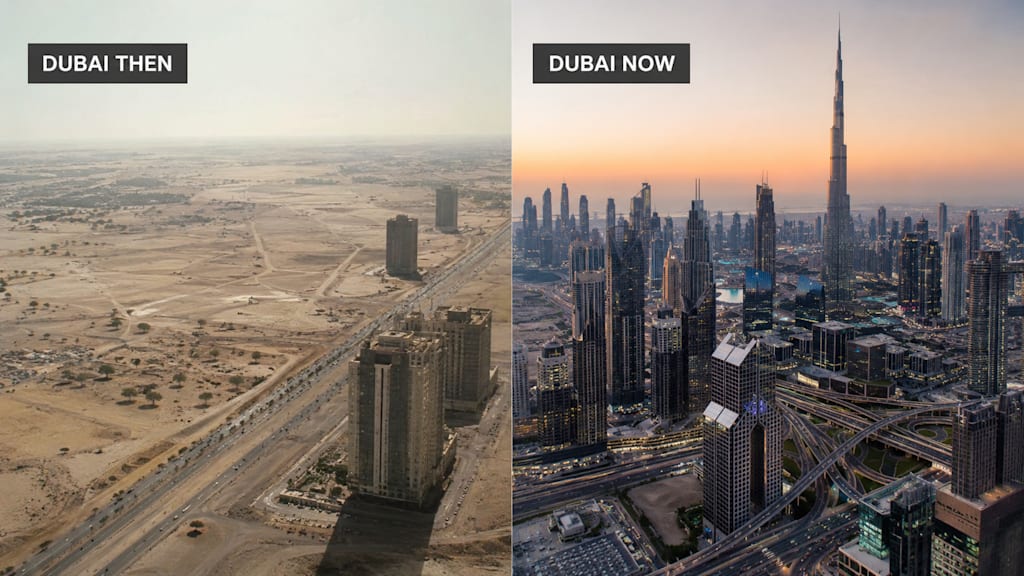
Dubai International Airport opened in 1960 with an 1,800-meter runway made of compacted sand, built for aircraft that no longer exist in commercial fleets. By 2025, that same airport handled 95.2 million international passengers. The world's busiest. That happened within one human lifetime.
Palm Jumeirah: construction started June 2001, first residents arrived October 2007. Six years to relocate 110 million cubic meters of sand into a recognizable palm shape, five kilometers out into the Arabian Gulf. There was no blueprint for it because it had never been done.
Burj Khalifa: construction started September 2004. In 2008, a global financial crisis hit and Dubai's property prices dropped 48%. Most comparable developments paused or collapsed entirely. The Burj kept going. It opened January 4, 2010, at 828 meters. Still the tallest building on earth.
Dubai Metro: launched September 2009 in a city built entirely around the car. By 2010, 39 million riders. By 2023, public transport accounted for 20.9% of how residents moved around daily. Changing the transit habits of a car city is genuinely hard to do. Dubai did it in under fifteen years
Museum of the Future: opened February 2022. A columnless torus with a perforated steel facade inscribed with Arabic calligraphy. The exhibits inside are set in 2071. Not documenting the past or the present. Building a version of the future that visitors can walk through.
What I keep coming back to is that these aren't wins in easy conditions. The Burj kept going through a crash. Expo 2020 ran through a pandemic. Same organization, different decades, different problems, same result. At some point that's not luck anymore.
What the four principles actually say
Sheikh Mohammed outlined four pillars when he launched Dubai-it.
The first is speed without haste, which sounds like wordplay until you look at how the Metro actually got built. It wasn't fast because corners were cut. It was fast because the planning was done properly and the decisions were made cleanly. Most delays I've seen in organizations have nothing to do with the actual work. They're about approvals nobody wants to own, calls that keep getting deferred, and accountability that's technically everyone's so it's effectively nobody's. That's what Dubai-it is pushing against.
The second is quality without slowness. Teams tend to treat these as a tradeoff. The Burj Khalifa is 828 meters tall, structurally immaculate, and was completed on time through a recession. The Palm Jumeirah has housed people for nearly two decades without fundamental engineering failure. The argument isn't "move fast and fix it later." It's more specific: know your standards before the project starts, so you're not negotiating them mid-delivery under pressure.
Third is ambition paired with execution. Big visions are not in short supply. Organizations that actually deliver on them are much rarer. The model is less about inspiration and more about what gets in the way between the announcement and the finished thing.
The fourth is the one he posted directly on X: "We say what we do, and we do what we say." When he announced Palm Jumeirah, plenty of people thought it wouldn't happen. Same with the Metro in a car city. Same with Expo 2020 when a pandemic hit. All three happened. That track record is what makes the phrase an actual standard rather than something printed on a motivational poster.
Why it matters outside Dubai
The initiative will be embedded across government institutions in Dubai and integrated into leadership training. University partnerships will bring it into MBA curricula globally, which is how a local model becomes a teachable framework.
That's the stated goal: not just to describe what Dubai did, but to make the approach replicable for any organization willing to apply it seriously.
Most cities, companies, and institutions have a version of these four principles somewhere in their values document. The difference here is the evidence base. When you say "we deliver what we promise," it lands differently if your portfolio includes the world's busiest airport, the world's tallest building, and a man-made island that took six years to build from nothing.
The part I keep thinking about
The concept doesn't really ask you to admire Dubai. That's the thing.
It asks what's stopping you. If a city goes from 60,000 people and a sand runway to the world's busiest international airport in sixty years, through recessions and pandemics, the uncomfortable follow-up is: what's the excuse?
Speed, quality, ambition, accountability. Nobody's keeping those words secret.
The gap is doing all four at the same time, for years, when conditions aren't good. Most organizations manage one or two. Dubai's record is doing all of them, repeatedly, at a scale that's hard to wave away.
I'm not sure "inspiring" is even the right word for it. It's more like: now you know exactly what the standard looks like. What you do with that is your problem.
About the Creator
Sarath Menon
Hi I am Sarath Menon working proffesional Insurance consultant, covering insurance latest trend especially in the middle east regions.
Enjoyed the story? Support the Creator.
Subscribe for free to receive all their stories in your feed.
Comments