
Discommunication and Malcommunication, THE MISCOMMUNICATION TRILOGY “The Conspiracy of Speech, Vol. I.” Part 22
Book Review

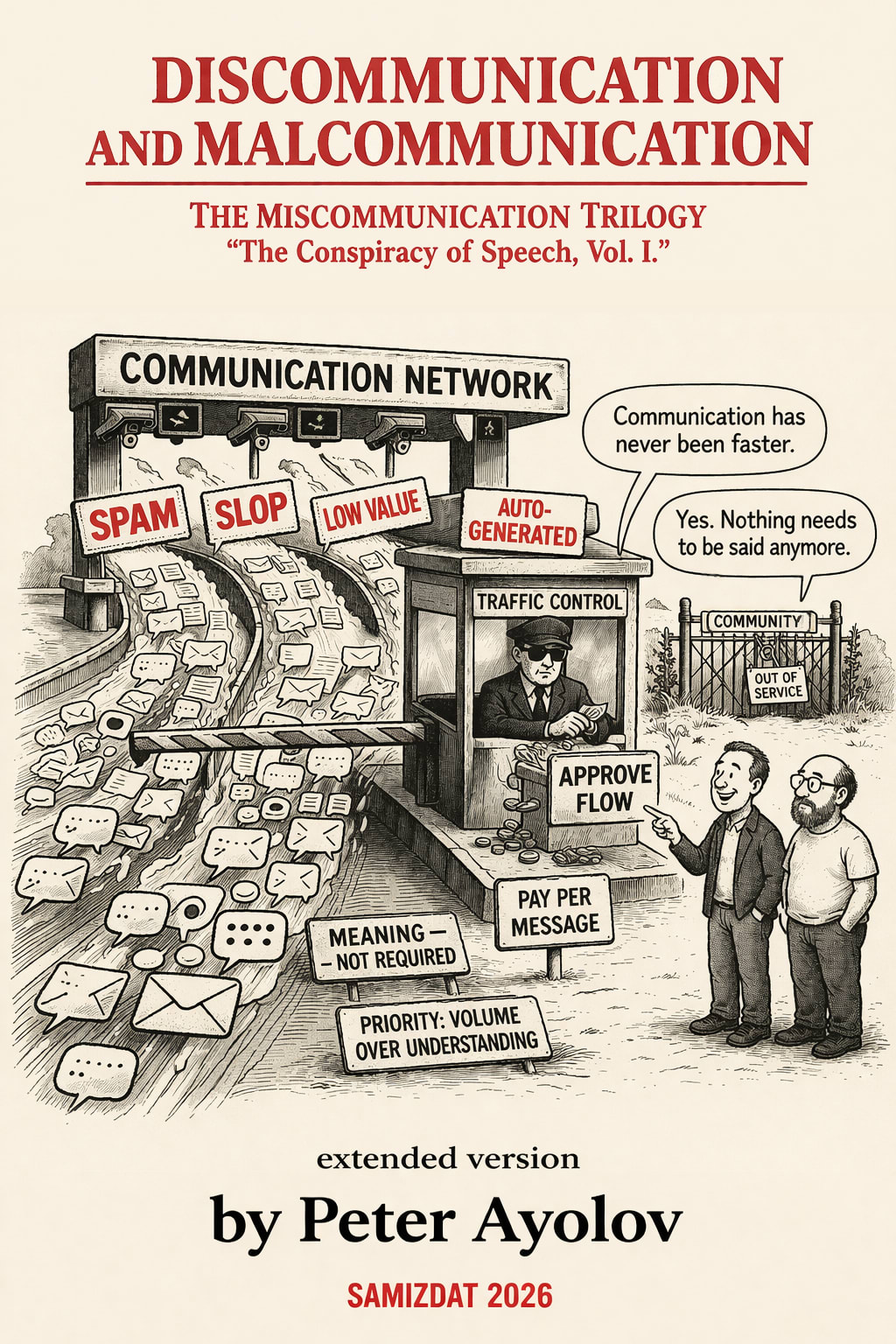
The Final Mirror of Miscommunication
The closing section of the first volume of the Miscommunication Trilogy stands not as a simple conclusion, but as a reflective surface in which the entire architecture of the work reveals itself with unsettling clarity. What precedes it is not merely gathered and summarized; it is reconfigured, intensified, and brought to a point where the reader is no longer able to maintain the comforting illusion that language is a neutral medium. Instead, language appears as an active force, a system that both enables and undermines understanding, a structure whose failures are not accidental but necessary. This final part functions as a culmination, yet it resists closure, insisting that the very notion of a definitive ending is incompatible with the dynamics it has exposed.
From the outset, the book establishes a radical premise: that miscommunication is not an exception within language but its defining condition. This premise is not asserted dogmatically but developed through a series of philosophical investigations that move from abstraction to application, from theory to lived experience. The final part gathers these strands and reveals their deeper coherence. What emerges is a vision of language as a system of perpetual deferral, where meaning is always in motion, never fully present, and always dependent on structures that simultaneously sustain and distort it.
One of the most striking achievements of this concluding section is its articulation of the concept of the planned obsolescence of language. This idea, introduced earlier in the volume, reaches its full significance here. Language is shown to function in a manner analogous to economic systems that depend on the continual replacement of goods. Words, concepts, and expressions are not designed to endure indefinitely; they are subject to processes of wear, dilution, and transformation that ensure their continued circulation. Meaning does not stabilize; it erodes and is replaced. This erosion is not a defect but a condition of possibility. Without it, communication would cease to generate new interpretations, and the system would collapse into silence.
The review must pause here to acknowledge the precision with which this idea is developed. It is not presented as a simplistic metaphor but as a structural principle grounded in the insights of thinkers such as Alfred Korzybski, whose distinction between map and territory provides a foundation for understanding how abstraction inevitably distances language from reality. Each act of naming introduces a gap, and each repetition widens it. The final part demonstrates how this gap is not merely epistemological but operational: it drives the continuous production of discourse. Language survives by failing to coincide with what it represents.
Equally significant is the integration of J. L. Austin into this framework. The performative dimension of language complicates the picture further, showing that words do not simply describe but act. In the concluding section, this insight is extended beyond its original philosophical context and placed within the broader dynamic of miscommunication. If utterances are actions, then their success depends not on truth but on conditions that are themselves unstable. The review highlights how this instability reinforces the central thesis: meaning is contingent, context-bound, and perpetually exposed to reinterpretation. The more language intervenes in reality, the less it can claim to represent it with certainty.
The influence of Ludwig Wittgenstein is perhaps most visible in the treatment of certainties. The final part draws on the notion that what we take to be unquestionable foundations of knowledge are in fact embedded in practices that can change. This perspective allows the book to move beyond a purely descriptive account of language toward a more critical stance. It becomes possible to see how certain patterns of speech establish frameworks of thought that resist scrutiny. The review emphasizes that the book does not simply borrow Wittgensteinian concepts but transforms them, placing them within a broader narrative of linguistic obsolescence. Certainties are not only socially grounded; they are also vulnerable to manipulation through the mechanisms of repetition and simplification.
This point finds its most concrete expression in the engagement with Victor Klemperer. The final part revisits the analysis of the Lingua Tertii Imperii, not as a historical curiosity but as a demonstration of how language can be engineered to reshape perception. The review underscores the importance of this example, noting that it provides a tangible illustration of the book’s abstract claims. Klemperer’s observations show how repeated phrases, altered meanings, and imposed structures can infiltrate everyday life, gradually transforming the way individuals think and feel. The concluding section does not treat this as an isolated case but as an extreme manifestation of a general principle. The same mechanisms operate, albeit less visibly, in other contexts.
What distinguishes this final part from earlier sections is its heightened awareness of the ethical implications of these insights. The book does not offer a solution in the conventional sense; it does not propose a method for restoring clarity or eliminating miscommunication. Instead, it calls for a transformation in the way language is approached. The review notes that this shift is subtle but profound. Rather than seeking certainty, the reader is invited to cultivate awareness of the processes that produce meaning. This awareness does not resolve the tensions inherent in language, but it alters the relationship to them. Communication becomes a practice of navigation rather than a pursuit of final truth.
The stylistic execution of this concluding section deserves particular attention. The prose maintains a philosophical density while avoiding unnecessary obscurity. Concepts are developed with care, and transitions between ideas are handled with precision. The review highlights how the continuous, uninterrupted flow of the text mirrors the very dynamics it describes. There are no abrupt breaks, no artificial divisions; the argument unfolds as a sustained movement, reinforcing the sense that language itself is a process rather than a static structure.
At the same time, the final part introduces a tone of quiet intensity that distinguishes it from the more analytical sections that precede it. There is a sense of urgency, not in the form of explicit warnings, but in the implications of the argument. If language cannot be trusted to convey meaning without distortion, then every act of communication carries a degree of uncertainty. This realization is not presented as a cause for despair but as a condition to be acknowledged. The review suggests that this balance between critical insight and measured restraint is one of the book’s greatest strengths.
The integration of the concept of malcommunication into the conclusion further deepens its impact. Malcommunication is not treated as a deviation from normal language use but as its most revealing expression. Harmful language, in this context, is not limited to overtly manipulative or ideological forms. It includes the subtle ways in which words simplify, exclude, and guide thought. The final part demonstrates how these effects accumulate, shaping perception over time. The review emphasizes that this perspective expands the scope of the book, connecting its philosophical analysis to everyday experience.
As the first volume draws to a close, it becomes clear that the work is not self-contained. The themes introduced and developed here point beyond themselves, suggesting directions for further exploration. The review notes that this openness is not a weakness but a deliberate feature. A definitive conclusion would contradict the central thesis of the book. Instead, the final part functions as a threshold, marking the transition from analysis to continuation. The reader is left not with answers but with a heightened sensitivity to the complexities of language.
In assessing the significance of this concluding section, it is important to consider its place within the larger project of the trilogy. As the final movement of the first volume, it establishes a foundation for what follows while also standing on its own as a coherent and compelling statement. The review concludes that the success of this section lies in its ability to bring together diverse philosophical perspectives into a unified framework without reducing their complexity. It does not resolve the tensions it identifies; it makes them visible.
Ultimately, this final part achieves what few philosophical works manage to do. It changes the way the reader perceives something as fundamental and ubiquitous as language. After engaging with its arguments, it becomes difficult to return to a naive understanding of communication. Words are no longer transparent; they are seen as layered, dynamic, and potentially deceptive. This transformation of perception is the true conclusion of the volume. It is not contained within the text but carried forward by the reader, extending the work beyond its own boundaries.
In this sense, the ending is not an ending at all. It is a continuation, an invitation to engage with language in a more critical and attentive manner. The Miscommunication Trilogy begins with this recognition and leaves it unresolved, ensuring that the process it describes remains active. The final part of the first volume does not close the book; it opens it further, revealing the depth of the problem and the necessity of confronting it without the expectation of final resolution.
About the Creator
Peter Ayolov
Peter Ayolov’s key contribution to media theory is the development of the "Propaganda 2.0" or the "manufacture of dissent" model, which he details in his 2024 book, The Economic Policy of Online Media: Manufacture of Dissent.
Enjoyed the story? Support the Creator.
Subscribe for free to receive all their stories in your feed.
Comments
There are no comments for this story
Be the first to respond and start the conversation.