
Deception and Falsehood, THE MISCOMMUNICATION TRILOGY “The Conspiracy of Speech, Vol. I.” Part 19
Book Review

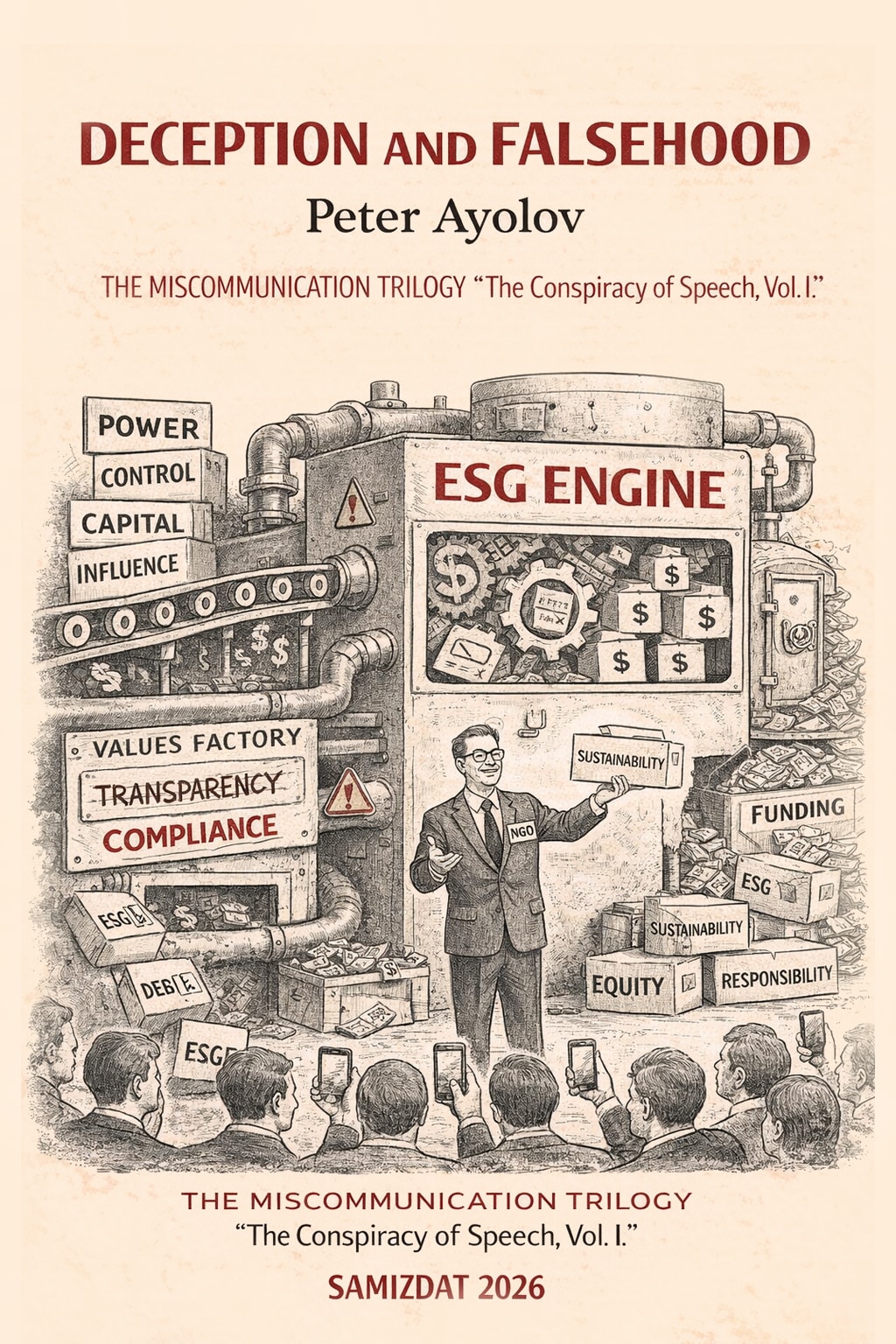
The Collapse of Clarity: A Review of Language in Its Age of Self-Undoing
This book presents itself not as a critique of language from the outside, but as an immersion into its internal contradictions, tracing the ways in which communication ceases to be a stable medium of truth and becomes instead a system that gradually undermines its own credibility. What distinguishes this work from conventional analyses of discourse is its refusal to treat deception as a marginal or pathological feature. Instead, it situates falsehood, hypocrisy, and distortion at the structural core of linguistic activity, revealing that the very conditions that make language effective also render it unreliable. From the outset, the central thesis unfolds with clarity and persistence: language is subject to a process of planned obsolescence. This is not a technological decay, nor a simple failure of usage, but a transformation driven by the internal pressures of communication itself. As societies become more complex, as interactions become more mediated, and as speech becomes increasingly instrumental, language shifts from a system oriented toward truth to one oriented toward function. The consequence is not silence, but proliferation—a vast expansion of discourse that simultaneously erodes the possibility of shared understanding.
One of the book’s most compelling strengths lies in its treatment of hypocrisy as a foundational phenomenon. Rather than reducing hypocrisy to moral weakness, the analysis reframes it as a structural necessity within systems that demand coherence under conflicting conditions. Individuals and institutions alike are compelled to maintain appearances that cannot fully align with internal realities. Language becomes the mechanism through which this alignment is simulated, creating a surface of consistency that conceals underlying contradictions. This insight elevates the discussion beyond ethical judgment and situates it within a broader theory of communicative survival. The transition from hypocrisy to falsehood and then to deception is handled with conceptual precision. Each stage is not merely an escalation but a transformation in how language operates. Falsehood emerges as the manipulation of meaning within an already flexible system, while deception represents the strategic deployment of this flexibility. What is particularly striking is the book’s insistence that deception does not disrupt communication; it depends on it. The same structures that allow language to convey meaning also allow it to mislead, and it is this dual capacity that defines its contemporary condition.
The analysis of modern communication environments further deepens the argument. The book convincingly demonstrates how speed, visibility, and competition reshape linguistic practices. In a world saturated with information, statements are no longer evaluated primarily for their truth, but for their impact. Language becomes performative in a new sense—not merely expressing identity or intention, but actively constructing realities that compete for dominance. This shift is not presented as a temporary distortion but as a systemic evolution, one that redefines the criteria by which communication is judged. Particularly noteworthy is the treatment of trust and its erosion. The book argues that repeated exposure to unreliable or strategically motivated communication leads to a fundamental transformation in how language is received. Listeners no longer assume correspondence between words and reality; instead, they approach statements with suspicion, reconstructing meaning through inference and context. This shift places an increasing burden on interpretation, turning communication into a process of decoding rather than understanding. The implications of this are profound, affecting not only individual interactions but the functioning of entire institutions.
The discussion of knowledge production is equally rigorous. By examining how language mediates scientific, political, and cultural claims, the book reveals the fragility of systems that depend on stable meanings. When language becomes unreliable, the authority of knowledge itself is called into question. The book does not fall into the trap of relativism, however. Instead, it presents knowledge as a process that must continually negotiate its conditions of expression. Truth is not abandoned, but it is no longer assumed to be directly accessible through language. It becomes a provisional achievement, sustained through ongoing practices of verification and critique. One of the most intellectually satisfying aspects of the work is its engagement with the idea of boundaries. The distinction between truth and falsehood, science and pseudoscience, sincerity and deception is shown to be fluid rather than fixed. These boundaries are not erased, but they are revealed to be contingent, shaped by historical, social, and linguistic factors. This perspective aligns with the broader argument that language is not a neutral medium but an active participant in the construction of reality. The instability of these boundaries is not a flaw to be corrected, but a condition to be understood.
The book’s style reinforces its philosophical ambition. The continuous, uninterrupted flow of argument mirrors the very processes it describes, refusing fragmentation in favor of sustained conceptual development. This approach demands attention from the reader, but it also rewards it with a sense of coherence that is increasingly rare in discussions of language. The absence of rhetorical excess allows the ideas to unfold with precision, creating a cumulative effect that strengthens the overall argument. At the same time, the work does not shy away from confronting the unsettling implications of its thesis. If language cannot be relied upon to convey truth, then the foundations of communication, knowledge, and social coordination are fundamentally unstable. The book does not offer simple solutions, nor does it retreat into pessimism. Instead, it calls for a reorientation—a shift from naïve trust in language to a critical awareness of its conditions and limitations. This is perhaps its most significant contribution: not the exposure of linguistic instability, but the insistence that such instability must be engaged with rather than denied.
The concept of planned obsolescence serves as a unifying framework that ties together the various strands of the analysis. It captures the paradox of a system that evolves by undermining its own foundations, where each attempt to stabilize meaning generates new forms of instability. This dynamic is presented not as a failure, but as a defining characteristic of language in its contemporary form. The book suggests that understanding this dynamic is essential for navigating a world in which communication is both indispensable and unreliable. Critically, the work also engages with the broader cultural implications of its argument. The proliferation of competing narratives, the fragmentation of truth, and the erosion of shared frameworks are shown to be direct consequences of linguistic instability. These phenomena are not treated as isolated problems, but as interconnected aspects of a system in which language no longer guarantees coherence. The challenge, as the book presents it, is not to eliminate these conditions but to develop the capacity to operate within them.
There are moments where the relentless focus on structural dynamics may leave readers searching for more concrete applications or examples. However, this is a deliberate choice rather than a limitation. The book prioritizes conceptual clarity over anecdotal illustration, aiming to provide a framework that can be applied across contexts rather than a catalog of specific cases. For readers willing to engage with its abstract level, this approach proves highly effective. Another potential point of tension lies in the balance between critique and possibility. While the book excels in diagnosing the problems of language, it offers fewer explicit pathways for addressing them. Yet this absence can be interpreted as consistent with its central thesis. If language itself is the medium through which solutions must be articulated, then any attempt to resolve its contradictions will inevitably be subject to the same conditions of instability. The lack of definitive answers thus becomes part of the argument, reinforcing the idea that communication is an ongoing process rather than a problem to be solved.
Ultimately, this work stands as a rigorous and uncompromising examination of language in its most complex form. It challenges deeply held assumptions about truth, meaning, and communication, forcing the reader to confront the possibility that the very tools used to understand the world are themselves unstable. In doing so, it does not diminish the importance of language, but redefines it. Language emerges not as a transparent medium, but as a dynamic system that both constructs and distorts reality. The review must therefore conclude by recognizing the book’s central achievement: it transforms the study of deception from a peripheral concern into a fundamental lens through which language itself can be understood. By exposing the structural conditions that make deception possible, it reveals the deeper logic of communication in an age defined by excess, speed, and fragmentation. It is not merely a critique of language, but an invitation to rethink its role in shaping human experience.
In an intellectual landscape often dominated by simplified narratives and superficial analyses, this work offers a rare combination of depth, coherence, and philosophical rigor. It demands effort from its readers, but it rewards that effort with insights that extend far beyond its immediate subject. It is a book that does not resolve the tensions it identifies, but instead illuminates them, providing a framework for understanding a world in which meaning is always in motion and truth is never fully secured.
About the Creator
Peter Ayolov
Peter Ayolov’s key contribution to media theory is the development of the "Propaganda 2.0" or the "manufacture of dissent" model, which he details in his 2024 book, The Economic Policy of Online Media: Manufacture of Dissent.
Enjoyed the story? Support the Creator.
Subscribe for free to receive all their stories in your feed.
Comments
There are no comments for this story
Be the first to respond and start the conversation.