
Cynical Reason, THE MISCOMMUNICATION TRILOGY, “The Tower Of Babble, Vol. III”, Part 13
Book Review

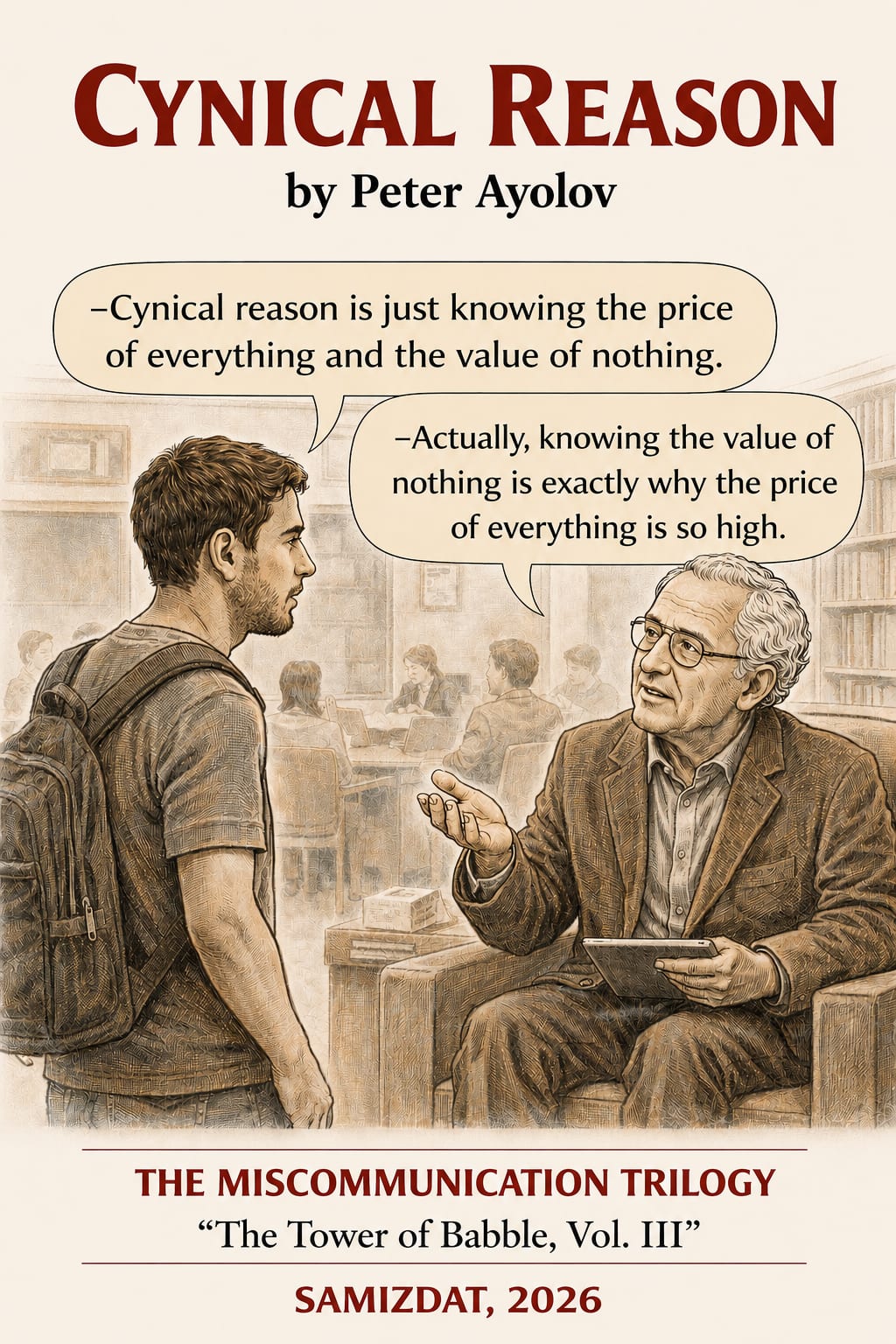
Cynical Reason: The Architecture of Disbelief
A Cartography of Modern Disillusionment
Cynical Reason stands as one of the most ambitious and intellectually provocative volumes in The Tower of Babble, the third installment of The Miscommunication Trilogy. Situated within the broader framework of the trilogy’s central theme—the planned obsolescence of language—this volume examines the emergence of cynicism as one of the defining psychological, cultural, and political conditions of modernity. Rather than treating cynicism as a simple attitude of pessimism or disbelief, the book approaches it as a historical force that has developed alongside the evolution of language, ideology, media, and social institutions. The result is a sweeping intellectual journey through philosophy, literature, sociology, political theory, cultural criticism, and communication studies, tracing the transformation of cynical thought from the ancient world to the contemporary age. One of the book’s greatest strengths lies in its ability to demonstrate that cynicism is neither a marginal phenomenon nor merely a personal disposition. Instead, it emerges as a structural feature of modern societies shaped by information overload, ideological conflict, media spectacle, and declining trust in public institutions. The volume begins by examining the origins of Cynicism in ancient Greece, where figures such as Diogenes transformed poverty, self-sufficiency, and public provocation into a radical critique of social convention. Through detailed explorations of Greek philosophy and culture, the book reveals how early Cynicism represented not simply rebellion but an attempt to recover authenticity in a society increasingly dominated by artificial values. The praise of poverty, the celebration of asceticism, and the rejection of conventional status become foundational themes that continue to echo throughout the subsequent history of cynical reason.
As the narrative unfolds, the volume demonstrates how Cynicism gradually evolved into a broader cultural phenomenon. Ancient philosophical practices gave way to modern forms of scepticism directed toward politics, morality, religion, and social life. Through discussions of thinkers such as Nietzsche, Baudrillard, Goldfarb, Lerner, and numerous literary figures, the book shows how cynicism transformed from a philosophy of personal liberation into a dominant mode of social consciousness. Particularly compelling is its treatment of modern democratic societies, where cynicism simultaneously functions as a defence against manipulation and a barrier to meaningful political engagement. Public discourse increasingly becomes saturated with suspicion, irony, and distrust, creating conditions in which every ideal appears compromised before it can be defended. What distinguishes this work from many studies of cynicism is its interdisciplinary breadth. Rather than confining itself to philosophy, it explores how cynical reason operates across multiple domains of social life. Education, journalism, electoral politics, mass media, popular culture, religion, and literature all become sites where the dynamics of cynicism unfold. The book convincingly argues that contemporary societies have developed an extraordinary capacity for exposing hypocrisy while losing confidence in the possibility of sincerity. In doing so, it offers not merely a history of cynical thought but a diagnosis of a civilization struggling to distinguish truth from performance and conviction from calculation.
Language, Power, and the Culture of Suspicion
At the heart of Cynical Reason lies a profound exploration of the relationship between language and power. Throughout the volume, language appears not as a neutral instrument of communication but as a contested terrain upon which political, cultural, and ideological struggles unfold. This perspective aligns closely with the broader concerns of The Miscommunication Trilogy, which argues that language is subject to a process of planned obsolescence. Words lose their explanatory power, concepts become detached from reality, and communication increasingly generates confusion rather than understanding. Cynicism emerges as both a response to and a consequence of this linguistic deterioration. The book excels in demonstrating how modern institutions contribute to this process. Political rhetoric becomes increasingly detached from genuine conviction, relying instead upon strategic calculation, focus-group testing, and media management. Public debates are transformed into spectacles where appearance often matters more than substance. Through its examination of figures such as Bill and Hillary Clinton, the volume reveals how attempts to introduce moral or spiritual concerns into political discourse are frequently met with ridicule by a media culture deeply invested in cynicism. The result is a self-reinforcing cycle in which idealism is mocked, politicians become more cautious, and citizens grow increasingly distrustful of public life.
Equally insightful is the book’s analysis of mass society and media culture. Drawing heavily upon Jean Baudrillard’s reflections on the silent majority, the text presents the masses not as active participants in democratic life but as absorbers of information, spectacle, and meaning. Media systems endlessly produce messages, yet these messages are increasingly consumed as entertainment rather than as sources of knowledge or engagement. Information multiplies while significance diminishes. The consequence is a society characterized by what might be called communicative saturation and interpretive exhaustion. People are exposed to more information than ever before while feeling less certain about what deserves belief. The volume also explores the educational and cultural dimensions of cynical reason. Discussions of Allan Bloom, E. D. Hirsch, Russell Jacoby, and other critics of American culture reveal how educational institutions increasingly struggle to provide shared intellectual frameworks. The decline of public intellectuals, the fragmentation of cultural literacy, and the dominance of mass entertainment all contribute to an environment where cynicism flourishes. Education becomes instrumental rather than transformative, focused on measurable outcomes rather than intellectual development. Under such conditions, scepticism toward cultural and educational institutions becomes understandable, though not necessarily productive.
Literary analysis forms another major strength of the volume. The discussions of George Eliot, Ford Madox Ford, Toni Morrison, Nietzsche, and contemporary novelists illustrate how literature serves as both a reflection upon and a resistance to cynical culture. Particularly noteworthy is the contrast between mass-cultural representations of social problems and more autonomous artistic explorations of historical trauma and moral complexity. Through these analyses, the book demonstrates that art remains one of the few spaces where the simplifications of cynical discourse can be challenged. Literature preserves ambiguity, complexity, and depth in a culture increasingly dominated by spectacle and simplification. The cumulative effect of these discussions is a portrait of a society caught between knowledge and disbelief. Individuals possess unprecedented access to information yet remain uncertain about meaning. Institutions continue to function while losing legitimacy. Language continues to circulate while becoming progressively detached from lived experience. Cynicism emerges as the emotional and intellectual atmosphere generated by these contradictions. It is not merely a reaction to social conditions but one of their defining characteristics.
Beyond Cynicism and the Search for Meaning
Perhaps the most significant achievement of Cynical Reason is that it does not simply document the rise of cynicism; it also investigates the possibilities for moving beyond it. While the book is relentlessly critical of ideological simplifications and institutional failures, it avoids surrendering to the very nihilism it analyses. Instead, it repeatedly returns to questions of meaning, responsibility, and democratic renewal. In this respect, the volume functions not merely as a critique of modern culture but as an exploration of how critical thought might coexist with hope. Michael Lerner’s politics of meaning provides one of the most important reference points in this search. His argument that contemporary societies suffer from a crisis of meaning rather than merely economic or political difficulties resonates throughout the volume. Cynicism thrives where individuals feel disconnected from larger purposes, communal bonds, and moral commitments. The solution, therefore, cannot be purely institutional or technical. It requires a cultural transformation capable of restoring trust, compassion, and shared responsibility. The book does not present this transformation as easy or inevitable. Rather, it recognizes the immense structural forces that sustain cynical attitudes. Yet it insists that critique alone is insufficient. Human beings require positive visions capable of sustaining collective life.
The volume’s treatment of ancient Cynicism reinforces this argument. Diogenes and the early Cynics were not simply destroyers of convention; they were seekers of virtue. Their provocations aimed to expose false values in order to recover authentic ones. By tracing this historical lineage, the book suggests that genuine critique must remain connected to ethical concerns. Suspicion without purpose becomes paralysis. Exposure without reconstruction becomes resignation. Cynicism retains value only insofar as it serves a broader search for truth and integrity. Another important contribution of the book is its recognition that meaning cannot simply be manufactured through political slogans or media campaigns. The contemporary crisis extends deeper than electoral politics. It involves the erosion of shared narratives, communal institutions, and cultural frameworks capable of sustaining long-term commitments. Consequently, the book repeatedly emphasizes the importance of education, art, philosophy, and autonomous culture as resources for resisting both manipulation and despair. These domains provide opportunities for reflection that transcend the immediate demands of markets, media cycles, and political calculations.
As a contribution to contemporary cultural criticism, Cynical Reason is remarkably comprehensive. It combines historical depth with theoretical sophistication and manages to connect ancient philosophical debates with the dilemmas of digital-age societies. Its analysis of language, power, media, and meaning offers valuable insights into the psychological and cultural conditions shaping contemporary life. More importantly, it demonstrates that cynicism is neither an unavoidable destiny nor a sufficient worldview. It may expose illusions, but it cannot replace the human need for purpose, belonging, and truth. Ultimately, Cynical Reason succeeds because it understands cynicism as both a symptom and a warning. It reveals what happens when language becomes detached from reality, when institutions lose credibility, and when public life becomes dominated by spectacle. Yet it also reminds readers that beneath every cynical critique lies an implicit longing for something better. The book’s enduring achievement is its ability to transform the study of cynicism into a broader reflection on the future of communication, culture, and democratic life. In doing so, it becomes not merely a critique of contemporary society but a powerful meditation on the conditions necessary for human meaning in an age increasingly defined by disbelief.
About the Creator
Peter Ayolov
Peter Ayolov’s key contribution to media theory is the development of the "Propaganda 2.0" or the "manufacture of dissent" model, which he details in his 2024 book, The Economic Policy of Online Media: Manufacture of Dissent.
Enjoyed the story? Support the Creator.
Subscribe for free to receive all their stories in your feed.
Comments
There are no comments for this story
Be the first to respond and start the conversation.