
"Crossing Division Street" Asks What We Really Inherit From the Past
Rebecca Chamian Ribaudo's debut novel connects one Chicago woman's present to a century of family history, neighborhood change and difficult choices

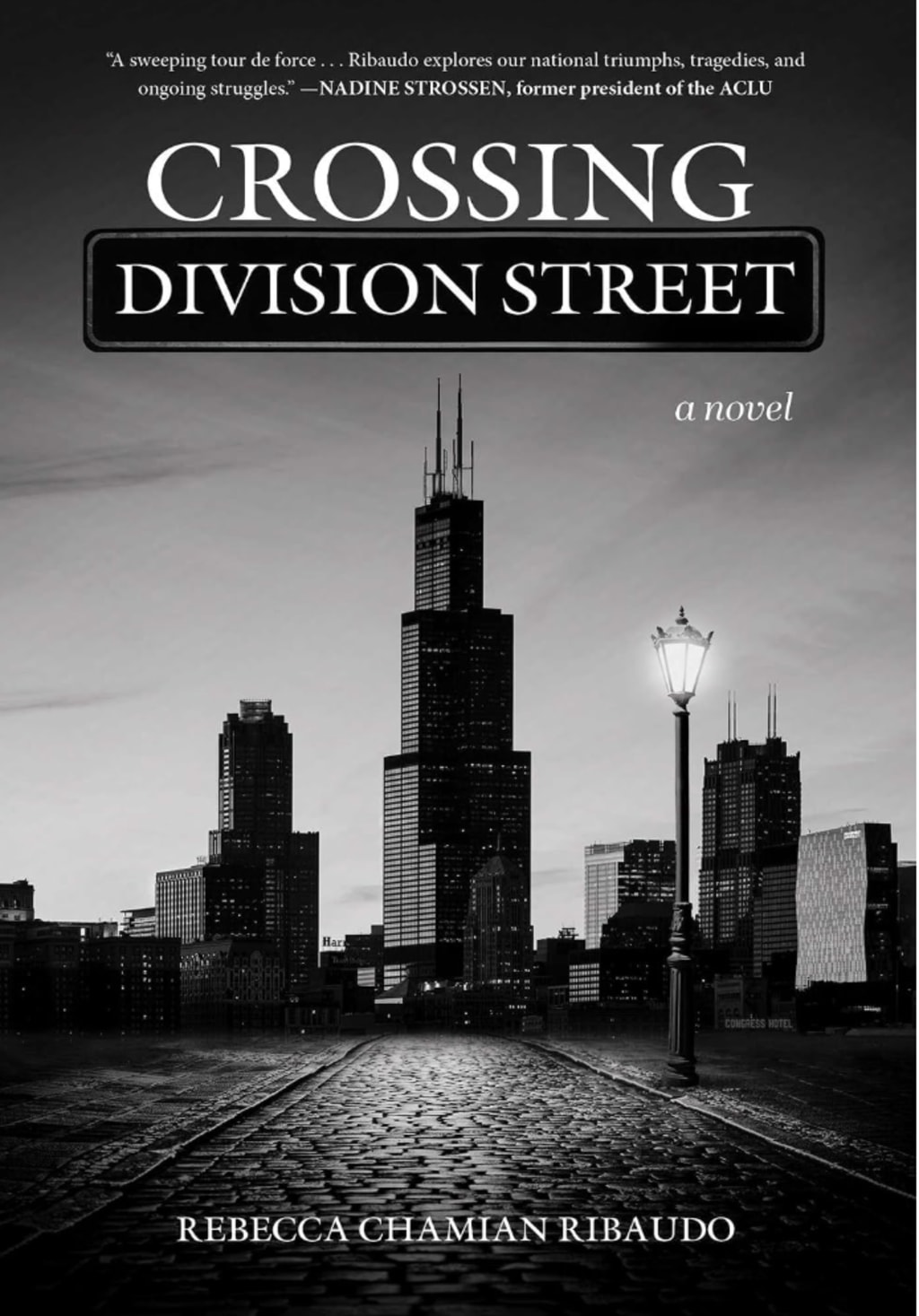
Rebecca Chamian Ribaudo's Crossing Division Street begins with a sudden encounter that changes the course of one woman's life. Set partly in Chicago's Cabrini-Green neighborhood, the novel follows Sidone Russo, a successful attorney whose carefully constructed independence is challenged when a young girl unexpectedly enters her car and asks for help.
The story opens in July 1999, with Sidone sitting at a red light in Cabrini-Green. When the child gets into her car, Sidone drives away with her, setting in motion a series of events that bring her into contact with questions about family, identity and the history she has tried to keep separate from her present.
Sidone has built her adult life around her career and her own principles. She is accustomed to making decisions for herself and maintaining control over the boundaries between her professional life and her personal history. But her connection to Cabrini-Green begins to expose ties she can no longer ignore.
Those ties reach back generations.
Ribaudo uses a dual timeline to connect Sidone's contemporary story with a family history that spans approximately a century and four generations. The historical sections reach into Chicago's past, including the neighborhood once known as Little Sicily or Little Hell, while exploring immigration, race, ethnicity, religion, war, riots, lynchings and assassinations.
These events give the family story a broader historical setting, but the novel remains focused on the people living through those circumstances. Their decisions, relationships and conflicts show how historical forces can influence a family long after the original events have passed.
For Sidone, the question of identity becomes increasingly difficult to separate from the past. Her success has allowed her to establish a life that appears distinct from the experiences of earlier generations. As she learns more about the connections between her family and Chicago's history, that distinction becomes harder to maintain.
The conflict becomes particularly urgent when Sidone becomes involved in a high-profile adoption trial. She faces a choice that could require her to reveal an aspect of her identity she has deliberately kept private. Doing so could have consequences for her career, her relationships and the secrets surrounding her family.
The dilemma gives the novel its central tension. Sidone must consider how much she is willing to disclose, what she stands to lose by doing so and whether protecting the life she has built is worth continuing to keep part of herself hidden.
Ribaudo's use of Chicago adds another layer to that conflict. The novel moves between neighborhoods and generations, showing how places can change while retaining traces of the people and communities that came before them. Little Sicily and Cabrini-Green occupy very different points in the city's history, yet both become important to the story Sidone is trying to understand.
The book also examines the complicated processes of immigration and assimilation. Family members inherit traditions, beliefs and memories, but they do not necessarily experience those inheritances in the same way. Each generation makes its own choices, sometimes embracing the past and sometimes attempting to distance itself from it.
That tension is especially apparent in Sidone's relationship with her own identity. The life she has created is real, but so is the history behind it. Her journey is not simply about discovering where she comes from. It is about determining what that knowledge means for the person she has become.
The title Crossing Division Street reflects the novel's interest in boundaries. Those divisions can be geographic, cultural, generational or deeply personal. Sidone's story requires her to cross several of them as she confronts information that challenges the separation she has maintained between her present and her family's past.
Ribaudo's debut combines a contemporary legal and personal story with a multigenerational historical narrative. The result is a novel concerned with the ways families carry their histories forward, even when individual members would prefer to leave certain chapters behind.
For readers interested in Chicago's changing neighborhoods and the histories of the communities that shaped them, Crossing Division Street offers a family-centered perspective on a complicated past. But its central questions are not limited to one city or one family.
Sidone's story ultimately asks what it means to define yourself while carrying a history you did not choose, and whether understanding that history can change the choices you make in the present.
Crossing Division Street will be published September 29, 2026, by Skyhorse.
About the Creator
Enjoyed the story? Support the Creator.
Subscribe for free to receive all their stories in your feed.
Comments
There are no comments for this story
Be the first to respond and start the conversation.