
Can You Ever Fully Trust Anyone?
A Review of Assassins Anonymous by Rob Hart

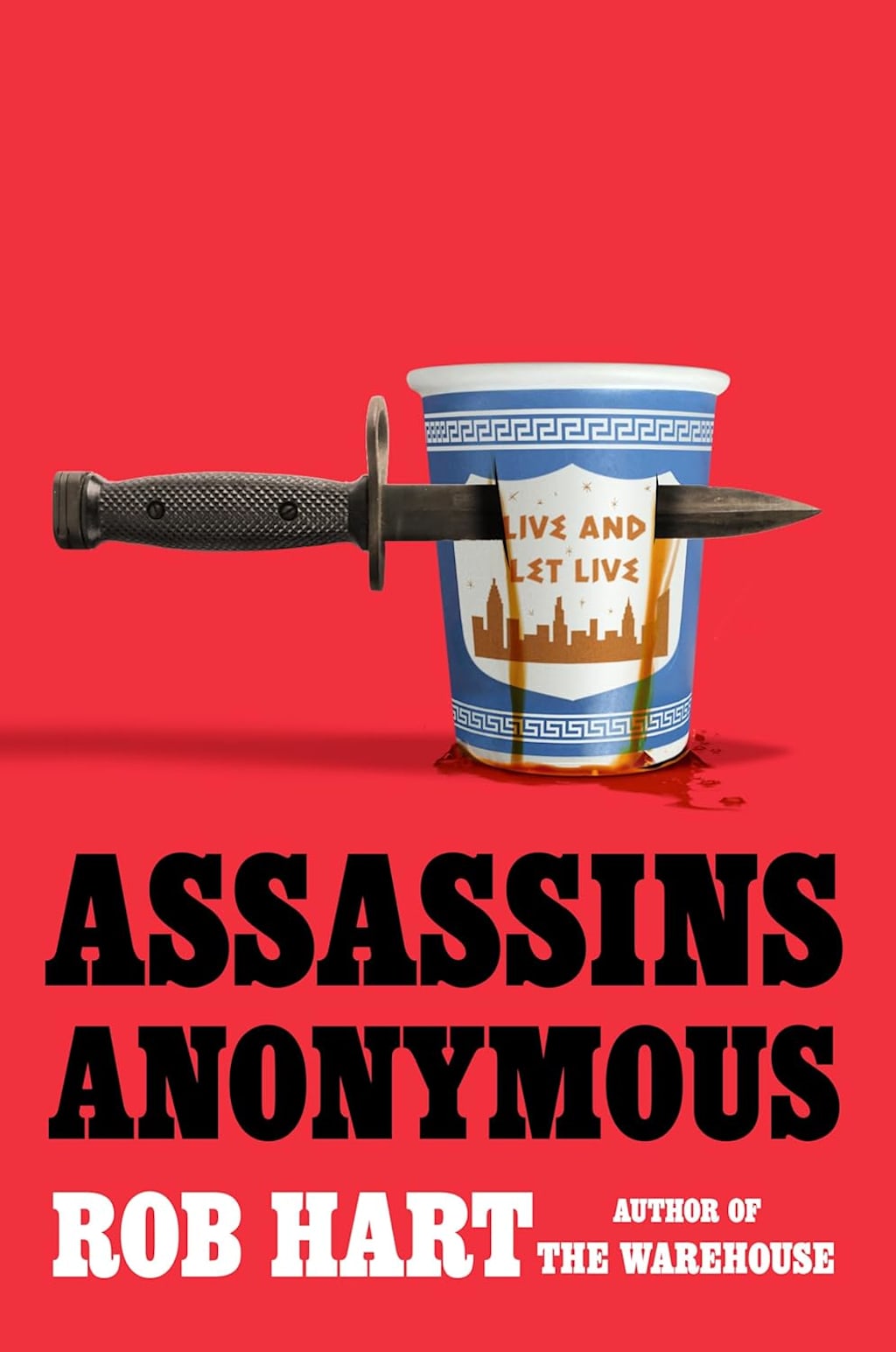
In Himouto Umaru-chan, we learn that hiding yourself can be used to protect your boundaries. Narcissistic Traps by Sharelle Ellis taught us how people hide their true selves to lure someone into a bad situation. In James by Percival Everett, we learn that hiding your true self is a form of protection. What happens if someone uses all of the above reasons to hide their true self? You get Assassins Anonymous by Rob Hart.
Our protagonist Mark has been a retired assassin for almost a year due to a tragic accident he caused. He attends an Assassins Anonymous ( a 12-step program for reformed killers). Mark is pretty content right now with the program and his cat, P-Kitty. However, his old life catches up with him, and he is attacked. Seems there are some people who are not happy that Mark is not in the assassins’ business anymore. Mark flees through multiple countries with a target on his back. Who is after him, and how can he fight back without losing his sobriety to not kill people?
The novel explores the concept of self in several ways. Assassins are encouraged to have boundaries with everyone they meet in order not to accidentally expose themselves. The agency preferred people who didn’t have any type of relationships. Mark realizes it is a lonely business until he meets his girlfriend, Sara. He wants to tell Sara everything about himself, but he is scared. What if she flees when finding out that he is a killer? It is a question that a lot of people ask (not the killer part). People often wonder if sharing all parts of themselves, including the bad stuff, can cause people to run away. Mark knows that Sara loves him, but he doesn’t want to risk anything to threaten their relationship. He thinks that he is protecting her, but it backfires when the truth is revealed too late.
There are quite a few people who hide their true selves to get Mark back in the assassins’ business. Their deception causes Mark to resort to bad habits again, which he so desperately tried to avoid. It shows how tempting old habits can be when you engage in them again, and Mark has to debate whether falling back into these urges again is worth his sobriety or not.
One of the things that I found interesting about the Assassins Anonymous meetings is that none of the participants could reveal what their code names were when they were working for different agencies or governments. Part of it was so that they would lose attachment to their past lives. However, it serves another purpose. Mark learns that the reason was a safety issue. His code name is Pale Horse. Without knowing the other people’s codenames at the meeting, he doesn’t know which people he has crossed paths with under his code name and whom he made enemies with. It is a difficult situation because he likes this group of people, but telling them about his identity could not only end the relationship between members, but also get him killed in the process. It makes Mark wonder if he can fully trust anyone.
One of the biggest questions that the book asks is whether it is realistic for a retired assassin not to be able to kill someone, especially if this is in self-defense. Mark struggles with this throughout the book. While he is running, he often wonders if it would be easier just to kill the people who are after him. He wavers between wanting to use non-lethal weapons and using weapons meant to kill. It is interesting because a lot of people struggle with the same question. Many people would say that taking a life in self-defense is okay because you are protecting yourself, but others will say that you don’t have the power to choose between life and death for an individual. Honestly, it is a question that I have gone back and forth on as well. I’m not sure what the correct answer is, and I’m not sure there is one.
Overall, I really liked the book. What I have learned from this book, along with Himouto Umaru-chan, Narcissistic Traps by Sharelle Ellis, and James by Percival Everett, is that hiding your true self is a grey area. When in a relationship with others, you want to be able to share a piece of yourself, but how much is enough? Should it be everything, little bits and pieces, or nothing at all? It is an interesting question because it will vary from person to person. After engaging with these different media, I believe that it is up to the person to decide how much is too much to share. You are the one who will be dealing with the consequences, whether it is good or bad, so you get to direct the way the relationship is going.
About the Creator
J. Davis Mallory
Writer of personal essays about living with muscular dystrophy and reviews of anime and books. Currently writing a memoir. Follow along as I escape into good books and anime while navigating my journey.
Enjoyed the story? Support the Creator.
Subscribe for free to receive all their stories in your feed. You could also become a paid subscriber, letting them know you appreciate their work.
Comments
There are no comments for this story
Be the first to respond and start the conversation.