
An Elephant in My Kitchen by Francoise Anthony-Malby
This isn't just about a game reserve - its about a philosophy
My wife, Heather, caught me on more than one occasion, watching videos on my phone quite late at night.
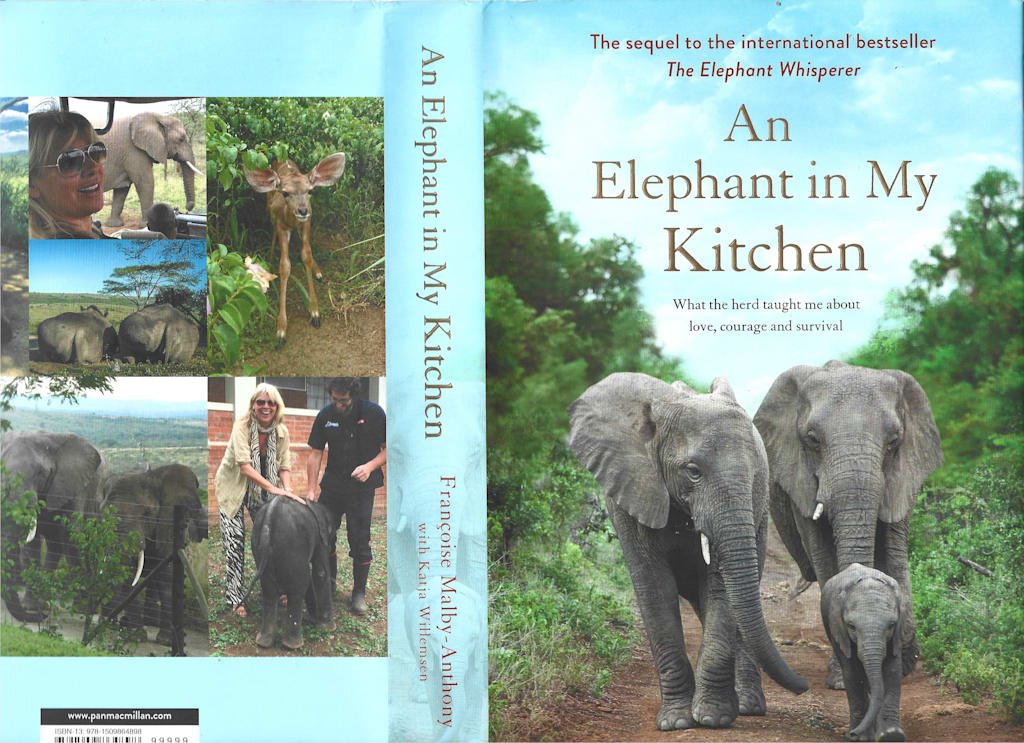
On my recent birthday she gave me a hardback book with a card saying, “You’ve been watching all of those videos on your phone so I thought you may as well enjoy reading about an elephant rescue centre somewhere in Africa”.
Inside the wrapping paper was a book titled “An Elephant in My Kitchen” by Francoise Anthony-Malby. The game reserve the book is based on is in Zululand in South Africa.
I already knew elephants were intelligent but after reading this book I now know that their intelligence quotient goes far beyond the basics needed for survival. Emotional intelligence might be a convenient collective description of these “far beyond” qualities but that is still an inadequate phrase. How else can the qualities of empathy, community, family, welfare, compassion, the ability to acquire knowledge, to pass that knowledge on to others and to be able to connect with us humble homo sapiens on a seemingly one way stream of telepathy without boundaries be summarised?
The first chapter is headed with:
“The only boundaries between ourselves and elephants are the ones we put up ourselves.”
I was seriously hooked. A book that was meant to keep me occupied on forthcoming long train journeys in a couple of weeks’ time only lasted about ten days. My engrossed reading sessions did get interrupted a couple of times by Heather mildly rebuking me with “You’re in that book again. You know we have an early start tomorrow.”
“Well, you bought it for me and you wanted me to enjoy it” was my reply.
No, I did not utter that but kept it to myself.
How was it that a chic Parisienne business lady who travelled the world and knew the Arrondissements of her home city better than the acacias of the savannah ended up living on and running a game reserve in South Africa? That journey started outside a hotel in London’s West End on a cold and wet winter’s day, involved an underground journey and a night out at Ronnie Scott’s.
The first test of resolve for Francoise and her eventually to become husband, Lawrence, was to adopt a herd of so called “rogue elephants” from another reserve in 1999. There they had been causing carnage and were getting closer by the hour to being shot. The mountain of paperwork was the least of their worries compared to the rogue herd escaping a couple of times and heading back to their old home oblivious of what their welcome would consist of when they got there.
An upgrade of the reserve was started by Francoise who brought her family background in the art of French cuisine and hospitality to make Thula Thula a vacation destination. The target client base were visitors who wanted to combine the bush experience with wildlife watching and a bit of savannah style luxury.
Along with making Thula Thula a holiday destination within a game reserve it became a centre for education for people from the surrounding hinterland. It became a destination for guests who wanted to learn more about the bush, conservation, animal photography and to volunteer to help.
By early 2012 everything with regards to the game reserve and its complementary hospitality business was coming together. One phone call changed everything. It seemed this one phone call about an event in Johannesburg three hundred and fifty miles away was about to wreak more havoc across the reserve than one of those freak cyclones that sweep across Zululand leaving destruction, devastation and distress in their wake.
Why was it then that the herd that had been rogue back in 1999 and hadn’t been seen near the residential parts of the reserve for months came to the perimeter fence within forty eight hours of that one call on 2nd March 2012?
They hadn’t come because they were hungry otherwise they would have spent their time grazing. They hadn’t come to show off a new arrival because there wasn’t one to be seen. They hadn’t come to alert their carers, guardians or surrogate parents that one of their family was injured or ill because they all looked in good shape.
Normally on their “hello” visits they would turn up in their family structure. Matriarchs and recent mothers at the front. Less senior females and then the bulls close by but removed. This time they had no order. They milled about restlessly and chaotically along the fence line for about forty minutes before disappearing back into the bush.
Elephants don’t have mobile phones; they don’t carry walkie talkies and as far as we know are unable to tune into our digital world. Is it possible that their highly developed emotional intelligence was able to pick up the tragedy associated with that one phone call? The author believes they could have, somehow.
As far as the main title of the book is concerned the author really did have an elephant in her kitchen. One night someone in the residential compound was disturbed by an unusual noise. They went out to investigate and found a very young calf elephant that had made her own way through the 8,000 volt perimeter fencing. She wasn’t in good shape leaving everyone in doubt about what had to be done. And, bearing in mind elephants are sociable and family oriented they her didn’t appear looking for the missing one.
Elephants’ newly arrived are supposed to be called a “calf” but throughout the chapters very young elephant are referred to as “babies”. “Calf” really fails to capture their enduring charm, stratospheric cute factor, their individual personalities and their way to make people laugh. Or worse, infuriate those looking after them. “Baby” or “babies” seem so much more appropriate.
After reading this book I reached the conclusion that Thula Thula isn’t just a game reserve but a way of life with its own unique philosophy. “Thula” is the Zulu word for keeping quiet or keeping a silence. That is the only way to deal with game as we are their guests and not their hosts.
Another Zulu word that came from these pages is “ubuntu”. It means “humanity” in terms of “I am because we are”. From this book I feel ubuntu is a philosophy that has been adopted by elephants. In our westernised, materialistic and dare I say, narcissistic world miles away from the savannah a little bit of ubuntu is something we should all be putting back into our lives.
Published in the UK by Sidgwick & Jackson of London ISBN 13: 978 - 1509864898 2018 £16.99
About the Creator
Alan Russell
When you read my words they may not be perfect but I hope they:
1. Engage you
2. Entertain you
3. At least make you smile (Omar's Diaries) or
4. Think about this crazy world we live in and
5. Never accept anything at face value
Enjoyed the story? Support the Creator.
Subscribe for free to receive all their stories in your feed.
Comments
There are no comments for this story
Be the first to respond and start the conversation.