bass
Beat lets the bass drop, over and over and over again.
My Exclusive Interview With Kayristin
The party doesn't start until Kayristin walks in. As a DJ, it's her job to keep the energy flowing with electrifying sets and exclusive remixes—and now that she's branching out into original music, you don't have to see her in person to enjoy her heart-stopping beats. Her love for music, passion for adventure, and fun, bombastic personality make Kayristin a natural entertainer, and as you read this in-depth interview, you'll realize how much work goes into these sets that seem like a spur-of-the-moment celebration.
By Kaitlin Shanks2 days ago in Beat
Sinister Fate: A First‑Hand Look at Chicago’s Long‑Running Shock‑Rock Trio. Content Warning.
There’s a certain kind of band that doesn’t just play music — they survive it. They bleed into it. They build something out of the chaos life hands them and then scream it back into the world with amps turned up high enough to rattle the bones of anyone standing too close. That’s Sinister Fate.
By Syl De'Vil14 days ago in Beat
Notes from the Mind Palace.
Music doesn’t just “inspire” me. It rewires me. It grabs my skull like it’s trying to tune a radio, and suddenly every part of me snaps into alignment. My thoughts stop tripping over each other. My nerves stop buzzing. The world gets quieter, even when the volume is stupidly loud. I don’t listen to music — I use it. The louder the music gets, the quieter those internal voices become — the ones that try to tell me I’m nothing, the ones that show up when I’m tired or hurting or stretched too thin. Volume becomes a shield. Bass becomes a boundary. A song becomes the thing that steps between me and the parts of my mind that don’t always play fair. It even helps with the autoimmune pain. Not in some magical “healing frequency” way — just in the way drowning in sound gives me something stronger to focus on than the ache. When the music is loud enough, my body stops screaming for a minute. I get a little space. A little breath. A little control. It’s the switch that flips me from “overstimulated parent with seven kids doing parkour through my sanity” to “feral writer pacing the room like a crow deciding which shiny object to steal.” If the song hits right, my whole brain goes cinematic. I stop seeing words and start seeing scenes: fog rolling in, headlights cutting through it, someone yelling in the distance, maybe something crawling out of the dark that shouldn’t exist. Music is the fuse that lights all of that. People think playlists are just background noise. Mine are battle plans . Each song is a mood, a memory, a weapon. Some tracks drag me back to Maine. Some drag me into the fog. Some drag me into the parts of my head I don’t talk about unless I’m writing. And some songs hit so hard I feel like I’m remembering a life I didn’t actually live. Music is the only thing that can match the chaos in my head without getting drowned out. It’s the one thing that keeps me steady. It’s the one thing that makes the stories come out clean instead of tangled. Music doesn’t just affect me. It possesses me. And honestly, I let it — because it’s one of the few things that makes the noise inside me survivable. Music doesn’t just affect me — it kidnaps me. It drags me by the hair into whatever universe it feels like throwing me into. And the louder it is, the quieter everything else gets. The voices that tell me I’m nothing? They get smothered under layers of distortion and screaming. They can’t compete with a sonic avalanche. I listen too loud everywhere. Car? Loud enough to rattle the bolts out of the doors. Shower? Loud enough the shampoo vibrates. Headphones? Weak. Earbuds? Pathetic. Party speaker? Coward. Nothing gets loud enough. So I keep turning it up anyway. Because when Yeah Yeah Yeahs — “Y Control” hits, something in my chest snaps awake. It’s like someone kicked the generator in my soul and yelled RUN . When Tegan and Sara — “Dark Come Soon” comes on, the world finally dims enough for me to breathe. Tiger Army — “Valley of Dreams” drowns the autoimmune pain under rhythm and pulse. Choking Victim — “In My Grave” lights a match in my ribcage and tells the darkness to fight back. Rancid — “St. Mary” is every too‑fast drive I’ve ever taken. Bad Brains — “F.V.K.” is adrenaline in audio form. Talking Heads — “Psycho Killer” is the part of my brain that laughs at the chaos, and shakes her butt a little at the sound. Social Distortion — “Far Behind” is grit and memory. something I would rather keep to myself. Bad Religion — “Generator” is the spark that keeps me writing. reminds me that there's more than what you see. Dramarama — “Anything, Anything” is the scream I never let out and the song I sing every time I feel like I could fall in love. then remind myself that love... its not for me. Then there’s The Church — “Reptile” , crawling under my skin like electricity. And Misfits — “Devils Whorehouse” , kicking open the door to the feral part of my brain. But you want chaos? Here’s chaos: Otep — “Special Pets” makes my blood feel like it’s boiling. It’s the one that shuts the internal voices up because they know they can’t compete with that kind of rage. Tool — “The Pot” hits like someone dropped a brick through my skull and rearranged the furniture inside. Mudvayne — “Dig” isn’t a song — it’s a detonation. It’s the moment the world goes white‑hot and I stop feeling anything except the beat. Volbeat — “Still Counting” is the soundtrack of every time I’ve said “I’m fine” while absolutely not being fine. Marilyn Manson — “Kill 4 Me” slinks through my nerves like a threat wrapped in velvet. Chevelle — “Take Out the Gunman” is the pulse that keeps me upright when everything hurts. Incubus — “Nice to Know You” is the moment I slam the door on the past and don’t look back. A Perfect Circle — “Magdalena” turns my brain into a cathedral full of ghosts. Straight Line Stitch — “Conversion” is the part of me that refuses to die, even when everything else is screaming. Wage War — “High Horse” is the moment I stop apologizing for being loud, chaotic, messy, and alive. "Teeth" the song that reminds me exactly where I stand with those in my life. These songs aren’t just tracks — they’re weapons . They’re shields. They’re pressure valves. They’re the only things loud enough to drown out the parts of me that try to drag me under. Music is the only thing that matches the chaos in my head without getting swallowed by it. It’s the one thing that keeps me upright. It’s the one thing that makes the stories come out clean instead of tangled.
By Syl De'Vil25 days ago in Beat
can Ozzfest return?
Recently I saw on Instagram how they were asking if should OzzFest return, many support the idea yes i see where you would get the idea that it would be a good idea but since things because of traffic was Ozzy’s namesake Festival I i feel like not without Ozzy it shouldn’t return because the tradition for Oz Fest was that you see you get to see Ozzy at the end of the night and during the day and the evening and what not until Ozzy comes on stage you get to see pretty cool metal bands too and up and coming metal bands andLegendary metal bands at the end of the night you get to always see Ozzy and stuff and that’s where I standThe question should Oz Fest returnAnd can Ozzfest returnI I don’t think so it wouldn’t be the sameQuite frankly it wouldn’t be right at least that’s the way I see it that’s allPeriodI guess I’m speaking as an Ozzy fan andYes I am speaking as a Ozzy fan and someone that really loves Ozzy. To me it doesn’t seem right I mean after all think about this Ozzy just passed and and yet i don’t I don’t know where yes I do know where I stand I don’t think it would work I mean you know this is Ozzy’s and Sharon’s baby and brainchild and stuff and you know like I said before I just don’t i just don’t see it that’s all that’s all I’m trying to say . To have Ozz Fest without its namesake this beautiful child has no way there’s just no way that’s all. It would be hollow and there would always be a reminder of the fact that Ozzy isn’t there. Not only would it be hollow but also empty.
By Revista Miko:XCI about a month ago in Beat
Matthew Stevens and the Many Meanings of Sound
By Brian D’Ambrosio For guitarist and composer Matthew Stevens, instrumental music is not a fixed statement but an invitation. It leaves room for listeners to bring themselves into the experience, carrying their own memories, moods, and interpretations into the music. That philosophy lies at the heart of Matthew Stevens, the Grammy-winning musician’s new self-titled release, a richly textured collection that feels both deeply personal and deliberately open-ended.
By Brian D'Ambrosio 4 months ago in Beat
The Is Jah Wobble
Introduction Apparently, Jah Wobble's stage name came because John Lydon could not pronounce the name John Wardle properly and slurred it into becoming Jah Wobble. I loved his dub-based bass playing with Public Image but then when he left he looks to have tackled every music genre you can think of and a lot that you can't think of.
By Mike Singleton 💜 Mikeydred 5 months ago in Beat
Why some pupils find music to be helpful while others find it distracting
Turning off the music is a common recommendation for students who have trouble concentrating. It is believed that a distracted brain cannot afford to divide its focus. The advice seems sensible. However, recent Australian research indicates that recommendations might be focusing on the incorrect variable.
By Francis Dami5 months ago in Beat
The Vegetable Orchestra
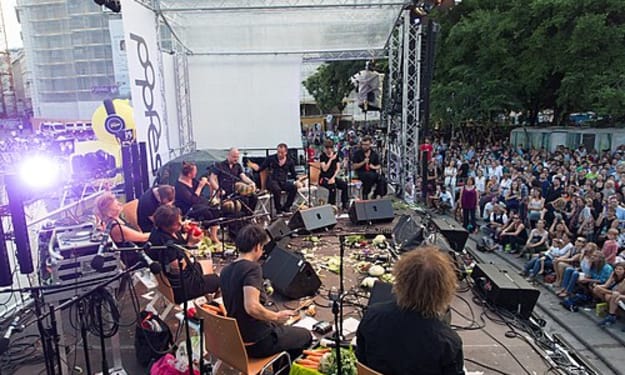
Imagine walking into a concert hall expecting guitars, drums, violins, or maybe a piano… but instead, you see musicians carving carrots like flutes, hollowing out cucumbers, slicing celery into percussion sticks, and carefully shaping pumpkins into drums. The smell of fresh vegetables fills the air instead of cigarette smoke or expensive perfume. The audience watches in confusion. Some laugh. Some stare silently. Then suddenly, the lights dim… and music begins. Not ordinary music. Music born from vegetables. This is not fiction. It is real. And it may be one of the strangest, most fascinating artistic experiments ever created. In February 1998, in Vienna, a unique group of artists came together with an idea so unusual that most people probably thought it was a joke. The group included musicians, sculptors, architects, designers, media artists, and sound poets. Even their cook became part of the performance. Together, they formed what the world would later know as the legendary vegetable orchestra. But this wasn’t just about making funny sounds with carrots. It was about completely changing the way humans experience music. Before every performance, the musicians gather piles of fresh vegetables: carrots, celery, peppers, squash, zucchini, pumpkins, onions, and more. Then the transformation begins. Knives slice through vegetables with surgical precision. Holes are drilled into carrots to create flutes. Pumpkins become deep bass drums. Celery stalks transform into rhythm instruments. Every instrument is handmade only hours before the concert starts. And because vegetables are fragile, every performance becomes unique. A carrot flute today may sound completely different tomorrow because vegetables naturally change with moisture, temperature, age, and freshness. No two concerts are ever exactly alike. In a strange way, the instruments are alive. That’s what makes this orchestra so mesmerizing. The musicians don’t fight against nature — they perform with it. Special microphones amplify the tiny cracks, vibrations, and textures hidden inside the vegetables. Sounds most people would never notice suddenly become music. Crunching, scraping, hollow echoes, soft whistles, deep thumps — the orchestra transforms ordinary kitchen ingredients into a surreal soundscape that feels almost alien. Some audience members describe the experience as hypnotic. Others call it beautiful chaos. But perhaps the most incredible part happens after the show ends. The instruments are not thrown away. Instead, the leftover vegetables are cooked into fresh soup and served to the audience. Yes — people literally eat the instruments after the concert. That single detail perfectly captures the philosophy behind the orchestra. Nothing is wasted. Music becomes food. Art becomes nourishment. Performance becomes community. The line between artist and audience almost disappears. And somehow, this bizarre idea worked far beyond anyone’s expectations. The group began performing across Europe, then expanded into the United States and Asia. They appeared at gallery openings, exhibitions, experimental art festivals, and community events. What started as a strange artistic experiment slowly became an internationally recognized phenomenon. On average, the orchestra performs 20 to 30 shows every year. Think about that for a second. For decades, people around the world have gathered to watch musicians perform with vegetables. That alone says something powerful about human curiosity. People are hungry for experiences that feel new, weird, unpredictable, and alive. In a world filled with artificial sounds, digital perfection, and computer-generated music, there is something deeply refreshing about hearing raw sound created from objects that were literally growing in soil days earlier. The orchestra eventually became so successful that they earned a place in Guinness World Records for the “Most concerts by a vegetable orchestra.” Between April 1998 and September 2012, they completed 77 official performances using instruments made entirely from vegetables. That record alone sounds unbelievable. But the deeper story is even more interesting. This orchestra quietly challenges the way we think about creativity itself. Most people believe art requires expensive tools, perfect training, or advanced technology. But these performers prove that creativity is not about what you own — it’s about how you see the world. To them, a carrot is not just food. It is also a flute waiting to be discovered. That mindset changes everything. Suddenly, everyday objects stop looking ordinary. The world becomes filled with hidden possibilities. And maybe that is the real reason audiences love them so much. The performances are not only concerts. They are reminders that imagination still exists in its purest form. In a time when many artists chase algorithms, trends, and viral attention, this orchestra chose something completely different: experimentation, curiosity, and sensory experience. Their music cannot be mass-produced. It cannot be perfectly repeated. It exists only in the moment — fragile, temporary, and alive. Just like the vegetables themselves. And perhaps that’s what makes the entire idea strangely beautiful. For a few hours, carrots become instruments. Pumpkins become drums. Celery becomes rhythm. Sound becomes soup. And ordinary vegetables become proof that human creativity has absolutely no limits
By Noman Khan 5 months ago in Beat
Eurovision 2026 and the Emotions Behind Europe’s Biggest Stage
Every year, millions of people across Europe and beyond gather around television screens to watch a competition that feels bigger than music alone. Eurovision Song Contest 2026 carries emotion, national pride, creativity, disappointment, celebration, and unforgettable performances all at once. That is why interest in “eurovision 2026” continues growing long before the event even begins. Fans are already discussing possible host cities, expected contestants, stage concepts, and emotional moments that may define the competition. Eurovision is not simply about winning a trophy. It is about artists standing in front of massive audiences while carrying the hopes of their countries on one emotional stage. Some performances become historic. Others disappear quickly. But every year, Eurovision creates moments people remember for decades because music has a way of connecting emotion across languages, borders, and cultures.
By Muqadas khan5 months ago in Beat
Fighting for More Than Survival: The Story Behind Shadow Fist
In a world where stories often prioritize spectacle over substance, some narratives choose a different path. They focus not just on action, but on the emotional weight behind every decision, every fall, and every rise.
By Andreas szakacs7 months ago in Beat
The Space Between Genres in Milan’s Live Music Scene
Milan is a city that understands scale. Big fashion weeks. Large exhibitions. Touring productions that arrive with full lighting rigs and precise choreography. Even in music, the dominant energy often leans toward spectacle.
By Hugo Valquez8 months ago in Beat