
The Architect Who Measured Love with a Scale Ruler
Their love story was built from burnt coffee, overexposed film, and a two-centimeter shoulder seam.
Her name was Sophie. A Leica M6 hung from her neck, always. His name was James. A scale ruler stood in his pocket, always.
They reached for the same book in the Architecture & Photography section of a used bookstore, their fingertips touching on the spine of Le Corbusier: Œuvre Complète. She pulled her hand back. He noticed the crooked hand-drawn Modulor figure on her camera strap, the raised-arm human scale symbol. He said, “You drew it wrong. The left arm should be raised fifteen degrees more.” She said, “Buy me a coffee, and I’ll fix it.”
They went to the street-corner coffee cart that always burned the first espresso. James never drank from street carts. That day he bought two cups. Sophie wrapped her hands around hers for warmth. On the lid he scored two parallel lines with his scale ruler. “That’s the correct Modulor.”
That was their first contact, and the first time in his life he had redrawn a symbol for someone else.
Over the next six weeks they invaded each other’s lives in ways neither had ever allowed before. Sophie never developed a roll of film until she’d shot the thirty-sixth frame. James never finished a full section drawing; he always left one corner for “later.” The climbing of their emotions was built from a series of specific points:
The first: 4:00 a.m., Sheep Meadow, Central Park.
Sophie texted: “The cloud cover is right today. I’m going to wait for a sunrise.” James replied with only two characters: Coordinates.
He showed up carrying two cans of hot chocolate. She was crouched behind her tripod, breath fogging the viewfinder. He pressed a can into her hand, then took off his overcoat and draped it over her shoulders the way he would lay a site blueprint. Through the lens she watched him step aside, his silhouette carved into a deep-blue cutout by the dawn. She pressed the shutter. The photograph she later titled 3:47 AM was the only image of him ever recorded not as an object to be measured.
After the hot chocolate was finished, she pointed at his coat and said, “The shoulder line is off by two centimeters.” He said, “You’re cold. Don’t pick at the seams.”
The second: an underground darkroom in Brooklyn.
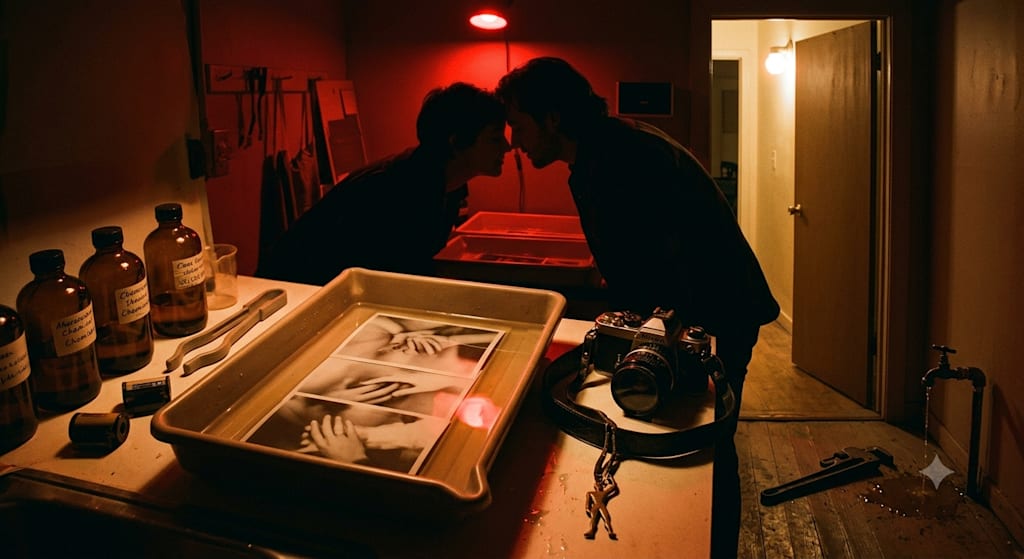
He was helping her load a roll of TRI-X 400. In the dark, the safelight threw the shadow of her eyelashes onto the wall, trembling like two calipers. The spool jammed. He reached to adjust it; her hand was still inside the sleeve of the changing bag, and their fingers met under the velvet cloth. He didn’t move. Neither did she. He lowered his head and caught the scent of fixer and sandalwood soap at her neck. She tilted her chin up. The distance between their lips was thinner than a sheet of film.
The doorbell rang.
It was the landlord downstairs, Mr. Dennis, holding a wrench, saying the main water valve needed replacing and the water had to be shut off immediately. The darkroom lights snapped on with a clack. They sprang apart like two sheets of accidental-exposure photo paper. James dropped the spool into the developer tray. Sophie turned to face the wall and said, “Ruined.”
Later, when she developed that roll, she found the first seven frames completely overexposed, nothing but blurred flares of light, like a promise that had never been honored.
The third: the restroom hallway at Chelsea gallery.
It was the celebration for his firm winning the bid. Sophie wore a charcoal-grey dress. He gave her a thin chain with a pendant, a tiny Modulor figure etched in brass from an architectural model kit. She wore it, but spent the whole night playing the role of “James’s beautiful partner,” introduced to investors and curators like a precisely placed piece of staging.
She withdrew to the hallway with a glass of champagne and talked about Francesca Woodman with a Scottish installation artist. James walked over, cut in naturally, and placed his palm against her back with just enough force to steer. “Sophie, I need you to meet Mr. Henderson.”
She said, “Hang on. I’m in a conversation.”
He said, “Mr. Henderson won’t wait.”
She looked at him, the man who had scored a coffee lid with a scale ruler, and his eyes now were the same as when he studied a blueprint. She unclasped the brass necklace and placed it in his suit pocket. “I’m not your project.”
He grabbed her wrist. “Don’t say that.”
“You never let anything out of your control, do you?” She pulled her hand free. The brass pendant slid from his pocket, hit the floor, bounced twice, and vanished into the carpet.
He didn’t chase her. He stood where he was, picked up the pendant, and scrubbed his thumb over it obsessively, wiping at a stain that wasn’t there.
This was the struggle before the break. She hadn’t misunderstood him; she had struck with precision at the core fear of his entire life: losing control.
The dark moment had no outside villain. There were no lies. It was simply two defects crashing into each other: his entire life he had only ever used control to deal with fear; her entire life she had only ever used flight to deal with intimacy. At the exact moment they most wanted to be close, they pushed each other farthest away.
Then came the hollow days.
James’s life continued to run with precision. Brew coffee at seven in the morning: weigh eighteen grams of beans, water at ninety-two degrees, thirty-second pour. But next to his measuring cup there now sat an unwashed mug with Sophie’s dusty-rose lip print on the rim. He did not wash it. Each day he poured fresh coffee into it, took one sip, left the rest to cool, and replaced it with new coffee the next day.
While organizing his drawings, he found a contact print slipped into his structural calculations, a shot she’d taken of his worktable: pencil shavings, crumpled tracing paper, a whole-wheat bagel with one bite taken out. On the back, in pencil: You don’t frown when you work. That’s cheating.
He didn’t call. He put the print into the top drawer of his toolbox, where he had never allowed any clutter to enter.
Sophie moved into a friend’s vacant apartment on the Upper East Side. She threaded the brass necklace James had given her onto her camera strap and tied it next to the hand-drawn Modulor figure. She deleted his number, but wrote the digits on a sticky note and pressed it to the inside of the refrigerator door, so she’d see it every time she reached for the milk.
She enlarged 3:47 AM. His hands were in his coat pockets, his chin slightly tucked, like a tower not yet built in the morning light. She stared at his fingertips; they were curled slightly, as if they’d just released something, or were readying to catch something.
Change must be proved by action, never declared in words. And they both proved it.
Six weeks later, on a Thursday, Sophie held a small photography show at an independent bookstore in Greenwich Village. No opening ceremony, no wine, just twelve black-and-white prints hung on the exposed brick wall.
James came. He didn’t tell her. He wore that old coat with the two-centimeter shoulder-line error, and he stood before each photograph for exactly the length of time it took him to read a construction drawing.
He stopped in front of 3:47 AM and stood there so long the high school kid flipping through books nearby glanced over. Sophie came out from the back room, still holding a roll of acid-free tape, and saw his back. She didn’t run. She walked over and stood beside him.
He pointed at his own fingertips in the photo. “This part is out of focus.”
She said, “Because you were moving.”
He was quiet for a moment, then pulled from an inner pocket of his coat a roll of negatives, her seven overexposed frames. One by one he had used darkroom dodging to gather the flares into faint shadows: the contours of two people, re-emerging in the fixer.
“You said ruined. I wanted to try.” He handed her the negatives.
She took them and held them up to the gallery’s pale spotlights, studying each one. When she finished, she didn’t say thank you. Instead she pushed the tape into his hand. “Help me straighten the crooked one.”
He did. He measured the left and right margins with his scale ruler, down to the millimeter.
She watched him finish, then asked, “Will you still be at that coffee cart tomorrow morning?”
“I go every morning.”
“Then see you tomorrow.”
The way she said “see you tomorrow” was the same tone she used to use when saying “then I’ll run.” But this time she stayed where she was.
He gave a single nod and walked out. Three seconds later he turned back, fished the little brass Modulor pendant from his pocket, and set it on the sign-in table by the door. He said nothing and left again.
The next morning, eight o’clock, the street-corner coffee cart. Sophie was already waiting, holding two cups of coffee. On the lid of one, two parallel lines had been scored, and it had cooled slightly. She handed it to him. “So is the left arm raised fifteen degrees this time?”
He took a sip, wiped the lipstick off the rim with his thumb, then pulled a folded sheet of vellum from his pocket and opened it. It was a hand-drawn section in full: a longitudinal section of that very first used bookstore: every shelf, every step, the exact bay where they had both reached for the book, all marked with elevations and scale. Only in that one corner he had put no data at all. Instead he had drawn two tiny figures, standing very close, her hand on the book, his hand overlapping hers. Below, in engineering lettering: Detail pending. Structure to be assumed by both parties.
She looked at it for a long time. Then she picked up a marker and drew a precise Modulor figure onto the little figure’s camera strap.
The coffee cart owner shouted, “Next espresso’s up!” The morning light threw their shadows across the hexagonal paving tiles of the sidewalk, stretching them long. A gust of wind lifted a copy of yesterday’s New York Times. Sophie stepped on it, bent down, picked it up, folded it, and dropped it into the trash.
James refolded the section drawing and tucked it into the side pocket of her camera bag.
They didn’t say any summarizing words about life. They simply finished their coffee and started walking together toward the subway. His sleeve brushed her shoulder now and then, the frequency growing steadier, like a rhythm that had finally been calibrated.
About the Creator
Jin
Writer of reamstories
https://reamstories.com/jin
Enjoyed the story? Support the Creator.
Subscribe for free to receive all their stories in your feed. You could also become a paid subscriber, letting them know you appreciate their work.
Comments
There are no comments for this story
Be the first to respond and start the conversation.