Illustration
A World of Imagination
Imagination is one of humanity’s most extraordinary gifts. It is the ability to picture things that do not exist, to dream beyond the boundaries of reality, and to envision new possibilities. While the physical world is governed by laws and limitations, the world of imagination knows no bounds. It is infinite, flexible, and full of wonder. Through imagination, we build entire universes in our minds, solve complex problems, and express the deepest parts of ourselves. In many ways, imagination is not just a product of the human experience—it is what defines it.
By Anwar Jamilabout a year ago in Art
Classic & Poetic
The Wanderer Above the Sea of Fog: A Story of Solitude and Soul The fog curled around the mountain peaks like a living thing, soft and silent, veiling the world below in mystery. From the jagged precipice where he stood, the wanderer could see only hints of what lay beneath—black ridges cutting through the pale, sea-like mist, like islands afloat in a spectral ocean. He had climbed since dawn. Now, as the wind curled his coat and tugged gently at his unkempt hair, he stood alone at the edge of the world, and time itself seemed to pause. He had no name anymore. Names were for towns, for people who lived among roads and roofs and reasons. Up here, among the rocks and clouds, he was simply a presence—a figure. The world had called him many things before: soldier, scholar, lover, son. Each of those labels had been shed along the way, dropped like stones in a river until the currents of time smoothed them out and carried them from memory. What remained was the journey. He had taken to the mountains years ago. At first, it had been an escape—from war, from heartbreak, from the sharp disappointments that come with living among men. Later, it became a search. For what, he hadn’t known. Still didn’t. Only that something called him forward, from ridge to ridge, from one lonely path to the next. The journey had changed him. Where once he had feared silence, he now found comfort. Where once he sought answers, he now embraced the questions. The mountains taught him to listen—not just to the howling wind or the crunch of boots on gravel, but to the quiet voice within. The one that whispers truths you cannot hear amid the noise of cities. And now he stood here, above the sea of fog, on a summit he'd chased for weeks. The sky above was iron-gray, vast and indifferent. No sun broke through. No birds called. Only the whisper of wind through the rocks. Yet the moment was not empty. It was everything. He thought of the countless souls below, caught in their cities, their days structured by clocks and debts and dreams not their own. He had once been one of them—working for a future written by other hands, walking streets that led to nowhere he wanted to be. But out here, with no audience but the sky, he had found a new freedom. A terrifying, beautiful kind. He closed his eyes. He remembered a woman once—soft-voiced, strong-eyed. She had loved him once, or at least tried to. But he had always looked beyond her, toward some invisible horizon. She had said he was always somewhere else, even when he was with her. Maybe she was right. Maybe he had always been chasing this very moment—the stillness, the view, the feeling of being nowhere and everywhere at once. He opened his eyes. The fog below shifted, revealing for a moment the shadow of a forest. Then it closed again. Like memory. Like time. He knew he would leave again. Climb down. Move forward. The journey was not over; perhaps it never would be. But for now, he allowed himself this one moment to simply be—a silhouette carved against the mist, a question without an answer. The world had become too full of noise, too full of certainty. Everyone shouted, everyone knew. But up here, the silence spoke truer than a thousand books. It said: You are small, and that is not a tragedy. It said: The world does not need to make sense to be beautiful. It said: You, too, are fog and stone, here and gone. He smiled faintly. The wind bit colder, reminding him he was still flesh. Still breathing. Still climbing. One day, perhaps, someone would find a painting of this moment—him, standing above the sea of fog—and wonder who he was. Some might call him a Romantic, a dreamer, a lost soul. Others might project meanings onto his stillness: rebellion, melancholy, transcendence. But he would not be there to confirm or deny. His truth was not in stories or labels. It was in the wind that tugged at his coat. In the ache in his legs. In the beauty of the unspoken. He turned away from the cliff’s edge, not because he had found what he was looking for—but because the journey was calling again. The path ahead, half-shrouded in mist, promised no answers, only more mystery. And that, he had learned, was enough. Author’s Note: Inspired by Caspar David Friedrich’s iconic painting “The Wanderer above the Sea of Fog,” this story imagines the life behind the silhouette—the soul who climbs not just mountains, but the invisible terrain of human longing. In a world obsessed with certainty and speed, sometimes it’s the wanderers—those who pause, question, and walk alone—who see most clearly.
By Soul Draftsabout a year ago in Art
The Sleeping Gypsy
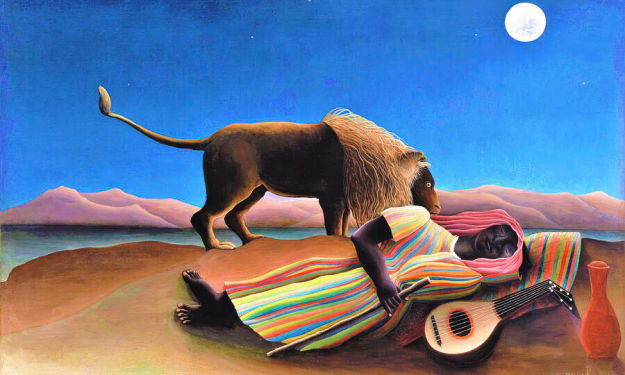
Title: The Sleep Beneath the Moon The desert had no name. It stretched in silence beyond the memory of maps, a vast ocean of sand lit only by the indigo breath of night. Wind moved softly across the dunes, lifting small whirls of dust like whispers from the past. Beneath the silver eye of the moon, there was no time—only stillness. And in that stillness, she slept. A woman lay curled on her side, wrapped in a robe of deep red and ochre stripes. Her skin, dark as ancient wood, glowed faintly in the moonlight. Her head rested on a worn mandolin, as if the instrument itself had lulled her to sleep. Beside her sat a simple jar, glazed and cracked, empty of water but filled with meaning. She was alone. A gypsy, they would call her—though no name ever followed. She was one of the wanderers. The kind who followed stars rather than roads, who sang lullabies to goats and lullabies to ghosts. She had walked across cities and sand, over mountains and along riverbeds, carrying her songs like seeds to be scattered. And now she slept in the sand, without shelter, without fear. But she was not alone. The lion watched. He had come silently, his golden paws pressing into the soft dunes like shadows. His mane shimmered beneath the moon, catching light like fire held in a net. His eyes, large and unreadable, studied the sleeping woman with neither hunger nor aggression. He did not growl. He did not move. He simply watched. It was a strange sight, even in a world that had long forgotten the border between reality and dream. A wild beast, drawn to a sleeping stranger not by scent, but by something deeper—something even he could not name. He sniffed the air. She smelled of cedarwood and smoke, of worn leather and faint rose. But beneath that—beneath the human details—she carried another scent. Memory. The lion blinked. The mandolin glowed faintly in the moonlight. Its strings vibrated softly, though no hand had touched it. It was as if the night itself had plucked a single note from its frame, a lullaby too old for language. The sound was not heard so much as felt—like an echo in the ribs, like the hush of a mother before the cradle. The lion lay down. The woman slept on. Before she had come to the desert, the gypsy had known many places and none. She had danced in courtyards where children threw petals at her feet, and she had sung to empty alleyways when rain made rivers of the streets. Her songs were not just songs—they were stories, memories, spells to keep loneliness at bay. But the world had grown louder. It no longer listened. Cities bustled with metal hearts. People moved too fast to notice music unless it shouted. She had tried to keep up, tried to play in crowded taverns and train stations. But her songs, soft and strange, were drowned in noise. So she turned back to silence. To the desert. To the moon. She walked for days. Ate little. Drank less. And when her feet could carry her no farther, she lay down, trusting the earth to cradle her. And so it did. And so did the lion. In the moments between midnight and dawn, when time breathes its slowest, the gypsy stirred. She did not open her eyes. But in her dream, she stood—barefoot and tall—on the dunes. The moon hovered close, large as a drum. And before her stood the lion, eyes glowing like small suns. “You found me,” she said, her voice a breath. “I followed your song,” the lion answered. “I didn’t know I was still singing.” “You were,” he said. “Even in silence.” She smiled. “What do you want?” “Not want,” the lion replied. “Remember.” He stepped closer. His breath was warm wind. “You forgot you were part of the wild.” “I grew tired,” she said. “Yes,” the lion said. “The world is heavy. But you are older than it. Your voice carries the sound of the first fire. The first lullaby.” “I am only one woman.” “You are one,” the lion said. “But you carry many. Your sleep feeds the sky.” She looked up at the moon. “Then let me rest a while longer.” The lion nodded. “I will guard you.” When morning came, the sun kissed the desert softly, slowly lighting the dunes in gold. The air was cool and expectant. The lion had vanished, as though dissolved into the light. The woman stirred but did not wake. Her breathing was slow, peaceful. Travelers would one day pass through this land, and they would speak of the woman who slept beneath the stars. Some would call her a mystic. Others, a myth. A few would say she never moved at all, as if preserved in time. But every so often, someone would stand before her and feel something stir within. A memory of music. A whisper of courage. A wild thing, still breathing inside them. And they would remember: The gypsy did not sleep to escape the world. She slept to hold it. To cradle it like a song in the dark. To remind even lions to listen. Author’s Note: This story is a fictional reimagining inspired by The Sleeping Gypsy (1897) by Henri Rousseau. In this surreal painting, a woman lies asleep in a moonlit desert with a lion curiously watching over her. Rousseau never fully explained the symbolism, allowing viewers to draw their own interpretations. This story explores the image as a poetic myth—one that blends solitude, feminine power, the mystery of dreams, and the strange tenderness between the wild and the weary.
By Soul Draftsabout a year ago in Art
"Unlocking Earnings: Your First Step to Making Money on Vocal Media"
Unlocking Earnings: Your First Step to Making Money on Vocal Media Learn how to turn your words into dollars—even if you're just starting out. Have you ever dreamed of making money simply by writing your thoughts and stories? With Vocal Media, that dream is closer to reality than you think. Whether you love telling stories, sharing advice, reviewing products, or writing poetry, Vocal Media gives you the platform to do it—and get paid! In this beginner-friendly guide, we’ll explore how to start earning on Vocal Media step-by-step, even if you have zero experience. --- 🔹 What Is Vocal Media? Vocal Media is a content publishing platform that allows creators to write and share articles across multiple niches like motivation, health, tech, love, fiction, and more. Unlike traditional blogs, you don’t need to set up a website, manage hosting, or promote with SEO knowledge. Everything is ready-made—you only need to focus on writing valuable content. You earn money based on reads and engagement. The more people who read your story, the more you earn. --- 🔹 Step-by-Step: How to Start Earning 1. Create a Free Account Go to Vocal.Media and sign up. You can choose the free version or go for Vocal+, a paid version that offers higher payouts and bonus challenges. 2. Pick a Niche Start by writing in a topic you enjoy. Popular categories include: Motivation Relationships Tech Fiction Health Travel Tip: Stick to one or two categories in the beginning to build your audience. 3. Write and Submit a Story Once logged in, click “Create Story.” Write directly on the editor or paste your content. Make sure to include: A strong title and subtitle An eye-catching cover image Subheadings and short paragraphs After submitting, Vocal’s team will review your story. If approved, it will be published within 24-48 hours. --- 🔹 How Do You Get Paid? You earn $3.80 per 1,000 reads as a free member and $6.00 per 1,000 reads as a Vocal+ member. Plus, there are bonus challenges where you can win $20–$500 or more just for writing stories around specific themes. Payment is made via Stripe, so make sure to set up a Stripe account linked to your Vocal profile. --- 🔹 Tips to Grow and Earn Faster 1. Share Your Stories Post links on Facebook, WhatsApp groups, Reddit, and writing communities to get more views. 2. Write Catchy Titles Titles like “How I Made My First $100 on Vocal Media” or “The Secret to My Daily Motivation” grab attention quickly. 3. Use High-Quality Images A good image increases clicks and keeps readers engaged. 4. Join Challenges They give you a chance to win extra cash and visibility. 5. Be Consistent Even 1 story per week can help you grow over time. Vocal rewards consistent writers. --- 🔚 Final Thoughts Vocal Media isn’t a get-rich-quick scheme. But it can become a steady source of passive income if you stay consistent, improve your writing, and promote your work. So if you're a writer at heart and want to make money doing what you love—Vocal is the platform to start with. --- 🖼️ Image Prompt (for Generation): "A young person sitting at a desk with a laptop, smiling while writing. The screen shows the Vocal Media website. Background includes coffee mug, notepad, and motivational posters. Warm, inspirational lighting."
By Sophia Graceabout a year ago in Art
10 Most Trusted Professional Illustration Services for Brands in 2025. AI-Generated.
In today’s visual-first world, illustrations are no longer a luxury—they’re a necessity. Whether you're building a bold brand identity, crafting content for digital platforms, or launching a creative campaign, illustrations can instantly capture attention and communicate your brand message. But with countless design platforms available, which ones truly stand out for professionalism, reliability, and creative quality?
By James Franklinabout a year ago in Art
How AI is Revolutionizing Creative Arts
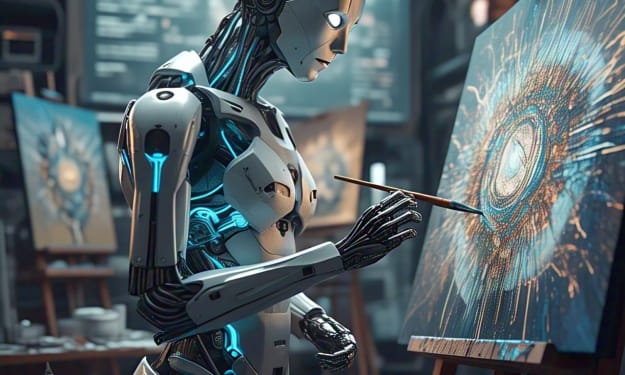
Introduction Art has always been a deeply human endeavor — an expression of emotion, culture, and experience. But in recent years, artificial intelligence (AI) has stepped into the studio, concert hall, and gallery, challenging traditional notions of creativity. The intersection of AI and creative arts is no longer a futuristic concept; it's a dynamic reality reshaping how we create, consume, and understand art. From AI-generated symphonies to algorithmic paintings selling for thousands, the revolution is here — and it’s only just beginning.
By Mehtab Ahmadabout a year ago in Art
The Smell of Beautiful
How perfumes unlock emotional and psychological triggers ? There’s something mysteriously powerful about scent. One whiff of jasmine, and you're transported to your grandmother’s garden. A trace of musk, and suddenly you're back in the arms of your first love. Perfume isn’t just about smelling good—it's memory bottled, emotion liquified, and psychology made wearable.
By Mehtab Ahmadabout a year ago in Art