History
A Modern African Tarot
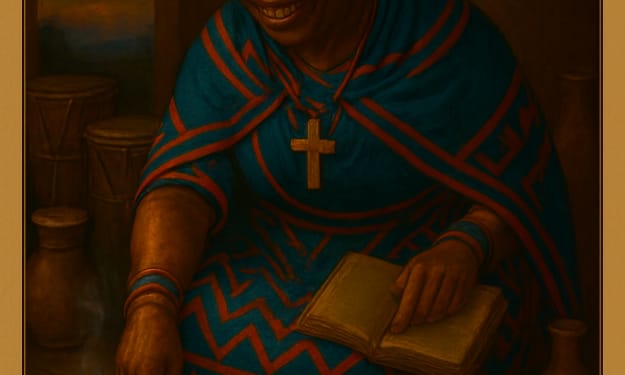
The fourth card in A Modern African Tarot shifts the journey from introspection to embodiment. Where O FOOL begins the walk, I MAGICIAN channels intention, and II HIGH PRIESTESS guards sacred insight, III EMPRESS celebrates manifestation. She is the archetype of fertility, creativity, and prosperity—reimagined here through the lens of African womanhood, economic power, and communal abundance.
By Vongani Bandi11 months ago in Art
A Modern African Tarot
The third card in A Modern African Tarot deepens the journey begun by O FOOL and I MAGICIAN. Where the Fool steps into possibility and the Magician channels intention, the High Priestess turns inward—toward silence, intuition, and ancestral knowing. She is the guardian of mystery, the voice between worlds, and the embodiment of spiritual depth.
By Vongani Bandi11 months ago in Art
A Modern African Tarot
The second card in A Modern African Tarot continues the journey begun by O FOOL. Where the Fool walks forward into layered realities, I MAGICIAN stands still—anchored, intentional, and aware of his tools. This card reimagines the traditional Magician archetype through the lens of African intellect, spiritual agency, and modern mastery.
By Vongani Bandi11 months ago in Art
A Modern African Tarot
Tarot has always been more than cards—it’s a mirror, a guide, a way to tell our stories. For centuries, the decks most people know—like the Rider Waite Smith—have been built on European imagery and symbolism. Castles, knights, biblical archetypes… powerful in their context, but distant for those of us whose roots and rhythms are African. These images speak to a worldview shaped by medieval Europe, but they often feel foreign when held in African hands.
By Vongani Bandi11 months ago in Art
A Modern African Tarot
This card marks the beginning of a powerful journey—a series of African-themed Major Arcana reimaginings that will culminate in the final card: The World. Each card in this series is designed to reflect modern African life, symbolism, and spirit, offering a fresh lens through which to explore timeless archetypes. We begin, as all journeys do, with O FOOL.
By Vongani Bandi11 months ago in Art
The Woman Who Became a Mirror
In the history of performance art, few moments have struck the human conscience as sharply as what unfolded in a modest gallery in Naples in 1974. It was an experiment that involved no words, no movement, and no stage—only a woman, a table of seventy-two objects, and the unpredictable landscape of the human soul. To this day, Marina Abramović’s Rhythm 0 remains one of the most disturbing, enlightening, and unforgettable explorations of human behavior ever witnessed. Marina Abramović, a young performance artist at the time, walked into the Studio Morra gallery with a simple—but terrifying—idea: she would stand motionless for six hours, offering herself as an object to the public. On a table beside her lay seventy-two items ranging from the harmless to the horrific: a rose, a feather, a piece of bread, a comb, perfume, honey, a whip, scissors, a scalpel, a chain, nails, a knife—and a loaded gun. The instructions were brutal in their simplicity: “Use any of these objects on me as you wish. I will not move. I will not resist.” And so she became what she later described as “a mirror for the audience—whatever they wanted to project.” The Opening Hours: Kindness in its Purest Form The first hour passed slowly, almost tenderly. Visitors approached her with caution, unsure how far they were permitted to go. Some whispered apologies as they placed a flower in her hand. One woman brushed Marina’s hair with soft, motherly care. Someone kissed her cheek, almost shyly. These gestures seemed to affirm something hopeful: perhaps when given the choice, humans would choose compassion. Perhaps empathy did not need rules, eyes watching, or fear of judgment. For a moment, humanity looked beautiful. But beauty in the human heart is often thin and delicate—easily shaken when boundaries blur. Curiosity Turns to Permission As the hours ticked on, something subtle began to shift. The crowd grew larger. More confident. More daring. The silent, unblinking woman standing before them no longer seemed entirely human. She did not flinch. She did not speak. She did not claim pain or protest. Slowly, curiosity became a kind of freedom—and freedom without accountability often becomes danger. Someone cut her dress with the scissors. Another cut her skin with the scalpel, watching her bleed. One person dipped the rose’s thorns into her skin, carving slow patterns of red. A man poured honey on her head, not gently but mockingly. Someone else picked up the metal chain and wrapped it around her arms. Laughter began to seep into the room—a laughter that did not sound joyful, but rather hungry. What was emerging was not simply cruelty, but a psychological phenomenon later deeply studied: deindividuation—the state in which people lose their normal restraints when they feel unidentifiable, unjudgeable, invisible. And Abramović had given them exactly that: total permission, total anonymity of guilt. When the Line Finally Broke The darkness reached its peak when a man picked up the loaded gun. He placed it in her hand. Then he lifted her arm, pointing the gun at her own chest. The room shifted instantly. A few audience members intervened, pushing the man away. But the damage had been done—not to her body, but to the collective conscience. In the silence of that gallery, humanity had shown how quickly kindness evaporates and how easily cruelty steps forward when consequences step back. Six Hours of Human Truth For six hours Marina Abramović remained still. She absorbed every gesture—the gentle, the curious, the humiliating, the violent. She gave herself as a canvas onto which strangers could paint their deepest impulses. But when the six hours ended, Marina finally moved. She lifted her head. She turned her eyes to the crowd. She walked toward them—not with anger, not with fear, but simply as a human being reclaiming her humanity. And then something extraordinary happened. The crowd froze. People stumbled backward. They could not meet her gaze. The same hands that had slapped her, cut her, mocked her, or threatened her now shook with regret. In those few moments, guilt flooded the room like cold water. When faced with a silent, motionless figure, people had forgotten she was human. But when she moved—when life returned to her eyes—they remembered. And they could not bear what they had revealed about themselves. Art or Warning? Debate erupted immediately around Rhythm 0: Was it art, or was it a psychological trap? Was it bravery or a dangerous experiment? Marina herself called it a “life-changing experience,” one that forever transformed her understanding of people. Psychologists, however, saw something else: a chilling demonstration of how environmental factors—not inherent evil—can unleash cruelty. When responsibility is removed, empathy fades. When accountability disappears, aggression awakens. When a crowd forms, individuality weakens. But the experiment also revealed something more balanced, more complex: not everyone succumbed to darkness. Some protected her, defended her, or stayed gentle even as the crowd shifted. Their quiet resistance became proof that goodness does not vanish entirely—it simply becomes harder. A Mirror for All of Us Rhythm 0 remains one of the most referenced examples in psychology textbooks on crowd behavior, mob mentality, and deindividuation. But beyond the academic world, it stands as a mirror held up to humanity. It asks questions that still make us uncomfortable: What would you do if there were no consequences? How much of your kindness depends on being watched? Would you stand with compassion—or fall with the crowd? Perhaps none of us can say for sure. But the purpose of Abramović’s performance was not to accuse—it was to reveal. To make us aware of the thin line between restraint and impulse, and the responsibility each person carries simply by being human. If You Had Been in That Room… Each reader must answer this question privately. Would you have placed a flower in her hand? Would you have wiped honey from her face? Would you have protected her? Or would you have followed the crowd, letting the illusion of anonymity loosen your empathy? None of us know with certainty. But perhaps the very act of asking ourselves makes us a little more aware, a little more responsible, a little more human.
By Ikram Ullah11 months ago in Art
Laghami Church in Svaneti
If you are not familiar with the history of Christianity in Svaneti, Georgia, you would not guess this building is a church. It looks more like a very old house, with no distinct Georgian church dome or bell tower. The only thing suggesting it’s a religious structure is the cross on its roof and the cemetery on its grounds.
By Lana V Lynx11 months ago in Art
Norman Rockwell: The Life, Art,. AI-Generated.
Norman Rockwell: The Life, Art, and Legacy of America’s Beloved Illustrator Norman Rockwell’s name has become inseparable from the visual identity of 20th-century America. His paintings—warm, humorous, emotional, and sharply observant—captured the stories of ordinary people with extraordinary sensitivity. From his early childhood in New York City to his final years in Stockbridge, Massachusetts, Rockwell’s life was a journey of artistic discipline, evolving ideals, and a lifelong commitment to telling powerful human stories through art. His legacy remains one of the most enduring in American illustration. --- Early Life and Artistic Beginnings Norman Percevel Rockwell was born on February 3, 1894, in Manhattan. Even as a child, he displayed a remarkable interest in drawing. While most children his age played outside, Norman preferred sketching the scenes around him—neighborhood life, people on the street, and images he imagined from books and newspapers. His family encouraged his talent, and by age 14 he was already taking art classes seriously. At 15, Rockwell enrolled in the Chase School of Art. A year later, he transferred to the National Academy of Design, and eventually to the Art Students League of New York, where he studied under well-known illustrators of the time. His training emphasized discipline, precision, and storytelling through detail—skills that would later define his style. By age 19, he earned his first significant job as an illustrator for the Boy Scouts of America, creating artwork for calendars and magazines. This was the beginning of his professional career, and it introduced him to a national audience. Rockwell was still only a teenager, but editors admired his ability to capture character, humor, and emotion with remarkable clarity. --- The Saturday Evening Post Era Rockwell’s life changed dramatically in 1916 when he painted his first cover for The Saturday Evening Post, one of the most widely read magazines in America. The Post became his artistic home for nearly five decades. Over the course of his career, he created 322 covers for the magazine, each one capturing a unique story from American life. His illustrations were instantly recognizable—bright, expressive, filled with personality, and often humorous. Whether depicting a child longing for a puppy, a family gathering around the dinner table, a young soldier preparing for war, or a pair of friends sharing a secret, Rockwell’s ability to connect emotionally with viewers was unmatched. He created scenes that felt both familiar and nostalgic, even when they portrayed contemporary life. During these early years, Rockwell’s work focused mostly on cheerful, heartwarming scenes. America was changing rapidly, and his illustrations comforted millions by reminding them of simple joys and shared values. His characters were ordinary people—teachers, soldiers, children, shopkeepers—but he painted them with such warmth that they became symbols of American culture. --- Life in Vermont and Artistic Growth In 1939, Rockwell moved with his family to Arlington, Vermont, a rural town that influenced his work deeply. The local people became his models, and the landscapes of Vermont shaped the settings of many of his most iconic paintings. During this period, his style matured: he became more detailed, more expressive, and more focused on capturing subtle human emotions. The 1940s were a defining decade for Rockwell. America entered World War II, and Rockwell wanted to contribute to the national spirit. The result was his legendary series The Four Freedoms, inspired by President Roosevelt’s speech promoting four essential human rights: Freedom of Speech, Freedom of Worship, Freedom from Want, and Freedom from Fear. Each painting depicted these ideals through ordinary Americans—humble, relatable people whose lives symbolized the values of their nation. The series became a national sensation. It toured the country to raise money for the war effort and earned Rockwell widespread praise. It proved that illustration could be more than entertainment—it could carry powerful messages. --- Iconic Works and Their Impact Over the course of his long career, Rockwell created hundreds of unforgettable paintings. Among his most celebrated works are: “Freedom from Want” – Often called the “Thanksgiving Picture,” this painting shows a family gathering around a dinner table, smiling as a turkey is placed before them. Its sense of warmth and gratitude has made it a timeless symbol of comfort and family unity. “The Problem We All Live With” (1964) – One of Rockwell’s most important social paintings, it depicts Ruby Bridges, a six-year-old African American girl, being escorted to school during desegregation. The painting is powerful, direct, and unflinching—a dramatic shift from his earlier, lighter work. “Breaking Home Ties” – A father and son wait beside a truck as the young man prepares to leave for college. The father’s worn clothing and the son’s polished suitcase capture the bittersweet moment when childhood ends and adulthood begins. “Triple Self-Portrait” – A humorous yet thoughtful depiction of Rockwell himself, painting a self-portrait while examining his reflection and sketches. It highlights his ability to blend comedy and introspection. These paintings, along with countless others, demonstrate Rockwell’s talent for storytelling. He could express tenderness, conflict, humor, and humanity all in a single scene. --- Later Career and New Themes In the 1950s and 1960s, Rockwell continued to evolve. After leaving The Saturday Evening Post in 1963, he joined Look magazine, which allowed him to explore more serious themes, including civil rights, poverty, and global issues. His shift in focus surprised many. The cheerful illustrator of small-town America had become a mature artist expressing complex social concerns. Yet his meticulous technique and emotional clarity remained consistent. He painted portraits of world leaders, activists, and everyday heroes. He created scenes that addressed inequality, injustice, and hope. He believed that art should not only entertain but also inspire social change. --- Personal Life and Character Rockwell was known for his discipline. He worked long hours in his studio, often sketching dozens of drafts before beginning a final painting. He photographed models, built props, and staged scenes with the care of a film director. His precision was legendary. Despite his fame, he remained humble. He saw himself not as a fine artist but as a storyteller who used pictures instead of words. His kindness, humor, and curiosity about people shaped every painting he made. He moved to Stockbridge, Massachusetts, in 1953. The small town became his final home and the site of the Norman Rockwell Museum, which now houses the world’s largest collection of his work. --- Final Years and Death Rockwell continued painting until his health declined in the 1970s. In 1977, he received the Presidential Medal of Freedom for his contributions to American culture. This honor recognized not only his artistic skill but also his ability to capture the spirit of a nation. He passed away peacefully on November 8, 1978, at the age of 84. His death marked the end of an era, but not the end of his influence. Today, Rockwell’s paintings remain celebrated around the world. They appear in books, museums, documentaries, and classrooms. They inspire artists, writers, filmmakers, and historians. His work continues to reflect the humor, struggles, hopes, and dreams that define the human experience. --- Legacy Norman Rockwell’s legacy is not just the art he left behind—it is the emotional connection he created with millions of people. His paintings remind us that even the smallest moments can tell meaningful stories. He believed that kindness, honesty, and empathy were worth illustrating, and he devoted his life to capturing them with beauty and truth. Rockwell showed that art does not need to be loud to be powerful. Sometimes, the quietest scenes—an old man reading a newspaper, a child tying her shoes, a family sharing a meal—carry the deepest meaning. Norman Rockwell painted America not as it was, but as we hoped it could be. His art remains a testament to the enduring power of humanity, storytelling, and the simple moments that shape our lives.
By Alshalil 77111 months ago in Art