Fiction
The Funny Things Cats Do
Cats are often hailed as the most entertaining pets, and for good reason. From their quirky antics to their vast array of silly expressions, our feline friends never fail to keep us amused. In this blog, we’ll take a look at some of the funniest things cats do that make them the lovable characters we adore.
By Karl Jacksonabout a year ago in Art
💔 The Bench by the Lake
**"** The cold wind whispered through the trees as **Mira** sat on the old wooden bench by the lake. It was their place. Her and *his*. The one spot where laughter once echoed, where quiet moments felt eternal, and where time used to stand still.
By The Wordsmith by Sanjina Hussainabout a year ago in Art
World Heritage: Protecting the Treasures of Humanity
The world is filled with places of extraordinary beauty, cultural importance, and historical value. From ancient temples and majestic mountains to grand cities and natural wonders, these places help us understand who we are, where we come from, and what we share as human beings. To protect and preserve these treasures for future generations, the United Nations Educational, Scientific and Cultural Organization (UNESCO) created the World Heritage List.
By Mr Rifat Ahmedabout a year ago in Art
The Age of Intelligence: How AI is Reshaping Our World
We are living in the age of intelligence—an era where machines no longer simply follow orders but can learn, adapt, and evolve. Artificial intelligence (AI), once confined to science fiction, is now embedded in nearly every facet of our daily lives. From the smartphones in our pockets to the algorithms behind online recommendations, AI is becoming a silent partner in the modern human experience. Its impact extends across industries, reshaping not only how we work, but how we think, communicate, and create. The Rise of AI: A Brief Overview Artificial intelligence refers to the development of computer systems capable of performing tasks that normally require human intelligence. These tasks include visual perception, speech recognition, decision-making, language translation, and more. The field has its roots in the 1950s but has exploded in the last decade, thanks to breakthroughs in machine learning, neural networks, and vast computing power. Today’s AI can do more than simple calculations—it can analyze enormous datasets, recognize complex patterns, and even generate original content. Technologies like OpenAI’s GPT models, autonomous vehicles, and facial recognition software all stem from advanced AI research and development. Automation and the Workforce One of the most immediate effects of AI is automation. Repetitive and rule-based tasks across industries are now being handled by intelligent systems. In manufacturing, robotic arms guided by computer vision can assemble products with precision. In customer service, chatbots respond to inquiries instantly and accurately. In logistics, AI-powered algorithms determine the most efficient delivery routes. While this automation boosts productivity and reduces costs, it also raises important concerns. Many traditional jobs, especially in sectors like transportation, retail, and administration, are at risk of being replaced. However, AI isn’t just eliminating jobs—it’s transforming them. New roles such as AI trainers, data analysts, and machine learning engineers are emerging, requiring new skills and education. AI in Healthcare: Revolutionizing Diagnosis and Treatment Perhaps nowhere is AI’s potential more profound than in healthcare. Machine learning models can now analyze medical images with a level of accuracy comparable to, or even surpassing, human radiologists. AI tools are assisting doctors in diagnosing diseases, predicting patient outcomes, and personalizing treatment plans. Moreover, AI-driven drug discovery is accelerating the development of new medications. During the COVID-19 pandemic, AI models were used to simulate how drugs might interact with the virus, significantly shortening research timelines. With AI, the promise of faster, more precise, and more accessible healthcare becomes a tangible reality. Creativity and Artificial Intelligence Beyond science and industry, AI is also making waves in creative domains. Tools like DALL·E and ChatGPT are enabling machines to generate art, music, stories, and poetry. These creations aren’t simply copied—they’re synthesized from patterns and styles learned through massive datasets. This fusion of human and machine creativity opens exciting new possibilities. Artists can collaborate with AI to explore new styles. Writers can generate ideas or full drafts using language models. Even video game development is benefiting, with AI helping design levels and characters dynamically. However, these advancements also provoke debate. What constitutes originality when a machine creates? Who owns the copyright of AI-generated content? As AI steps into creative territory, society must reconsider long-held assumptions about art and authorship. Ethics, Bias, and Responsibility While AI offers incredible benefits, it also presents serious ethical challenges. AI systems are only as good as the data they are trained on—and that data often reflects societal biases. If unchecked, these biases can lead to unfair treatment in areas like hiring, policing, or loan approval. There are also concerns about surveillance, privacy, and the potential misuse of AI in military applications or misinformation campaigns. Deepfake technology, for instance, can create convincingly fake videos, posing threats to democracy and personal reputation. As AI capabilities grow, so too must our efforts to govern and guide them. Transparent development, accountability mechanisms, and ethical frameworks are essential to ensure AI serves humanity positively. The Future of AI: Opportunities and Unknowns Looking forward, AI’s trajectory is both exciting and uncertain. Emerging fields like artificial general intelligence (AGI)—machines with human-level thinking and reasoning—are on the horizon, though still theoretical. AI is expected to become more deeply integrated into daily life, from personal assistants that manage our schedules to smart homes that anticipate our needs. In education, AI can personalize learning experiences to suit individual students. In finance, it can detect fraud and manage portfolios with astounding accuracy. In environmental science, AI helps model climate patterns and propose sustainable solutions. Yet, the full impact of AI depends on how we use it. Will it amplify inequality or create new opportunities? Will it concentrate power or democratize innovation? The answers lie in the decisions we make today. Conclusion Artificial intelligence is not just another technological trend—it is a transformative force reshaping our world at an unprecedented pace. From the way we work to the way we create and care for one another, AI is driving change on a global scale. As we navigate this new age of intelligence, it is essential that we remain both visionary and vigilant—embracing the possibilities while guarding against the perils. The future of AI is, ultimately, the future of humanity. And it is up to all of us to ensure it is one that uplifts, empowers, and unites. . .. n ..........
By Mujeeb Ur Rahmanabout a year ago in Art
I Published a Story Online and Thought No One Would Read It
I still remember the moment I clicked “Publish.” It was 2:16 a.m., and my cursor hovered over that button for what felt like forever. My heart raced—not from fear exactly, but from the kind of vulnerability that comes when you bare a piece of your soul to a silent crowd.
By Muhammad Sabeelabout a year ago in Art
Memories - part 2
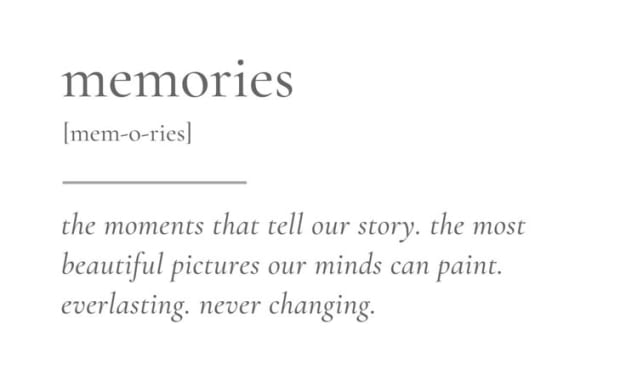
A simple thought crossed my mind at that moment. I thought I’d jot it down somewhere. The memories I talked about in my previous writing piece, if you read it, I mentioned some "lost memories". If put together plainly - we are humans. As humans, from the very moment we are born, we see things, we hear things, we learn what is taught to us and we live. In the entire process whatever life has thrown at us or in other words, "taught us" or made us who we are now, or who we have grown to be - those moments or so-called life lessons become quite valuable to us. We even end up calling them “cherished memories”. But with everything, somewhere along the way, each moment, each day, the things we do, or the way we lived a day, or a month, or a year, with time we end up losing most of the memories. It kind of fades away with time. We aren’t invincible neither are our brains. We aren’t machines. We possibly can't always remember every single thing we did in our lives.
By Ealisha Acharyaabout a year ago in Art
Education is Necessary for All People
intrduction Education is one of the most powerful tools for personal and societal development. It is the foundation upon which individuals build their futures and nations progress. Education is not just about acquiring knowledge from books; it is about developing critical thinking, problem-solving skills, and the ability to make informed decisions. In today’s rapidly changing world, education is more important than ever before. It empowers individuals, reduces poverty, promotes gender equality, and fosters economic growth. Therefore, education is necessary for all people, regardless of age, gender, or social status.
By Azra parveenabout a year ago in Art
Microblading Eyebrows: Understanding The Techniques To Its Core
Microblading Eyebrows is a cutting-edge technique that has transformed the beauty industry as it provides a solution to people with sparse or uneven eyebrows. This semi-permanent technique refers to the process of implanting pigment into the skin, giving the brows an appearance of being fuller, well-defined, and intricately shaped. However, over the years, many techniques and styles have developed to meet the needs of different people and their skin types.
By Metamorphosis Microbladingabout a year ago in Art
The Weaver’s Daughter
The Weaver’s Daughter In the far end of Nabinpore village, in a mud-and-thatch hut, lived Raghu the weaver. His days passed weaving thread after thread. His only daughter, Kanchana, a 25-year-old village girl, was perhaps the quietest soul in the village. She spoke little, her eyes heavy with fatigue and some unnamed waiting.
By Kevin Hudsonabout a year ago in Art