Exhibition
Rabi Pirzada: A Story of Art, Faith, and Starting Over. AI-Generated.
🎨 The Colorful Comeback of Rabi Pirzada: From Pop Star to Artful Heart We often hear about celebrities stepping away from the spotlight, but very few choose a path so different and meaningful that it touches lives beyond fame. Rabi Pirzada is one of those rare souls. Once known for her music and media appearances, Rabi has transformed into a visual artist, a philanthropist, and a voice for modesty, spirituality, and kindness.
By Muhammad Adilabout a year ago in Art
Brighten Your Walls with Colorful Artwork Prints
Are your walls feeling a little plain? A splash of color can change that in an instant. Colorful artwork prints are one of the easiest ways to breathe life into any space. Whether you're decorating a bedroom, living room, or hallway, adding vibrant prints can turn a blank wall into something special.
By sedona art studiosabout a year ago in Art
Art That Touches the Soul
Art has always been more than mere decoration. From ancient cave paintings to modern digital installations, art has served as a profound channel of human expression, capable of communicating emotions, ideas, and truths that words alone often cannot capture. Some forms of art entertain, others provoke thought—but the most powerful art reaches deep into the human experience. It touches the soul. It moves us, heals us, challenges us, and sometimes even transforms us. “Art that touches the soul” is more than just aesthetically pleasing; it resonates emotionally and spiritually, revealing the depth of human existence and connection.
By Anwar Jamilabout a year ago in Art
Whispers in Blue: The Story Behind Degas’ Dancers
Title: Whispers in Blue: The Story Behind Degas' Dancers The rehearsal room was hushed, though not silent. The wooden floor creaked like the hull of an old ship. Dust drifted lazily through the late afternoon light, golden and tired as it spilled through the high windows. In a quiet corner of the room, Edgar Degas sat still, eyes half-lidded, sketchbook on his lap, his gaze fixed on the blue. Four girls stood like petals of the same flower—slightly apart, yet turning toward a shared center. They moved in rhythm not to music but to memory, to instinct, to an echo of a piano long since gone quiet. The girl nearest to Degas was Clara—barely seventeen, her limbs wiry from years of training. Her hands fluttered as she adjusted the bow at her waist. She was always adjusting, always correcting, never quite sure she belonged. Her mother had once danced here, long ago, before love and illness claimed her bones. Clara bore that legacy like a bruise beneath the skin. Next to her, Elise brushed invisible dust from her tutu. Her fingers, pale and slender, betrayed a nervous energy. Elise had come from the provinces with a letter of recommendation and a dream stitched into her bodice. She danced with the desperation of someone who knew this stage might be her only one. Behind them, Camille stretched her arms above her head, her eyes closed in the grace of a swan. She was the quiet one, the one who never laughed too loud or cried too long. She danced as if gravity did not apply to her, as though her body remembered flight. And then there was Margot. Margot was the sun around which the others turned—unknowingly, perhaps unwillingly, but inevitably. Her movements were effortless, her form a study in balance and breath. She was not the most technical dancer, nor the most disciplined, but she possessed that rare thing: presence. When Margot danced, time bowed before her. Degas had sketched these girls before. Many times. He knew their backs better than their faces, their poses better than their postures at rest. He was drawn to the moments before the performance—the lull between sweat and spectacle, the grace that came not from choreography, but from the simple act of being. Today, he painted them in blue. Not the vivid blue of summer skies, nor the somber blue of a storm. No, this was the blue of velvet shadows and soft silence—the color of reflection and breath held in anticipation. The rehearsal had ended an hour ago, but they lingered, as dancers often did, caught in the gravity of their shared devotion. They talked softly—about slippers worn thin, instructors too harsh, the ache in their hips and the dreams in their chests. Their voices wove around each other like ribbon. Clara watched Margot out of the corner of her eye. She envied her, but it was a gentle envy—like watching a bird take flight and knowing your wings were still growing. “Do you ever get scared?” she asked. Margot smiled faintly, as if remembering something far away. “Always,” she said. “But I dance through it.” Degas made no sound, but his pencil moved quickly, hungrily. He wanted to capture that—not the fear, but the dancing through it. Camille, noticing him, lowered her arms and turned ever so slightly away. “Monsieur Edgar,” she said quietly, “you always catch us at our most tired.” He smiled, without lifting his head. “That’s when you’re most real.” They laughed, a little. It was a sound like bells dropped into water—delicate, muffled, fleeting. He had painted them many times—sometimes in oils, sometimes in pastels. Sometimes only in memory, days later. He did not ask them to pose. He let them exist and tried to keep up. Blue was the only color that felt right for today. It softened the edges. It held their forms together, like a binding spell. The dresses floated, the bows curled, the necks bent like lilies under moonlight. There was no spotlight here, no stage. Only the hush of dreams rehearsed in half-light. The girls gathered their things eventually. Time crept forward, as it always must. They stepped out into the Paris dusk, their shadows long and overlapping. They would return tomorrow, and the day after, until their bodies no longer obeyed or the world found some other use for them. Degas remained, his brush sweeping the last curve of a shoulder, the final whisper of tulle. He didn’t paint ballerinas for the stage, for the sparkle and adoration. He painted them because they were metaphors—for fragility and fight, for beauty forged in silence, for the small acts of grace that happen away from the curtain. Blue Dancers wasn’t a portrait. It was a memory. A quiet ballet in a world that moved too quickly. And maybe, just maybe, it was a prayer—that these girls, with their aching feet and quiet fears, might one day know how radiant they looked, even when they weren’t looking.
By Soul Draftsabout a year ago in Art
More Than a Painting: The Story of Madonna Litta
Title: The Silent Bond – A Story Inspired by Leonardo da Vinci’s “Madonna Litta” In the stillness of a Renaissance room, where the light barely dances across the stone floor and the heavy curtain parts to reveal the sky, a young woman cradles her child. Her gaze is soft, her expression serene, yet beneath the tranquility, there is an unspoken intensity — a bond beyond words, brushstrokes, or time. This is the world captured in Leonardo da Vinci’s “Madonna Litta,” a painting as enigmatic as it is tender. Painted around 1490–1491, likely during Leonardo’s years in Milan, “Madonna Litta” depicts the Virgin Mary breastfeeding the infant Christ, a common theme in Christian iconography. But in Leonardo’s hands, it transcends the symbolic and enters the realm of deeply personal human experience. And yet, despite the layers of emotion infused into the painting, the story behind it remains cloaked in mystery — and, perhaps, myth. Let us imagine, then, a story. The Milanese Court, 1491 The winter was mild that year, though the stone corridors of the Sforza court still held onto their chill. Duke Ludovico Sforza, known as Il Moro, was building his legacy not just through politics and war but through art. His court had become a sanctuary for thinkers, architects, musicians, and painters. Among them stood Leonardo da Vinci — a man whose hands never ceased sketching, whose mind was never still. It was during this time that Leonardo, ever curious about anatomy and emotion, began a study not of nobility or myth, but of motherhood. He had seen mothers in the market, watched their instinctual gentleness, the way their bodies curved toward their children. He wondered: could art ever truly capture that moment of sacred intimacy? In a modest home outside Milan, a young woman named Lucia lived quietly with her newborn son. She had once been a lady-in-waiting, known for her calm spirit and luminous beauty. Her life had taken a quieter turn, far from the whispers and expectations of court. When Leonardo met her — through a midwife he sketched for anatomical studies — he saw in her not just a model, but a presence. Lucia agreed to sit for him, not out of vanity, but because she sensed in Leonardo a reverence that had nothing to do with flattery. Days turned into weeks. In a softly lit studio, with windows high and dust motes catching the morning light, Leonardo painted. Lucia would come with her child, and together they would sit in silence. The baby, restless at first, would grow still in her arms, lulled by her heartbeat, her warmth, the gentle rise and fall of breath. Leonardo observed everything — the slope of her neck, the arch of her hand as it supported the child’s head, the half-smile that lingered on her lips even in her weariness. But most of all, he watched the gaze. That unbreakable thread of love between mother and child. It was not something he could fully explain in words. It was something he would have to show in paint. The Painting In “Madonna Litta,” Mary is dressed in rich crimson and deep blue, colors of sacrifice and divinity. Her veil, drawn delicately over her hair, speaks of modesty and grace. But it is her face — youthful, focused, inward — that holds the viewer. Her eyes are not looking at the child, but through him, as if contemplating a future that only she can sense. The Christ child, chubby and alert, feeds eagerly, grasping at her robe. He is no ethereal figure here, no golden-haloed abstraction, but a real child, hungry, alive, human. Behind them, arched windows open to a clear, mountainous landscape — perhaps a reminder of the divine beyond the domestic. Or perhaps, like much of Leonardo’s work, it symbolizes the coexistence of nature and humanity, the eternal and the immediate. While the painting is sometimes debated in attribution — with some suggesting it may have been completed or touched up by Leonardo’s student Giovanni Antonio Boltraffio — the design and essence bear Leonardo’s unmistakable touch. The intimacy, the anatomical precision, the spiritual undertones without overt religious symbolism — all hallmarks of the master. Legacy and Interpretation For centuries, “Madonna Litta” has stirred the hearts of those who view it. Though now housed in the Hermitage Museum in St. Petersburg, the painting continues to speak in a universal language. It doesn’t need Latin inscriptions or dramatic gestures. The emotion is quiet, yet profound. Some art historians suggest the painting is less about theological doctrine and more about the sanctity of motherhood itself. In an age where Madonna images often emphasized divinity at the cost of humanity, Leonardo turned the tide. His Virgin is not remote or regal — she is real, tender, infinitely strong in her softness. This subtle revolution in religious art — the shift toward emotional realism — would ripple through Renaissance painting, influencing generations. And it began here, with a mother, a child, and a man obsessed with capturing truth through beauty. The Story That Lives On Whether Lucia truly existed as described, or whether she was a figment of Leonardo’s imagination, we may never know. But in the “Madonna Litta,” she — and every mother like her — lives eternally. This is not just a portrait. It is a moment carved out of time, a meditation on love, sacrifice, and the divine made flesh. It reminds us that even the greatest of stories — the rise of kings, the miracles of prophets — begin in the arms of a mother, in the quiet miracle of life being nourished. Leonardo, always seeking to understand the cosmos, found his universe in a single gaze between mother and child. And that gaze still meets ours, more than 500 years later.
By Soul Draftsabout a year ago in Art
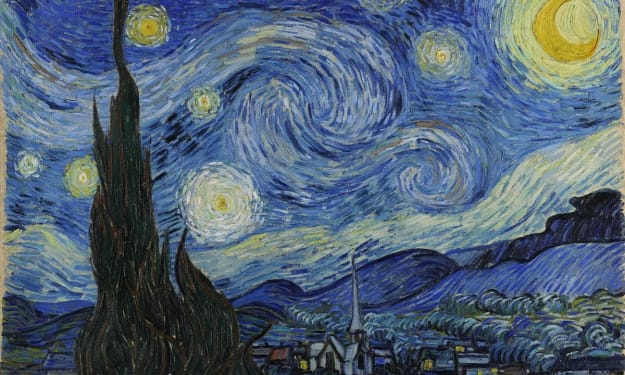
"The Starry Night: A Masterpiece Born from Madness"
The Starry Night: A Symphony of Silence and Madness In the hush of a Saint-Rémy night, the stars whispered. It was 1889, and Vincent van Gogh sat behind the iron bars of the asylum window, his breath fogging the glass as the wind stirred the cypress trees beyond. The room behind him was still—too still. Silence had always been his shadow, but now it had teeth. Every ticking second scraped at his thoughts. Yet, above him, the sky lived. The world outside did not sleep as he did; it pulsed, it wept, it sang. Vincent could see it more clearly than anyone ever had—not with his eyes, but with the fevered clarity of a soul that had been both broken and reborn. He didn’t paint The Starry Night from a real view, not entirely. No, what he painted was truer than real. It was the sky as he felt it. It was turbulence, longing, hope, and fury tangled together in color. By day, the village below was quiet, ordinary. But by night, in Vincent’s mind, it bloomed—golden windows glowing like small embers of humanity, a sleepy chapel reaching like a prayer, the cypress tree a flame that refused to go out. The stars? They were not dots. They were whirlpools of light, great celestial dancers caught in a storm of meaning. They spun with sorrow, joy, and everything in between. They knew Vincent, and he knew them. Each brushstroke was a breath, a confession, a scream. The sky swirled in his mind and poured out in ultramarine and cobalt, slashed with streaks of lemony yellow and milky white. He didn’t paint what he saw. He painted what he felt—what he needed to believe: that something divine was out there, beyond the chaos, cradling the world in light. And yet, even with the cosmos alive above, the night had weight. Vincent was not just an artist. He was a man fractured by loneliness, haunted by thoughts he couldn't escape. This masterpiece, now immortal, was born in the confines of a room meant to contain madness. But what the world later hailed as genius, the world at the time barely noticed. He sold only one painting in his lifetime. One. Vincent painted because he had to. Because to not paint would be to drown. As he stood back from The Starry Night, the oils still wet, something in him stirred. He had captured not a scene, but an emotion—the exact moment when despair kisses awe. The moment when the soul, even shattered, dares to look up. He once wrote to his brother Theo, "Why, I ask myself, shouldn’t the shining dots of the sky be as accessible as the black dots on the map of France?... Just as we take the train to get to Tarascon or Rouen, we take death to reach a star." Vincent didn’t fear the stars. To him, they were destinations. And though he would not live to see his painting grace museums or inspire generations, The Starry Night became a language the world could understand. Long after he left this world, the sky he painted continued to speak—of pain, of passion, of the indescribable ache to feel connected in a universe that often feels indifferent. Today, millions stand before the canvas in hushed wonder, not realizing they are walking into the echo of a man’s final hope. Each swirl, each spark, is a reminder that beauty can emerge from the depths of torment. That even in confinement, the soul can take flight. The Starry Night is not just a painting. It’s a promise. That no matter how dark the world becomes, the stars will still burn. That someone, somewhere, will always see what others cannot. That art—raw, imperfect, heart-wrenchingly human—can outlive the silence. So the next time you look up, remember Vincent. Remember that behind every star, there may be a story not yet told. And within each of us, there may live a night sky just waiting to be seen.
By Soul Draftsabout a year ago in Art
Love in the First Rain . AI-Generated.
Love in the first story The sky was a deep shade of grey, the clouds swollen with anticipation. The air was heavy with the scent of wet earth and ozone. A storm was brewing, and the atmosphere was electric. For Ayesha, it was as if the universe was holding its breath, waiting for something momentous to happen.
By Sophia Graceabout a year ago in Art
Eye Catching Vivid Paintings That Dazzle the Senses
If you've ever walked into a room and felt your mood instantly lift, color likely played a big role. Art has the power to shape how we feel, and vivid paintings do this best. With bold tones and lively strokes, these pieces aren’t just decorations they’re experiences. They draw your eye, wake up your senses, and speak without saying a word.
By sedona art studiosabout a year ago in Art
Panoramic Landscape Art Nature’s Beauty in Wide View
If you love nature and want to bring its beauty into your home, panoramic landscape art is a perfect choice. These wide-format artworks capture breathtaking views mountains, oceans, forests, and skies all in one stunning image. They’re not just pictures; they’re windows into nature’s peaceful and powerful world, beautifully expressed through panoramic landscape art.
By sedona art studiosabout a year ago in Art