Drawing
Unlocking the Power of Perception
Greetings, fellow artists and art enthusiasts! Today, I'm excited to share with you a drawing exercise that has had a profound impact on my artistic journey, and I believe it has the potential to do the same for you. Join me as I delve into this transformative technique that has changed the way I perceive the world around me.
By Stella Oehtam3 years ago in Art
Japanese Wall Art:
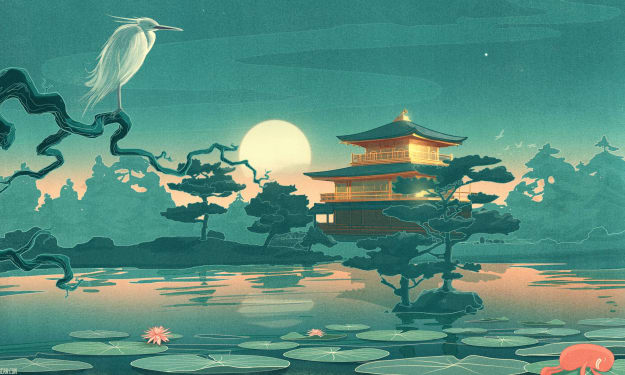
Japanese wall craftsmanship has a long and rich history, tracing all the way back to the Jomon time frame (10,000-300 BCE). Probably the earliest instances of Japanese wall workmanship can be found as cavern compositions, which portray various creatures, plants, and mathematical plans.
By muhammad javaid3 years ago in Art
Beyoncé Renaissance Tour: Air Icon T-Shirt
In the realm where music and artistry converge, few names shine as brightly as Beyoncé. A true cultural phenomenon, Beyoncé's influence reaches far beyond the stage, transcending generations and leaving an indelible mark on the world. With the announcement of the Beyoncé
By Seyi Egbeyinka 3 years ago in Art
How Mona Lisa became so overrated?
If you want to praise Leonardo daVinci's Mona Lisa as art, you can find it. But what if you think it's just...well? What is the cynical explanation for the Mona Lisa? Why is Mona Lisa so famous? Is it really that much better than da Vinci's Lady in Ermine? It looks better. There is one more ermine. But the Mona is so famous that the director of the Louvre, where the Mona Lisa lives, said that 80% of his visitors are there just to see one painting.
By Shubham Bajaj3 years ago in Art
My voice
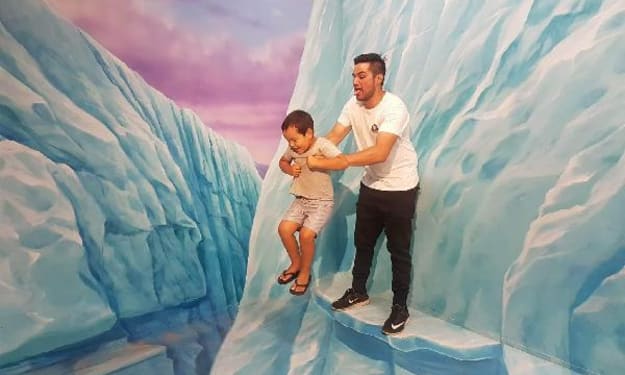
3d art Creating 3D eye art, also known as "eye-popping" or "illusion" art, involves using shading, perspective, and optical illusions to make a flat drawing appear three-dimensional. This can be done with various subjects, but let's focus on creating a simple 3D eye art trick.
By sandip thapa3 years ago in Art
Decoding the Challenge: AI Art's Struggle with Depicting Hands
In the realm of AI-generated art, there's a curious phenomenon that has captured the attention of many: the struggle to accurately depict hands. It's an odd predicament, considering the remarkable feats of creativity AI models can achieve, from envisioning a post-apocalyptic giraffe astronaut to portraying Genghis Khan playing a pixel art guitar solo. But when it comes to portraying something as seemingly simple as a man holding a delicious apple, AI art tends to falter. Why is it that AI, with all its technological prowess, stumbles when it comes to rendering such a basic and familiar human gesture? Before delving into the peculiar world of AI and hands, let's first acknowledge that AI art is indeed a marvel of modern technology. It can seamlessly blend historical figures like Abraham Lincoln and glam rock icon David Bowie, creating a surreal yet captivating fusion of eras and styles. But it's when we attempt to depict everyday human actions and interactions that the limitations of AI become apparent. To understand this artistic anomaly, we turn to the insights of an artist who has guided countless individuals in the art of drawing hands from imagination. Before embarking on formal artistic training, individuals develop a natural ability to recognize patterns from observing the world around them. This pattern recognition is crucial for creating accurate representations of objects and actions. AI operates similarly, but its learning environment is akin to being confined within a museum. Imagine an AI growing up with access only to images and their accompanying descriptions, much like the placards beside exhibits in a museum. The AI's "museum" is brimming with images of objects, including hands. However, the difference lies in the approach to understanding. While humans can hold an apple, examine its texture, and rotate it in their hands, AI must rely on finding additional images of apples within its limited museum. This pattern recognition forms the basis of AI-generated art, yet it lacks the innate understanding humans possess due to their lived experiences. When an artist undergoes formal training, they delve into the realm of rules and techniques. By simplifying complex objects into basic shapes, like breaking down a hand into a palm, fingers, and thickness, artists can then add their personal style and detailing. AI, on the other hand, operates differently. It can produce visually appealing representations, as seen in its ability to capture light and texture, but it lacks an understanding of how objects truly function. Consider an AI-generated hand illustration. While the shapes may appear unconventional, the AI excels at showcasing intricate details through pixel patterns. However, it's evident that the AI hasn't comprehended the mechanics of finger joints and how they bend. Instead of simplifying forms as artists do, the AI is attempting to mimic hand-like pixels based on its stored patterns, devoid of a deep understanding of hand anatomy. The struggle with hands in AI art isn't an isolated quirk; it offers valuable insights into how AI art models operate. To further explore this phenomenon, conversations with experts in generative art shed light on three significant challenges: data size and quality, hand behavior, and a low margin for error. In the AI's museum, there's an unequal distribution of data, with an abundance of facial images and a scarcity of hands. Consider datasets like Flickr HQ, which boasts thousands of faces with detailed annotations. Yet, datasets for hands may not be as prevalent in training AI art models. The scarcity of data is compounded by the complexity of hand behavior, which remains largely unannotated. While we can describe intricate details of a hand holding an umbrella, AI is left to make educated guesses based on its patterns. Unlike facial images that often follow a centered and symmetrical pattern, hands are incredibly diverse in their movements and positions. The AI struggles to capture this diversity, resulting in peculiar hand renderings that deviate from real-world mechanics. While AI excels in various artistic domains, its hands remain a stumbling block due to the absence of a comprehensive understanding of their dynamics. Despite these challenges, progress is being made. The introduction of Midjourney version 5, the latest AI art generator, offers promising advancements in rendering hands. Yet, complete mastery remains elusive. To address this, AI developers are exploring two avenues: expanding the AI's exposure to a wider range of images and soliciting human feedback. By allowing the AI to analyze a greater volume of pictures, developers aim to enhance its pattern recognition abilities. However, this approach requires substantial computational power. Alternatively, involving more individuals in the AI's learning process could yield valuable results. Drawing parallels with ChatGPT, where human feedback refined language generation, a similar strategy could be employed for AI art. Through human ranking of generated images, the AI can refine its output based on what people find visually appealing. In conclusion, the quirk of AI struggling with hands in art creation offers a fascinating glimpse into the intricacies of AI learning. Despite its remarkable abilities to generate captivating and imaginative art, the AI's limitations provide valuable insights into the nuances of pattern recognition, data availability, and the complexities of human behavior. As AI art continues to evolve, the challenge of hands serves as a reminder that, while machines can simulate creativity, the essence of art lies in the intangible fusion of human insight, emotion, and understanding.
By Shubham Bajaj3 years ago in Art
Whispers of Eternity: A Journey Through Art
In a quaint corner of a bustling city, nestled between towering skyscrapers and bustling streets, there stood an unassuming art gallery named "Whispers of Eternity." Its walls held within them stories, emotions, and dreams woven by the hands of artists from across the world. Each canvas and sculpture told a unique tale, inviting visitors to embark on a journey through the realms of imagination and creativity.
By parth patel3 years ago in Art