

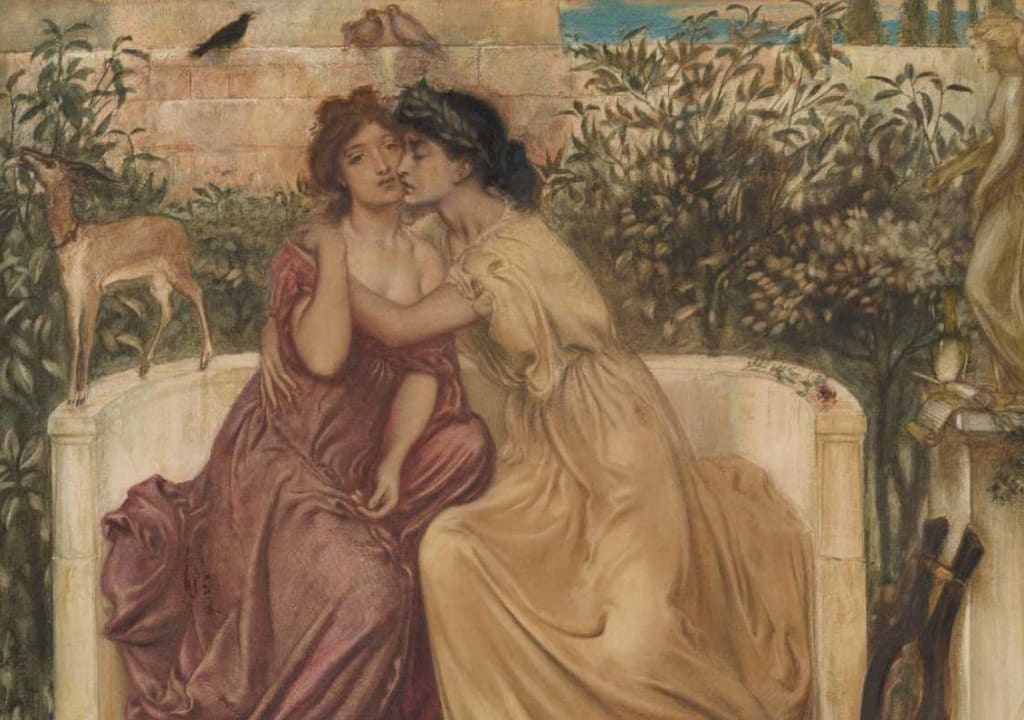
When I first heard about Queer British Art 1861-1967, the first such exhibition at Tate Britain in London, I was a little uneasy about the use of the term "queer." The word was not as current at the time of the exhibition in 2017 as it is now and, growing up in the 1960s and 70s, the term had always had a negative meaning to me. Tate made it clear at the time that they had consulted LGBTQ+ communities, who were supportive.
The title of this article, "Nowt so queer," is taken from the UK (North of England) expression "Nowt so queer as folk" meaning there is nothing as strange as people. It refers to people in general and is not a reference to LGBTQ+ people or culture.
Queer British Art included art and culture in the UK from 1861, when sodomy ceased to be a capital offence (those convicted were hanged) and 1967, when sexual acts between some men became legal. In UK jurisdictions, the law has nothing to say about relations between women, a mark of lesbian invisibility perhaps.
In 2017, I was employed by Her Majesty's Prison and Probation Service, which is part of the UK Ministry of Justice. I was also (and still am) a volunteer visitor host at Tate. As an 'associate' member of the LGBTQ+ support network at HMPPS, I thought it would be great to arrange for a group visit to the exhibition and this I did, with the kind help of some of the more prominent members of the group.
We duly arranged to meet one afternoon for the short and pleasant walk to Tate Britain's museum building on Milbank, part of the system of embankments on the northern shore of the River Thames. Tate Britain (formerly known as the Tate Gallery) was built on the site of the former Milbank Prison, which operated between 1816 and 1890.
There were nine or ten of us, and we looked around the exhibition in smaller groups and individually. On show were, not only paintings and sculptures, but also items from theatrical and other shows and such artifacts as the prison door behind which Oscar Wilde was incarcerated in Reading Prison. He served a two year sentence with hard labour for 'gross indecency' (homosexual acts). Hard labour including walking a treadmill.
Some of the paintings and artists were ones I knew from the collections of Tate and other art museums. Seeing them in this exhibition helped me to see the work in context and in a new light. As the Tate publicity for the exhibition explains, the exhibition: "Explores connections between art and a wide range of sexualities and gender identities in a period of dynamic change."

The part of the show that interested me the most was the "Theatrical types" room, described by Tate:
The use of ‘theatrical’ as a euphemism for queer hints at the rich culture on the late nineteenth and early twentieth century stage. The extent to which audiences were aware of this varied. Music hall male and female ‘impersonation acts’ were wildly popular but were mostly seen as innocent ‘family fun’... whether as the subject of a moralistic ‘problem’ play or an innuendo in a saucy song, queer perspectives could find public expression on the stage (Tate website, photo of Hetty King in 'theatrical' costume and "HMS Bloomsbury" sailor's hat).
As a child, I never understood the pantomime convention of a young woman playing the part of the male hero lead (Robin Hood, Peter Pan) or the older, badly made-up man, playing the 'Widow Twankey' pantomime dame. To be perfectly honest, I found it weird and uncomfortable (again, as a child). I also hated 'audience participation.' I was shy and retiring as a little boy. Conversely, and perhaps oddly by comparison, I never found transvestite men in real life at all weird (unlike many of my contemporaries). I can only think that the theatre environment created a sense of disturbing unreality to my infant mind. Judge me as you will.
So if I learnt nothing else from Queer British Art it was that 'queer' culture and theatrical convention go hand in hand. It may seem obvious to most but the point had, to some extent, eluded me. At least, I had never understood the reason and importance of that interplay. Now that I do, a whole lot of other things about theatre and about LGBTQ+ culture make more sense. Again, judge me, man or boy, as you will.
After viewing the exhibition we agreed, as a group, to extend our afternoon out at one of the wonderful old Edwardian-style pubs (of a kind that London is famous for) nearby. A very pleasant evening it was too. Not the first or last time I went to a local pub with work colleagues but this time it was different. Somehow, this time, the evening with my newly-met colleagues was far more relaxed compared with other work drinks nights. Also for the first time (that I can recall) I was asked, in a pub, about my sexuality. It didn’t seem an impertinent or unwelcome question given the context of the occasion and that fact that, if you saw me at work, my dress and demeanour probably suggest, very much, a 'straight' lifestyle. I like to think I have a more interesting personality if you get to know me.
It was not, in any case, taken as an unfriendly question. When I explained how I came to be part of the group, I heard myself described as an 'ally' for the first time. I thought it was a better way to put it than 'associate' or 'supporter.' When some of us were discussing sexuality, one of my female colleagues said she didn't like to be described as 'lesbian'. She liked to think of herself as a "gay girl."
This also reinforced the point that people have their own way of describing their own identity and we should avoid giving people labels out of convenience. Sexuality is a very broad spectrum and it always sounds odd to me, not to mention inaccurate, for a man to describe himself as '100% straight' (though a long time since I have heard this), as if to avoid any aspersions. To me, such a description always suggests there is something being hidden.
To complete the picture, our little social group also included a trans woman, whom I had already met at work.
We only touched on the sexuality and identity questions briefly. Mostly we talked about a range of subjects of common interest, as you do, and I don't particularly recall what they were, as is often the case when I have been for a night out at the pub. I will always remember it, however, as a lovely evening with a new group of work friends.
For the purposes of the Vocal Challenge this article is being entered into, I am expected to:
Reflect on a moment when you encountered queer representation that deepened your understanding or empathy for the LGBTQ+ experience. How did this shape your perspective?"
I am not going to say that seeing Queer British Art, at the Tate, was a Road-to-Damascus moment, a revelation. Neither was the group visit to Tate Britain or the pub afterwards. I am sure my understanding and empathy were deepened, but not sure if I can put my finger on anything specific (Oooo...errrr...missus, to use a theatrical expression). If you have read this article through, I hope some of this comes across.
O ~ 0 ~ o ~
If you enjoyed reading this article, you might also like:
Thanks for reading
About the Creator
Raymond G Taylor
Author based in Margate on the English Kent coast, having moved from London. Known for his short stories and flash fiction, as well as poetry and non-fiction writing on subjects such as art, science, technology and the human condition
Enjoyed the story? Support the Creator.
Subscribe for free to receive all their stories in your feed. You could also become a paid subscriber, letting them know you appreciate their work.
Comments
There are no comments for this story
Be the first to respond and start the conversation.