
Most Iconic Buildings in Honolulu, Hawaii
Impressive architecture


Aloha Tower
Completed in 1926 and standing 184 feet tall, the Aloha Tower is situated at Pier 9 in Honolulu Harbor. The tower features the Hawaiian Gothic style, a late Gothic Revival design. It was originally a lighthouse. The tower was designed by architect Arthur L. Reynolds, giving it a modern twist with a convexly rounded dome. Visitors enjoy panoramic views from the observation deck. The Aloha Tower has become a significant historical landmark.
Hawaii State Capitol
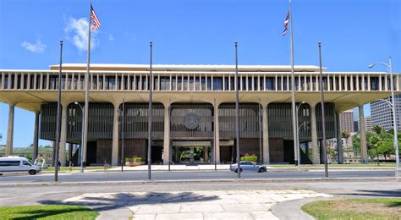
The Hawaii State Capitol serves as the seat of government for the state of Hawaii. It features unique architectural elements that reflect the islands' culture and environment. It offers tours and is part of a walking tour of historic sites in Honolulu.
The capitol was commissioned and dedicated by John A. Burns, the second governor of Hawaii. It officially opened on March 15, 1969, replacing the former statehouse, Iolani Palace. The building features a unique design that symbolizes Hawaii's natural elements, such as the open-air concept representing the islands' climate.
Honolulu Hale
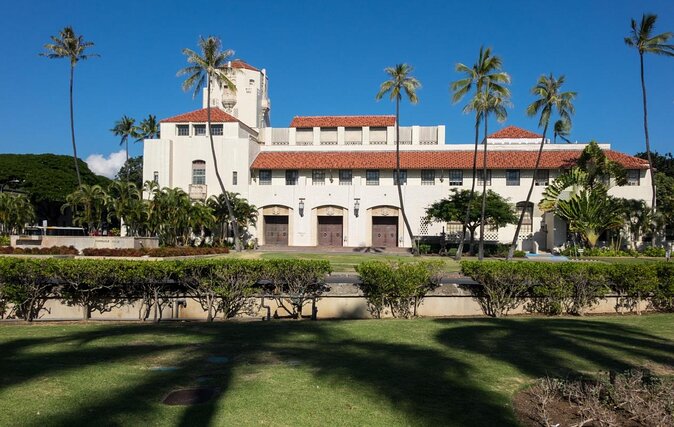
Honolulu Hale is a prime example of Italianate Spanish Colonial Revival architecture. Built in 1928, this historic building showcases a blend of Italianate and Spanish Colonial Revival styles, which were popular in Hawaii during that era. The design was crafted by notable architects including C.W. Dickey, Hart Wood, Robert Miller, and Rothwell Kangeter & Lester. The building features an interior courtyard, a grand staircase, and an open ceiling, all modeled after the Bargello in Florence, Italy.
Honolulu Hale, located in downtown Honolulu, serves as the official city hall for the City and County of Honolulu, housing various government offices and functions related to local governance.
Iolani Palace
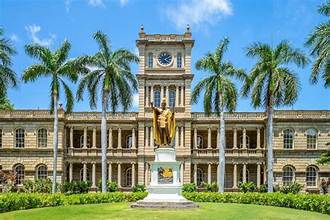
Situated in the Capitol District of downtown Honolulu, Iolani Palace was the royal residence of the rulers of the Kingdom of Hawaii. The palace features both European and Hawaiian elements. It was built out of bricks and supported by a wooden frame with six towers that reflect the Renaissance style. Visitors can enjoy touring the restored rooms. King Kalakaua commissioned the palace to symbolize the Hawaiian Kingdom's prosperity and modernity.
Kawaiaha’o Church
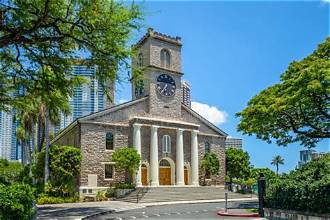
Known as the “Westminster Abbey of Hawaii," Kawaiaha’o Church is situated in downtown Honolulu. It is a historical congregational church featuring New England-inspired architecture. The church has a symmetrical facade, round-arched portals, and pilasters. It was built using 14,000 coral rock slabs from an offshore reef. The church has been the site of many royal events, including weddings and inaugurations and is part of the Honolulu District Historic Landmark walk.
Liliʻuokalani Botanical Garden Bridge
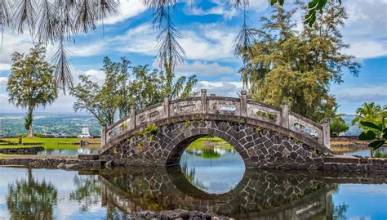
The Liliʻuokalani Botanical Garden features a picturesque bridge that enhances the garden's serene atmosphere, providing visitors with a scenic view of native Hawaiian plants and waterfalls. This garden, once owned by Queen Liliʻuokalani, is dedicated to preserving Hawaii's unique flora and offers a peaceful retreat in the city. The bridge complements the garden's natural beauty, allowing visitors to cross over the Nuʻuanu Stream.
Royal Hawaiian Hotel
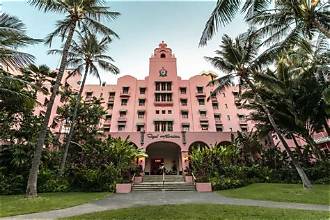
Situated on Waikiki Beach, the Royal Hawaiian Hotel is a significant architectural landmark. It is known as the “Pink Palace of the Pacific.” The hotel features a distinctive Spanish-Moorish style and is part of The Luxury Collection brand by Marriott International.
The Royal Hawaiian Hotel was built by the Matson Navigation Company and opened on February 1, 1927. The project was spearheaded by Ed Tenney and William Roth, who were key figures in the company. It was built on Helumoa, a site historically significant as a coconut grove and former residence of Hawaiian royalty.
Shangri La
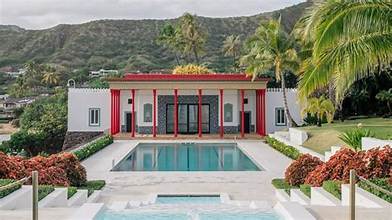
Shangri La is a unique cultural center and museum dedicated to Islamic art, founded by Doris Duke in the 1930s. It is the only U. S. museum dedicated to Islamic art, promoting cultural dialogue. It now serves as the Shangri La Museum of Islamic Art, Culture & Design, promoting cultural understanding. The center offers public tours, exhibitions, and community partnerships to enhance understanding of Islamic culture.
The residence blends modernist architecture with Islamic design elements, reflecting Duke's extensive travels and cultural influences. Built between 1936 and 1938, the house was designed by architect Marion Sims Wyeth.
St. Andrew’s Cathedral
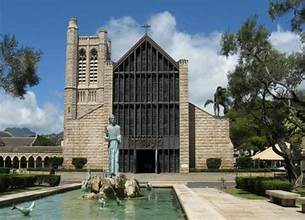
The St. Andrew’s Cathedral is a prime example of Gothic Revival architecture. The design of the cathedral was inspired by the Gothic churches in Europe, which Queen Emma visited in 1865. It was designed by architects William Slater and R.H. Carpenter from London, England. The cathedral features massive columns and Gothic vaulting.
About the Creator
Rasma Raisters
My passions are writing and creating poetry. I write for several sites online and have four themed blogs on Wordpress. Please follow me on Twitter.
Enjoyed the story? Support the Creator.
Subscribe for free to receive all their stories in your feed. You could also become a paid subscriber, letting them know you appreciate their work.
Comments
There are no comments for this story
Be the first to respond and start the conversation.